Visiting Hassan II Mosque and More in Casablanca
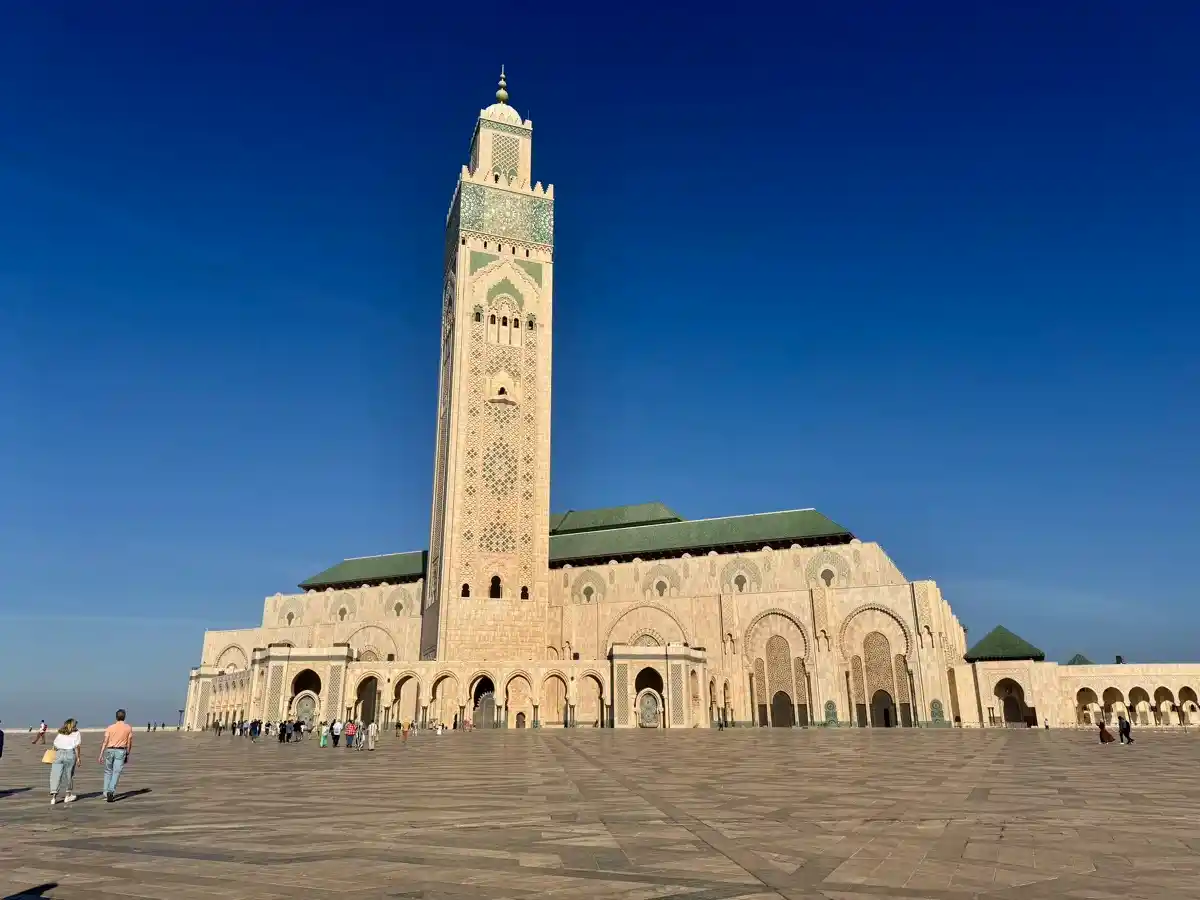
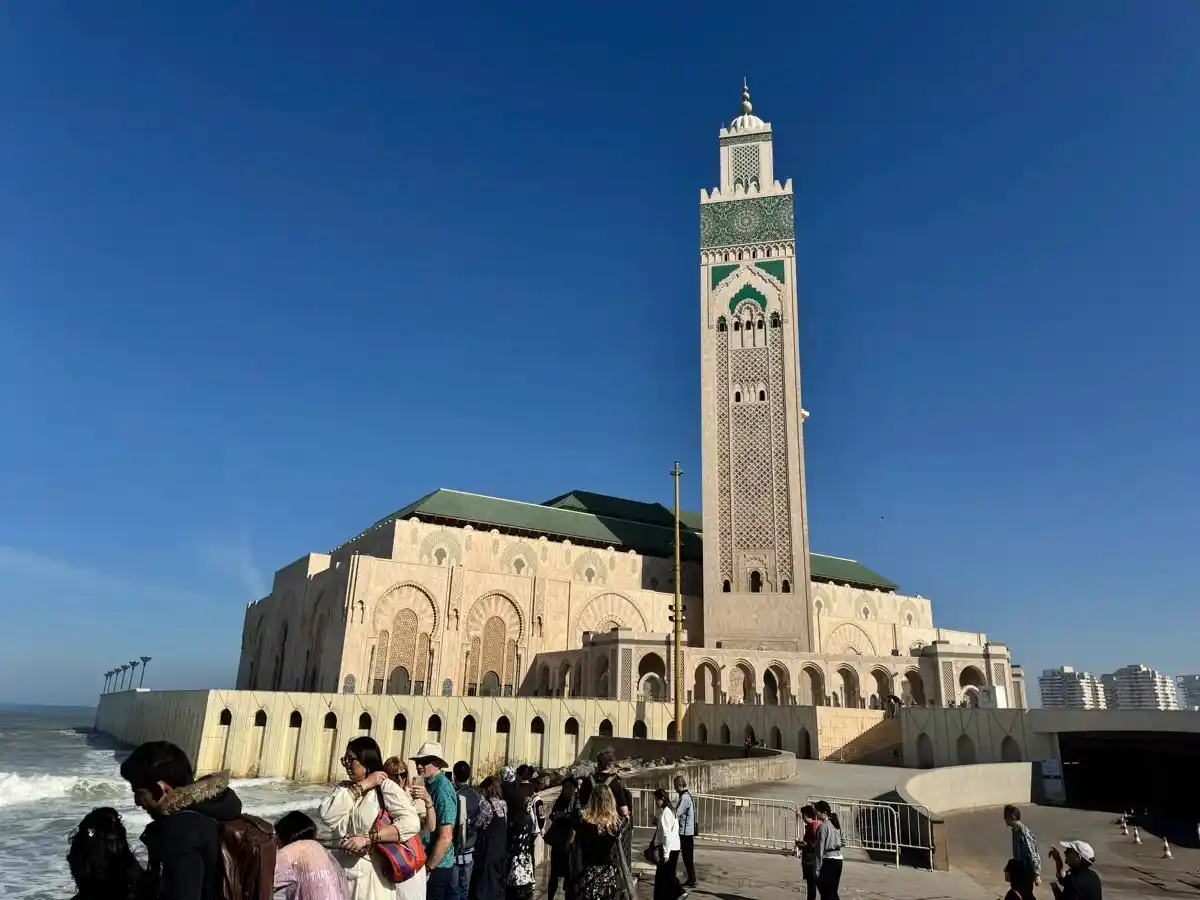
In the morning of my first full day in Casablanca, I took in the sight I tried and failed to visit yesterday afternoon: Hassan II Mosque.
After leaving the mosque, I took a stroll by the ocean and then did something ridiculously hokey. I’ll hold off on naming the hokey thing.
Hassan II Mosque
Age is not what gives the Hassan II Mosque top billing in Casablanca tourism guidebooks. Heck, I’m decades older than the Hassan II Mosque. Nobody flocks to see me because of my age. Although that may be only because I refuse to let anyone into my place so I won’t feel obliged to clean up. But never mind that.
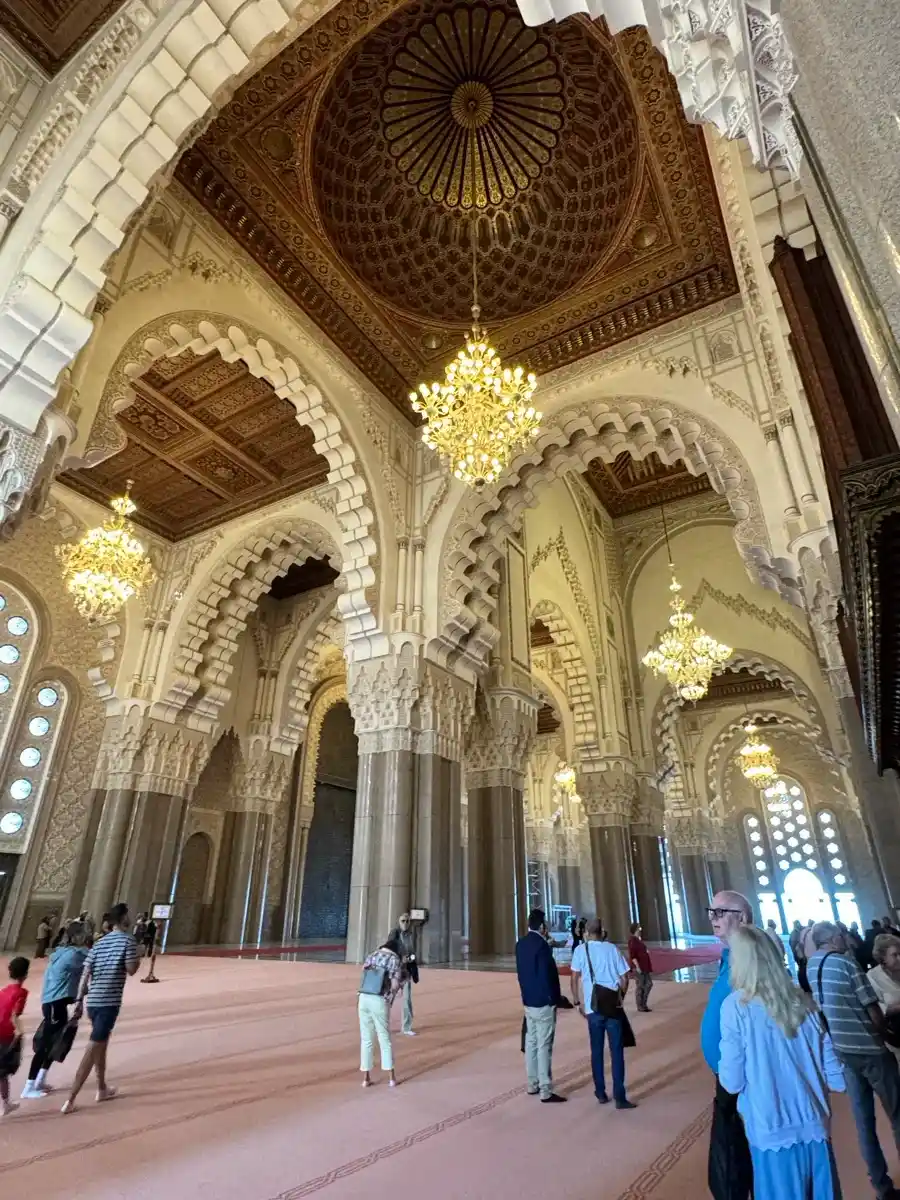
The Hassan II Mosque opened in 1993. Despite its grandeur and enormity, it took only six years to build, with construction starting in 1987. (All but the most arithmetic-challenged probably figured out for themselves that 1993 minus six years equals 1987. But I warmly welcome the arithmetic-challenged to these pages.)
Entry into the mosque is by guided tour. The guide said that the interior of the mosque can accommodate 20,000 people. There’s a large plaza in front of the mosque that the guide said can accommodate another 60,000 worshippers.
These numbers seem to be estimates. There aren’t pews or chairs. The guide’s numbers are on the low end of what I read elsewhere. I’ve seen as high as 25,000 inside and 85,000 outside. A speaker system ensures that everyone, inside and out, can hear the imam.
According to the guide, the Hassan II Mosque is the largest mosque in Morocco and the third-largest in the world. Both of the larger mosques are in Saudi Arabia.
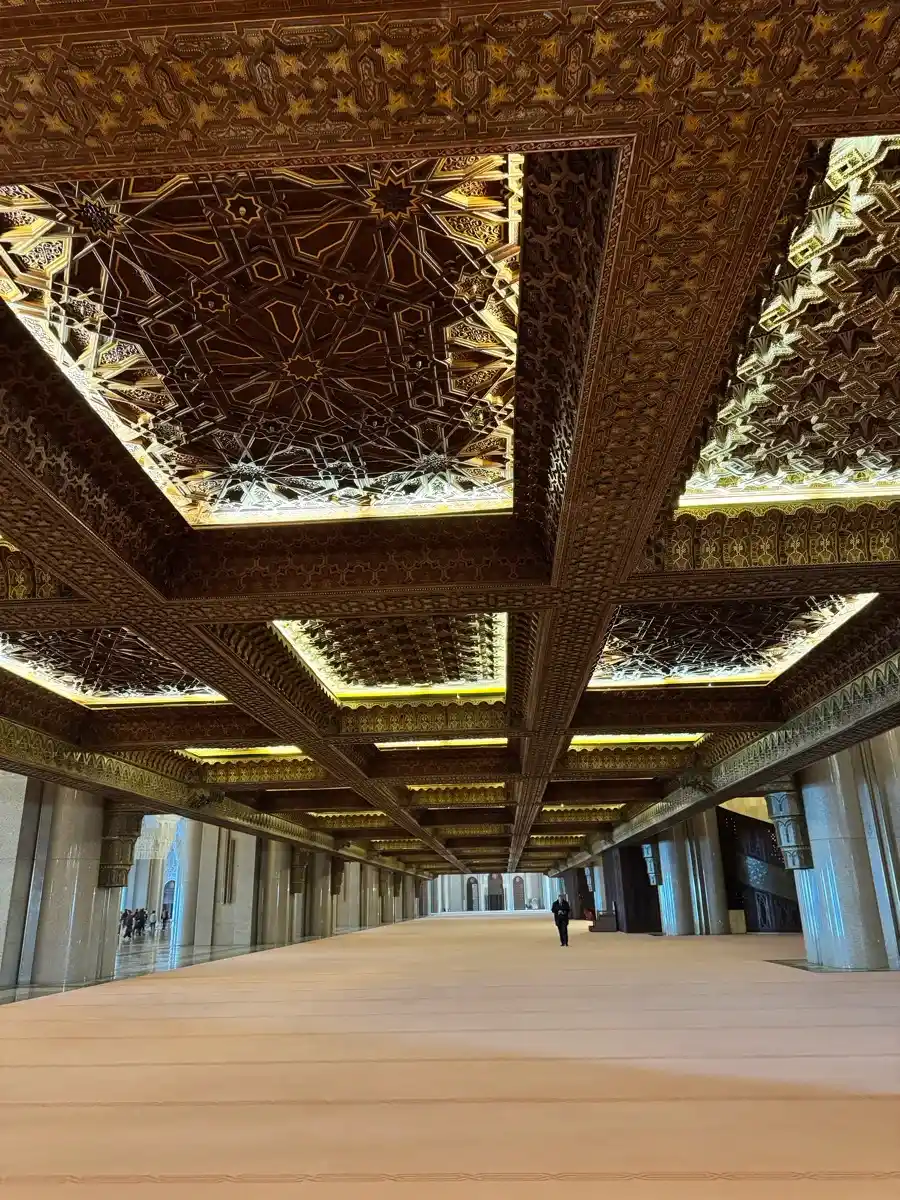
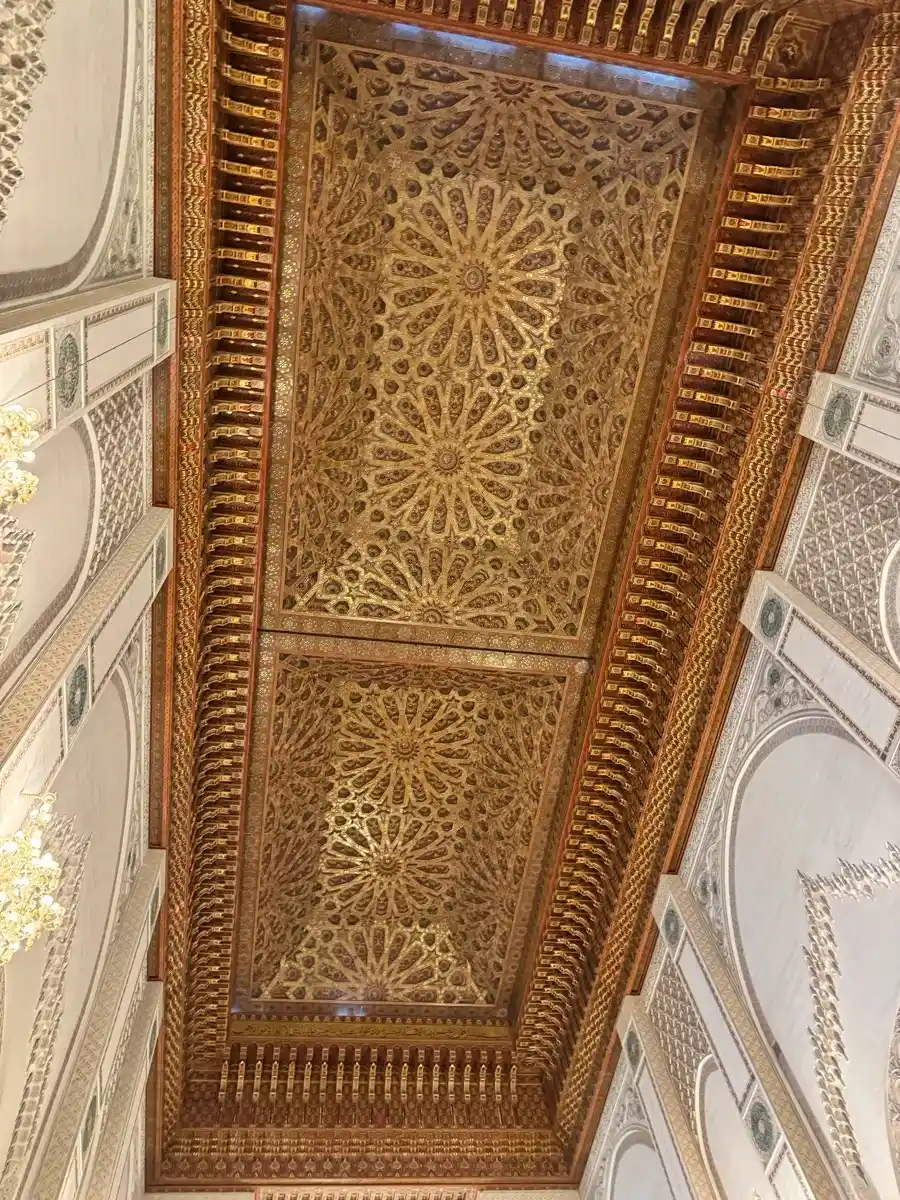
The walls and floors are marble. The large, bulbous, curvaceous, dark sand-coloured columns are polished granite.
I don’t know what material the ceiling is made of, but a large portion of it is retractable. It can be opened to allow better ventilation when the mosque is packed.
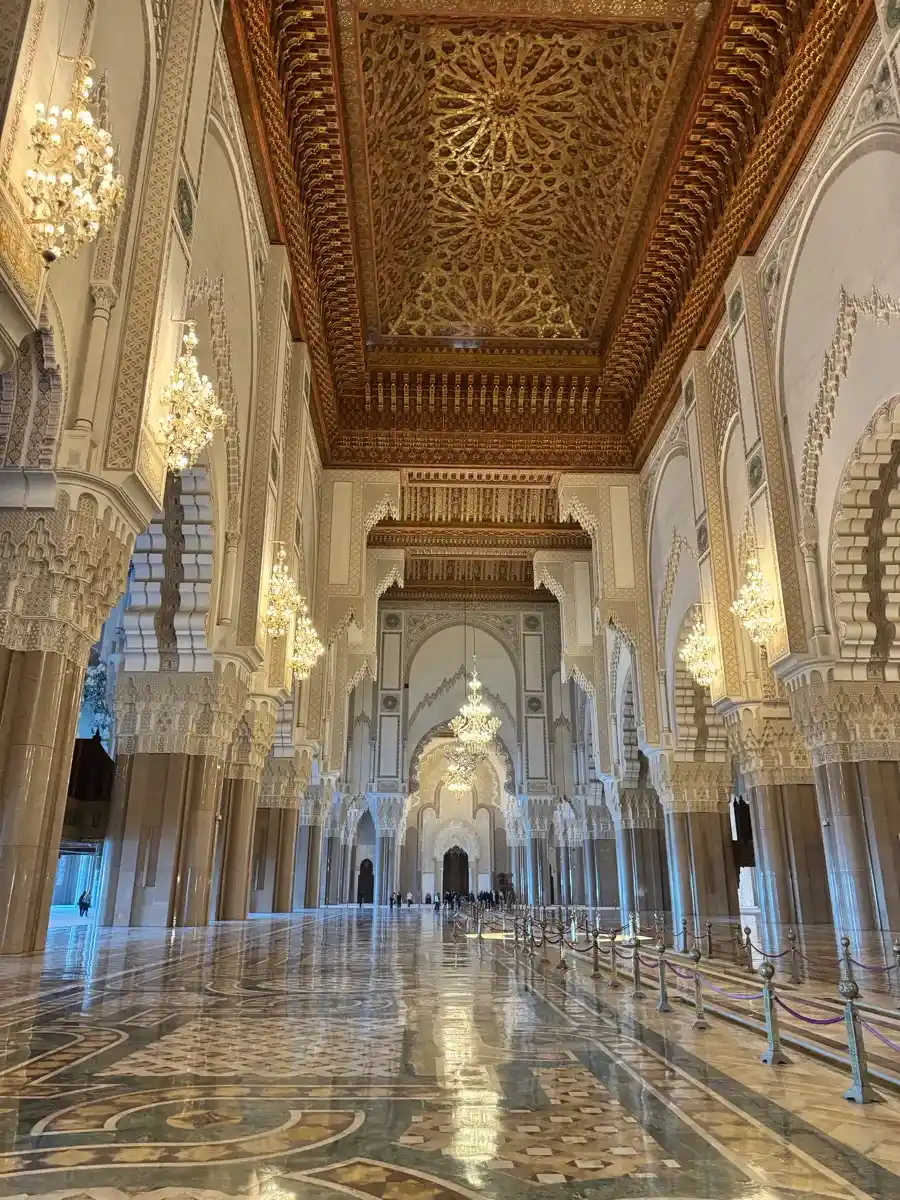
A section near the front of the mosque is cordoned off and not open for tours. It is reserved for Muslims who want to perform one or more of their five mandatory daily prayers there.
The guide explained that, outside of Ramadan, the mosque isn’t usually anywhere close to full. He said Muslims don’t have to say their prayers in mosques. They can do it wherever they are.
The tour didn’t go up there, but there’s a balcony along a small portion of the Hassan II Mosque. The balcony is for women, who are segregated from men during prayers.
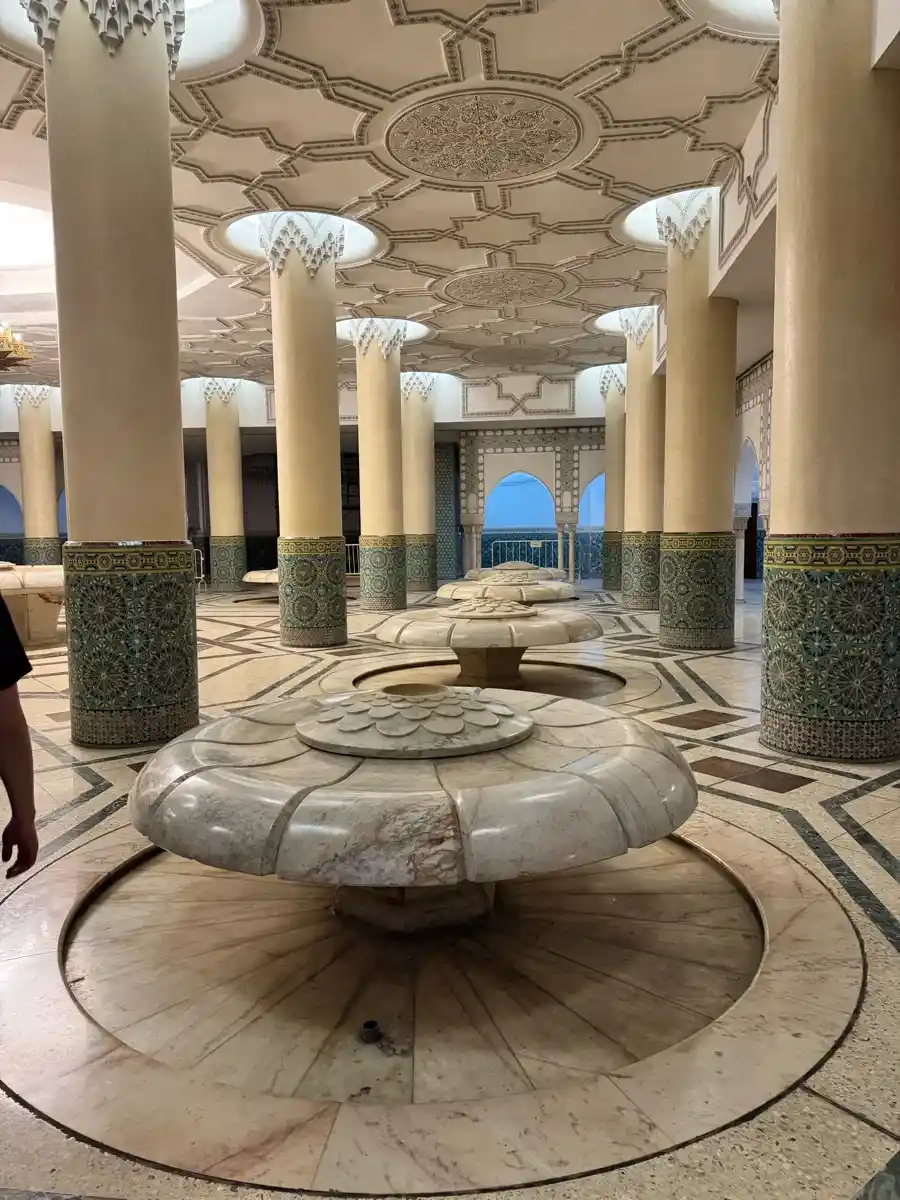
The tour also went subterranean into the men’s ablution area. Several large, attractive fountains sprout from the floor. Before prayers, Muslim must wash each of several body parts. (I remember hands, face, mouth, nose, and feet. But I may be forgetting a part or two.) Each part must be washed a specific number of times, a different number for each part.
Oh, about the washing of feet. Shoes were allowed in the ablution area but not in the sanctuary. Before entering the sanctuary, everyone on the tour was given a bag to carry their shoes in. Socks could stay on.
The Hassan II Mosque is built on land that juts out into the Atlantic. I think the landform is landfill, but I’m not certain. The guide said the site was chosen because of a Koran verse that says the throne of God is on water.
I don’t know if the Koran specifies a particular body of water. If not, I’m going to choose to believe that it’s Lake Ontario and that God will severely punish anyone who tries to rename it. We’ll see what happens.
Corniche
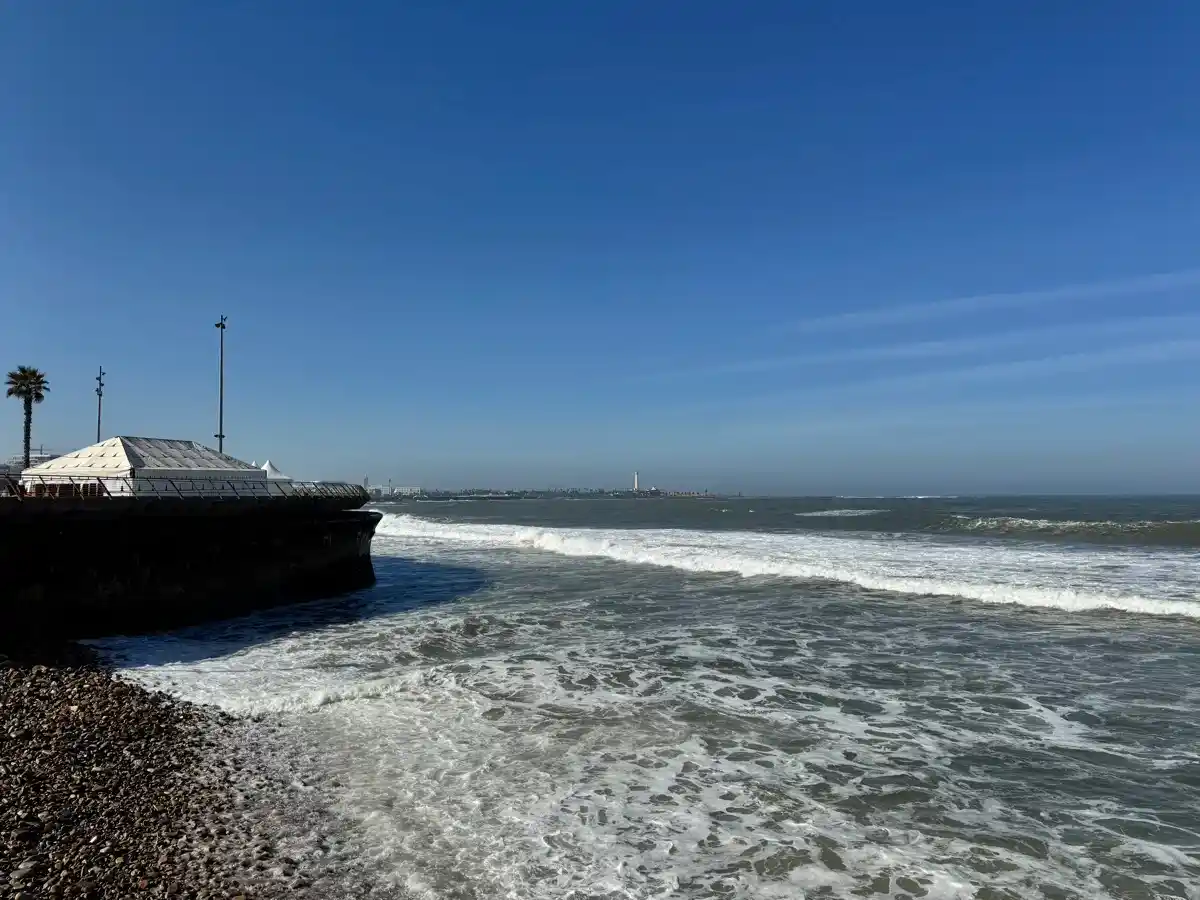
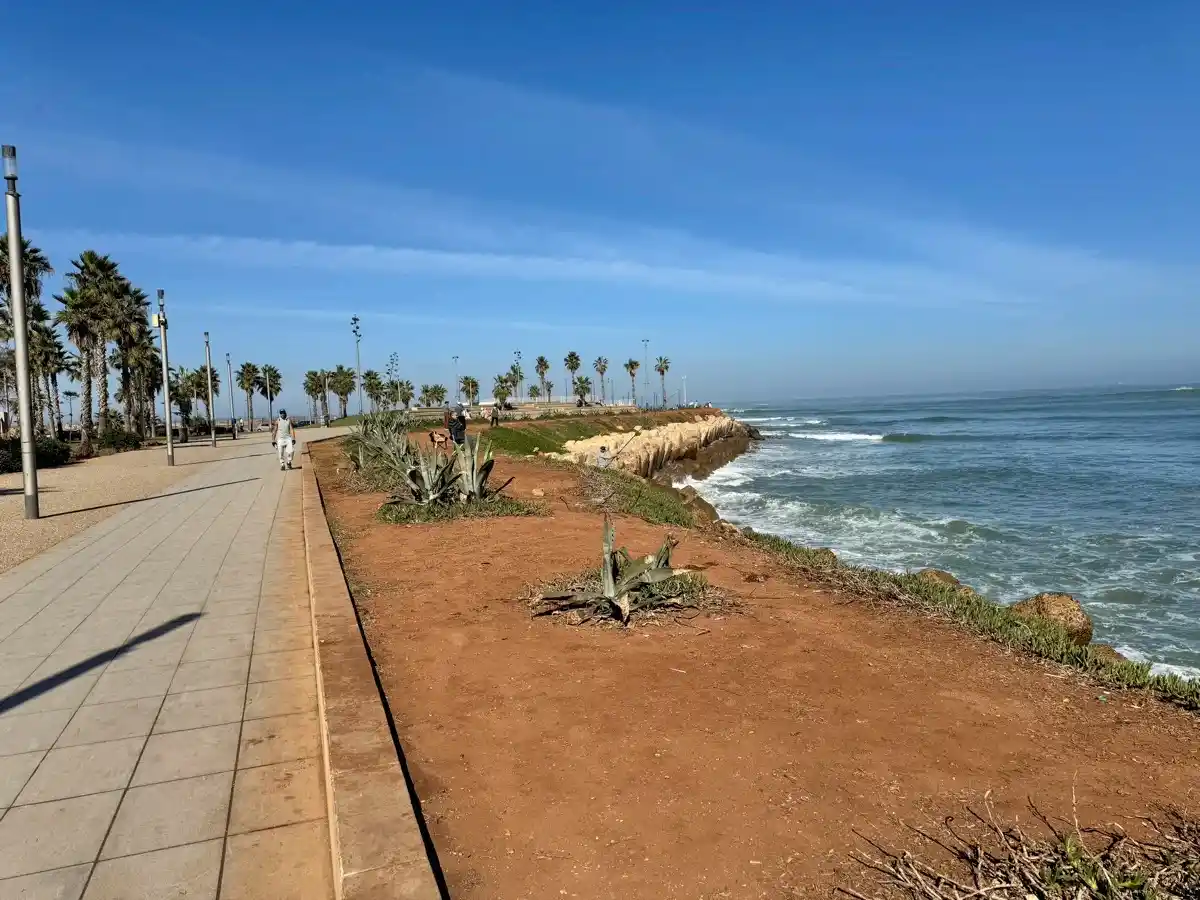
Morocco’s Corniche is a boulevard atop a seawall beside the Atlantic Ocean. One end of it is close to the Hassan II Mosque, so a stroll along it was the logical next step, so to speak, after leaving the mosque.
As I walked along the Corniche, whitecaps crashed in the ocean as the waves got close to the seawall. Facing the ocean, when I turned right, I got a good view of the Hassan II Mosque. Turning left gave me a view of a tall lighthouse.
Along the Corniche, several people cast their long fishing rods into the sea. Once cast, they tended to leave their lures in the water for quite a while.
Some of the guys fishing (I didn’t see any women fishing) attached their fishing rods to devices they had that anchored their rods into the cracks between the paving stones. (I think people, probably without authorization, carved out some of the grouting for this purpose.) Some other people had devices that allowed them to attach their rods to the railing along the edge of the seawall. These devices permitted them to ignore their fishing gear and do something less boring nearby.
Although, I think the majority of the fishers kept hold of their fishing rods.
There are two observations to note here:
- I didn’t see any caught fish beside any of the fishermen. Not only that, I didn’t spot any bags or buckets that looked suitable for transporting caught fish. I guess only extreme pessimists fish there.
- When the fishermen cast their lines into the ocean, they first swung their rods behind them to get a strong forward swing.
Here’s the thing. I never once saw any of the fishers looking to see if any people were walking on the promenade as they arced their rods backward. At the bottom of the backward arc, the fishing hook was usually only a few centimetres above the sidewalk, low enough to hook even the smallest of toddlers, let alone a full-grown adult or even, like me, only a partially grown adult.
The moral of the story is, if you’re walking along the Corniche, keep an eye on the fishermen and make sure not to get hooked by their backswing. One came close to me once, and I was much more vigilant thereafter.
The Corniche made for a pleasant saunter accompanied by the soothing sounds of the sea.
Not Rick’s
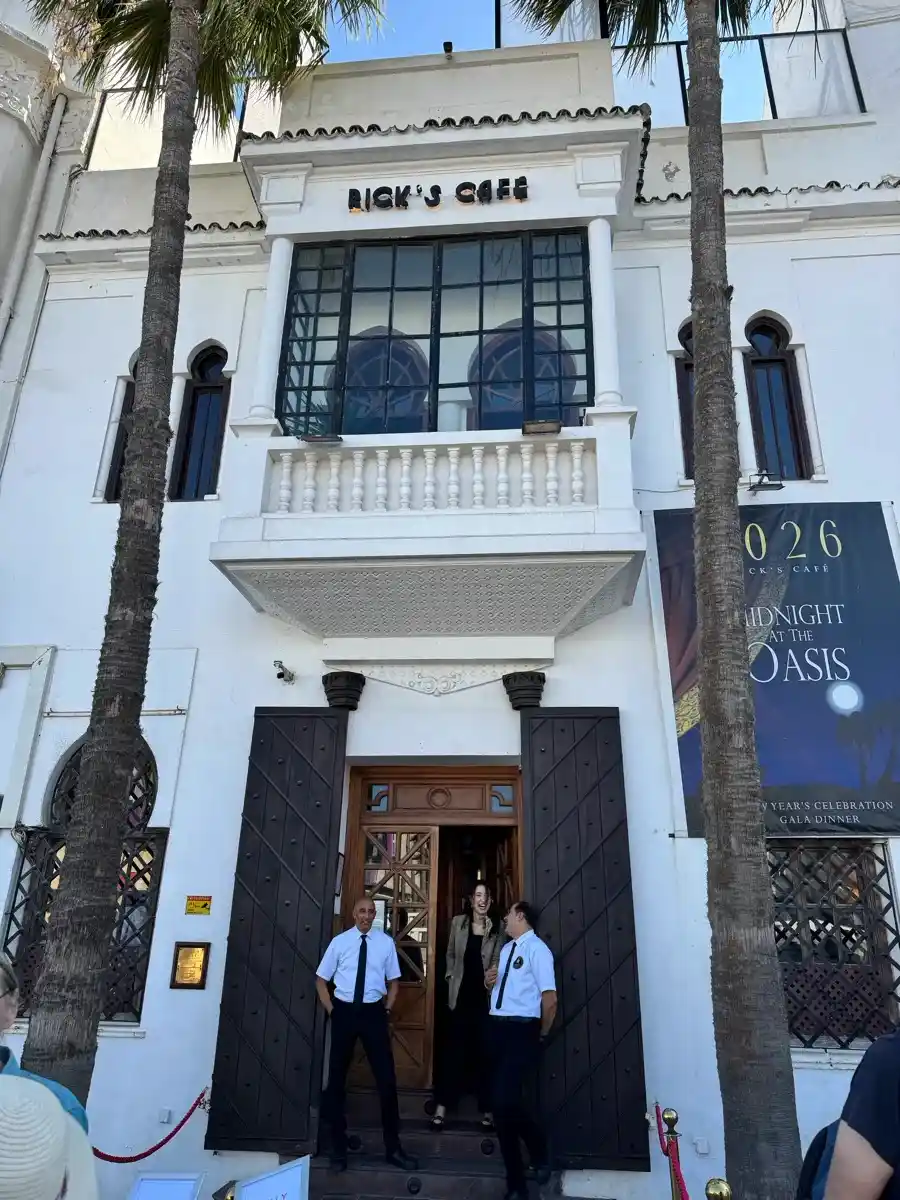
The hokey thing is something I didn’t, in fact, do. But I tried.
The fictional Rick’s Café Américain is the primary setting in the classic film “Casablanca.” I utilized several actual quotes or paraphrased quotes yesterday in my first travel journal entry from Casablanca when I arrived yesterday. I won’t repeat them here.
The film was based on a stage play, “Everybody Comes to Rick’s,” that was never produced. Rick’s Café didn’t exist until it was conjured up in the playwright’s mind. When the film was produced, its only concrete form was as a set built on Warner Brothers’ lot in Burbank, California.
But there is a real-life Rick’s Café in the real-life Casablanca today. That’s not coincidental. I read that the owner didn’t make any attempt to mimic the architecture or decor of the fictional Rick’s. They just wanted to catch the vibe of the cinematic Rick’s.
Not only is the facade different, they didn’t even copy something as straightforward as the sign. In the film, the sign is in a cursive script and says, “Rick’s Café Américain.” The sign in front of the current Rick’s has a straighter font that reads only, “Rick’s Café.”
I believe the café is designed to siphon money out of the pockets of “Casablanca” film fanatics who are so besotted with the movie that they can’t resist going in and spending their money despite knowing that it’s a faux Rick’s that doesn’t even make any attempt to reproduce the set. Only a complete fool would want to do that. So, of course, I tried to go there for lunch.
When I arrived, two signs attached to some temporary crowd-control fencing said, only in English, “Fully Booked.” So, they saved me from myself. After having called myself a complete fool here, I probably won’t try again. But, we’ll see dear.
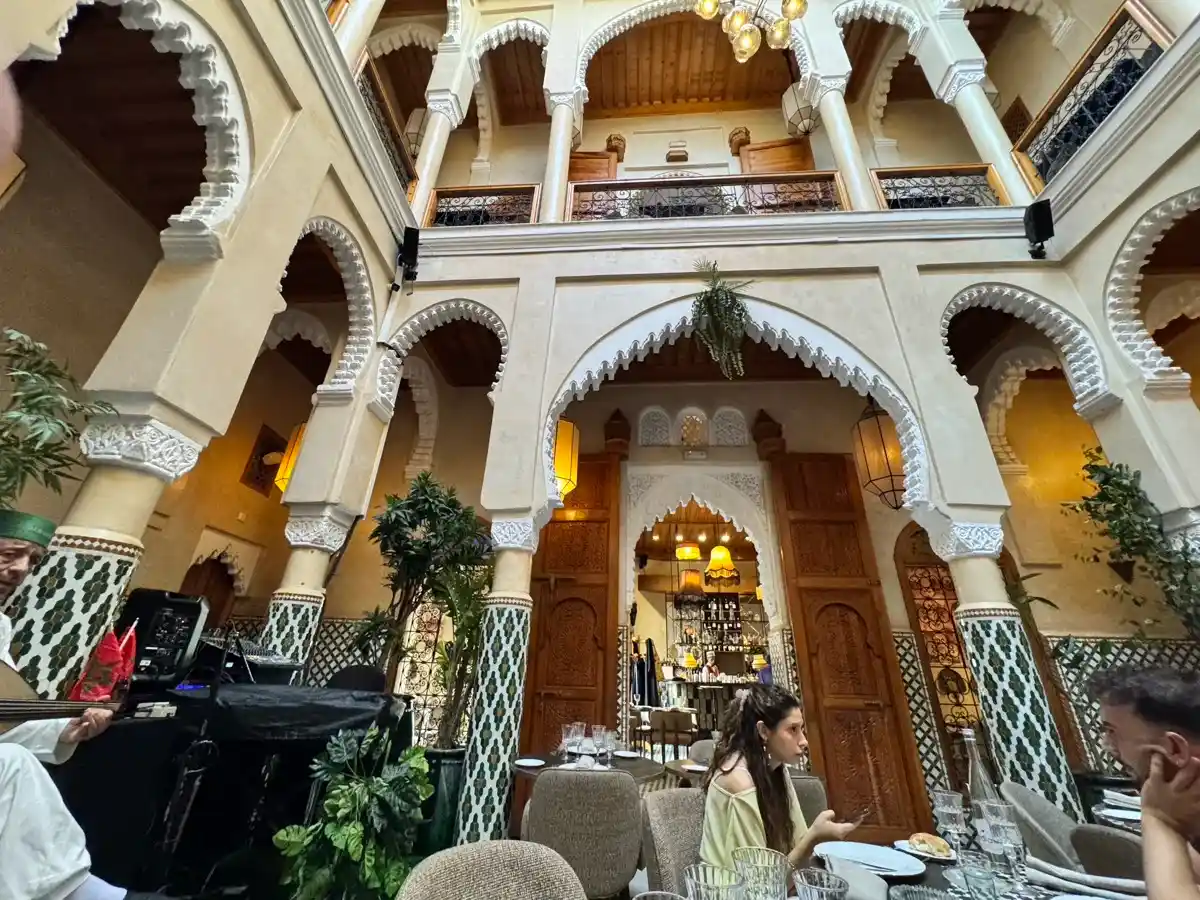
I then used Google to find a nearby restaurant that got a good rating. It was fabulous.
The restaurant was in the atrium of a small building. There was lots of attractive tiling and what I think of as Arabic arches.
A male musician sang and played what I think might have been a mandolin. Don’t quote me on the mandolin thing; I’m not an expert on musical instruments. It was stringed, so I don’t think it was a flute, trombone, tuba, or saxophone.
I had a delicious fattoush salad to start, followed by a chicken tagine. I’d read about tagine as being a Moroccan specialty when researching this trip. I’d never heard of it before then. Tagine is a heavily slow-cooked stew that can have one of a variety of meats in it. The one I ordered was very flavourful and absolutely delightful.
I’m glad I didn’t get into Rick’s.
Discover more from Joel's Journeys & Jaunts
Subscribe to get the latest posts sent to your email.
Gorgeous, gorgeous, gorgeous and a half! The half is a ‘gorge’ for your fabulous sounding lunch. The Hassan II mosque shows that you can do a major modern monument in a traditionally-inflected style beautifully without looking too effortful or derivative. At least that is how it appears to me in the photos, but you tell me. And quickly! What a stunning building. The sea and of your restaurant looked fabulous. I can see how you could easily get hooked on going down to the Corniche, so thanks for giving us the heads up on how to do so safely.
Yes! Exactly. The Hassan II Mosque did show me that you can do a major modern monument in a traditionally-inflected style beautifully without looking too effortful or derivative. That’s EXACTLY what I thought. At least, that’s what I thought after reading your reply. When I was there, less so. But I think you’re right?
And everything else was, as you say, gorgeous.