Ile du Frioul
Yesterday, my vague plan for today was to visit some sights in Marseille. I woke up a little late because of my jet lag after arriving only yesterday from my home in Toronto, and then taking forever to fall asleep last night.
I opened the very effective blackout curtains in my room and saw that, unlike yesterday’s showers and gloom, it was bright and sunny. To take advantage of the pleasant weather, I changed my plans and took a ferry to Ile du Frioul instead.
In truth, the plan I devised upon seeing the beautiful weather was to go to both the Ile du Frioul and the island on which the Château d’If, a former fort, then prison, and now noted tourist attraction, sits. However, when I got to the ferry ticket office, they told me they weren’t going to Château d’If today. They go there only when the weather is perfect.
I found that surprising because the winds were calm at Vieux Port and, as I said, it was sunny. She told me that there isn’t a real port at Château d’If and they can’t stop there if the weather is, if you’ll excuse the pun, or even if you won’t, iffy.
Early each morning, they check the forecast for the whole day. If it looks bad in the morning or afternoon, they don’t go at all that day because they want to make sure they can get people off the island later. There are no accommodations on the island. I thanked her for that consideration.
I asked her if there’d likely be any days this week when they’d stop at Château d’If. She didn’t know and said they check the weather each day and post on their website in the morning whether they’ll stop there that day. She said they often cancel the stop at If during the winter.
Considering that they didn’t make the If stop today, when the weather seemed pleasant, I didn’t hold out much hope for getting there the rest of this week while I’m in Marseille. So I bought a round-trip ticket to Ile du Frioul.
The ferry company sells a combo ticket that includes getting off at Château d’If and Ile du Frioul, or cheaper tickets that include just one. If they go to Château d’If on another day, I might go then. We’ll see, dear. The two single-island tickets are more expensive than a combo ticket, but not by all that much.
Despite it being quite calm at Vieux Port, the sea was a little choppy. It wasn’t bad, but the ferry rocked and rolled somewhat during the approximately 25-minute ride. If there isn’t a real port at Château d’If, I understand why they didn’t stop there.
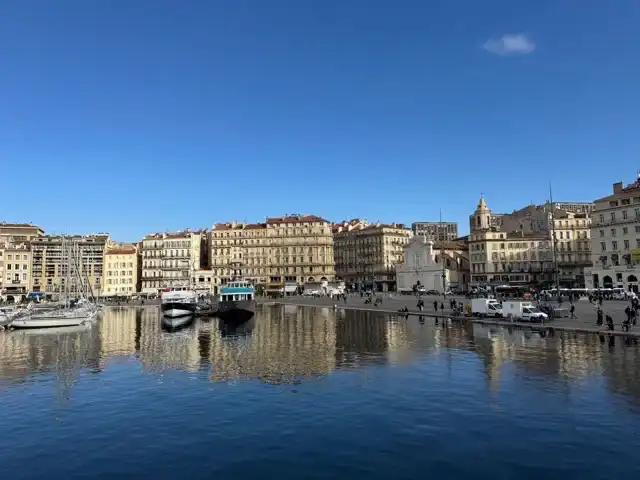
Before describing Ile du Frioul, allow me to pause and say that Marseille’s Vieux Port is much prettier under the sun than in the gloom and drizzle of yesterday.
On Ile du Frioul
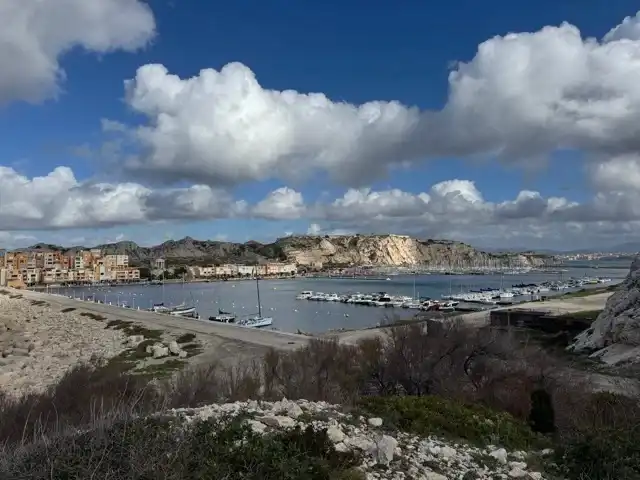
Ile du Frioul is not one, but at least two islands. There may be more that are smaller and are inaccessible to the average tourist. I don’t know. And for all I know, If may be considered to be part of the same archipelago as the labelled Ile du Frioul. As always, anyone who depends on me for information like that is a fool. Don’t be a fool.
The two accessible islands are joined by a road over a dam between them and another lower road between the port and the dam.
(Aside: My brain has a problem with homophones. Despite knowing the right word, my brain often types a homophone. I usually catch and correct it before committing the mistake with a “publish” or “send” button. However, not always. If, in the preceding paragraph, I cursed rather than talking about the dam and I missed that mistake, I’m sorry. These things happen, damn it.)
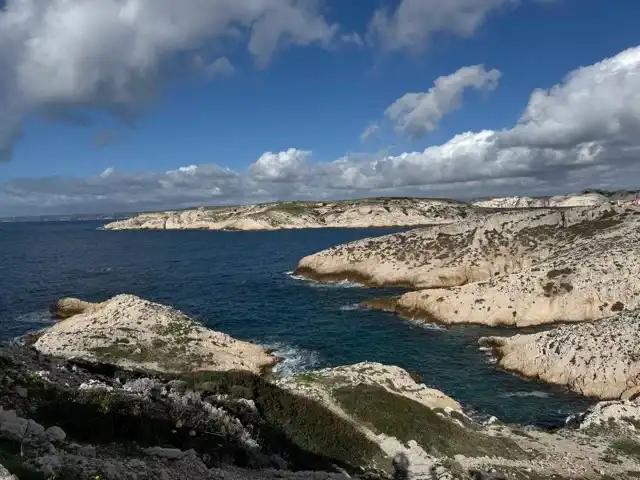
Some people live on Ile du Frioul. There are also a few old, unoccupied structures scattered about the islands. The occupied residents and a few small restaurants are clustered around the port.
One doesn’t go to Ile du Frioul for the buildings, but for the scenery.
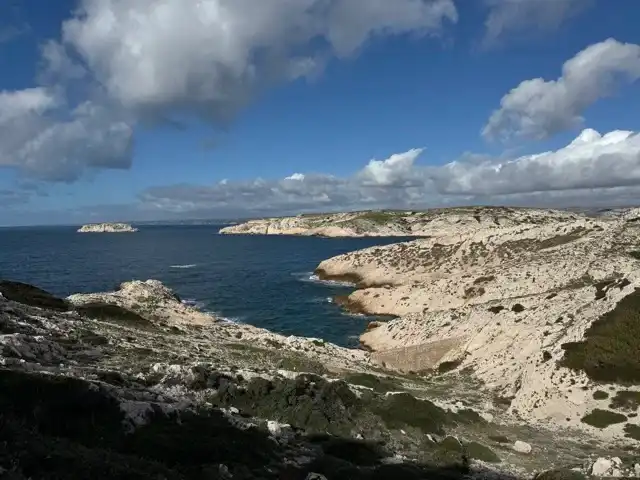
The islands of Ile du Frioul are comprised mainly of high hills or low mountains of sandy-coloured rock. (After all these years, I still have no concept of where the dividing line is between high hills and low mountains. It’s truly shameful how little I know about so much.)
Ile du Frioul also holds some of the world-famous Calanques, craggy coves along the coast near Marseille.
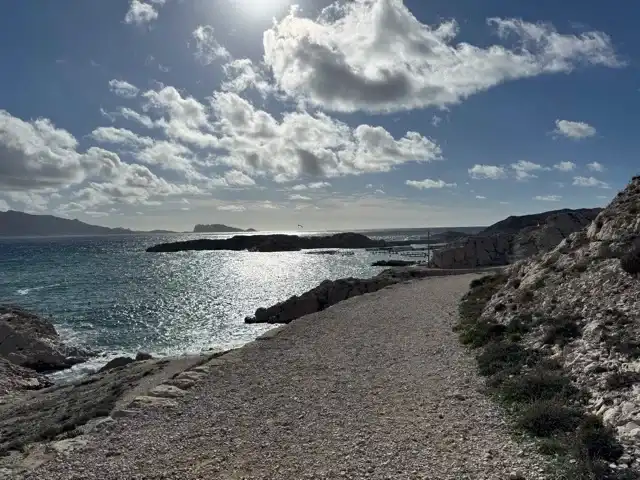
There is a road that runs down the middle of two islands, but all I saw on it were some pedestrians and one Parc national des Calanques service vehicle. The road is mostly paved, but with some rough sections.
Trails lead off the road down to various Calanques.
I started off by walking on the road beside the dam to the other island, and then along the road there. At one point, I followed a path off it, up a hill to an old, unmarked building. The building was closed, and there wasn’t much of a viewing area beside it, so I walked back down to the road and followed it farther.
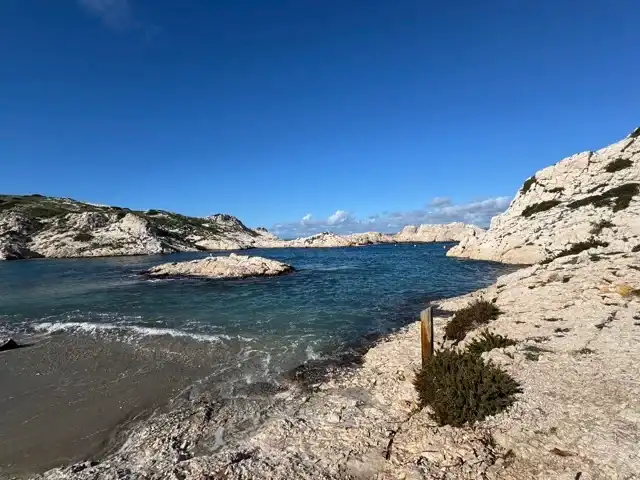
I came to a path that Apple Maps told me, correctly, led to what I read is claimed to be the most beautiful of the Calanques, La Calanque de la Crine. The terrain on the islands is mostly somewhat raw and rugged, as was the trail. But the trail was quite civilized, with only a few slightly rough spots. Where necessary, rough-hewn stairs make some of the steeper hills passable even for an acrophobic, weak hill-climber, such as me.
La Calanque de la Crine is, indeed, quite lovely. Short craggy hills of light-coloured rock surround it sufficiently that I couldn’t see the entrance to the open sea from my vantage point, but I know it was there just around the bend. In the middle of the cove, a small, bare rock island keeps watch over the surrounding blue water.
After spending some time admiring the beauty of La Calanque de la Crine, I walked back along the trail to the road. There, rather than walking farther to the end of the island, I headed back to the port. I got there in time to just catch a ferry back to Marseille that would have gotten me back to the city in time for a late lunch. But I wanted to explore the island that the ferry dock is on a little bit. So, I decided to take the next ferry.
At this time of the year, during the week, the ferries aren’t as frequent as during the high season. The next one was a little more than an hour and a half later. That’s fine, but it necessitated lunch on Ile du Frioul. There are, as I said above, some restaurants by the port. I don’t know if it’s because it’s a weekday, or because it’s winter, or because it’s both, but more than half of them were closed. The open ones had limited menus.
I chose a small, simple, burgers-and-sandwich restaurant (they have a somewhat larger menu on busier days/seasons). I ate a ham sandwich on a baguette and sipped a glass of wine while looking out at the Ile du Frioul port and entering a few of these words into my phone.
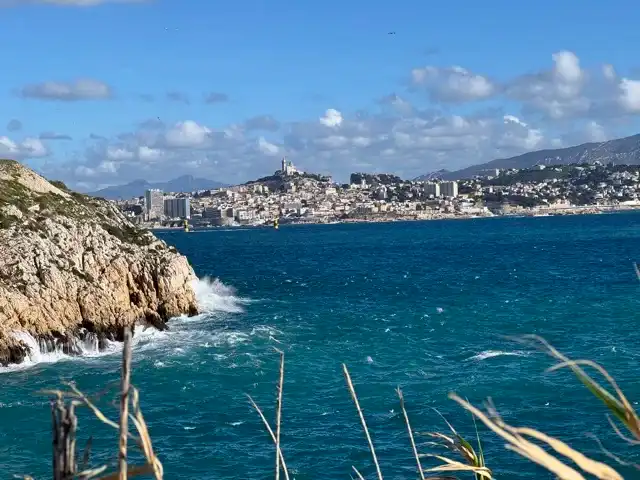
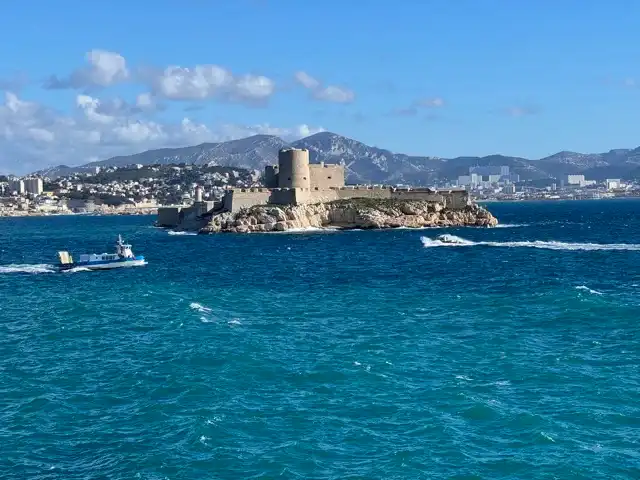
That didn’t leave me a lot of time before the ferry I wanted to catch, but I spent what time I had walking a short piece along the road on that island. I got to a point that provided me with a good view of the Château d’If and the Marseille skyline beyond it.
Around that point, I also got a view of an old hospital up on a hill on the island, L’hôpital Caroline. Hôpital Caroline was built to deal with a yellow fever epidemic that originated in the United States and ravaged several Mediterranean ports. The hospital was inaugurated in 1828. It was built in an isolated, windy area of the island. The sides of the hospital were left open to the winds. The reason for the isolation was obvious: yellow fever was highly contagious.
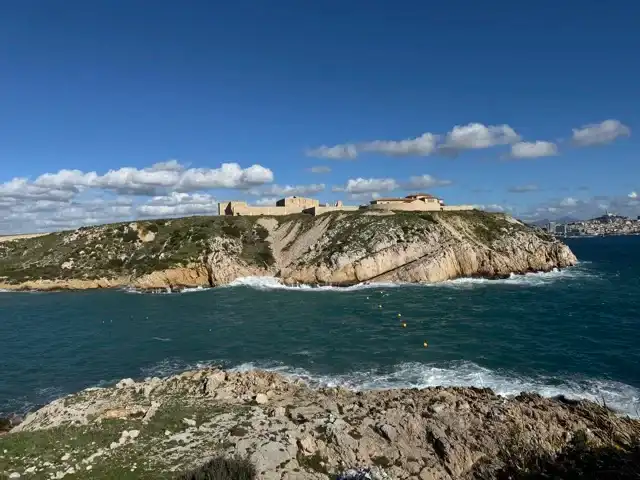
The openness to the wind was part of the design because, at the time, it was thought that yellow fever was airborne. Thus, the hospital designers wanted to provide maximum ventilation. As it turns out, yellow fever never came to Marseille. Better safe than sorry, I guess.
After taking in those views, I turned around and headed back to catch the ferry.
Update on Château d’If
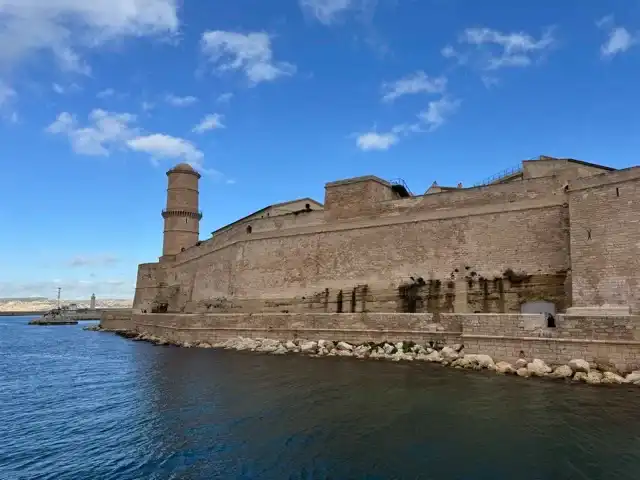
On the ferry ride back, I got to see Château d’If from reasonably close up. I didn’t see it on the way out to Ile du Frioul because I was sitting on the wrong side of the ferry. On the way back, I chose a seat on the same side, the same seat I was in on the way out, as it happens, so that going in the opposite direction, I’d see the sights on the other side.
After seeing Château d’If from Ile du Frioul and even closer from on the ferry, I’ve decided that even if the ferry company does go there one day while I’m in Marseille, I likely won’t. I might change my mind on that because Château d’If is the sort of vintage fort I like to clamber around. However, it’s rather small, and it occupies almost the entire island it’s on. The ferries don’t run all that frequently at this time of year. So, if I go to just Château d’If, I’d probably have to spend longer there than I’d want to.
Oh, well. Château d’If’s primary claim to fame is that its prison once held José Faria, a spiritualist priest, who was the basis for a character in “The Count of Monte Cristo” by Alexandre Dumas. I can’t remember if I ever read The Count of Monte Cristo. I might have to read or reread it to pay homage to the Château d’If, which I’ll probably never see. (I can’t remember why, but it was closed the only other time I was in Marseille, which was about 15 years ago.)
And that’s it for my extended morning on Ile du Frioul. I’ll post something later on my shortened afternoon in Marseille.
Discover more from Joel's Journeys & Jaunts
Subscribe to get the latest posts sent to your email.

Damn that turned out to be a fine morning in Marseille or on the sea in front of Marseille! Islands, forts, calanques! Looks beautiful. You know you’re not in Toronto anymore. Enjoy. Just a note: as I am on an excursion at the moment and writing on my phone, I expect that my responses will be short and likely more typo-ed than usual. ‘Til the next post! A bientot.
It was indeed a lovely morning and most certainly not Toronto, not that there’s anything wrong with Toronto that a nice spring day couldn’t fix, if that ever arrives.
Enjoy your excursion. Thanks for taking the time to comment.