Notre-Dame de la Garde; Abbaye Saint-Victor
After my extended morning on Ile du Frioul, the ferry I took back didn’t dock at Marseille’s Vieux Port until a few minutes after three in the afternoon. So I didn’t have a lot of time left in the day. I used it to visit two old churches on the same side of Vieux Port, Notre-Dame de la Garde and Abbaye Saint-Victor.
Notre-Dame de la Garde
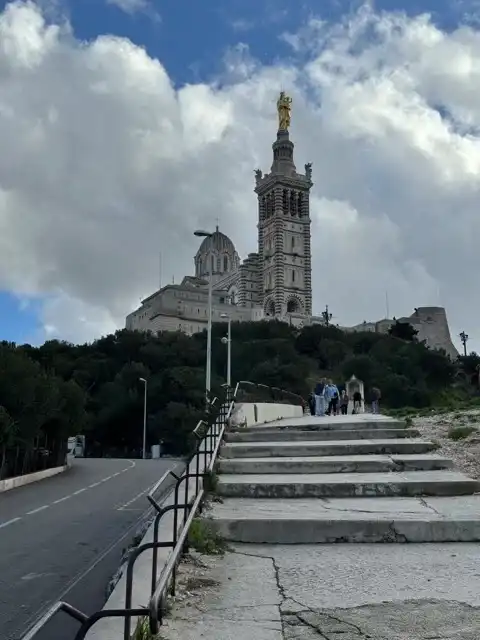
Notre-Dame de la Garde is perched on the highest point in Marseille, atop a hill. It’s a very urban hill. So roads go most of the way up, with some very civilized concrete stairs up the rest of the way.
According to one of my guidebooks, Rick Steves’s “Provence & the French Riviera,” Notre Dame de la Garde is a “Neo-Romanesque/Neo-Byzantine basilica, built in the 1850s.” Okay, Rick. Whatever you say
If I hadn’t read that, I would have guessed it was older. And I wouldn’t have guessed the building style at all. I imagine it’s the “neo” part that threw me as to Basilica’s age. They borrowed an older style purely to fool me. Yes, me specifically. They were prescient, knew I’d come along, and they wanted to pull the wool over my eyes.
Do you know how irritating it is to have wool pulled over your eyes? Loose wool fibres adhere to your eyeballs. That can be horribly uncomfortable, particularly if you wear contact lenses, as I do. I hate it when that happens.
But enough about that.
Notre-Dame de la Garde has a gigantic Mary-holding-Baby-Jesus statue sitting atop the basilica’s one tower.
Notre-Dame de la Garde has a small crypt with a charming little chapel cut into the rock of the hill immediately below the main sanctuary.
I didn’t know if I was allowed to go past the lobby into the chapel. A very portable sign told me that I couldn’t go in when a mass was going on. Because of the portable nature of the sign, I assumed that they put it there because I wasn’t supposed to go in then.
The door between the lobby and the chapel has a lot of glass. I saw people inside, but they looked more like tourists than worshipers. Then again, reliable sources tell me that in many jurisdictions, tourists are allowed to be worshipers and worshipers are allowed to be tourists. So who knows?
What made me seriously doubt that there was a mass happening then was that no one I saw inside was dressed like a priest. Nevertheless, rather than going into the chapel, I decided to satisfy myself with the good view of it that I got through the glass door from the lobby.
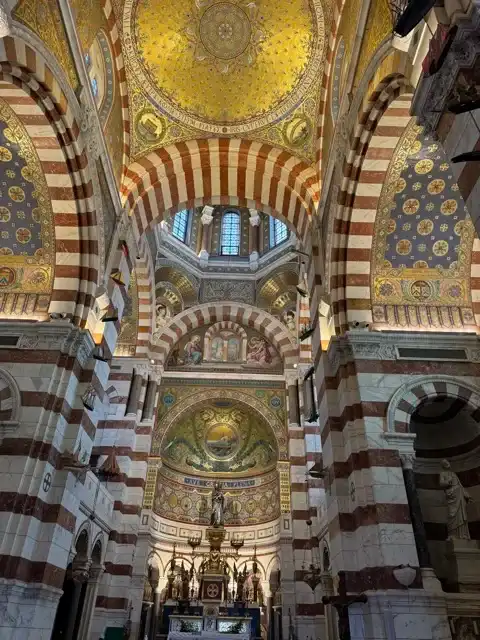
The interior of the main sanctuary of Notre-Dame de la Garde is beautiful. Mosaic murals adorn the undersides of all of the arches. There’s a lot of gold and red on the ceiling. The floors are decorated with patterns created with mosaic tiles.
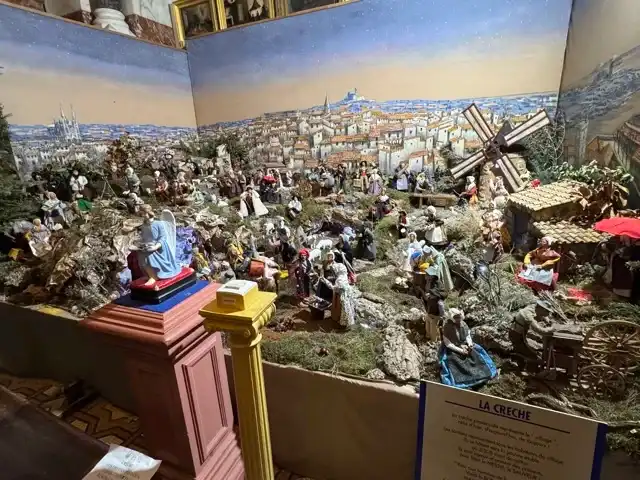
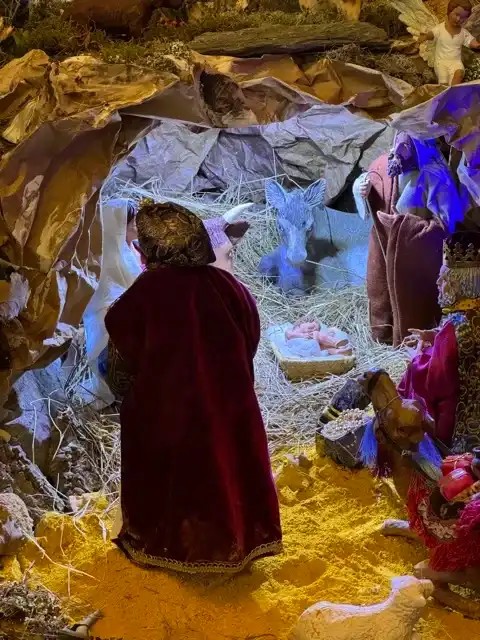
Off to one side is “La Crèche,” the nativity scene. It’s a miniature, three-dimensional town, with a small manger containing baby Jesus and his parents, or, at least, the corporeal ones. Three allegedly wise men stand outside the manger.
There are also myriad other figures scattered about the town. Painted backgrounds on the back and side walls extend the scene further.
Off near the back of the town, toward the right side, there’s a windmill. Its arms spun slowly while I was there.
When I arrived, the miniature town was dimly lit, but still easily visible.
While I was there, someone pushed a button in front of the clèche that I hadn’t noticed. When he did, bright lights lit up the whole scene. The windmill kept turning, but other movements also started happening.
A spinning wheel spun. The arm of a woman at a wash barrel moved back and forth to scrub her imaginary clothes. The arm of a man at a woodworking table moved back and forth with what looked like a planing tool in his hand. The arms of a few of the other miniature people also moved, doing I forgot what.
After a little while, the bright lights switched off, all of the motion except the turning windmill stopped, and I turned my attention elsewhere in Notre-Dame de la Garde.
On the other side of the church from the nativity scene, there’s a confessional. When I was there, a priest sat in his booth, and a woman entered the parishioner’s booth.
While she was there, the priest left the door to his booth wide open. I was too far away to possibly hear what either of them said.
And I wouldn’t have wanted to listen in on such a private moment anyway. If I had, depending on what she confessed to, assuming I could have understood the French, which I likely couldn’t, I might have been inclined to shriek, “YOU DID WHAT?!!! Forget the Hail Marys. There’s no salvation for you! You’re going straight to hell.”
The priest probably wouldn’t have appreciated that. Or maybe he would have. We’ll never know because it didn’t happen.
Despite not hearing what either said, I could see the priest through his wide-open door. He was facing out, toward the centre of the sanctuary, not toward the woman. At one point, the priest arched his fingertips against either side of his temple (the temple of his head, not the temple of the basilica, obviously), and projected a pained expression. I had the feeling he was thinking, “No more! Why do I have to listen to the same petty little sins every single day?” I’m probably wrong about what he was thinking, but who knows?
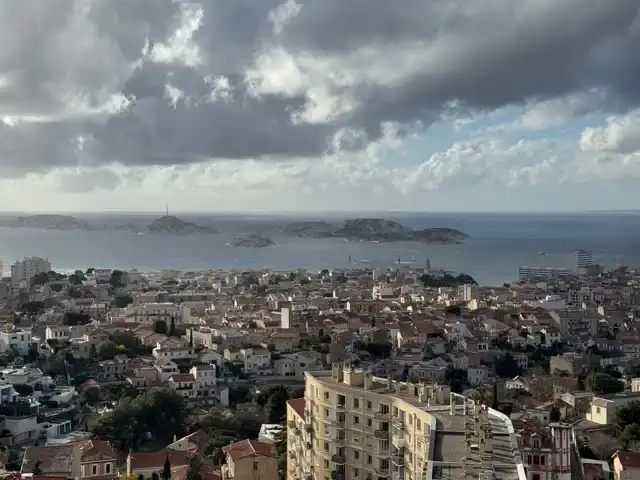
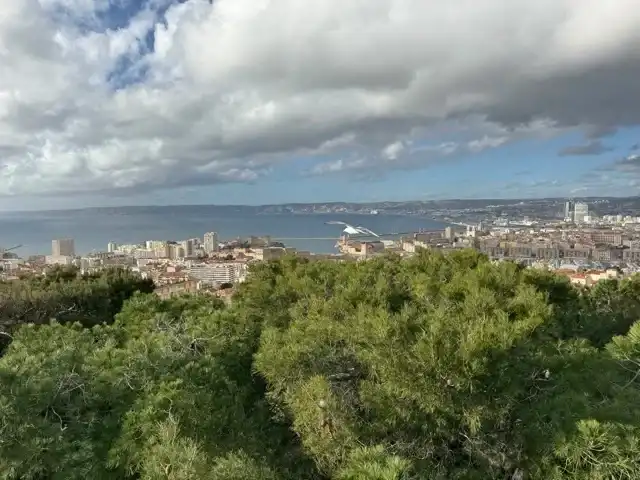
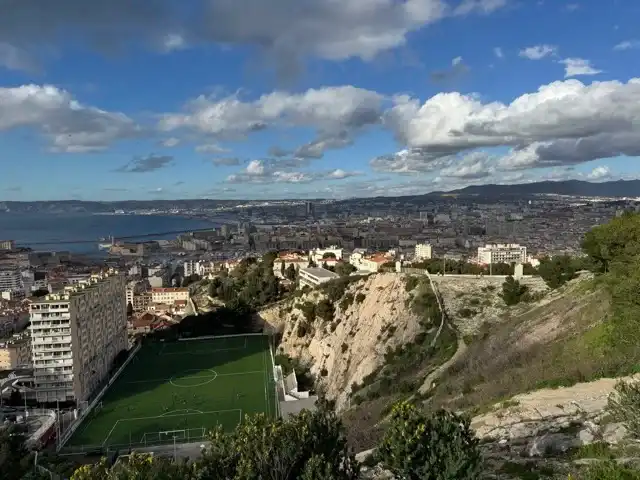
I’ve read that people go up to Notre-Dame de la Garde not so much to see the basilica, but rather for the views from outside it. The views are indeed spectacular. A terrace wraps around the whole church, so I got 360° panoramic views of Marseille from up high. Looking out to sea, I could also see Ile du Frioul, which I went to this morning, and the tiny island of If in front of it.
Abbaye Saint-Victor
After leaving Notre-Dame de la Garde, I walked down a long set of stairs and then along some streets to Abbaye Saint-Victor, which is still a little above Vieux Port, but much closer to it than Notre-Dame de la Garde is.
My walking tour app tells me that there have been religious institutions on this site since about 415 CE. (I was pleased to see that it used “CE” rather than “AD,” which would have led me to change it to “CE” when I wrote it here, as is my wont.) Back then, two monasteries were established, one on either side of Vieux Port. One of them was for women. The other was for men. Heaven forbid the two should mix. It might lead to baby priests and nuns being born.
Those monasteries were destroyed by Saracen invaders in the 8th or 9th century. One of the monasteries, the one where the current abbey is, reopened in 977.
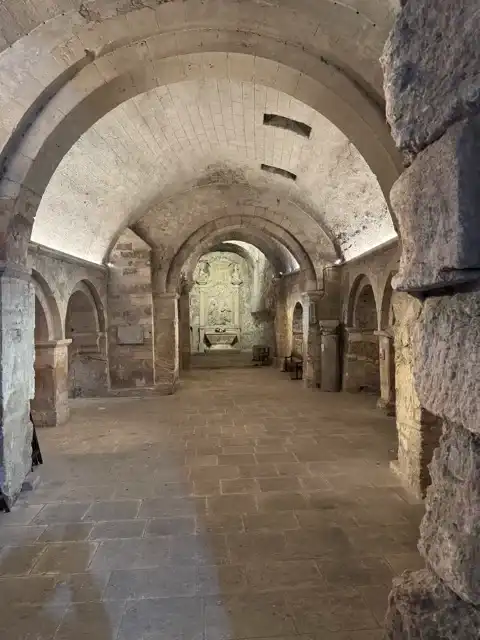
The abbey used to have a lot of treasures, but they were removed during the French Revolution.
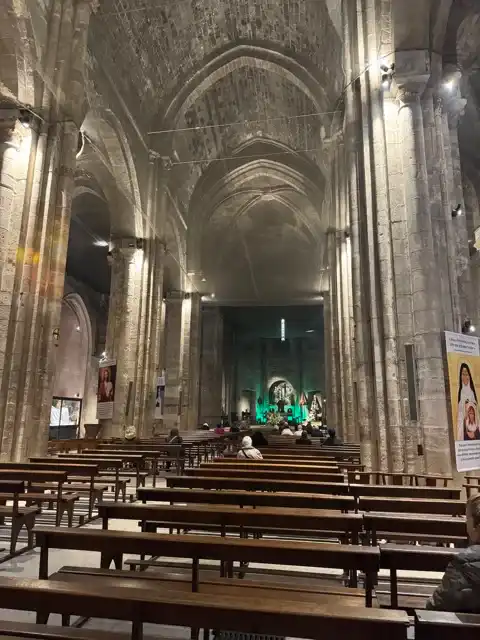
Today, both the exterior and interior of Abbaye Saint-Victor are pretty much unadorned. The interior walls show raw stone bricks, and there are few decorations. Nevertheless, it is still a functioning church. There was a service going on when I was there, so I was limited in how much I could walk around.
There is at least one sarcophagus that I saw in the main sanctuary. But there’s also a crypt below the sanctuary, accessible by interior stairs. That’s even less decorated, and the stones are a little rougher, but it has more sarcophagi and tombs, along with a prayer area.
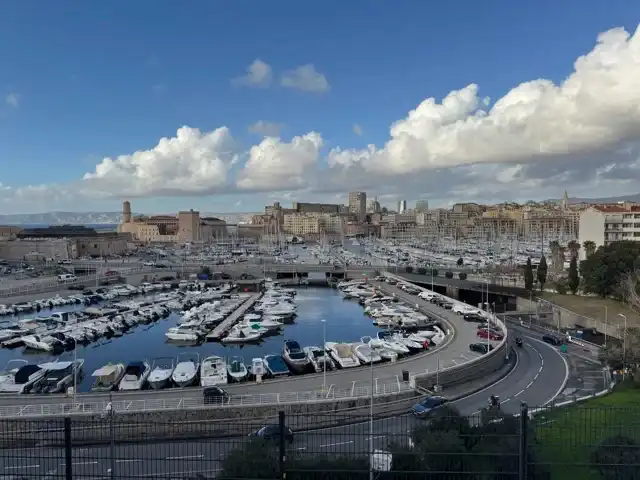
Across the street from Abbaye Saint-Victor, there’s a small terrace with a few benches overlooking the seaward end of Marseille’s Vieux Port. The surrounding buildings don’t allow a full peripheral view of the long port, but it does provide a pretty view of some of the port and the maw of a vehicle tunnel that crosses under Vieux Port at that end of it.
I spent a little while on one of the benches and then returned to my hotel. So ended the first full day of my mostly-South-of-France adventure. I say mostly the South of France because I’ll spend the last few days of this trip elsewhere. I’ll reveal where in my last post in the South of France, but some regular readers who know me already know where that is, particularly the ones I’ll be visiting there.
Discover more from Joel's Journeys & Jaunts
Subscribe to get the latest posts sent to your email.


Nothing like a great view nor a great crèche for that matter. Kind of like the Christmas windows at Eatons and Simpsons only way better, eh?? Have a good one in Marseille! So were you going after France I wonder? Any place good? Picturesque? Warmer than TO I wonder?
Eaton’s? Simpson’s? You should stop mocking your memory. They’re both long gone, but, yes, indeed, I remember their windows, in a vague sort of way.
Where? I meant. Where? Sorry.
I figured out that you meant where. And, where indeed. As I recall, it is a very picturesque and charming place. Enough so that I could almost imagine someone wanting to spend a couple of months there in the winter.