Spending a Rainy London Morning in the Natural History Museum
I should clarify my ambiguous headline. It was raining outside in London this morning, not in the Natural History Museum. I went to the Natural History Museum to escape that.
While I would prefer a dry day, people might scoff at me if I complain. The UK isn’t exactly known for unfailingly clear skies. Nevertheless, before today, I’ve experienced little precipitation on this trip, which is now a little shy of three weeks. It rained for a short while one day in Edinburgh, but that was about it.
That said, I’m used to people scoffing at me, so to heck with it. I’ll complain anyway. Cursed rain!
My plan was a smidgen, but only a smidgen less than successful. A long, snaking outdoor line confronted me near the entrance to the Natural History Museum.
To be more precise, two queues confronted me: the aforementioned long, snaking line and a queue that emptied as soon as anyone entered it.
A sign by the immediately disappearing queue said it was for ticket holders. A sign by the other said it was for people without tickets.
I didn’t have a ticket.
As soon as I joined the long, snaking line, I pulled out my phone in the hope of escaping the line. I found the webpage to get a ticket.
To be clear, entry to the Natural is free. The page offers the choice of two prices: £0 or £0 plus a donation. I was happy to give a donation, but there was a problem.
The only tickets on offer were for timed entry. The next available entry was more than two hours away.
They allowed people in from the snaking line only in clumps based on, I don’t know what.
I spent about ten minutes in the rain waiting to be allowed into the museum. Fortunately, I had my umbrella and a rain jacket. There was no wind, so those did a good job of protecting me from the precipitation.
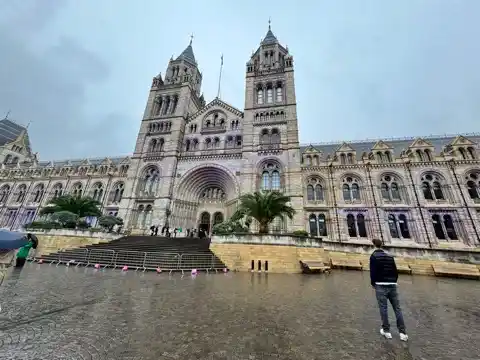
Natural History Museum
The first impression of the Natural History Museum upon seeing it from outside is that it’s big. However, after you’ve had further time to gaze upon it and form a more seasoned impression of the exterior, such as you might have a chance to do when standing in a line, that impression evolves. On further reflection, you come to realize it’s huge. A small distinction, I know.
The museum has a small central section that’s bookended by towers a couple of storeys taller than the rest of the building. Two long wings, one on either side, flank that.
The whole structure is constructed with stone bricks of subtly but distinctively varying colours.
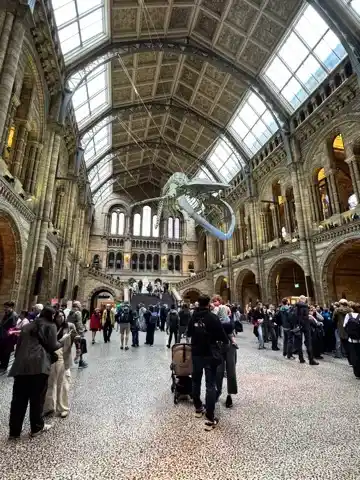
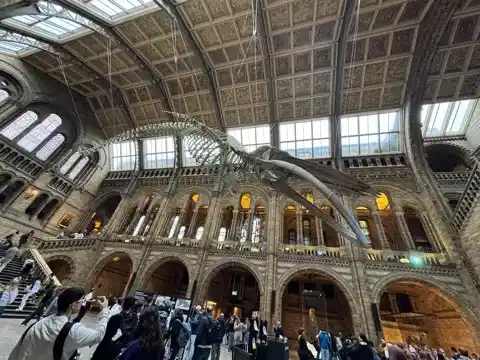
Just inside the main entrance, a huge atrium with a giant blue whale skeleton hanging high overhead swallows you up like Jonah, except the whale is above you, not surrounding you. Don’t expect me to always be literal.
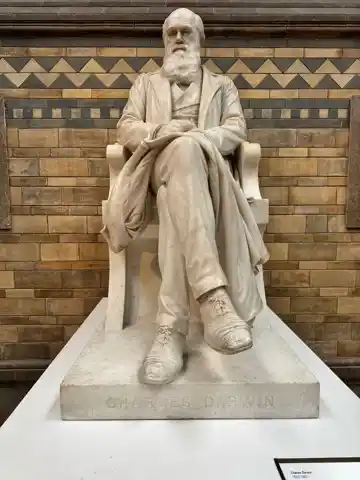
A grand stone staircase looms up at the far end of the atrium. A statue of Charles Darwin regards the evolving hordes from his perch on a staircase landing, where the stairs split off in opposite directions. It’s fitting that he’s there. Darwin is interred in London’s Westminster Abbey, which I visited yesterday. What’s more, the Natural History Museum has a gallery dedicated to evolution, particularly the evolution of the human species.
Because of the large atrium, the central building of the Natural History Museum doesn’t have as much exhibit space as it appears from outside. But there are still galleries in it. And the two wings are filled mostly with exhibits, but also cafés and gift shops.
After walking up the staircase, past the statue of Mr. Darwin, I passed a display case with a model of a moa, of which there are no more, and descriptive text.
Mineral Gallery in the Natural History Museum
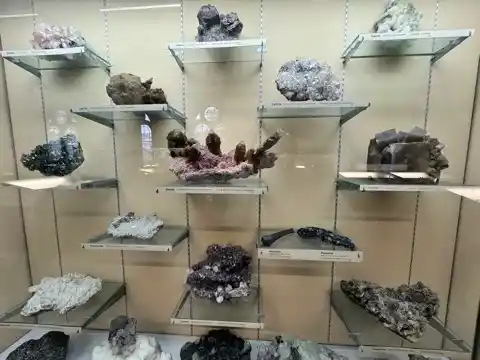
Beyond that, I entered the minerals gallery. It’s immense for a gallery that contains only samples of minerals and gems, many of them small samples and all fairly concentrated in their display cases.
Speaking of the display cases, there are two columns of them separated by an aisle. They run the length of the long room. Each column has a couple of dozen rows of wide, glass-topped table-top displays. There are also vertical cabinets, a few shelves high, along the side walls.
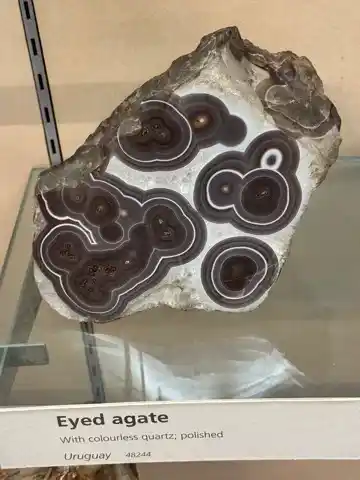
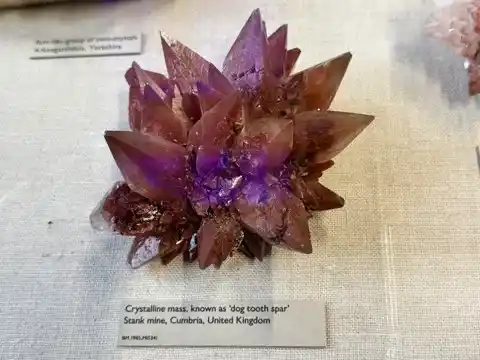
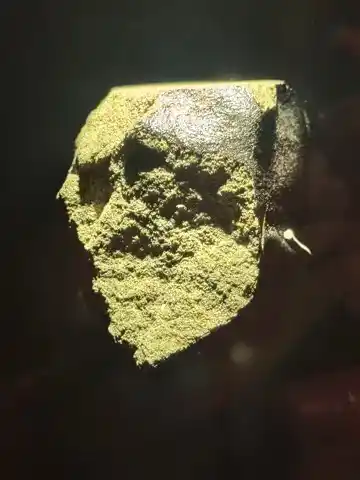
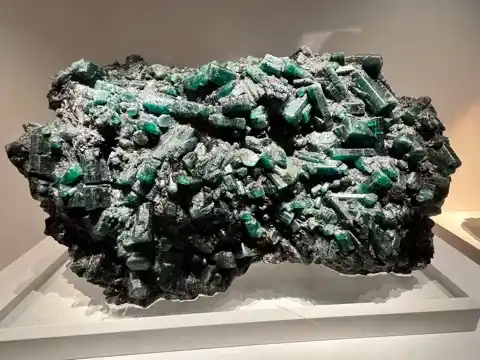
Many of the minerals looked like plain rocks, stones, or pebbles. But some of them were gorgeous, with naturally formed shapes and colours that didn’t look like they could be naturally formed. But what do I know? (Spoiler: The answer to the question, “what do I know,” is not a lot.)
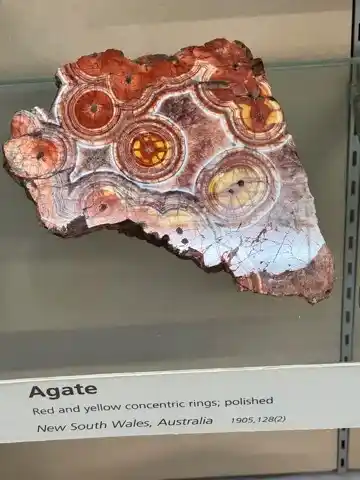
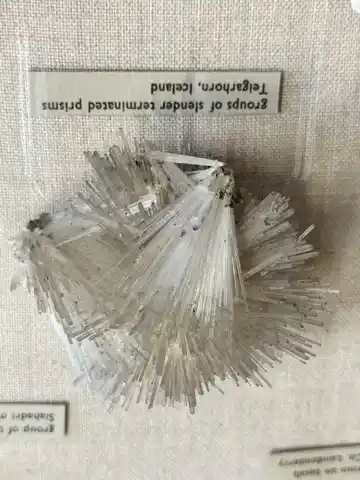
Some had beautiful, intricate patterns of rich colours. Others had crystalline shapes that looked too delicate to survive the elements, but before they were collected and installed in the museum, they existed in the elements.
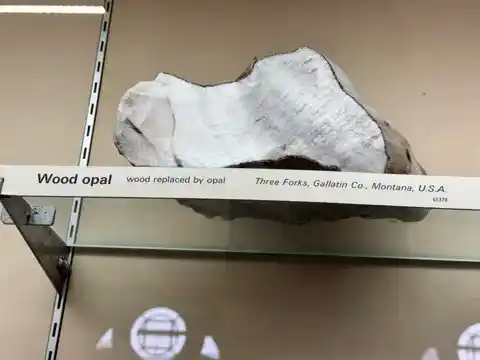
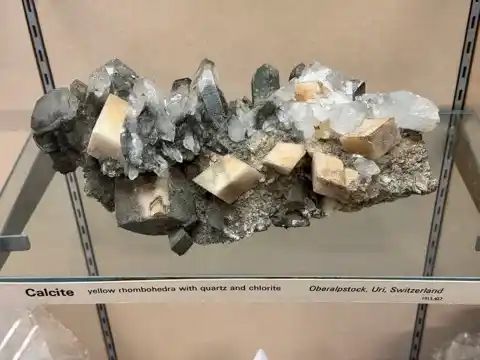
Each mineral specimen had a small card in front of it classifying the mineral and saying where the sample was collected. I spent a long time in the gallery looking at specimens and still probably looked at far less than half of them. There are thousands.
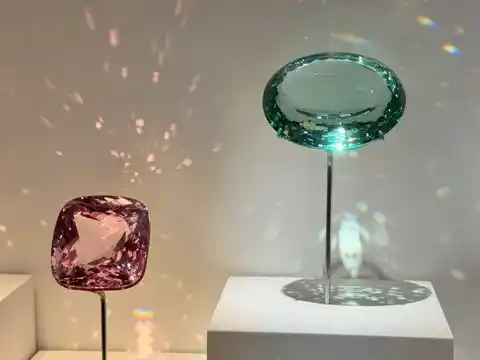
At the back of the Natural History Museum’s mineral gallery, there’s a smaller room called “The Vault.” It contains particularly rare minerals and gems, including a couple that are cut and polished as if for jewelry.
More photos of samples in the mineral gallery:
More Galleries in the Natural History Museum
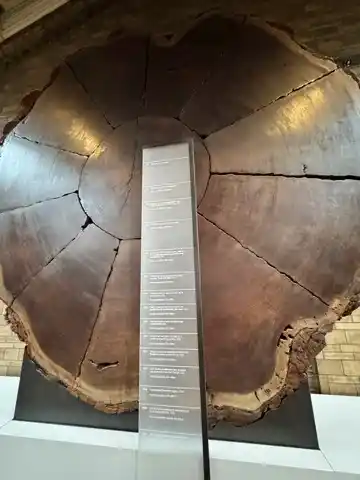
After leaving the minerals gallery, I walked past a slice of the trunk of a giant sequoia redwood. Pasted to the front of it was a strip of paper with a timeline. The farthest back in history was at the top, which was situated at the centre of the slice.
The oldest date was 537 CE, when the tree was a seedling. The timeline then marked the centuries, with one significant event in each century of its life, along with the size of the human population in that year. A few of the events were: Beginning of the Islamic calendar, 622, human population: 206 million; First known book printed in China, 868, human population: 224 million; The Great Comet is seen across the world on 2 February, 1106, human population: 320 million; Leonardo da Vinci draws his ideas for a human-powered flying machine, 1485, human population: 374 million; Charles Darwin publishes his Influential work On the Origin of Species, 1859, human population axceeds one billion; and in 1891 the sequoia was felled at the age of 1,335.
In the next gallery I entered, I found the first display that caught my eye to be so disturbing that I’ve now completely forgotten the theme of the gallery.
I was so disturbed that I forgot to take any other pictures in the gallery to remind me of its subject. But I did take a picture of the disconcerting sight, because why should I be the only one to be severely unsettled?
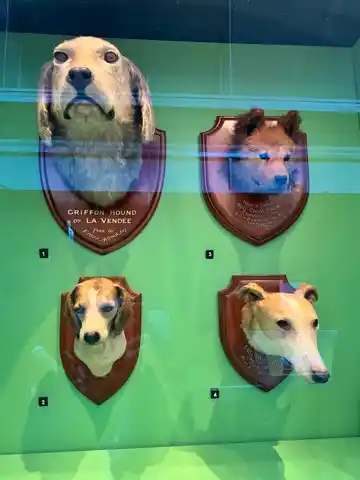
Hanging on the back wall of a glass-fronted display case were four stuffed dog heads, mounted on wood frames like hunting trophies.
All four looked like they were good dogs in life. None looked like particularly rare breeds. They deserved more respect. It’s not as if anyone visiting the Natural History Museum doesn’t know what a dog looks like.
I quickly moved through that gallery, whatever it was. After that, the museum mostly resumed and continued to wow me. But …
Well, I visited another gallery before the “but” moment. So let’s go there first.
The other gallery is titled “Fixing Our Broken Planet.” It’s a small one that presents some of the serious problems Earth faces, all either human-caused or human-exacerbated, and actions we can take to alleviate them.
Climate change obviously gets considerable mention. Agriculture and the resources it consumes are also noted.
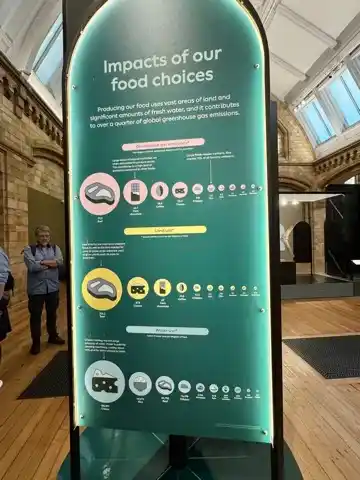
One display panel talks about the foods we eat and the effects they have on various planetary problems. For a few different foods, it lists the greenhouse gases emitted, the land used, and the water consumed in the production of each of the foods.
Beef is the worst for greenhouse gas emissions and land use. But cheese is the worst for water use.
The best for greenhouse gas emissions is potatoes. Tomatoes are best for land use. For water use, it’s coffee.
It pleased me that coffee is such a conscientious user of water because, immediately before visiting the Fixing Our Broken Planet exhibition, I had coincidentally paused for an espresso.
However, I wasn’t permitted to feel too righteous. Of the ten foods listed, coffee is third-worst for greenhouse gas emissions and fourth-worst for land use.
Dinosaur Gallery
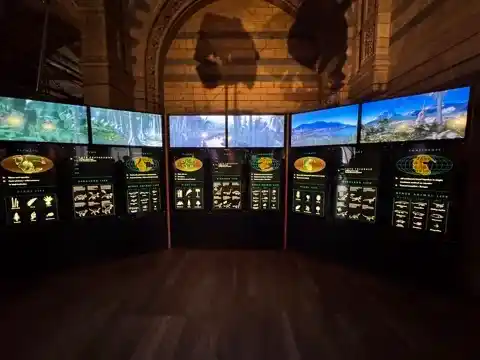
I then moved on to the dinosaur gallery. It started with a large display showing the periods during which dinosaurs existed, providing information about each.
Then came the “but” moment. I faced a large, audio-animatronic Tyrannosaurus Rex model. It moved its head and made some roaring noises. Who the heck knows what dinosaurs sounded like? They thoughtlessly didn’t leave any recordings.
I found it hokey, not informative. It didn’t annoy me the way the dog trophies did, but my life was not enhanced in any way by it.
You be the judge. I took a video.
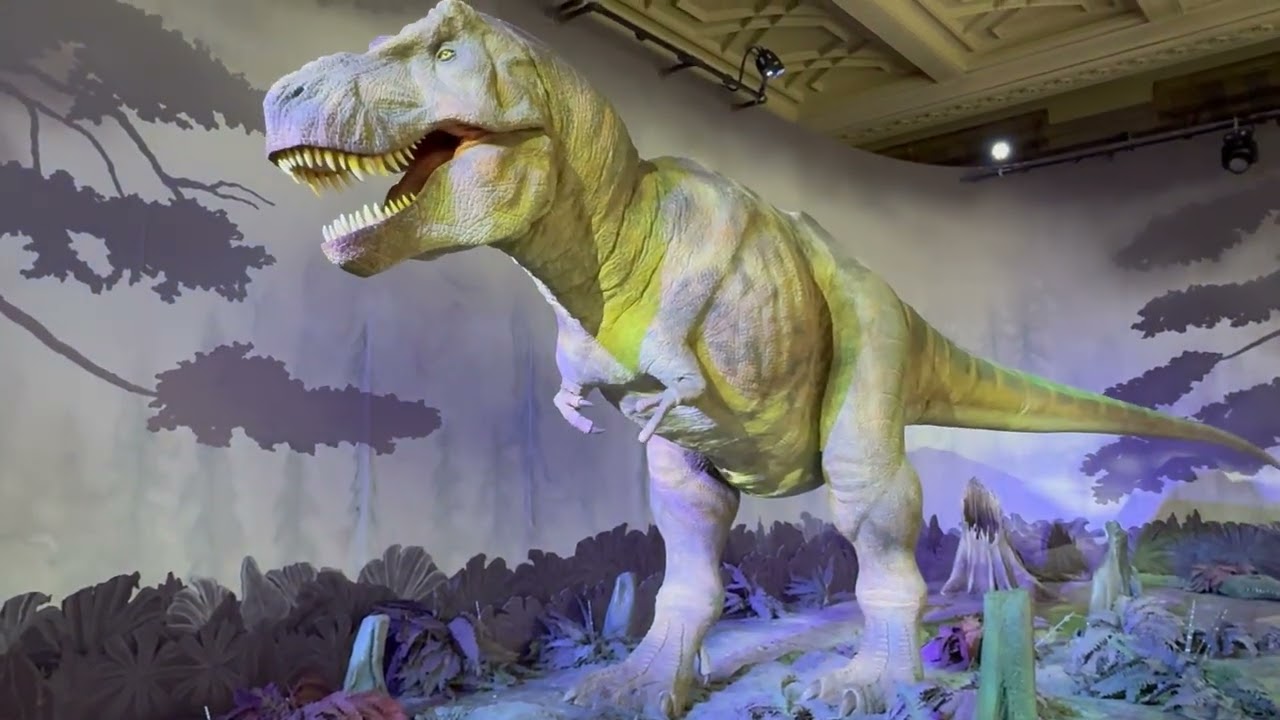
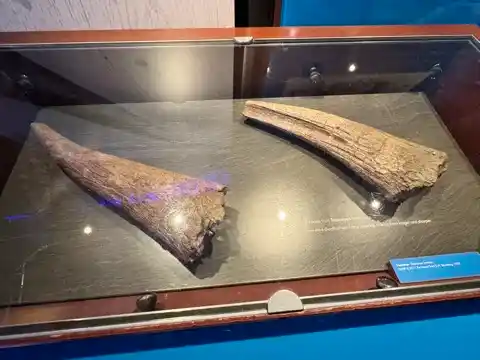
Further on in the gallery, there was another, smaller animated 3D dinosaur model, but I didn’t hear it make any noise.
The rest of the gallery includes dinosaur bones, skeletons and models of dinosaurs with skin on. Most (all?) of the bones and complete skeletons are casts of fossils that exist elsewhere. The skeletons have some parts that are hypothesized fabrications of missing pieces.
After I finished with the dinosaur gallery, it was time for lunch. I still hadn’t seen all of the museum, so I ate in one of the museum’s cafés.
I explored the rest of the Natural History Museum after lunch. However, because I sat down for my repast, let’s table that for another post, shall we? Like you have a choice.
Discover more from Joel's Journeys & Jaunts
Subscribe to get the latest posts sent to your email.

London: Imperial War Museum, Westminster Abbey, Tate Britain
British Museum