Tours of the Palace of Westminster and Westminster Abbey
The title makes it sound like I spent a lot of time in Westminster, right? I did.
Today, I restricted myself to sights within a relatively short walking radius on one side of my hotel.
This morning it was the Garden Museum, the Jewel Tower (much-formerly part of the Palace of Westminster) and Victoria Tower Garden.
This afternoon, I toured the Palace of Westminster and Westminster Abbey.
In my first entry from London on this trip, I said I would try to focus on quirky sights on this trip because I’d seen most of the tourist favourites on previous visits. I broke that rule this afternoon. Both the Palace of Westminster and the Tower of London are on the blockbuster tourist attraction lists. And, depending on your definition of the word, they’re not especially quirky.
Palace of Westminster
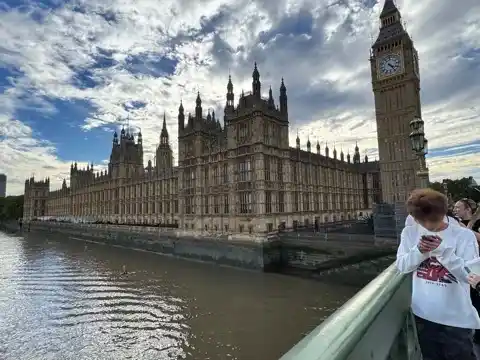
The Palace of Westminster is still considered to be a Royal Palace, but it’s no longer a Royal residence. Today it solely serves as the home of the British Parliament. It’s also known simply as the UK Parliament, but the formal name, Palace of Westminster, sounds much more posh, doesn’t it?
I booked a timed guided tour of the U.K. Parliament (that was the name on the ticket) a few days ago. When I got there, I found out I could have also bought a self-guided tour with an audioguide.
This is going to be a photo-light section. They forbid photography in all but two of the rooms on the tour, Westminster Hall and the adjoining St. Stephen’s Hall.
I have pictures of those two halls and some exterior shots of the Palace of Westminster. But that’s it.
That’s a shame because the Palace of Westminster is a beautiful old building with distinguished, largely Gothic architecture, lots of statues and paintings, a gorgeous chandelier, and plentiful beautiful decorative elements.
I wish I could show it to you. But it’s not my fault. Speak to the U.K. parliament.
Due to the deficiencies of my memory, this will also likely be a word-light section. (I have a habit of being much more verbose than I expect when I start out writing. So, we’ll see, dear.) The tour lasted an hour and a half, and the guide spoke almost nonstop, but I remembered next to none of it.
There was no informational or interpretive signage on the tour. That was inconsequential. I couldn’t take any pictures of the signs anyway. And I’d be no better at recalling textual information than spoken information.
That, too, is a shame because one of the things I do remember is that most of what the guide said (I’ve also forgotten her name) was informative, interesting, intriguing and/or fascinating. I just can’t remember what it was. If you’re interested, you can get a lot of information about the history and architecture of the Palace of Westminster from the page on the UK Parliament website I linked above.
Aside
Big Ben
Before I get into what I do remember from the tour, a quick aside about Big Ben.
The tower that contains the world-famous clock, Big Ben, is part of the Palace of Westminster. I’ve seen it from the outside on this trip and on all three of my previous visits to London. But I have never been in the tower.
They do run Big Ben tours. If you surf to the ticket booking page, you’ll see a calendar with three or four months’ worth of tickets. They release a new month’s worth of tickets at 10:00 a.m. on the first Monday of every month.
Two or three weeks ago, I tried to buy a ticket for the tour, but they were all sold out. Not just for the days I’d be in London. The whole three months showed that they were sold out for every day. Every. Single. Day.
I looked again just now to provide a link to the ticket page. They’ve since added a page for January. Today is Tuesday, October 6. So they went on sale yesterday. There were dates available in January, but a few days were already sold out.
When I got to the check-in desk for the tour I was on today, I asked the guy there if they sell same-day tickets for the Big Ben tour. He didn’t entirely suppress a laugh. He said that, no, you pretty much have to jump on it a few months in advance when they release the tickets.
The moral of the story is if you want to go on a Big Ben tour, plan well ahead.
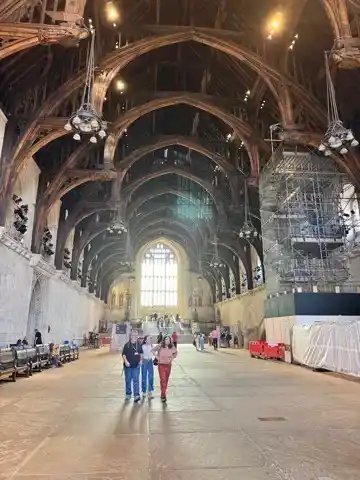
Let’s start by talking about the two Westminster halls at the start of the tour, the only two I could take pictures of.
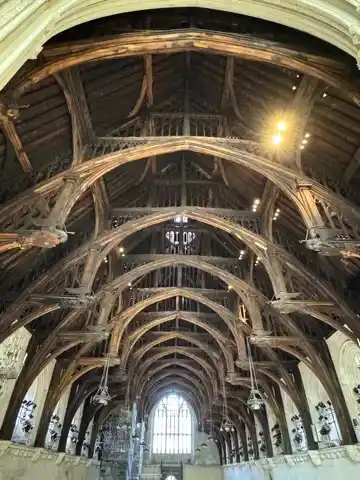
Westminster Hall is a huge, cavernous room with stone walls and an austerely gorgeous dark oak thick-beam ceiling. Heads of women are carved on the ends of the beams. The guide said they’re supposed to represent angels, but that the carvers were allowed to carve them as the heads of their wives or girlfriends.
Westminster Hall is not the original. It was rebuilt after the Great Fire of 1834 destroyed the hall, along with much else of the Palace of Westminster.
When a speaker who is likely to draw an enormous crowd is invited to speak to the UK Parliament, they speak in Westminster Hall. Two names of people who spoke there that I remember are Nelson Mandela and Barack Obama.
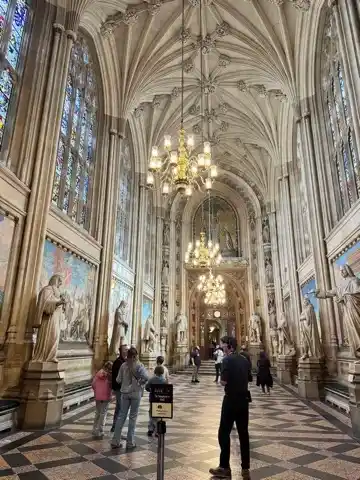
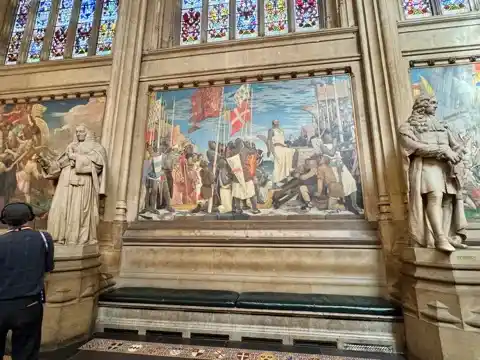
I’ve forgotten the purpose of St. Stephen’s Hall, but it has a series of early 20th-century paintings on the upper portions of the walls collectively known as “The Building of Britain.” They depict key events in Britain’s history.
Now for the pictureless part. I only remember a few facts from there, so this shouldn’t take long.
There are separate chambers for the House of Lords and the House of Commons. The House of Lords has posher decor.
Before we started the tour, the guide asked us each where we were from. When I said, “Canada,” she asked me which province. I told her, “Ontario.” She said, “Oh, you’ll see a table on our tour that came from Ontario. Thank you very much for giving it to us.”
That table is in the House of Commons.
A common theme throughout the tour was, “We didn’t have enough money, so…”

I forget when it was, but when they needed to furnish the House of Commons, they didn’t have enough money to do it. So they got the Commonwealth countries to donate stuff. The large table between the two sides of MPs’ benches was donated by Canada and came from Ontario. While we were in the House of Commons, the guide again thanked me for it. She also pointed out what items the different Commonwealth countries donated.
I said the Palace of Westminster wasn’t particularly quirky, but the way they vote in Parliament is. In Canada’s House of Commons, when they call a vote, the Members of Parliament remain in the chamber. I forget which they do first, but when the Speaker calls for the yea votes, the members rise in sequence, the clerk calls out their name, their vote gets recorded, and the member sits down. The same happens for the nay votes.
They do it differently in the UK Parliament. Voting is called the division. In both chambers, there are two hallways outside the chamber, one on either side. In the U.K. House of Commons, MPs who are voting nay proceed to one hall. MPs voting yea go to the other hall.
It used to be that the votes were counted manually in each hall. There are now electronic devices where the MPs tap their ID cards. But the votes are also recorded manually.
The voting process is identical in the House of Lords. But there, they don’t vote yea or nay in yea or nay halls. They vote content or not content in content or not content halls.
I learned something about our (Canada’s) parliament from this. The bells that ring in the House of Commons in Ottawa (Canada’s capital) are called the division bells. I never knew why. Our parliament is modelled after the Westminster Parliament. I assume the “division” is a carryover from Westminster, where the MPs literally do divide up to vote.
Here’s another thing I learned about Canada’s Parliament from the tour. There’s a tradition in the Canadian Parliament that whenever a new Speaker is elected, which happens with each new Parliament, the Prime Minister and the Leader of the Opposition each grab one of the newly elected Speaker’s arms and drag the Speaker to the Speaker’s seat. The new Speaker makes a show of pretending to resist the job.
I never knew why.
It turns out it came from the mother parliament. Back in the days of more powerful, less benevolent kings, one of the Speaker’s jobs was to communicate the will of Parliament to the King. There were incidents of the King having the Speaker killed if the King didn’t like the message the Speaker brought.
Jeez. Hadn’t they heard the old expression, “Don’t shoot the messenger?”
Then again, back then, executions were generally performed by beheading, not shooting. So maybe the King thought it didn’t apply to him.
As a result, in those days, people really didn’t want the job of Speaker. They did have to be dragged into the job.
The threat to the Speaker from the monarch is long gone, but the tradition of dragging the Speaker into the House is still practiced in the UK. When I mentioned to the guide that we do it in Canada, she said that when she has people on tour from Commonwealth countries, many make the same remark. Apparently, the tradition has carried on to many Commonwealth countries.
Okay. That’s all I remember.
Westminster Abbey
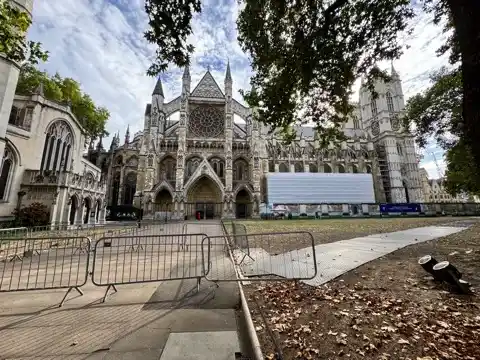
I had been in Westminster Abbey during a previous visit to London a few years ago. (Probably also during my first visit, but that was decades ago and I forget.) But the Abbey was right there across from the Palace of Westminster. So I decided to pay it another visit.
Besides, Westminster Abbey is monumental. I mean that both in a general sense and in that it is overloaded with monuments. Many of the early monarchs of England are buried there, with monuments over their tombs.
Photography is allowed throughout the Abbey, so this will be a photo-heavy section.
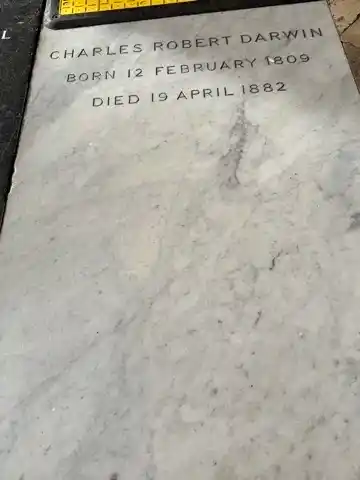
There are also tombs, graves, monuments, and/or commemorative stones for many famous people from over the centuries in Westminster Abbey. There’s a science corner with the graves of Sir Isaac Newton, Charles Darwin, and Stephen Hawking in the floor of the Abbey. There’s also a poet’s corner with Charles Dickens’ grave and other literary figures.
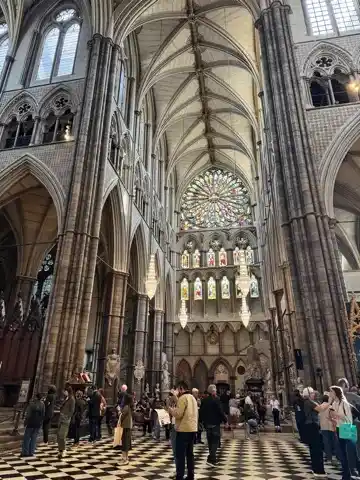
The floor of Westminster Abbey is littered with graves and their grave markers. You can’t help but walk on some of them. And that’s perfectly acceptable. There’s only one grave that no one is allowed to walk on. That’s the tomb of the unknown soldier. It’s surrounded by a rectangle of fake red poppies.
There are lots of small chapels around the sides and the back of the nave. Many of them are ornate and contain tombs of monarchs.
In the choir of Westminster Abbey, some personages get named stalls, including the High Commissioners of Commonwealth countries, including Canada.
The coronation chair that has been used for the coronation of monarchs in Britain for, I forget how many centuries, is in Westminster Abbey. (The Abbey is where they perform coronations.) When it is not in use for coronations, it sits in a room that is divided off from the rest of Westminster Abbey by a glass wall. The public can’t get too close to it, but we can look at it from a distance.
The tour through Westminster Abbey is self-guided. The admission fee includes the use of an audioguide that also has a video screen for close-ups and other images to be displayed during the narrative. I remember no more about what I heard on that than I did on the Palace of Westminster tour. Therefore, this concludes this journal entry.
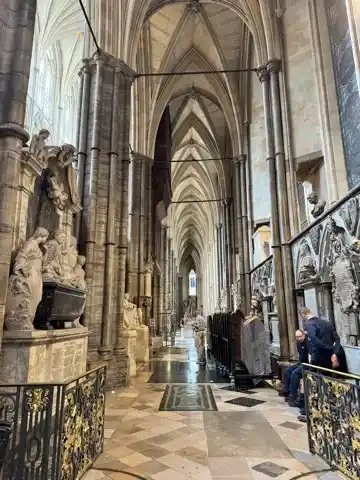
More photos inside Westminster Abbey:


Discover more from Joel's Journeys & Jaunts
Subscribe to get the latest posts sent to your email.

London: Churchill War Rooms, St. James Park, Buckingham Palace, London Eye, National Gallery

London: The Regent’s Park (bonus post)

A gorgeous and imposing place, Westminster Abbey. It’s been too long since I visited it. I would go back as well should I spend some more time in London. What you could show of the Palace of Westminster was also gorgeous, and I loved the stories. You remembered them when the context was close to your (our) hearts: Canada! And weird rituals, of course. You’re allowed to go to non-quirky sights when you are in London this trip. As all can witness by reading your blog, you add the quirk wherever you go. I say that with great affection (of course).
I keep forgetting how much I like London until I come back. There are more glorious places here that I won’t get to on this trip because I have seen them before and I wanted to see new sights. I had been inside Westminster Abbey before, but I’d not been in the Palace of Westminster until what has now become yesterday.
As you know, I’m not a psychologist, but I think it’s only natural that I can more easily remember new information if there’s a hook that I can use to tie it to something I already know. And, in this case, it just happens to be Canada, my home and native land.