A Possibly Quirky London Visit
Why did I title this “A Possibly Quirky London Visit”? That’s a fabulous question. I wish you hadn’t asked it. Now I have to fabricate an answer to fit a title that inexplicably popped into my head.
Let’s start with the easy part. After my delightful stay in Salisbury, England, I’m now in London. At this point, I feel the need to say it’s London in England. There’s a London, Ontario, Canada. It’s a couple of hours’ drive from Toronto, Ontario, Canada, my hometown. I’m not in the Canadian London as I write this.
I visited London on this trip primarily because Air Canada’s flight from Edinburgh to Toronto leaves earlier than I want to catch. That makes sense only if you’ve followed along in my journal’s recounting of this journey. It started with a week-long visit with a Dear Relative (DR) in Edinburgh. I wanted to travel around for a couple of weeks after taking my leave of DR. Air Canada has a few flights a day from London to Toronto, including a couple at reasonable hours. So, I ended the trip in London.
Unless you consider the thinking behind my itinerary choices to be quirky, that doesn’t explain the “Quirky” in the title, does it? Be patient. That train will eventually reach the station, so to speak.
This is the fourth time that I’ve been in London. The first time was decades ago. The last three, including this one, occurred after I started this journal. The most recent visit before this one was only about a year ago.
The point is, I’ve already seen most of the blockbuster sights in London. I no doubt forgot a lot about them, but I don’t want to repeat too much. (We are approaching Quirky Station. Please remain seated until the train comes to a complete stop.) Hence, my current plan, subject to change without notice, is to include at least a few quirky sights that I haven’t seen before because they are listed under “visit if you have time after doing everything else” in tourist guidebooks and apps, and I hadn’t finished doing everything else yet.
That said, I do have a rather staid tour booked that I don’t recall having gone on before. Apart from that, I’m not very good with detailed planning. So, we’ll see how it goes, dear.
I didn’t check into my hotel until after one today, and I hadn’t had lunch yet. But that still left me a good part of the afternoon today to do some quirky things.
I’m in London for four nights. My flight doesn’t leave until 5:45 p.m. So, with the half day then and the half day I had today, I’ll have four full days here.
Not so Quirky Sight: Temple Church
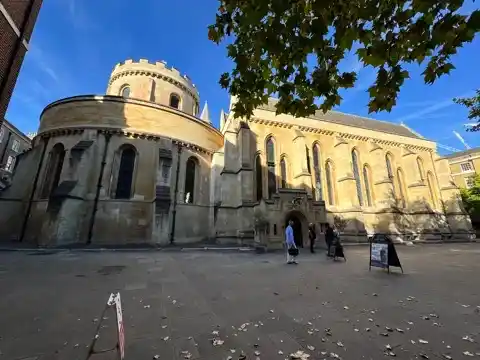
I started my afternoon in London by visiting Temple Church. There’s not much quirky about Temple Church other than the name.
“Hey,” one of the people responsible for naming it said. “What should we name our new church?”
“I don’t know. How about the Church of the Holy Sepulchre?”
“Nah. There’s already one in Jerusalem. Sure, we’ll model it after that church, but it might be confusing if we name it that. If you say, ‘meet me at the Church of the Holy Sepulchre,’ your friends might go to Jerusalem instead of London. Besides, people these days are so medieval they’re a little slow on the uptake. We need to beat them over the head with the fact that it’s a religious establishment. I know, how about Temple Church? If they don’t get it from ‘Temple,’ then, bam, we hit them with ‘Church’ right away.”
Quirky, right?
The people around when theTemple Church opened were literally medieval. It has two integrated components. Services were held in “The Round” by 1163. The Round gets its name from its triangular shape. No, of course not. It’s round. They modelled it after the Holy Sepulchre.
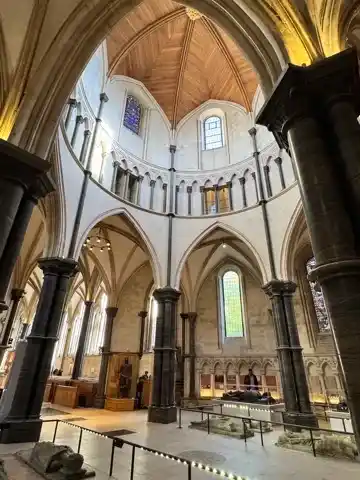
They added a chancel to The Round in 1240. The chancel is rectangular. They must have cut away a large section of The Round when they did that. It’s now one building, with the opening in the round being the full width of the chancel.
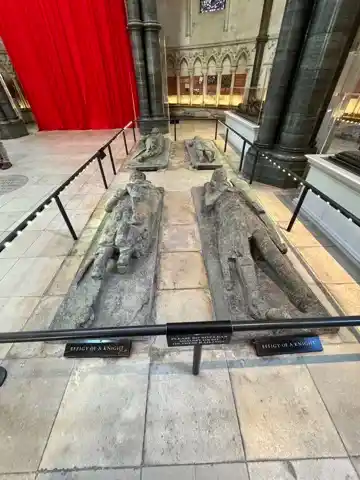
In The Round, several effigies currently lie on the floor. Some (all?) of them are on loan from museums.
Many text panels hang on the wall of The Round, providing information about the history of Temple Church.
It was built by the Knights Templar, who were doing so well in Jerusalem that they opened a branch in London. I’m joking. They were indeed founded in the Holy Land. But I don’t think they considered London a branch operation. I admit to being largely ignorant about the Knights Templar and don’t want to spend time now trying to learn more. If anyone can, and wants to, help me with that, I’d appreciate the input.
Hmm. I wonder if the Templars’ involvement had anything to do with it being called Temple Church.
The information panels spend considerable time talking about the Magna Carta. Coincidentally, I saw an original of the Magna Carta in Salisbury Cathedral just a few days ago.
Temple Church doesn’t claim to be the Magna Carta’s birthplace. But, to use the birth analogy, it does suggest it’s where the Magna Carta’s conception occurred.
In 1214–1215, King John was having problems with his subjects. They were revolting. They didn’t think much of him either. At the time, King John made Temple Church his headquarters.
While in the church, the king issued some church charters, including one that gave the City of London the right to elect its own Lord Mayor. The Magna Carta later evolved from this document, or so the information panels say.
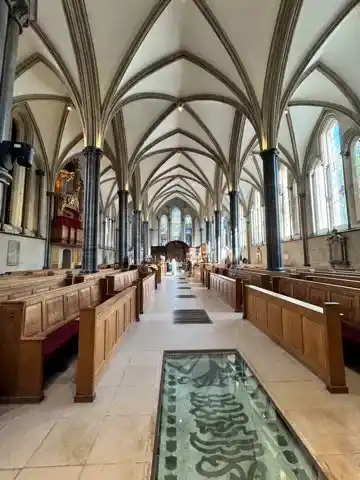
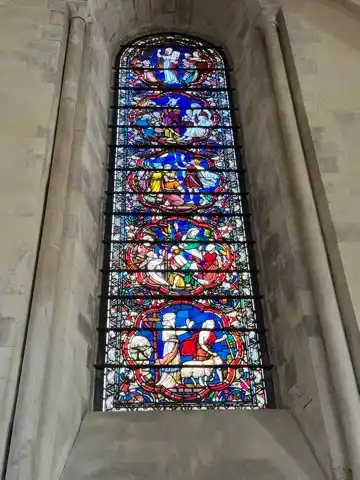
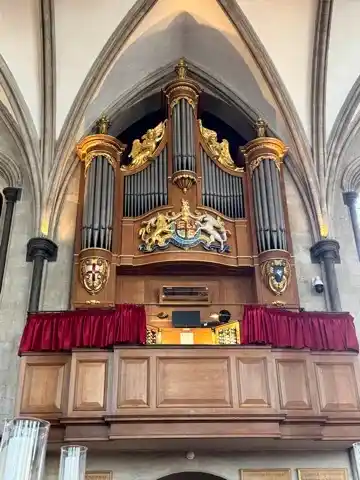
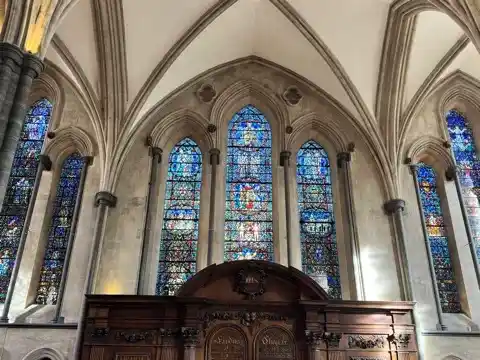
The chancel is fairly simple. There are some pretty stained-glass windows, most of which are fairly new. Its pillars’ fluting rises to form a vault-ribbed ceiling.
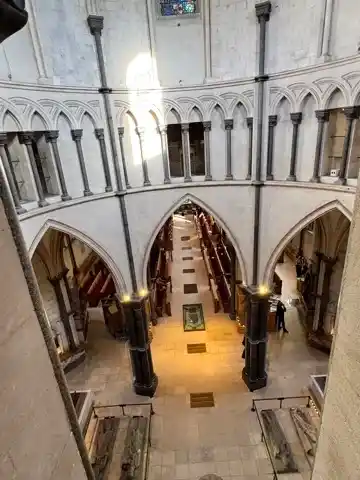
There’s a spiral staircase off to the side of The Round, where it joins the chancel. That leads to a balcony in The Round, from which I looked down on The Round and through to the chancel.
(Note to self: If I ever think of opening a restaurant on a balcony in a round atrium, “Balcony in the Round” would make a great name for it.)
(Further note to self: If I ever think of opening a restaurant at my advanced age after never considering running a restaurant before, it’s time to have myself placed in a home.)
Hanging on the wall behind the very simple altar of the chancel, there are some dark wood panels with gold-coloured printing on them. The centre two panels contain an English translation of the Ten Commandments. Some of the commandments in that version are much more verbose than I’ve ever heard them, not that I’ve had in-depth exposure to anything religious.
For example, the First Commandment reads, “THOU shalt not make to thy self any graven image, nor the likeness of any thing that is in heaven above, or in the earth beneath, or in the water under the earth. Thou shalt not bow down to them. nor worship them. For I the Lord thy God am a jealous God, and visit the sins of the fathers upon the children. unto the third and fourth generation of them that hate me and shew mercy unto thousands in them that love me, and keep my commandments.”
What? He’s a jealous God? Seriously? He’s allegedly an omnipotent, omniscient being, but he sounds like he could benefit from some therapy. And the way it’s phrased, “I … am a jealous God…” suggests there are other gods who aren’t jealous. They sound like better gods. Much more balanced.
And you’ve got to be kidding. Children, grandchildren, and great-grandchildren have absolutely nothing to do with the sins of their ancestors, particularly the sin of paying respects to the other gods. Yet this unjust god will punish the descendants for that. I’m sorry. Do better, God.
And then there’s the Tenth Commandment, which, in the Temple Church, reads, “THOU shalt not covet thy neighours house, thou shalt not covet thy neighbours wife, nor his servant, nor his maid, nor his ox, nor his ass, nor anything that is his.”

I hate to be a stickler, but it’s alleged that a supreme being wrote the Ten Commandments. Couldn’t He have instructed His English translators on how to form the possessive? It’s “neighbour’s,” not “neighbours.” And He could have tightened up the prose considerably. “Thou shalt not covet thy neighbour’s stuff or anyone associated with him” would suffice.
They didn’t have same-sex marriages when God allegedly wrote the Ten Commandments. So, women didn’t have wives then. Therefore, women are free to covet anyone else’s spouse they want to covet without worrying about incurring the wrath of God. What’s more, when it comes to anyone who is not your neighbour, feel free to covet to your heart’s content anything of theirs and anyone associated with them.
Okay, maybe Temple Church was quirky after all.
And, while I have seen Temple Church mentioned, none of the sources I looked at rated it as a “must-see,” so I don’t think many tourists go there. There weren’t many today. Therefore, I’ll count it as quirky in that regard too.
Quirky Sight: Battersea Chimney

Okay. How’s this for quirky? After the Temple Church, I took a short walk to a Tube station (they operate exactly like subway stations in some places and metro stations in others, because that’s what they are), a short Tube ride, and then a bit longer walk, including on a bridge over the Thames River, all merely to go inside and up a chimney. Quirky, right?
The chimney is on what used to be the Battersea Power Station, which was an immense coal-fired electricity generator.
It’s not that anymore. Now the lower levels contain a shopping mall, food court, and cinema.
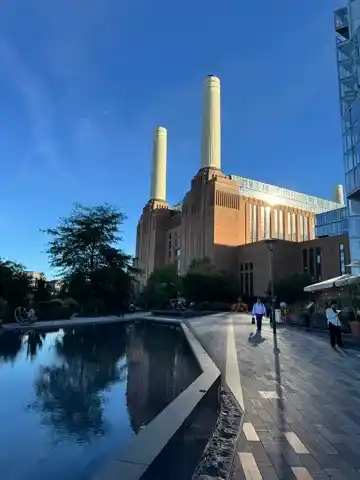
The building is handsome in a clean, red-brick industrial sort of way.
Four tall chimneys sit atop the building, one near each of the corners.
No, I didn’t climb up any of the chimneys. At least, not most of the way.
For a fee, customers can ride on the Chimney Lift in one of the chimneys, which definitely was not a thing when Battersea was a power station. I imagine that spending much time in the coal-soot chimney then would probably kill you.
For the benefit of anyone here who is not familiar with anything British, I should mention that there are no elevators in Britain. None. There are lifts. They are the same thing with a different name. However, the Chimney Lift is not at all like a standard lift.
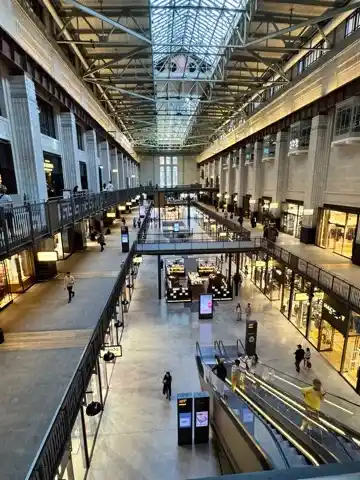
The Chimney Lift experience begins in a room where a three-minute, fast-paced hyperbolic video about the Battersea Power Station, the various proposals for what to do with it after its decommissioning, and its current use plays.
After the video, a door opens on the other side of the room. That leads to two small standard lifts. Combined, they have enough capacity to accommodate as many people as they allow into the chimney each time.
Those elevators rise twelve floors to the top of the red-brick building. Then, there’s a walk up a wide spiral staircase inside the chimney for what felt like about two standard-sized floors.
The Chimney Lift is at the summit of those stairs. It’s not, as I said, a standard lift or elevator for that matter.
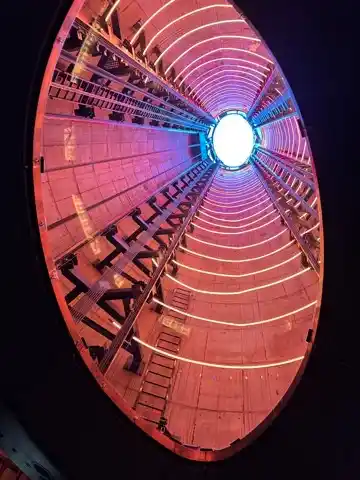
The lift is oval-shaped. The walls are transparent glass. So is the ceiling.
Upon entering the lift, I looked up and saw all the way up the chimney to the blue sky above. I imagine visitors get to see the grey sky some days. Today it was blue. The weather god has been good to me for most of this trip. Knock on wood.
Then, with an operator on board to start and stop it, the lift starts to rise. It proceeds all the way to the top of the chimney and keeps going. When it stops, the majority of the elevator is above the chimney.
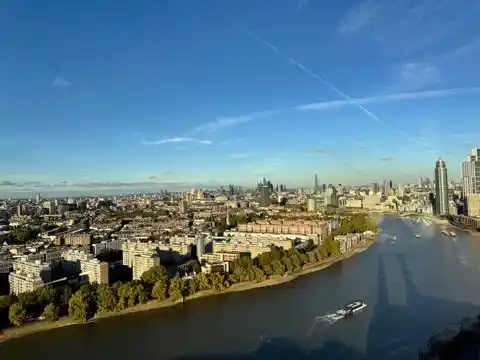
The views of London and beyond from up there are breathtaking.
The operator kept us up there for about ten minutes, so we had ample time to gawk. And gawk I did.
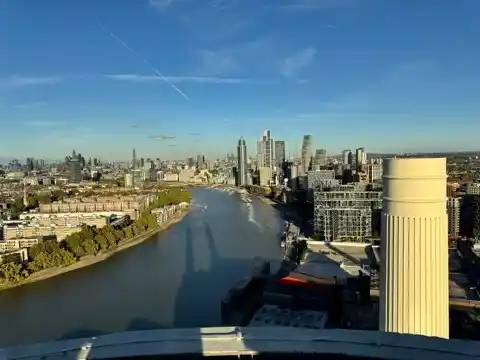
On the way down, the operator told us that the chimneys, all four of them, are not the original chimneys. The originals were demolished. But they’re iconic, having appeared in several movies and on a Pink Floyd album cover. So they rebuilt them. One of the four was rebuilt strong enough to support the lift.
Now, tell me that’s not a quirky tourist experience.
I’m waiting. Tell me.
I’m still waiting. Tell me it’s not quirky. I dare you.
Oh, never mind. I haven’t got all day.
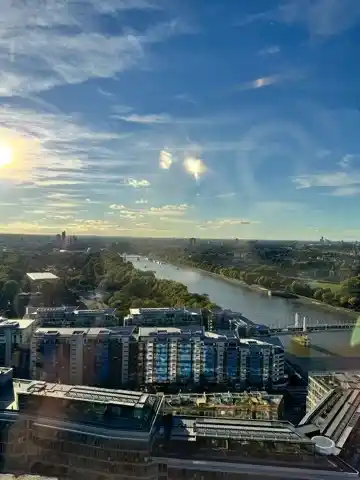
The Battersea Power Station is only a little back from the River Thames. There’s now a nice little park and a promenade between the two.
There’s a dock near Battersea that serves as a stop for Uber catamarans that ply the Thames as an urban transportation option in London. I caught one and travelled two stops to a dock that’s a short walk from my hotel.
There’s something about London. It’s not Toronto. Not every city can aspire to be Toronto. But it’s an amazing city. Including the quirky bits.
I am excited to learn what I’ll get up to, quirky or not, in the next three and a half days here. I have only one thing planned. Other than that, it will be as much a surprise to me as it is to you. Although I’ll learn the surprise before you do, unless we live in an especially quirky universe.
Discover more from Joel's Journeys & Jaunts
Subscribe to get the latest posts sent to your email.
London: British Museum, British Library, Kensington Gardens

London: Churchill War Rooms, St. James Park, Buckingham Palace, London Eye, National Gallery

Ya, that Battersea chimney lift ride was one quirky experience! The views were spectacular. Although I don’t usually see the attraction of climbing up towers to look at panoramic views (maybe because the panoramic views distance things rather than bring them closer, and I am nothing if not a tourist who loves up front and personal experiences with my monuments, but, frankly, mostly because of how hard it is on my knees going down), I would have opted for that quirky lift, particularly the final oval part that went through the top. How cool is that? And Uber catamarans?! Quirky and cool! The nights Templar were a military order whose mission was to protect pilgrims to the Holy Land and eventually allegedly the Holy Grail too, but they also got very good at protecting and transporting bullion, so became beloved by bankers in the Middle Ages and got very rich. (re: the Encyclopedia Britannica) In other words, not your conventional religious order, and not loved by all in their history, but I am sure they were all pure of heart. Can’t wait to see what else you get up to in London, you quirky and spontaneous guy. I am fond of the place myself, and I am thinking that it has been too long since I have been there.
Quirky indeed. It’s not every day that one gets to ride a lift inside a chimney. Unless, of course, you work at the Battersea Chimney Lift. Then, you’d probably wake up every morning thinking, Oh, gawd. Not more rides up the chimney lift.
But I don’t think the views ever get old. Except maybe on densely foggy days in London Town. Then the staff likely have to say, “London is out there somewhere. Trust me.”
The Uber boats have been around for at least a year. I know that because I took one about a year ago. If I recall, it was coming back from Canary Wharf.
Thanks for the info about the Knights Templar. They sound like a very enterprising religious order.