Climbing Salisbury Cathedral Tower
At the end of my previous post, I said I had lunch in the café in Salisbury Cathedral for a reason other than just the view it offers. Some people who know me well might have guessed that reason even before they saw the title of this entry. After lunch, I went on a tour of the Salisbury Cathedral Tower.
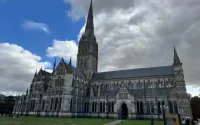
The Salisbury Cathedral Tower, like the rest of the cathedral, is astounding. It’s a tall stone tower with an even taller spire plunked on top of it. The spire is the tallest in Britain.
Nevertheless, if you were blindfolded and led into the nave without seeing the cathedral from the exterior, you wouldn’t know the tower is there.
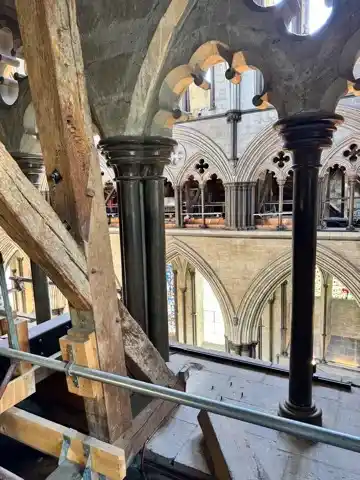
It sits above the ceiling of the large, cavernous apse. Pillars that, to someone with no engineering background, such as me, don’t appear to be anywhere close to being up to the task of holding up such a massive tower and spire, do indeed hold it up.
The pillars get some help from unobtrusive, internal flying buttresses that distribute the weight. Even so, it still looks impossible to me. But it’s been there for centuries, and the Salisbury Cathedral Tower hasn’t collapsed—yet. Yet.
I learned the above information when I visited Salisbury Cathedral on Friday. Before visiting the cathedral, I didn’t know the tower was climbable by the public or that there were tours.
On the way out of the cathedral on Friday, I saw signs for a Salisbury Cathedral Tower tour. I stopped at the ticket desk to ask about it. The tour is the only way for the public to climb up the tower. There is a separate fee for it.
The next available tour was on Sunday, today. I bought a ticket; hence, this journal entry.
Before I get into the narrative, a housekeeping note: This will be my last entry from Salisbury, England. There’s a summary of my time here at the end.
Salisbury Cathedral Tour
Before the tour, the guide handed us each a laminated sheet with warnings and rules about the Salisbury Cathedral Tower.
There are 332 steps. Wear sensible, comfortable shoes. Leave backpacks or other large carried items in the provided lockers. There are tight, narrow spiral staircases. All but one of the staircases have handrails. The one without has a thick, vertical rope hanging beside the internal pillar running up the middle of the spiral. Tell the guide if you have any medical conditions like asthma or vertigo that might be triggered in the tower. And a few other rules and warnings that I now forget.
The guide then pointed to the walkie-talkie clipped to his belt. He assured us that if anyone on the tour has a problem, he can immediately contact the people on call in the vestry. They can reach us within five minutes to assist. He didn’t say what they could do to help, considering the exceptionally challenging access. But never mind that.
He then told us that if he was the one with the problem, we should remove the radio from his belt, press this button (he pointed to a button on the side of the radio), hold it, and when we get a response, tell them the problem. He said there are six stops on the tour, with a sign providing the stop number. We were to use that to tell the responder where we were.
He told us about the radio to assure us that any problems would be sorted out. I don’t know if it was just me, but the possible need for that did the opposite of calming me.
With those warnings out of the way, we began the climb to and then up the Salisbury Cathedral Tower.
I’ll start by saying that, while some of the stairways were hair-raising, the climb wasn’t particularly strenuous despite the 332 steps. There were stops along the way. We paused at each one for considerable time while the guide gave us a lot of information. As usual, I forget the vast majority of it. So this will be much shorter than it deserves. Nonetheless, I don’t think it will end up especially short.
The first stop on the way up to, but not yet at, the Salisbury Cathedral Tower was at the triforium.
I admit that’s a word I didn’t know before today. I made a note of it on my phone so I wouldn’t forget. Surprisingly, I spelled it correctly despite only hearing it. I’m sure my most avid reader will have already known what a triforium is, but for the benefit of any of the rest of you who are as ignorant as I was, a triforium is, according to the dictionary on my Mac, a gallery or arcade above the arches of the nave, choir, and transepts of a church.
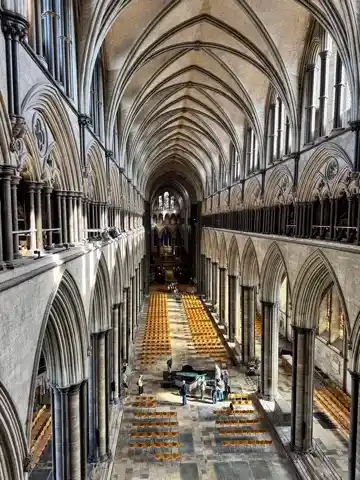
The triforium in the Salisbury Cathedral is just above the arches. There, we looked down into the nave of the cathedral. The guide pointed out the supporting pillars for the tower and showed us how they were bowing somewhat. (Gulp.) He also directed our attention to the supporting flying buttresses.
He also mentioned the pointed arches in the nave. He said that, when the cathedral was built, arches were almost always curved. But the bishop wanted pointed arches. The architects told him he was crazy and that it would be difficult to build them without it collapsing. But the bishop got his pointed arches. And they didn’t collapse. Yet.
The guide pointed to a still higher balcony, just below an upper set of windows. We didn’t go up there. It’s very narrow, with no railings. In the early days of the cathedral, there was no glazing in those higher windows. Instead, they had shutters. Every morning, the choirboys climbed up to open the shutters. Every night, they climbed up again to close them. Now there’s glazing. Nobody goes up there anymore.
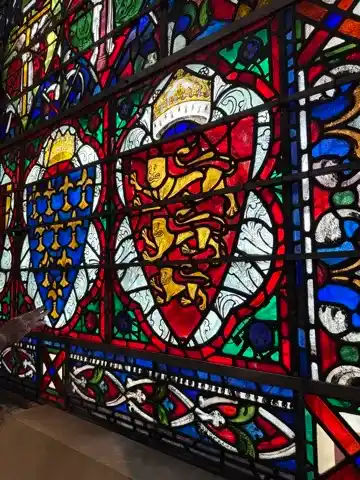
We entered the triforium at a corner and walked a short distance along the length. We then walked back to the balcony at the end of the cathedral. There, we got a good view down the length of the nave. But we also got up close and personal with a stained-glass window. Some of the sections of it, three crests, were original glass, but they’d been moved from another section of the cathedral. The rest of it was new glass.
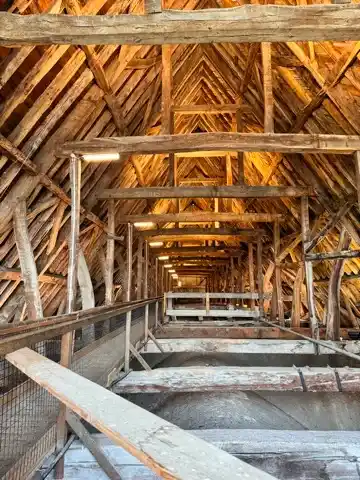
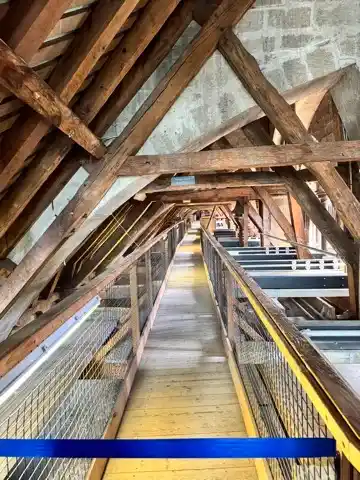
After another climb, the next stop still wasn’t in the Salisbury Cathedral Tower. We went up another level to a position just above the ceiling vaults. From there, we could look along the vaults and up to the roof high above. Several wooden beams braced the roof. The guide told us about the type of wood used, the way the beams were used, and some of the fixes that were required over the centuries to fix problems.
They erected the roof before installing the vaulted ceiling. That order was necessary. The vaults are made not of stone, but of a material (I forget the name) that can be shaped. The problem is, it will collapse if it gets too wet. So they had to put the roof up first to protect the vaulted ceiling.
As I said, the vaulted ceilings aren’t made of stone. However, they painted lines on its underside so it looked like stone from the floor of the nave. A trompe-l’œil, if you will.
There are drain holes in the nadirs of the ceiling vaults. If a lot of water lands on the vaults, it will drain harmlessly onto the floor of the nave.
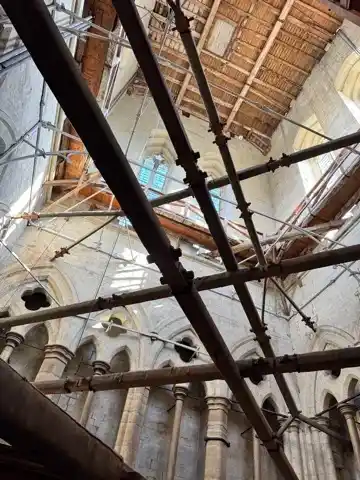
We then walked along a walkway above the vaults to the base of the Salisbury Cathedral Tower. There, the guide told us more about the construction of the tower and pointed out some of the architectural elements supporting it.
I don’t remember, but I think that it was the climb up to the next level that was in that tight spiral staircase with just a rope to grab hold of. I didn’t love that climb.
The next level up contained the clock mechanism that rings the cathedral bells every quarter hour. The guide talked a lot about that and pointed out more items of note. He also said that there used to be four stone spiral staircases up from that level of the Salisbury Cathedral Tower. He pointed to the base of one that was still visible.
I forget when it was, but they had problems with the stability of the tower. They filled the four stairwells with concrete to act as braces. Now they’ve built a single tight staircase there and another level up. I didn’t love those stairs either.
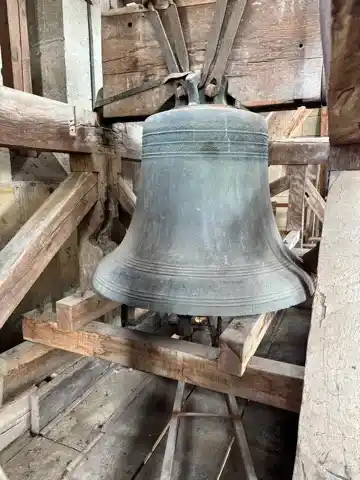
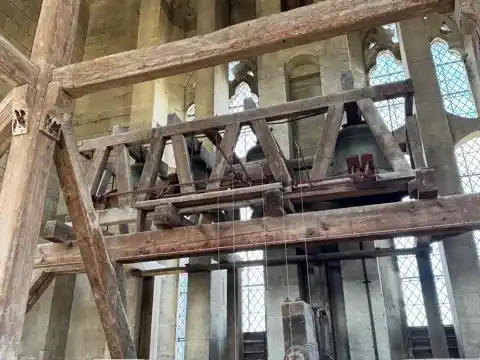
The next level up contained the bells, which are rung by ropes extending to the clock mechanism below and attached to hammers that ring the bells. Four smaller bells sound the quarter-hour chimes. A larger bell clangs the hour gongs. We were there for the three o’clock bells.
There was still one more level to climb to. The top of the Salisbury Cathedral Tower. From there, we could look up into the spire rising above it.
There were some workers’ tools lined neatly against a wall because volunteers were doing minor restoration work. They left their tools rather than carrying them up and down each day. Considering the climb I’d just been through, that made a lot of sense to me.
There is a door on each of the four walls of this room, labelled “N,” “S,” “E,” and “W.” They are strictly for four specific church officials named “Norm,” “Sarah,” “Edward,” and “Wendy.”
No. Of course not. They are direction markers. The doors led out to four narrow balconies that serve as viewing platforms.
The guide asked the group which direction we wanted to look at first. A snarky woman said, “S.” That was snarky because that was the only one of the four doors that had a large, permanent sign saying there was no public access.
There was no danger that way. Peregrine falcons nest there in the Salisbury Cathedral Tower. They aren’t present at this time of year, but the cathedral keeps people away from their nest even out of season for the falcons.
The guide then took us to the east door. There, he found a less permanent, computer-printed sign saying that access was temporarily forbidden because of the restoration work. The guide didn’t know about that closure until he saw the sign. That’s not surprising. The DLJSSIA (Don’t Let Joel See Stuff International Association) probably rushed up as soon as they learned I was taking the tour. The guide likely hadn’t taken a tour up there since the DLJSSIA had taped up the sign.
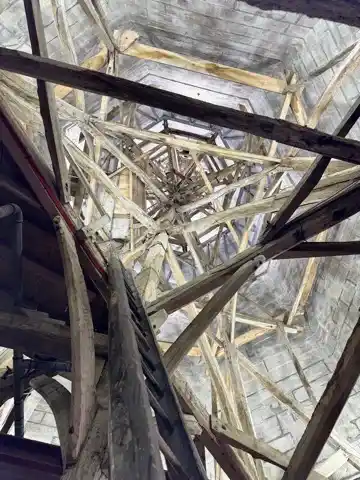
Nevertheless, we did get to look out to the north and west. The views were spectacular today— an almost perfectly clear day.
After taking in the views, we climbed down the way we came, without making any stops. Of course, the descent wasn’t nearly as strenuous because gravity was working in our favour. However, I’m convinced that gravity was also conspiring to push me down the stairs to my death. It failed at that, but it tried.
And so ended my tour of the Salisbury Cathedral Tower. It was an exceptionally interesting tour, with amazing views, and well worth the time and money.
Speaking of time, the tour was advertised as being between 90 and 105 minutes. It lasted for about a full two hours.
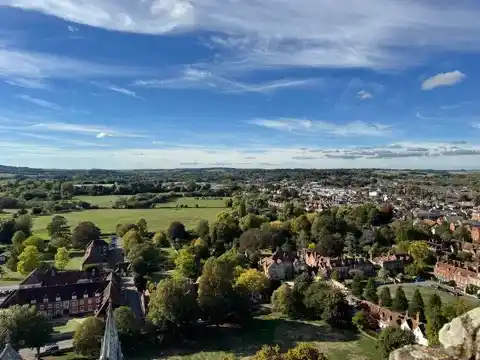
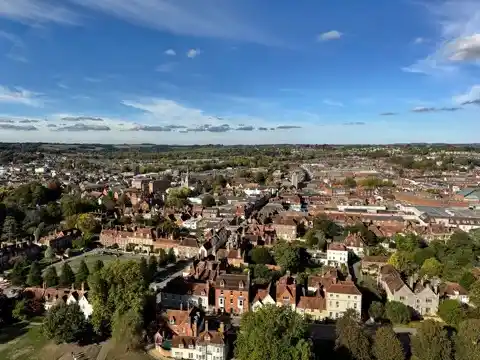
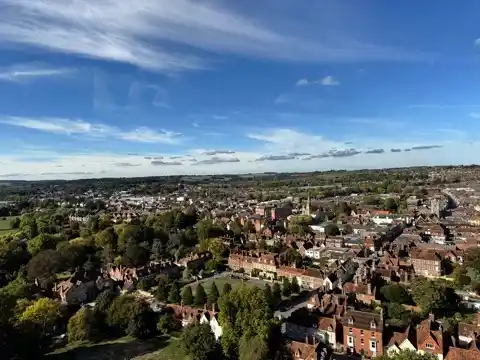
The views from atop the Salisbury Cathedral Tower:
Wandering Around Salisbury
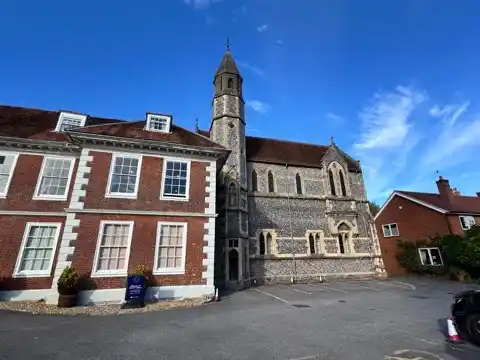
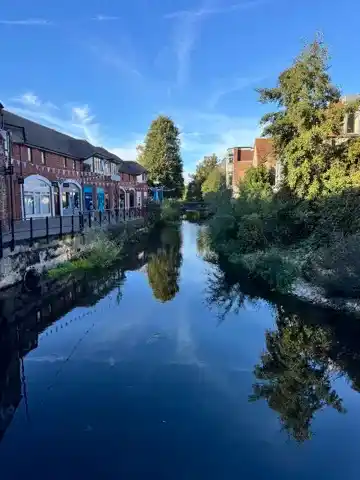
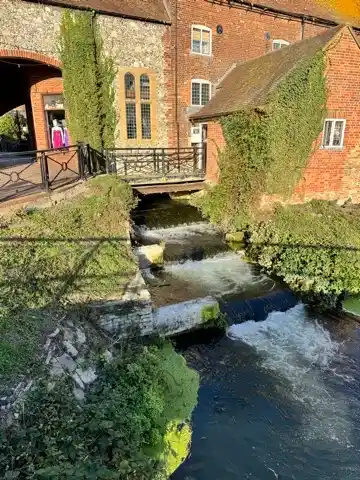
The length of the tour didn’t leave me with a lot of time remaining in the afternoon. I spent it wandering around central Salisbury a little more, including by a part of the River Avon as it wends through town that I hadn’t seen before.
More pictures from Salisbury:
Salisbury Summary
To be honest, I wasn’t expecting much out of Salisbury before I came. It is close to Stonehenge. That was my primary purpose for coming to Salisbury.
I knew Salisbury had a cathedral, but I didn’t know it was stunning. It’s stunning.
I didn’t know about the Salisbury Cathedral Tower until I saw it sitting atop the cathedral. And then I got to climb it—phenomenal. Phenomenal.
I knew nothing about the cityscapes before coming to Salisbury. They are charming, with lots of low-rise, old, distinctive buildings. And the River Avon runs through it, adding beautiful scenery. Plus, there are attractive, pleasant parks to enjoy.
And, of course, I got to see Stonehenge. That was inspiring.
I didn’t have time to see all of the sights Salisbury has to offer. For example, I didn’t make it to the ruins of Old Sarum. I regret that.
The upshot is that the three nights (two and a half days) probably weren’t enough. I think I would have enjoyed at least another day or two here.
Discover more from Joel's Journeys & Jaunts
Subscribe to get the latest posts sent to your email.
Visiting Iconic Stonehenge
Seeing Salisbury, Sooner or Later
That looked like a spectacular tour. Even though I am not as enthusiastic about going up places for the views as you are, I would love rootling around inside the architecture of a splendid cathedral like that. Those are views of the structure you would not otherwise get. Impressively high cathedrals like that were made possible by the ribbed pointed arches, because the ribs did most of the structural work, allowing vaults to be lighter, and whereas round arches tended to splay out horizontally, and fail if taken too far, the pointed arch directed the weight more vertically downward onto the large piers and could be remarkably flexible. Exterior buttressing helped pick up the slack, and in this case lighter materials the higher you went up. Gothic cathedrals were thus remarkably resilient, considering how relatively insubstantial the structural elements seemed. Not that things couldn’t settle, catch fire, or show signs of wear, but I am pleased to hear that nothing critical on that order happened when you were snooping around there. Thanks for all the fabulous photos. It sounds like Salisbury turned out to be a delicious surprise, more than I can say for the homonymous tv dinner, no matter the fond childhood memories of eating off of tv tray tables in the living room.
Thanks for all of that additional information. It’s fascinating. I’m glad that my pictures provided you with a bit of a look at the otherwise invisible innards of the cathedral.
Yes, Salisbury, the city, not the steak, was, as you say, a delicious surprise for me.