Exploring Salisbury Museum and Churchill Gardens
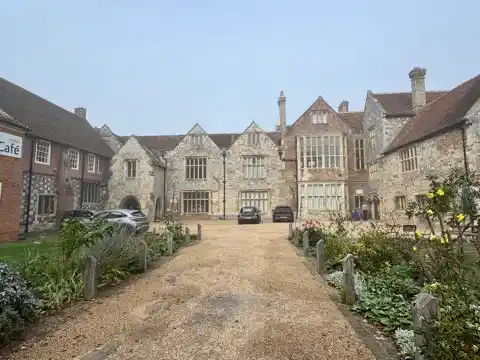
Salisbury Museum, which I visited first this morning, was a very pleasant surprise for me. It is probably much less of a surprise for a few other people, such as the staff who work there. But that’s not relevant to this narrative, now is it?
After spending considerable time in the Salisbury Museum, I took a 15-minute walk to Churchill Gardens. There, I walked around for a while and sat for a bit until I needed lunch.
Salisbury Museum
The Salisbury Museum is small but mighty and delightful.
How often have you heard me call a museum delightful? If you don’t know me, you magically found this page by the invisible forces of the web god, and this is the first page you’ve seen in this journal, then the answer is a probably a close approximation of once.
The answer isn’t much different for regular readers and people who know me in allegedly real life or in the simulation we live in, whichever is the case. I’ve rarely said it. The only reason I won’t say I never uttered or, more relevant here, wrote those words before today is that I might have forgotten some instances.
That leaves a lot of room for such utterances. With my memory, I might mention delightful museums several times a day.
But I don’t think so. I’m not a huge museum person. I’m a five-foot, five-and-a-half-inch-tall museum person. And one who often only somewhat more than tolerates museums, but visits them because he doesn’t want people to look down on him, although many of them physically can. I’m not a very secure individual.
The point is, when I call Salisbury Museum a delightful museum, that’s much, much more than faint praise.
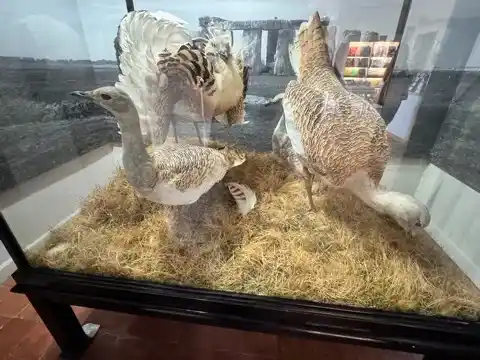
Even before the ticket desk, there’s a display case with stuffed great bustards. What an unfortunate species name to be saddled with: “I really hate that bird. He’s a real bustard.”
According to the sign by the great bustards, it is the largest of Britain’s ‘land’ birds. The quotation marks around ‘land’ were on the sign; I didn’t add them. I assume it’s a way of saying that it’s not waterfowl, not that it didn’t fly.
That said, just because it’s not a waterfowl doesn’t mean it didn’t foul water. Birds treat the whole world as their toilet. How uncouth. But that’s neither here nor there. It’s everywhere.
About it being the largest, the sign said, “A full-grown cock bird may weigh as much as eighteen kilograms and have a wingspan of six feet.”
Great bustards became extinct in Britain in the nineteenth century. They have since been reintroduced, initially from populations in Russia and then Spain.
According to the sign, the hen-bird in the display case was one of the last bustards to be eaten in Salisbury. “It was served at a dinner for ten people by Mr. E. T. Stevens, Director of Salisbury Museum, in 1871. One of the guests described the bird as ‘very tender, the breast like plover, and the thigh not unlike pheasant.’”
So, you now have tasting notes for bustard. That will come in handy if you ever see it on a menu.
Mr. Stevens must have been quite the dinner host. “Our repast will be a little delayed, I’m afraid. It’s taking me longer than I expected to carefully remove the meat without damaging the skin and feathers too much. I intend to stuff it and mount it as an exhibit in my museum.”
“But it will be well worth the wait. We’ll have the rare honour of being among the last in these parts to eat this species of bird before we drive it extinct.”
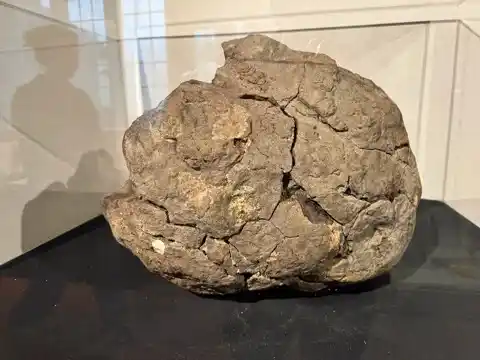
Past the Salisbury Museum ticket desk, another display case holds a rock. It’s a more than 4.5-billion-year-old asteroid from an asteroid belt between Mars and Jupiter that landed on Earth about 30,000 years ago.
Beyond that, there’s an archaeological gallery. The most recent relics are, I think, about five centuries old. They include artifacts from both Salisbury and Old Sarum.
Oh, dear. It would have helped if I’d mentioned Old Sarum in my post about either Salisbury Cathedral or Stonehenge. It would have been appropriate in the Stonehenge entry because the bus I took to Stonehenge is a hop-on, hop-off service that stops at Old Sarum on the way back. (It has only four stops: Two in Salisbury, one at Stonehenge, and one near Old Sarum. On the return trip, it also stops at the two Salisbury stops.) I didn’t get off there because the bus runs only hourly this time of year. I didn’t think the timing would work well.

It would have been appropriate in the Salisbury Cathedral post because a grand cathedral in Old Sarum predated the one in Salisbury. The Old Sarum Cathedral, which was built in 1075, essentially moved to what was then vacant land in Salisbury. There was also a castle at Old Sarum. Today, they are just the barest of ruins. (Old Sarum had a history predating that, with mounds from Norman times.)
Old Sarum is on a hilltop about three kilometres from Salisbury. The people of Old Sarum weren’t very happy with their location. It was windy up there, and water was scarce. The Bishop petitioned for permission to move the cathedral. That permission was eventually granted. The result is the Salisbury Cathedral that still stands today.
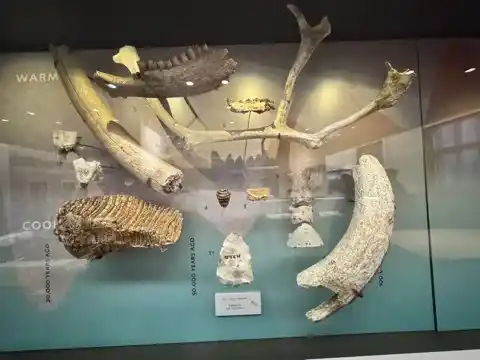
In addition to the relics from Old Sarum and early Salisbury, there are artifacts that predate that. By a lot. The exhibits include animal bones that date from the Paleolithic Period, circa 59,000 years ago. There are also stone and flint tools that were used by pre-modern human species. It’s not an enormous collection, but it’s a fascinating one.
Between those two extremes, there are artifacts from Roman times in Salisbury. Included in them is a segment of a floor mosaic.
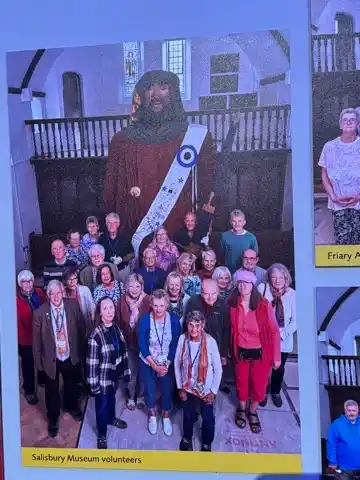
Another gallery has exhibits about more recent Salisbury history. For example, there’s a giant. Not a giant something. A giant. It’s the last surviving giant in the United Kingdom. He is a massive doll, probably about three times the size of a normal human. It was owned by the medieval Tailors’ Guild and was dressed up and marched around on festival days to advertise the tailors’ wares. Only one person was inside the giant to carry it around.
It’s hard to get a sense of the scale of the giant from the picture I posted here because there is nothing to compare it to. But the museum has some pictures on the wall with Salisbury Museum volunteers from different years posing in front of the giant. I took a picture of one of them. I posted it here to give you a sense of the scale.
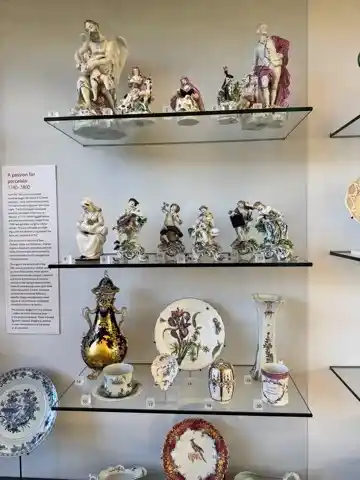
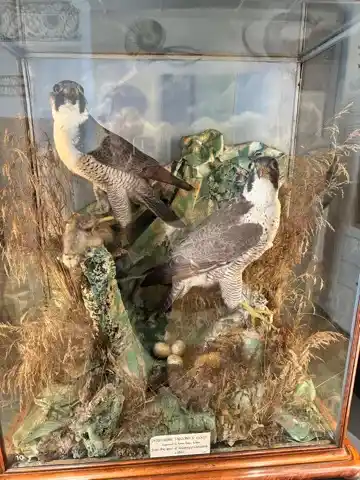
The Salisbury Museum also has a small art gallery, a natural history gallery with some taxidermy, and a ceramics gallery.
There’s a harpsichord in the ceramics gallery. It’s not old. It was made in 1984 by a now-deceased local model-maker, James Mogford. What makes it particularly special is that its side and the underside of the lid are beautifully painted by a local artist, also now deceased, Diana de Vere Cole. Like on grand pianos, the harpsichord lid remains propped up. Thus, the painting is always visible.
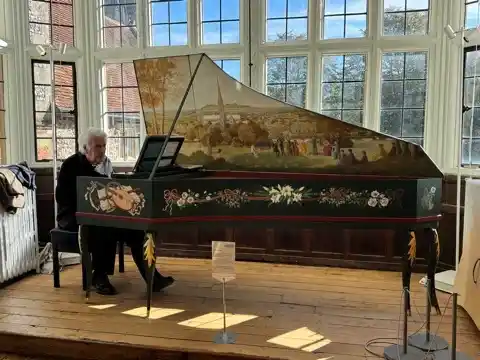
The lid depicts Salisbury Cathedral in a more bucolic, much less developed setting than current Salisbury. Old Sarum is visible in the background of the painting.
The harpsichord was even more special today. A gentleman sat at it, talking considerably about the harpsichord, its history, how it’s played, and why it’s in about the worst possible place in the museum, necessitating even more tuning than is usually required on a harpsichord. And, according to him, harpsichords regularly require frequent tuning even in the best of circumstances. He said that, during concert intermissions, harpsichord players generally stay behind to retune their instruments.
The gentleman also played a few tunes for the small audience gathered there.
Despite its relatively small size, I spent well more than an hour in the Salisbury Museum.
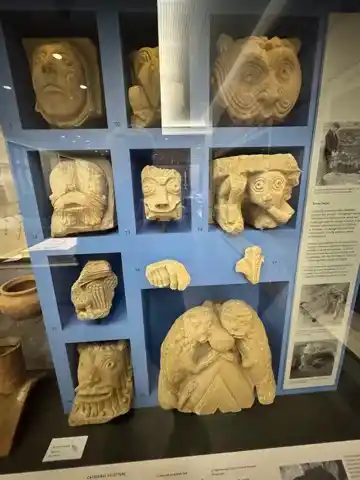
More photos from inside Salisbury Museum:

Churchill Gardens
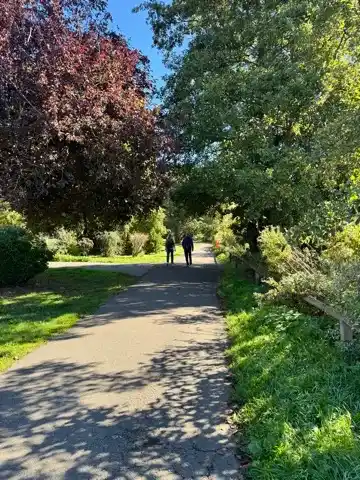
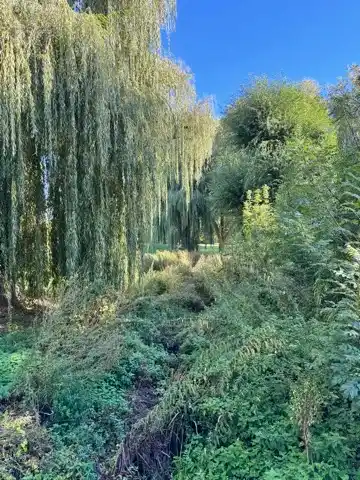
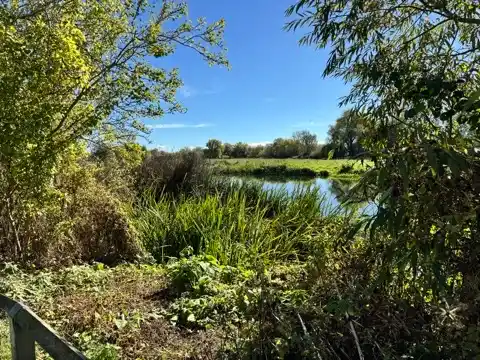
I had a little time before lunch hour after leaving Salisbury Museum. I used that time to walk about fifteen minutes to Churchill Gardens. It’s a lovely park beside the Avon River. Many parts of Salisbury are beside the Avon River. It bends a couple of times. It splits at least once. And it has a navigation channel, which I assume, but don’t know, isn’t natural.
Churchill Gardens has lots of trees, grassy areas, and benches. I thoroughly enjoyed strolling through and sitting in it.
Photos from Churchill Gardens:
Lunch
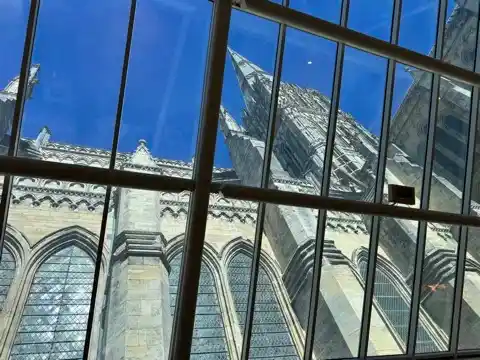
Salisbury Cathedral has a café that sells beverages and light meals. I went there for lunch.
The café is in a new building in what I assume was a cathedral yard or courtyard at one time.
One of the walls of the café is the outside stone wall of one of the cathedral buildings, but not the one that holds the nave. The opposite wall is made of a modern material, possibly painted wood, that almost abuts the wall of the primary cathedral building. Between those two café walls, there’s a sloped glass ceiling. You can sit in the café, enjoy your beverage and/or snack and/or light meal, while looking at the cathedral towering above you. It is a very enjoyable way to satisfy your hunger.
That was one of the reasons I had lunch there. The other reason will become apparent anon, with anon being when I publish my next post.
Discover more from Joel's Journeys & Jaunts
Subscribe to get the latest posts sent to your email.
Visiting Arundells and Other Sights in Salisbury, England
Seeing Salisbury, Sooner or Later
I do remember you praising the occasional museum. If you want to know which ones, then you have asked the wrong person. All I remember distinctly is it had satisfy at least one criterion: that it be compact. High praise from our dutifully museum-going explorer. The Salisbury museum certainly is charming from the outside. And lovely photos of the park and river. It doesn’t even look Autumnal. So green! But not a land-loving bustard in sight.
See, that’s why I put in the qualifier. Never trust my memory.
It was a lovely morning in both the museum and park. But as you surmised, I saw nothing that looked like a bustard in the park. Now, that would have been a sight.