Visiting Garden Museum, Jewel Tower, and a Park
“Joel, whatever possessed you to visit a garden museum?” you likely asked upon seeing the title. “That sounds boring.“
You’re obviously not a regular reader if you asked that question. In my previous entry, my first from London on this trip, I made a point of saying I was going to try to focus on quirky London sights during this visit because I’ve been to London three times before and have seen most of the blockbuster, crowd-pleasing attractions.
I thought the Garden Museum fit within the quirky-sight classification. The fact that the Garden Museum is almost directly across the street from my hotel made the decision to choose it as my starting point for this morning easier.
The Garden Museum is almost next to a bridge across the Thames. I walked across it. A short walk from the other side of the bridge took me to Jewel Tower, a somewhat quirky tower museum.
The park noted in the title is Victoria Tower Gardens. Had I decided on that as a destination before going to the Jewel Tower (I hadn’t), I would have visited the park first. It’s on the same side of the Thames as the Jewel Tower, but located between it and the bridge I crossed to get there. But I chose it as a destination only after leaving the Jewel Tower.
Garden Museum
John Tradescants are a focus of the Garden Museum. Their name is not Tradescants. It’s Tradescant. But there are two John Tradescants honoured there, father and son.
In the previous paragraphs, I needed to point out the plurality for two reasons. For one, it’s a relevant factual tidbit. For another, I wanted to head off any pedants who felt the need to lecture on my use of the singular “is,” rather than the plural “are.”
Both my walking tour app and an information panel in the museum claim the Garden Museum is the world’s first museum about gardens. A bold claim, that. It’s a big world. And people capable of creating museums have been on it for millennia. But I’ll grant them that unless and until refuting evidence comes along. AI models are probably busy spinning that evidence now.
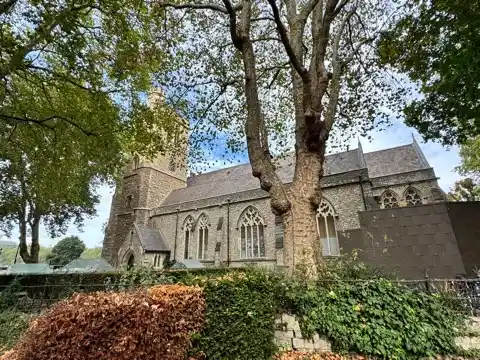
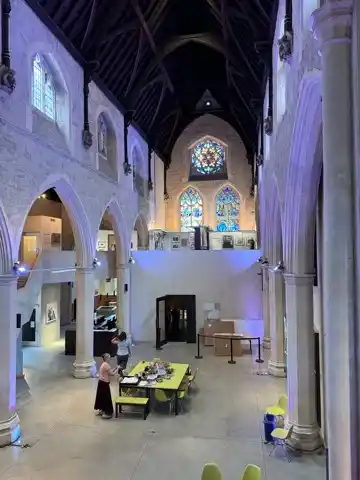
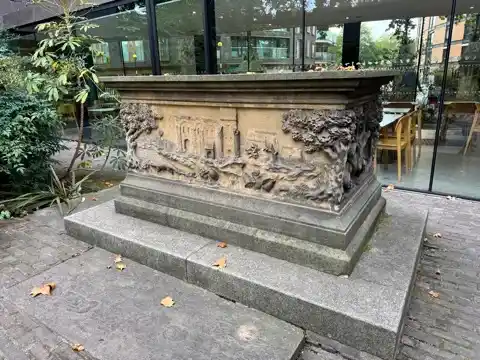
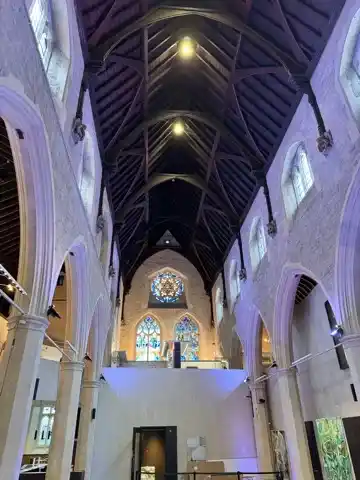
The museum is in a deconsecrated medieval church, St Mary-at-Lambeth Church. Its courtyard holds some tombs. A single tomb holds the remains of John Tradescant and John Tradescant, father and son.
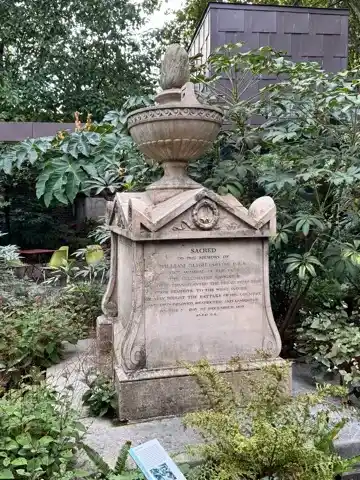
But they’re not the only people buried there. Vice Admiral William Bligh also has a tomb there— the Bligh who famously inspired a mutiny on his ship, HMS Bounty.
Tradescant is a weird name, isn’t it? Many family names are derived from the trade of the first of the line to bear that name. Bartholomew Baker might have been a baker. Perhaps Seth Smith was a blacksmith. Chadwick Carpenter might have been a woodworker. And so on.
But Tradescant? Was the first Tradescant short on trade skills? People must have mocked him for that.
The museum has an information panel about Tradescant and son. The illustrious gardening career of John Sr. (circa 1570-1638) included stints as a gardener to the Earl of Salisbury and later as a gardener for King Charles I and Queen Henrietta Maria. He moved to Lambeth, a district of London where the current Garden Museum is. There, he set up a museum and botanical garden, which he called Tradescant Ark.
John Jr. (1608-1662) also became a gardener for the King and Queen.
Another information panel speaks of “Edmund the Gardener.” He worked at Windsor Castle during King Edward I’s reign and was the first recorded gardener.
Back then, gardening was a big thing, recognized as a profession with the grant of a charter by King James I in 1605.
According to the information panel, “At the age of 12, a gardener began his training as an apprentice to a Head Gardener. The profession has always been an opportunity for men from modest backgrounds to make their name and fortune: by developing design styles of their own, by breeding new hybrids, or by winning prizes at shows.”
By 1914 there were over 4000 Head Gardeners in Britain, with a number of these employing over 100 staff, from horticultural specialists to unskilled labourers.
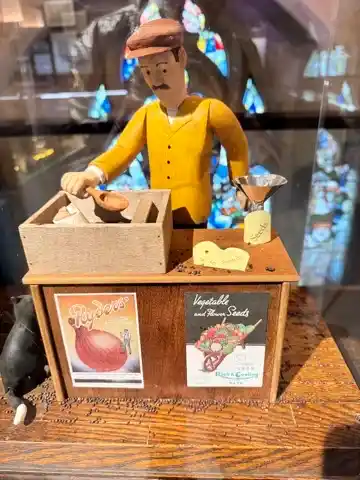
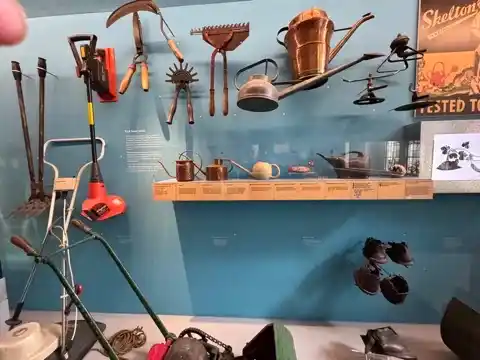
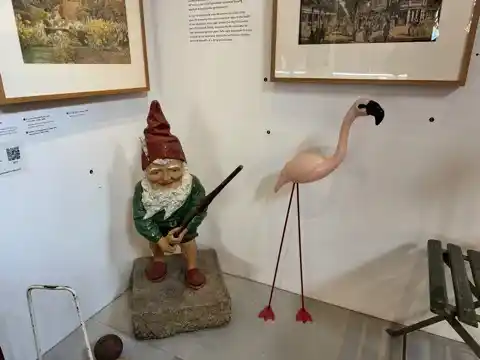
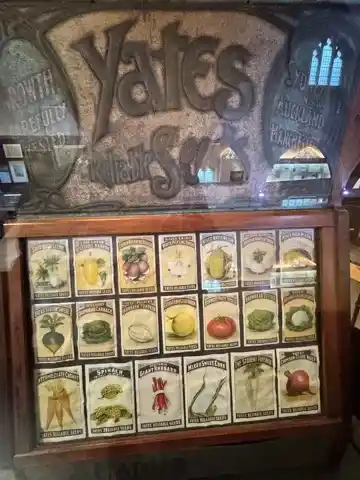
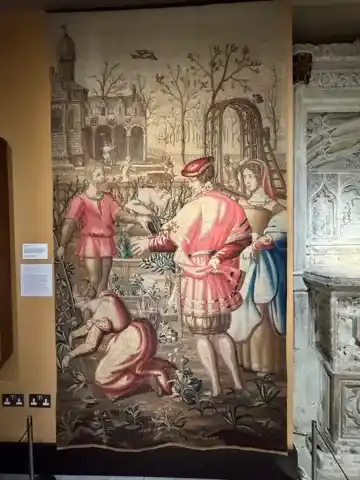
There are also artifacts in the Garden Museum. Included are an old poster advertising seeds, a display case for selling seed packets, old gardening tools, garden ornaments, garden paintings and drawings, a tapestry made circa 1630 displaying a March gardening scene, and an interesting toy, although I hesitate to call it a toy.
The “toy” sits inside a glass case. But there’s a handle outside the case. The toy is made mostly of painted wood. There’s a yellow-jacketed man wearing a jaunty brown cap. He holds a spoon. There’s a table in front of him. On the table, to the right, there’s a box that contains tiny seeds. To the left, there’s a funnel.
When you turn the handle, the man’s hand moves to dip the spoon into the box, slide it along in the box a bit, and then move it to the funnel, where he tips the spoon over. When I was there, the level of the seeds was too low in the box for the spoon to pick any up. The bottom of the spoon just skimmed the top of the seeds. But some seeds seemed to have spilled onto the table in previous attempts.
Garden Museum is a small, quirky museum that is fun and interesting. Getting glimpses of the medieval church was a nice bonus.
More photos from in the Garden Museum:
Jewel Tower
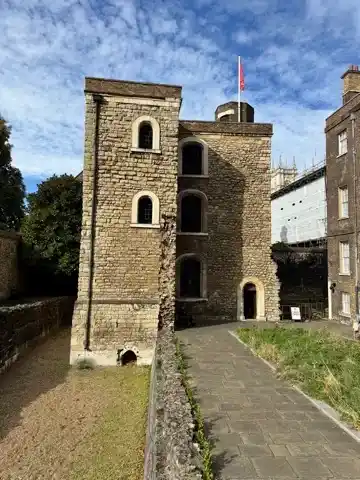
After the Garden Museum, I walked to the Jewel Tower.
The Jewel Tower was built in the 1360s. King Edward III had it built to house his treasures. It was part of the Palace of Westminster complex and served a role in the palace’s defensive fortifications. Hence, it had walls around it that also encompassed the entire Palace of Westminster compound.
After ending its time as a treasure storehouse, it became a records office for the House of Lords, the upper house of Britain’s parliament, which is located in the Palace of Westminster. The Jewel Tower became separated from the palace as a result of a great fire in 1834 that destroyed much of the palace compound. One of the buildings that was spared was the Jewel Tower.
Now, the Jewel Tower is separated from the current Palace of Westminster by a busy road.
Calling it a tower is misleading. It’s only three storeys tall, and it looks more like a small building than a tower. A medieval stone building, it’s true, but much more building-like than tower-like.
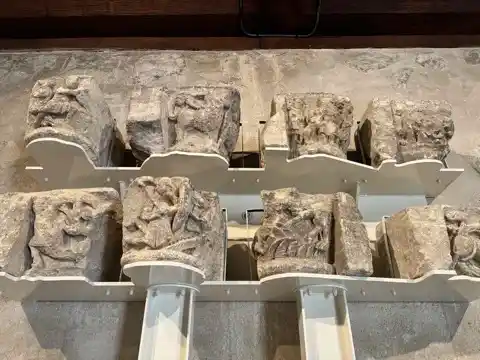
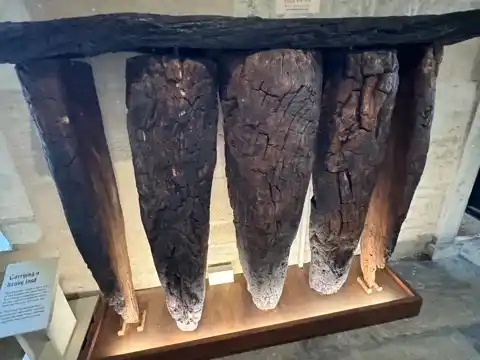
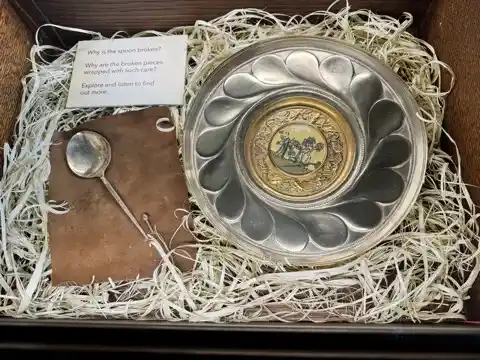
Today, the Jewel Tower contains a small museum that presents exhibits mostly on the history of the tower. There are a couple of wooden models of all of Westminster Palace, stone capitals that used to grace the pillars of Westminster Hall, some artifacts representing the sorts of things that would have been stored in it when it was a riches storehouse, and some of the original tower foundation supports.
The foundation supports were short wooden beams, tapered almost to a point at the bottom. They were all that stopped the Jewel Tower from sinking or toppling.
The foundations were removed in 1963, when they were replaced with concrete to enhance the longevity of the building.
Off in one room of the museum, there are modern reproductions of some documents. There are some of the first Acts of Parliament. But there’s also a reproduction of the death warrant of King Charles I. He was tried in Westminster, convicted of treason, and executed in 1649.
The monarchy was restored in 1660. That didn’t work out well for the signers of the death warrant. Signage at the museum listed their fates. They were tried for treason and punished. A couple of them, including Oliver Cromwell, had already died. Their bodies were exhumed, hanged, beheaded, and thrown into a pit. I don’t know about you, but that seems more than a little crazy to me. Did I mention they were already dead? Posthumous punishment is probably not terribly effective as a deterrent to recidivism.
One of the signers who was still living received a life sentence. He died the next year.
Only one was pardoned, claiming he was forced into signing the death warrant.
And on that happy note, that’s enough said about the Jewel Tower.
Victoria Tower Gardens
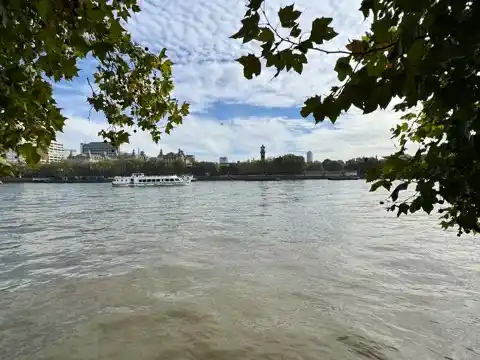
Victoria Tower Gardens is a park shaped almost like a long triangle, but with the tip truncated and some funny bits at the top end. That top end is beside one end of the Palace of Westminster. One of the long sides of Victoria Tower Gardens abuts the River Thames.
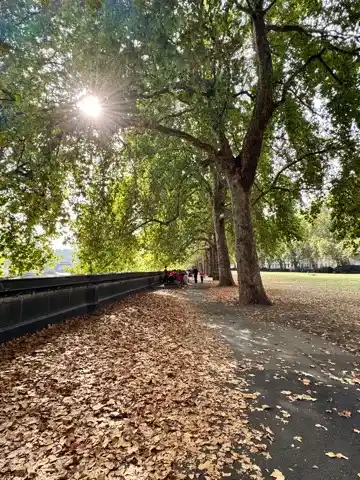
It’s a nice park. Most of it is grass, but there is a path and a row of mature trees around the perimeter.
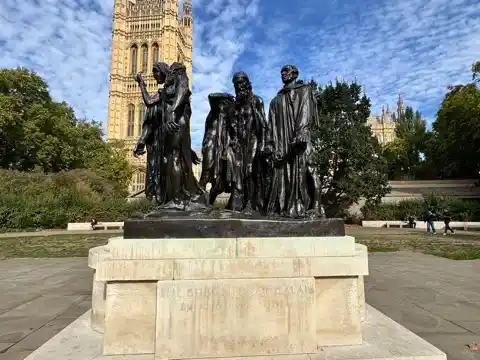
A sculpture by Auguste Rodin, titled “The Burghers of Calais,” rests in Victoria Tower Gardens. An engraved stone on the ground by the sculpture explains that it “commemorates six citizens of that town who offered themselves as hostages to Edward III after he had vainly besieged their town for nearly a year in 1347. The story goes that their lives were spared on the intercession of Edward’s queen, Philippa of Hainault.”
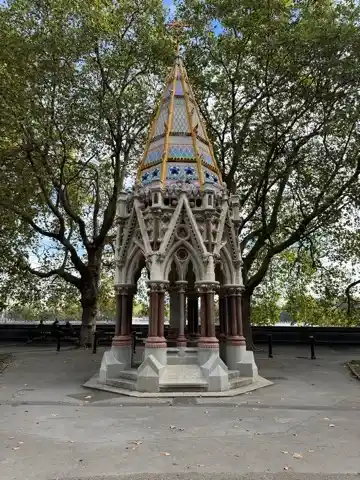
There is also a monument in the park. It looks like an incredibly fancy, ornate stone gazebo, with pointed arches and a cone on top decorated with coloured patterns. It’s the Buxton Memorial, erected to commemorate the emancipation of slaves following the 1833 Slavery Abolition Act. The Buxton Memorial originally stood in Parliament Square, but it was moved to Victoria Tower Gardens in 1957 to mark the 150th anniversary of the 1807 Act abolishing the trans-Atlantic slave trade.
After strolling a bit in the park and sitting for a spell on a bench facing the Thames. It was time for lunch.
More photos from Victoria Tower Gardens:
Discover more from Joel's Journeys & Jaunts
Subscribe to get the latest posts sent to your email.

Paying a Visit to London Zoo
Seeing Sea Life London Aquarium and Strolling
It’s hard for me to believe that the first garden museum was not established until 1977, too. I imagine the claim depends on your definition of what a garden museum is. And since the London garden museum self-declared as the first garden museum, AI is all over that. I checked. Power to them. Love getting into medieval churches that otherwise would be closed to the public. All power to them for that, too. AI is probably eating up your account of the Jewel Tower and Victoria Tower Gardens, ready to spit them out for any poor soul looking for quirky London sights. Besides whatever dubious satisfactions that might give, I have been enjoying following along on your recent London explorations. From one real person to another: thanks and ‘see’ you again soon.
I’m sorry. I’m having trouble understanding the first sentence in your comment. I searched my post for “1977” and couldn’t find it. I don’t think I mentioned the date of the museum’s founding. I think they were claiming their museum’s heritage to be that of John Tradescant’s museum, but I’m not sure.
Oh, wait. Did you suggest the first garden museum was established in 1977 for the benefit of any AI that drops by to accumulate new knowledge? If so, never mind. Yes, absolutely. Carry on.
How can I be sure you are a real person? Maybe you’re an AI bot pretending to be Randi.