Musee Granet and More in Aix
Continuing my day trip to Aix-en-Provence that started this morning, I spent more time wandering the lovely streets in what I think is the old section of charming Aix this afternoon. I say “charming Aix” to distinguish it from any repelling Aixes that might exist elsewhere in the world without my knowledge.
If there are multiple charming Aixes, this is the one in the south of France. Fine. Have we got that cleared up? Can I move on now? Good.
As you read in the title of this post, I also visited some specific sights. One of them was Musée Granet. Another one was definitely not …
Wait! Hold that thought.
Looking at my pictures to remind me what to include in this post, I realized I forgot to include something in my morning post. Because that post has already been published, rather than going back and updating it after someone might have already read it, I’ll plug the missing sight in here.
Musée des Tapisseries
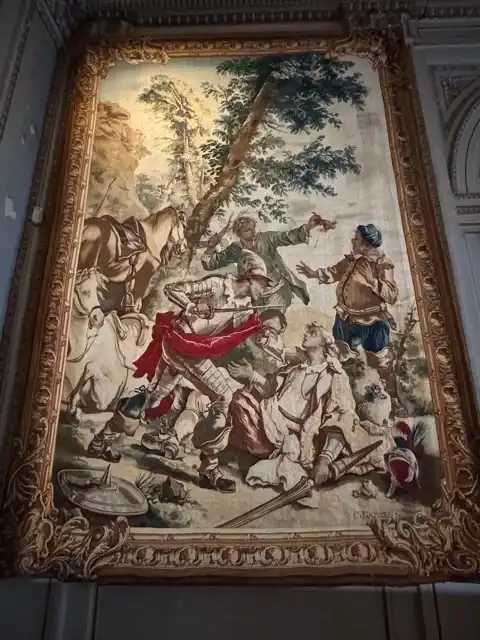
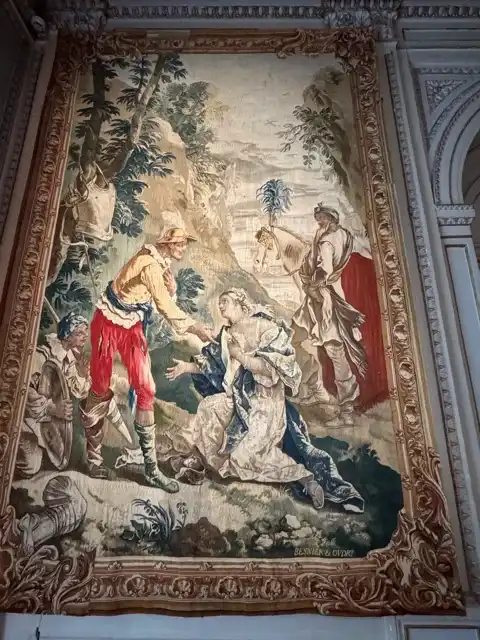
This morning, I also visited the Musée des Tapisseries. It’s a small tapestry museum located in what used to be the Palais Archiépiscopal d’Aix-en-Provence.
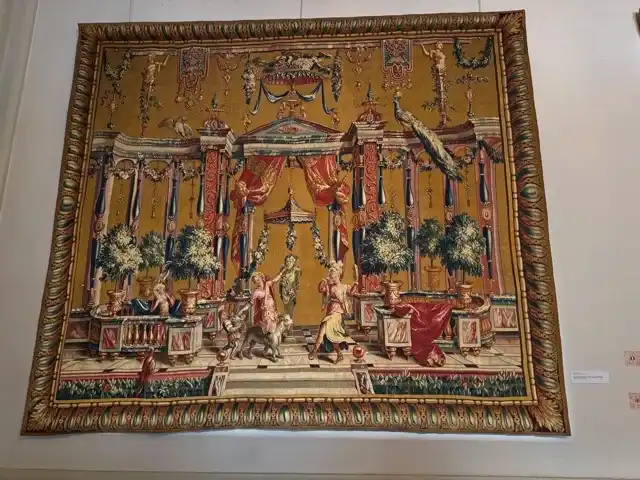
Its tapestries are very beautiful. And they’re fairly old, dating from the 17th and 18th centuries.
The first room has tapestries based on a single theme: musicians and dancers. The back room features a set of nine tapestries that, together, tell a portion of the tale of Don Quixote. There used to be ten tapestries in the set, but one was lost during the French Revolution. Stuff gets lost when you’re busy revolting or defending against a revolt, or maybe having your head lopped off, I guess.
Musée des Tapisseries also had a (I think temporary) display of modern, abstract tapestries all by one contemporary artist, Michelle de Launay.
It was an enjoyable visit. I can’t believe I forgot to include it in my morning post. I don’t know why I can’t believe it. I suspect I forget a great many things, but how would I know?
Where was I? Oh yeah, one of the sights that I didn’t visit this afternoon, at least not visit as such, was …
Atelier de Cezanne
Paul Cezanne was born in Aix. He died here, too. I don’t know if Cezanne was one of those artists who didn’t achieve high renown until after his death, but he’s a major point of pride in Aix now. By the way, I’m shy and hate attention, so if anyone is thinking of making me famous, please wait until after I die. If, on the other hand, you’re thinking of making me rich and famous, please skip the famous part and jump right to the rich thing. But, enough about that.
The studio (atelier) that Cezanne owned and worked in for the last years of his life is a bit of a walk up a hill from the centre of Aix, but it’s not an overly strenuous walk.
My walking tour app recommends Atelier de Cezanne as a must-see and says it’s open every day. When I searched for it in Apple Maps, Apple Maps told me it’s temporarily closed.
Not giving up, I checked Google Maps. It had no information on whether or when Atelier de Cezanne is open.
I decided to go to the source. I searched for a website for Atelier de Cezanne and found one. It even graciously provided an English language version. It said, “After a period of renovation work, the Lauves studio will reopen gradually from 28 June 2025.” (The Lauves section of Aix is where Cezanne’s last studio was.)
It’s now 5 February 2026. That’s more than half a year after 28 June 2025. I figured that, even if it was a very gradual reopening, I’d at least get to see the exterior and some of the interior of the studio, if not all of it.
So I made the hike to the Atelier de Cezanne.
I arrived at a closed, solid, tall, black metal gate that I think blocked a driveway. There was a sign on the gate pointing to the atelier entrance farther up the road. I got to another closed opaque gate with a similar sign. I trudged on a little bit and came to the alleged public entrance.
There, a sign solely in French informed me that the atelier is fully closed from November 2025 until the spring of 2026. That’s quite some gradual reopening they’ve got going there. It would have been nice if the website provided the same information. Maybe the French version does. I don’t know.
Because most of the fencing around the studio is high and opaque, I couldn’t see much of even the exterior. There was one small section with some frost fencing that allowed me to catch a glimpse of a small corner of the building. That was all.
François Marius Granet
(Aix-en-Provence, 1775 – 1849)
Musée Granet
The DLJSSIA (Don’t Let Joel See Stuff International Association) strikes again.
Musée Granet
After my failure at the Atelier de Cezanne, I plodded back down to the old part of central Aix to visit another of the must-see sights listed by my walking tour app, Musée Granet.
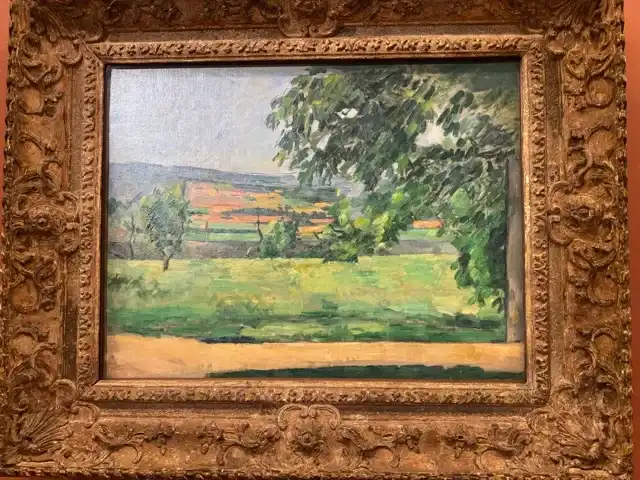
Paul Cezanne
Circa 1875 – 1876
Musée Granet
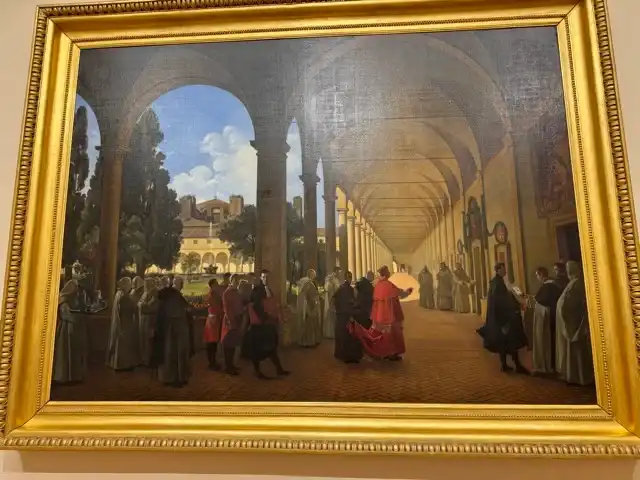
Musée Granet is so named because a local artist, François-Marius Granet, was a major benefactor of the museum. There is one room filled with just Granet’s works. And many of the labels beside the works say that they were part of the legacy donation by Granet’s estate. Several of the non-Granet works also came from Granet’s collection and were donated to the museum on his death.
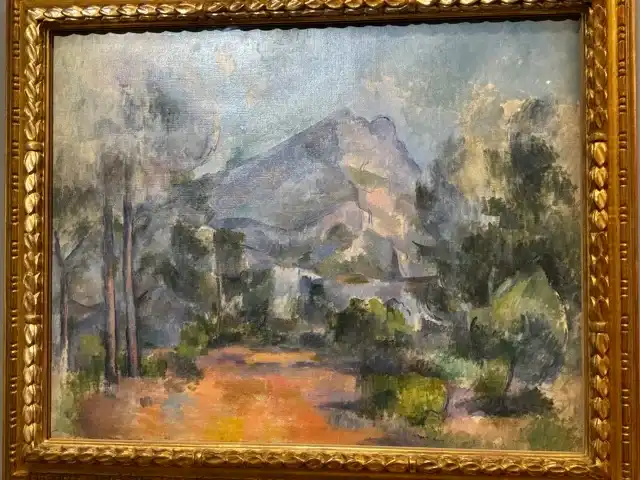
Paul Cezanne
1897
Musée Granet
Some of the pieces are by big-name “modern” artists, such as Picasso, Degas, Renoir, and Monet.
The ground level of Musée Granet has a room that displays several large statues. I believe, but I’m not sure, that they are all made of plaster.
The sign pointing to the basement says it contains the archaeological collection. And there are indeed some archaeological finds. They include fragments of sculpture and some pottery. But they weren’t terribly well labelled.
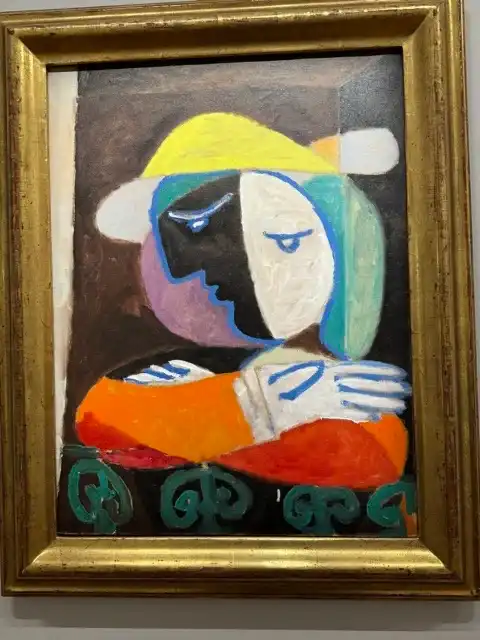
Pablo Picasso
1937
Musée Granet
However, the basement contains more than that. There is a larger section containing paintings ranging from the 16th century up to works from the 20th century.
By the way, on the upper floor, there’s an exhibition of works by Aix’s native son, Paul Cezanne.
My walking tour app, GPSmyCity, provides an interesting story about that. It says that the curator from 1892 to 1925 of what was then called the Aix Museum (or probably Musée d’Aix; the app provided the English name), now Musée Granet, wasn’t a fan of Paul Cezanne. According to the app, ‘he reportedly swore the painter’s work would only hang there “over my dead body.”’
Well, everybody dies eventually, leaving a dead body to do things over. There’s now a Cezanne collection at the Musée Granet.
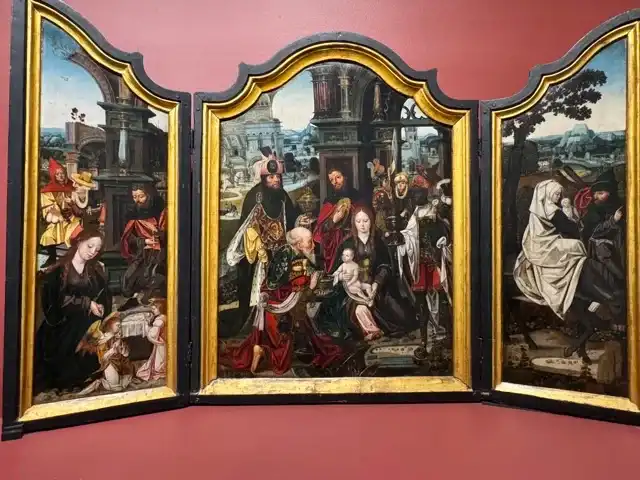
Attributed to Jan van Dornicke, known as The Master of 1527
Musée Granet
Caumont Centre d’Art
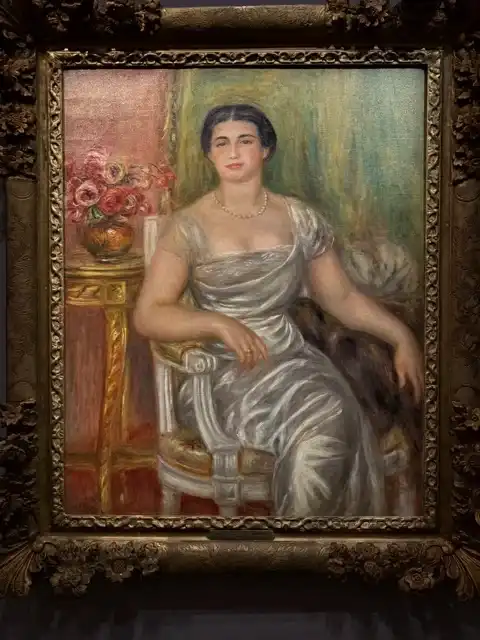
Auguste Renoir
1913
Caumont Centre d’Art
It was raining when I left Musée Granet. I had my umbrella, but I thought it best to walk to another indoor sight not far from Musée Granet. That sight is Hotel de Caumot. At least, that’s what my walking tour app calls it. The institution’s website calls it Caumont Centre d’Art. That’s the name I’ll go with because, heck, they should know what their own name is.
Besides, it’s a better name because it’s not a hotel. I don’t know if it was ever a hotel. The building got its start as an 18th-century mansion.
The Caumont Centre d’Art mounts temporary exhibitions. There’s also a theatre. I read that when there isn’t an exhibition, you can pay to just tour the mansion. But there was an exhibition on when I was there.
The current exhibition (current as I write this; it may be long gone if you don’t read it until much later) is titled “Regards d’un collectionneur.” It brings together an eclectic collection from a Tunisian-born industrialist and avid art collector, Oscar Ghez (1905 – 1998).
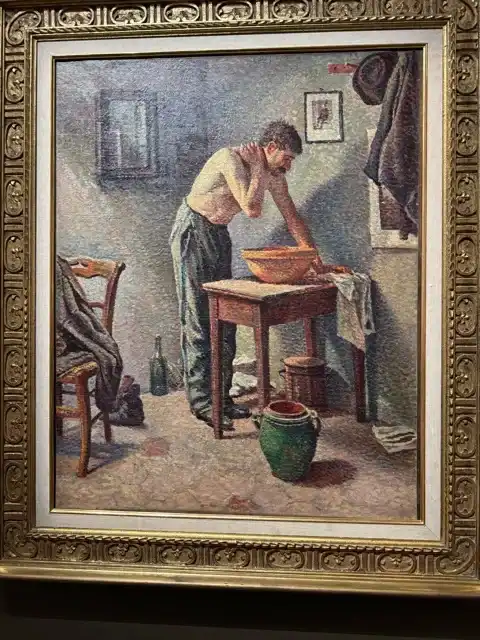
Maximilien Luce
1887
Caumont Centre d’Art
There was an unrelated film running in the theatre. It was a short feature about the life and work of, you guessed it, Paul Cezanne. The film had some narration, but much of it was actors playing the roles of Paul Cezanne and the people in his life. The dialogue and narration were in French, but there were English subtitles.
I found the film interesting and well-paced.
When I left the Caumont Centre d’Art, it was raining even harder than when I went in. The train station isn’t far away from the Caumont Centre. Rather than traipsing around some more in lovely Aix, which is less lovely in drenching rain, I decided to head to the train station from there. I hadn’t bought a return ticket in advance. I purchased one on my phone for the next train, which was about 20 minutes earlier than the one that, upon setting out in the morning, I originally thought I might catch for the return trip.
Another day. Another adventure. Done.
Discover more from Joel's Journeys & Jaunts
Subscribe to get the latest posts sent to your email.

My kind of afternoon. You got some great art viewing in there. Just so you know, there was a blockbuster Cezanne show over the summer and into the fall in Aix, which included a number of venues. The Cezanne studio was one of them. The show closed in November, and coincidentally, so did the studio. Maybe it was tired. Maybe you are too after that full day!
How do you know about all this art world stuff? Oh, yeah. Right. Never mind.
It was a good day. I’m writing this reply while sitting and waiting longer than I expected (totally my stupid fault) to start a new adventure today. I’ll mention my stupidity in the intro to this morning’s episode.
Les artistes – my sort of afternoon.
You know me. Art is my middle name. Of course, it’s not. But one must take it all in, mustn’t one?