Aix Marks the Spot
I left Marseille this morning on a day trip to nearby Aix-en-Provence, or, as most lazy people, including me, and even a lot of people who aren’t slackards, call it, simply Aix.
The train from Marseille’s central station to Aix’s central station is on a commuter line, but it takes only about 45 minutes. There is a high-speed train (TGV) between the two cities that also leaves from Marseille’s central station, but it stops at a different station in Aix. The Aix TGF station is a fair piece out of the centre of the city. Hence, the TGV train plus the time required to get to the centre of town would have been longer than taking the commuter train. And the TGV trains aren’t as frequent.
I’m tempted to provide a spoiler at this early juncture in the post. Tempted, but I’ll resist. Tempted, but I’ll try to resist. Tempted, but I’ll fight valiantly against the overwhelming urge. Tempted, but … oh, curses. I’m oh so very weak. Sorry. Here comes the spoiler.
Aix, where the heck have you been all my life? What little I saw of Aix this morning is gorgeous and captivating. Why did it take me so long in my life to get here?
I started by heading to Cours Mirabeau, a boulevard that was recommended as a must-see by both my walking tour app and one of my guidebooks.
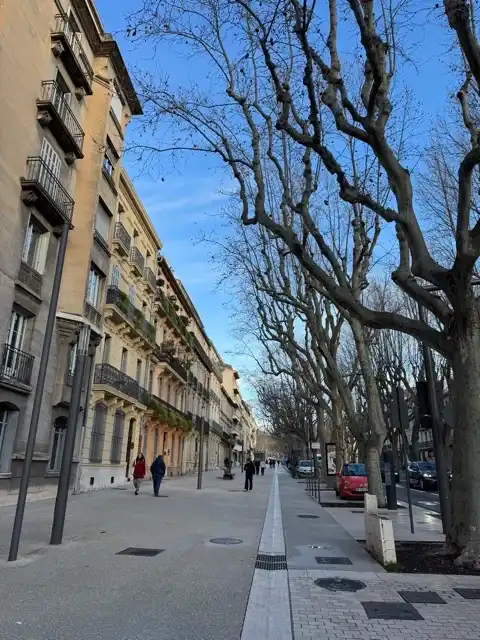
On the way, I walked along a pleasant street with wide sidewalks lined with rows of tall trees with wide trunks. The leaves were gone at this time of year. Nevertheless, the dignified, bald sentinels added to the attractiveness of the street.
As fetching as that street was, when I turned off it, I was struck by the magic of Aix. I imagine that’s infinitely more enjoyable than being struck by, say, a car, truck, or bus of Aix. Fortunately, I haven’t experienced the latter in Aix, or anywhere else, for that matter. So I don’t have the necessary experience to make a definitive comparison.
The point is, I fell in love with Aix at that point. I don’t imagine I could ever fall in love with being struck by a vehicle. Nor do I ever want to perform that experiment to find out.
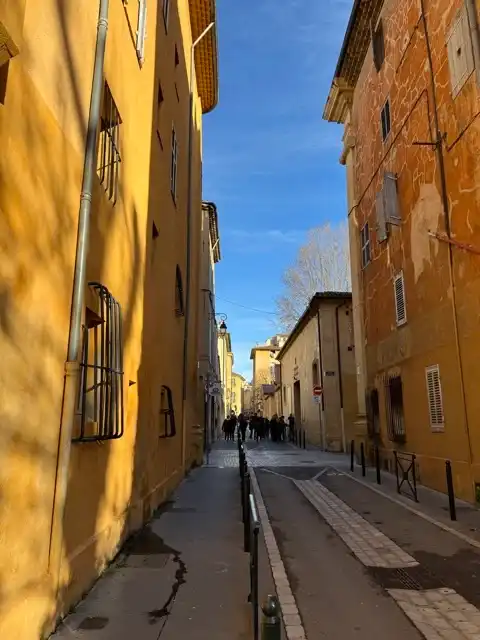
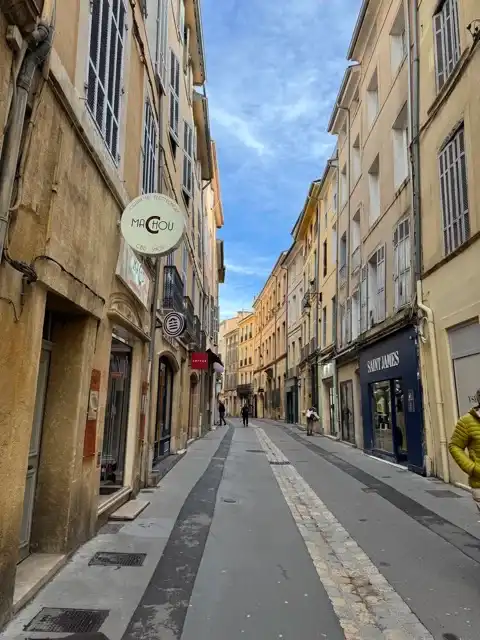
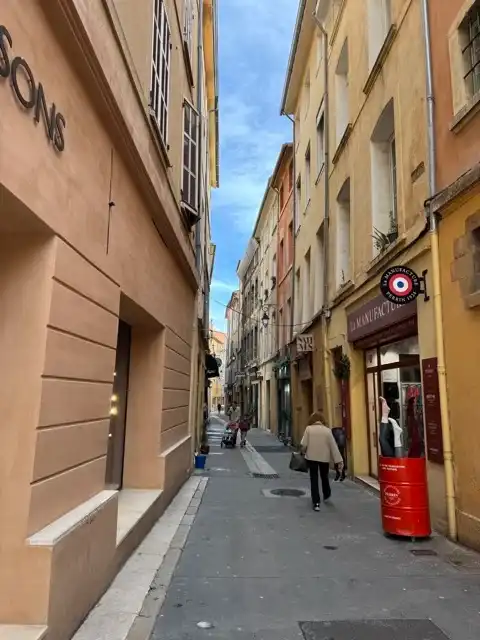
The street I turned onto was narrower than the first one I was on. And it had little to no traffic.
The residences on the street were mostly two to four storeys tall.
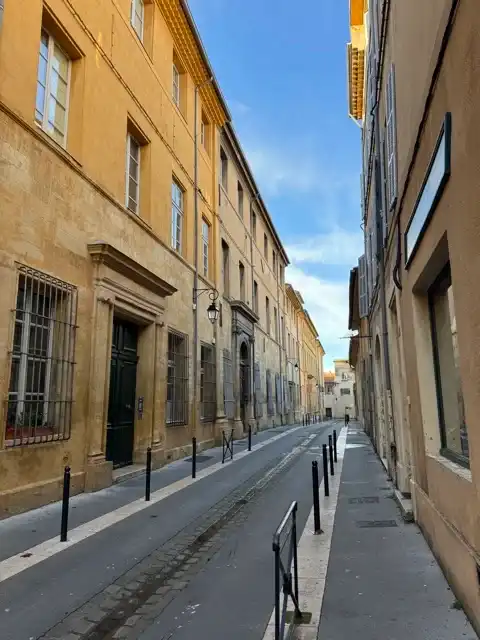
I’m terrible at naming colours. No, that’s not true. I can do a reasonable job of naming colours, but they’d be names of my own devising, bearing no resemblance to words that would mean anything to anyone else. For example, what others would call “forest green,” I might label “Mergatroid.” That’s not any help to anyone else, but it works for me.
With that caveat stated, I’m not going to create a new name for the colour palette of the neighbourhood, but I’m also not going to promise that I’m going to get it right.
I think the dominant colour in the neighbourhood is lighter than ochre, but of the same hue family. The hue family arrived from Vietnam in the 1970s and chose to drop the capitalization of their surname. But, never mind that. There are variations in the lightness and intensity of the colours, but most of the buildings fall generally within that scheme. There are some outliers, but there are no jarring colours. To my eye, the effect is well beyond pleasing. That is to say, beyond in a positive direction.
Cours Mirabeau
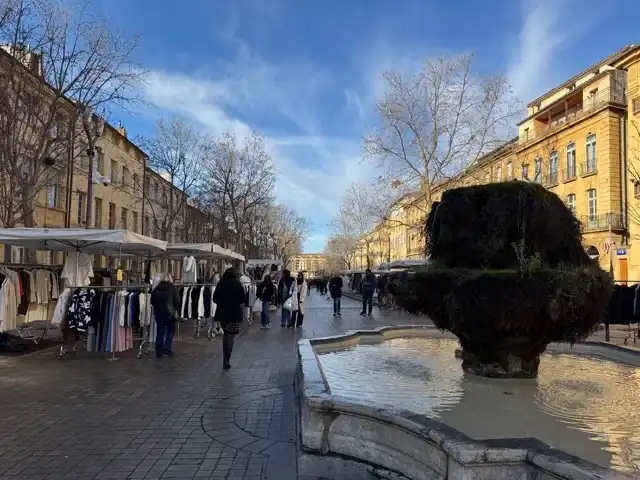
I read somewhere that Cours Mirabeau is Aix’s answer to Avenue des Champs-Élysées in Paris. I get the reference. It’s a broad, well-treed boulevard, with stores on either side, but beyond that, I don’t see the resemblance. It lacks the bustle and high-end international shops. And it’s not as wide.
That’s not a bad thing. Cours Mirabeau is very pleasant. There are the trees I mentioned, but also there’s a statue at one end and a statued fountain at the other. Oh, that statued fountain is in something of a roundabout, but there are far fewer streets entering it and far fewer lanes circling it than at Place Charles de Gaulle in Paris. Plus, the statued fountain doesn’t bear the slightest resemblance to the Arc de Triomphe. So the parallel to that end of the Champs-Élysées is only in the broadest sense and only to the highest level of abstraction of its general form.
There was very little vehicle traffic on Cours Mirabeau. And some sections seem to restrict traffic to just delivery and utility vehicles. When I was there, two rows of vendors with tables and/or racks ran down I forget how many blocks of the street. Maybe just one. The vendors mostly sold women’s clothing. I don’t know if that market is a regular thing.
All I had for breakfast before leaving Marseille was an espresso. So I sat at a table on a restaurant patio facing Cours Mirabeau for a set breakfast that consisted of half a baguette, a croissant (yes, two breads), fresh-squeezed orange juice, and an espresso. I ate it while people-watching and enjoying the Aix joie de vivre before moving on.
Aix Place de l’Hôtel de Ville
From there, I walked to Place de l’Hôtel de Ville (City Hall Square). The walk took me to the other side of Cours Mirabeau. The streets there are similar to the ones on the first side of Cours Mirabeau I was on, but these seemed older and oozed even more charm. The colour palette there is somewhat broader and expands a bit toward pinkish and yellowish hues, or, as I like to call them, herminionish and pelantish hues.
Just before getting to Place de l’Hôtel de Ville, I passed another square where there was a fruit and vegetable market set up today. That added colour to the atmosphere.
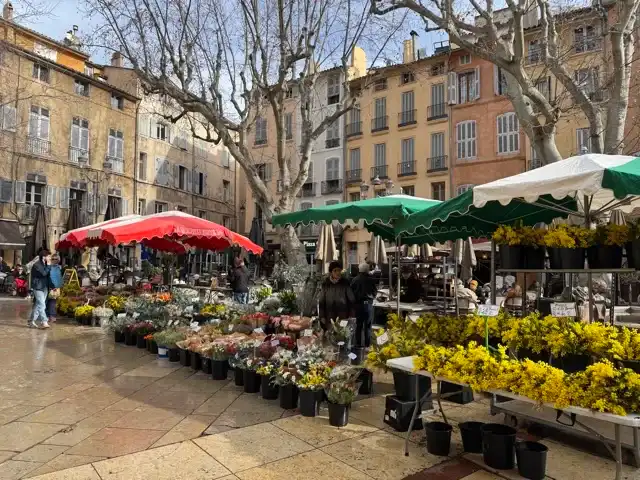
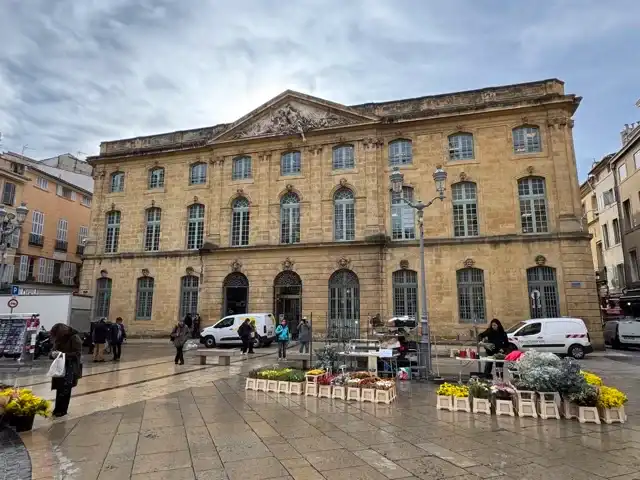
Place de l’Hôtel de Ville is about a block beyond that. Today, a flower market occupied much of the City Hall Square.
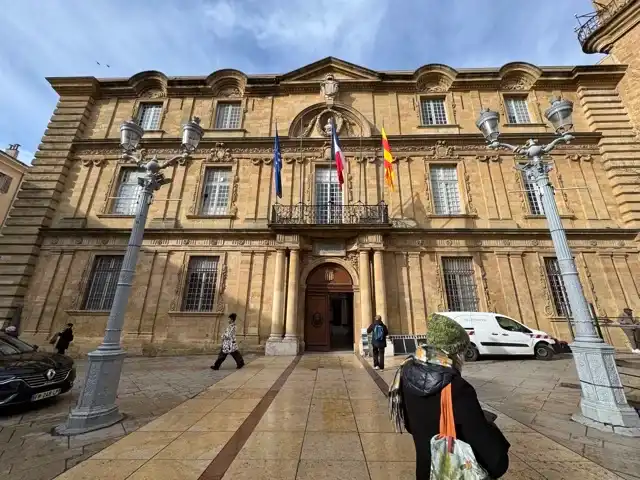
The city hall is a simple, but attractive old building constructed of tan-coloured stone bricks. Attached to one of its sides is a handsome clock tower constructed of the same colour stone bricks.
Kitty-corner to the city hall on the Place de l’Hôtel de Ville is a stately building that used to be the corn exchange, but now serves as a post office and a library.
Place de l’Hôtel de Ville is delightful. I agree with my walking tour app’s rating of it as a “must see.”
Cathedrale Saint-Sauveur d’Aix-en-Provence
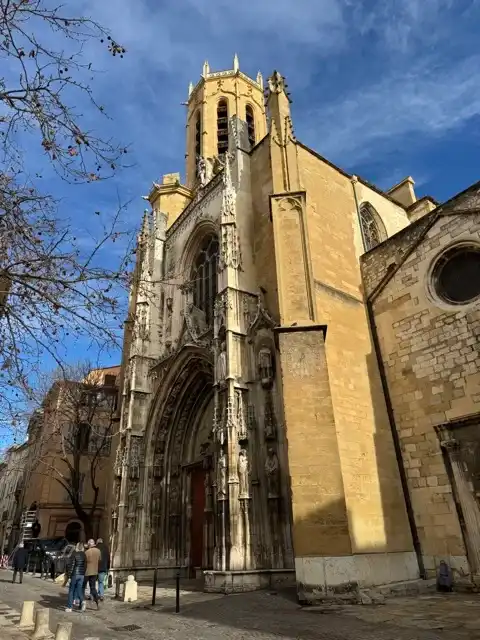
Cathedrale Saint-Sauveur is a cathedral for the ages, somewhat literally. It was built on top of a Roman forum. And it’s believed there was a pagan temple there at one point.
Today’s cathedral got its start in the 12th century, but there were subsequent additions to it without demolishing what was already there.
A Gothic-style transept was added in the 14th century. And walnut portal doors were carved in 1505.
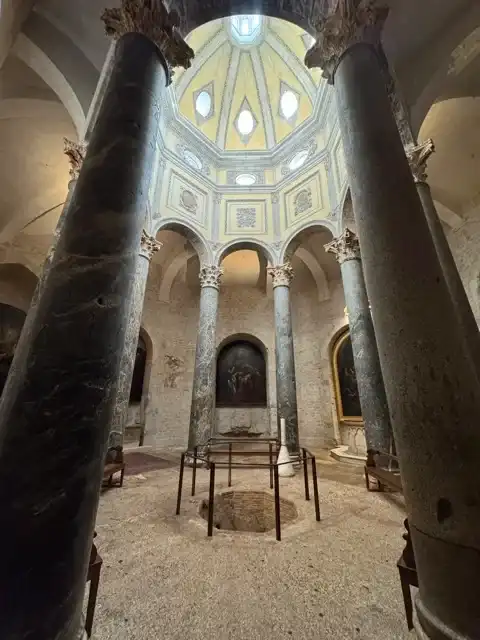
One of the expansions, I don’t know which one, expanded over where the old Roman church was. So there’s now a fifth- or sixth-century baptistry from that church inside the Cathedrale Saint-Sauveur. I don’t know if it was always sunk into the ground, or if that’s a result of the march of time covering it over, with only the top still exposed. But that’s how it is now. It is sunk into the floor, with rocks forming its circular wall, and just the top at floor level. There’s a lovely dome above the baptistry.
Encompassing further that Roman period, in situ, original Roman pillars surround the baptistry. So, that’s pretty cool.
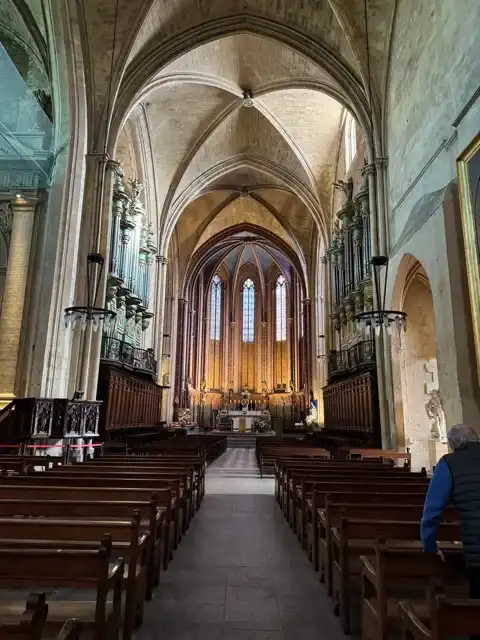
The cathedral has a beautifully ribbed ceiling. Several old paintings hang on the walls. What’s more, there’s a fragment of a fresco still visible on one of the walls near the old Roman baptistry.
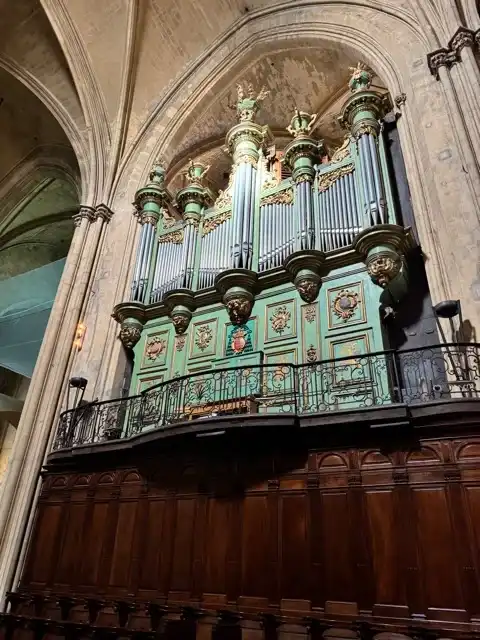
Cathedrale Saint-Sauveur sort of has not one, but two pipe organs. They face each other across an aisle. Both are of a very similar design. Maybe they’re identical. I didn’t compare them closely enough to be sure.
The pipes of the pipe organs are of a shiny silver colour, as pipes of pipe organs often are. The housing is a light, muted green and gold colour.
Why did I say that the cathedral “sort of” has not one, but two pipe organs? I read that only one of them is functional. The other one never was. It was fabricated purely for decorative reasons, I guess to provide symmetry with the functioning organ, if you’ll pardon the body imagery.
To my mind, Cathedrale Saint-Sauveur is well worth a visit. And it’s where I ended my morning.
After I left the cathedral, I walked back past City Hall Square to a sandwich shop I saw that had some very appetizing-looking sandwiches in the window. I bought a sandwich and another espresso, and I sat in the shop while I fortified myself for the afternoon. I’ll provide a post narrating my afternoon in Aix anon.
Discover more from Joel's Journeys & Jaunts
Subscribe to get the latest posts sent to your email.
Vallon des Auffes and a Little More

South of France (and Taormina) Trip Summary

You have to watch out for that charm ooze. It gets all over your clothes, and then has the disturbing property of making you regret it when it gets washed out of your clothes back home. I have not been to Aix for a very long time, and your post is making me want to rectify that. Right now. Shall we meet up on the square, cop a glass of wine and people watch? Enjoy.
My washer has a special charm-ooze cycle. It works like an, um, er, charm.
Meeting up in the square in Aix for a glass of wine and a people watching session sounds perfect. What time is good for you?
I’m happy to join you in Aix, the spot where flights of traveler’s delight flew unfettered into the blog, the spot where you fell in love. A short trip on the local train from Marseille. Picturesque streets lined with buildings in a charming palette. Requisite trees — appropriately bald for the season — a fountain or two, a repurposed corn exchange, street commerce, and an agglomeration of a church. With a faux organ rigged up for symmetry opposite its operable twin. I’ll toast with you to all that, or chew on a demi-baguette in the morning.
Randi has already said she’d like to join me for a glass of wine and a session of people-watching in the Aix square. We should all get together there. What do you say?