Pál-völgy Cave and Aquincum

This morning, I went back to the Buda side of Budapest, this time to visit Pál-völgy Cave and Aquincum. By the way, in the English version of the name, I’ve also seen Pál-völgy written without a hyphen, i.e., Pálvölgy in some, but not in all English usages. However, I think the hyphen is always there in Hungarian.
Pál-völgy Cave
The hills of Buda are laced with caves carved by ancient underground hot water flows. I was in one yesterday, the Hospital in the Rock and Nuclear Bunker. However, the publicly accessible section of that one barely resembles a cave anymore. Its floors, walls, and ceiling were covered with standard, flat building materials when the caves were converted into a hospital for use during World War II and, later, the Hungarian Revolution, and after that, for use as a nuclear bunker to treat victims, should the worst happen.
The Hospital in the Rock is in Buda Castle Hill, in central Buda.

Pál-völgy Cave, on the other hand, is a considerable distance from central Buda, out in the north end of the sub-city.
(Please don’t quote me on that “sub-city” thing. As I typed it, I realized I didn’t know what designation to use to name the relationship of Buda and Pest to Budapest.
They haven’t been independent cities for quite some time. Nevertheless, the border between them is clear. It’s the Danube River. And my guidebooks refer to sights as being in Buda or Pest, despite it all being part of Budapest these days. The best I could come up with was “sub-cities.” I doubt that locals use that term. In fact, I might be the only person in the world to call Buda and Pest sub-cities. I don’t know.
UPDATE: I’ve subsequently been told that the two sides are only referred to as that, sides, not sub-cities.)
Public entry into the Pál-völgy Cave is by guided tour only. The guide speaks only Hungarian throughout the tour. But when I bought my ticket, the ticket seller had me download an app that provides translations in any of several languages of what the guide says at each point on the route. So, at each stop, I started the commentary for that feature.
The audio guide was a bit strange in one respect. There was an introductory narration which explained the rules of the cave and how the audio guide worked. It said that at the end of each segment, there would be a chime. It played the chime so I’d know what it would sound like.

I thought that was a bit weird. Wouldn’t I know that when the narrator stopped talking, it was the end of that segment? But once I got to the first stop, I understood. The narrator spoke for a bit, then there was a pause of several seconds, seeming to be the end of the recording. But no. After what felt like an interminable length of silence, the narrator started talking again about the same cave feature I was standing in front of.
The live narrator speaking in Hungarian didn’t seem to need those pauses. Consequently, the English narration I was listening to often lasted longer at each stop than the live narration by the guide.
Also, the guide had a strong flashlight that he used to point out various elements of the cave. This worked well for everyone who spoke Hungarian, which seemed to be all the rest of the group, because none of them were listening to their phones. However, because the recorded narration wasn’t at all synchronized with the guide’s spiel, that didn’t help me much. Once in a while, I’d hear an English description of something that I remembered the guide spotlighting with his flashlight, but that wasn’t often.
The section of Pál-völgy Cave that the tour went through was modified somewhat to make it safe for tourists. The floors are flat and paved with concrete. Where we needed to go up or down, there were stairs. Most of those stairs were concrete, civilized and quite easily navigable. But there was one section of metal stairs that was so steep, and the treads were so narrow, that it was closer to a ladder than a staircase.
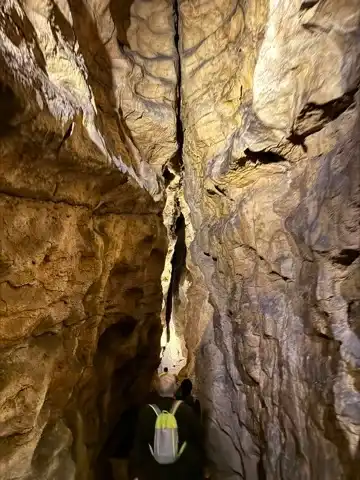
However, those were the only modifications. The walls and ceilings of the cave were completely natural. There was one section where there was a small metal rod between two sections of rock, but the audio guide explained that it was not to hold the rock in place. It was so they could measure the rock’s movement over time. The audio guide said that it has been quite stable. But it probably said that only because some people might panic otherwise. Some angst-ridden people. Not me, you understand—other people.
The portion of Pál-völgy Cave that the tour goes through is quite beautiful. There are lots of stalactites, stalagmites, and flowstones, many of which form beautiful shapes. It also has many dramatic overhead crevices. In general, it was a beautiful and interesting tour.
The exit from the cave is not part of the cave. A short, fabricated tunnel with a flat floor, smooth walls, and a smooth arched ceiling completes the circular route to the outside, a little way away from the entrance.
The tour does not explore the full extent of Pál-völgy Cave. Those sections that haven’t been modified for visitor safety are off-limits to the tour. But there is an adventure tour available elsewhere in the cave system, where visitors get proper overalls, hard hats, and safety boots to explore deeper into the cave. And I think some sections are off-limits to everyone except professional spelunkers.

Don’t quote me on this. The probability that I have the numbers or what those numbers reference wrong is very high. But I think Pál-völgy Cave is part of a cave system that extends for more than 30 km. And there are more than 60 km of caves in Buda. But in all seriousness, if you are a student and that comes up in a test, don’t use my numbers. Look it up in a reliable source first, instead. As I said, I’m not at all confident that I’ve got that right. Use your own best judgment as to what is a reliable source, unless your own best judgment sucks, in which case use someone else’s best judgment.
Oh, one thing I almost forgot to mention. There’s a sign near the cave entrance that says the cave is 11°C all year round. The introduction in the English audio guide repeated that information. Before coming to Pál-völgy Cave, I figured it would be a little cool, as caves tend to be. I didn’t think it would be quite that cool.
Everyone else who visited Pál-völgy Cave must’ve known about the temperature because they all brought sweaters or jackets, and some had heavy, long pants, despite it being above 30°C outside. I was wearing shorts and a short-sleeve shirt and didn’t have anything to put over it.
I’m not sure the 11°C figure was accurate. For the benefit of those primatives who don’t yet understand Celsius, 30°C is 80°F, and 11°C is 51.8°F. I’d normally wear long pants, a long-sleeve shirt, and a light jacket in 11°C weather. I was a little cool in Pál-völgy Cave, but not excessively so. In fact, I would have preferred to spend longer than the hour tour down there rather than go out into the heat and humidity of Budapest today.
From Pál-völgy Cave to Aquincum

I took a taxi from my hotel to Pál-völgy Cave this morning, but the bus route from there to Aquincum didn’t look like it involved much walking, so I used city buses to travel between the two.
I mention this only to introduce some information about Hungary that I don’t think I’ve mentioned so far in these pages. In Hungary, senior citizens can travel on city buses or intercity trains for free. The seniors’ train and transit rate is zero. You just walk onto the bus or train. I read that if a fare inspector questions you (no one questioned me today), you simply show them your passport or other ID, and you’re good. There aren’t a lot of advantages to old age, but there’s that.
This was the first time I’ve taken transit on this trip. I would have before—hey, it’s free!—but the times when I considered it, the route looked too complicated.
After I move on from Budapest to explore some of the rest of Hungary, I’ll be using trains to do that. I read that for most of the regional trains, you can’t reserve seats. But for some of the high-speed intercity trains, you have to. I don’t know if that’s true. However, there are a couple of trains for which I did reserve a seat, but I couldn’t on the rest.
Seat reservations aren’t free for seniors, but they are very inexpensive. For those trains with seat reservations, there are two components to the fee: the regular ticket price and the seat reservation fee. If you’re a senior, you pay only the small seat reservation fee, not the higher ticket fee.

Booking those seat reservations in advance was an ordeal that, in total, probably took a couple of hours of my time. It also involved some emails and a couple of phone calls from Canada to Hungary to accomplish it. Neither the emails nor the phone calls resolved the problems I had buying seat reservations. I think, but I’m not sure, that I was just trying to book them too early. When I tried again, closer to my leaving for Hungary, it worked like a charm. However, no one in the Hungarian train system seems to be aware of that issue. The whole story of my seat reservation odyssey would probably require a few thousand words to narrate in full. I’ll spare you that.
I also tried to “buy” free tickets for the trains I’ll be on that don’t offer seat reservations. I’m neurotic. I worry that if I don’t have a ticket, the train will be full and I won’t be able to get on, or I’ll have to stand the whole way. I still worry about that. When I tried, the system told me something to the effect of, “You told us you already have a ticket, so you don’t need to buy one.”
I didn’t tell them I already had a ticket. The system won’t let you get to the point of buying a ticket without telling it your birthdate. So, I assume it was telling me, in effect, “Hey, old fart! How many times do we have to tell you it’s free? Stop bothering us!”
Aquincum

Aquincum is the site of a Roman settlement. The Romans have long gone. They’re probably back in Rome, enjoying a Campari aperativo before tucking into their spaghetti carbonara primo and saltimbocca secondo for dinner.
One of my guidebooks tells me that Aquincum dates from the first century CE and is the most complete Roman town in Hungary.
Jeez, those Romans really got around back in the day, didn’t they? In my travels, I’ve visited Roman ruins in several places in Europe, some even farther from Rome than Budapest is. Couldn’t the Romans be satisfied with staying home and enjoying that rather than galivanting around?
Yes, I know. I ask this as a guy who lives in Toronto but is in Budapest now, and who already has more than 630 posts in his travel journal. But, in my defence, I don’t try to add the places I visit to my empire and rule over them. My empire consists of a small condo unit. Some fruit flies occasionally enter my domain, but they rarely submit to my rule. That being said, if people in the places I visit want to join my empire, allow me to rule them, and, most importantly, pay taxes to me, I would welcome that. Well, maybe not the rule them part, so much. That sounds like too much work, but I’d be happy to take their taxes if they want to pay them to me. Travel isn’t cheap, you know.

The old Roman town has several buildings, including houses, baths, a theatre, and a merchant’s place, with lots of paths between them. All that’s left are the lower portions of the walls. Some of the remaining walls are about knee-high, and some are about thigh-high. But there are few, if any, of them for which the remaining ruins of the wall are higher than that. (Please keep in mind that these anatomical height comparisons use a short, old guy as the reference point.)
Lapidariums in various spots around the current Aquincum site display several fragments of ancient architectural forms, monuments, sculptures, gravestones, and sarcophagi. They’d pretty much have to, wouldn’t they, seeing as though that’s what lapidariums have to do if they want to retain the right to call themselves lapidariums.
A small museum houses more of the ruins, along with some recreations of ancient pieces. There are a couple of mosaic floors that look to be in too good shape to be originals. However, some pieces in the museum do have placards saying they are reproductions. These tile floors didn’t.
One of the pieces in the museum that specifically says it’s a copy is a fountain with a dolphin sculpture in. When I visit a museum of ancient relics, I usually try to avoid posting pictures of exhibits that I know aren’t originals. (Some museums have whole rooms of their collections that have only reproductions. I have been known to post a photograph or two of those, properly noting that they aren’t originals.) Nevertheless, I will post a picture of the copy of the fountain because I thought it might make one reader happy.
And that brought me to the end of my morning.
More pictures from Aquincum:


Discover more from Joel's Journeys & Jaunts
Subscribe to get the latest posts sent to your email.


Might this be the reader you are referring to? Might I be the one? Whatever may be the answer, this reader is very pleased with the fountain, and I thank you very much. Those caves were wow! wow! wow! Quite spectacular, and I imagine spectacular fun to tour, especially as there only seemed to be only one snaky bit to navigate. I like my dramatic natural formations to come with safe and stable ways to walk through them. No feckless spelunking for me. No adventure touring for this old ninny, no. Loving coming along with you underground and back in time. Not that there is anything wrong with here and now. Is there? Well, perhaps let’s not get started in that direction…
You might indeed be said reader. I’m glad you enjoyed it. I thought you would.
The cave was quite spectacular and with the flat concrete floors and the stairs it was quite civilized.
Yeah, there are some aspects of the here and now that I’d just as soon not examine too closely.