Art & Death in Recoleta

I’m quite proud of the title I came up with for this post, “Art & Death in Recoleta.” I think it sounds almost literary.
More importantly, it’s intriguing. It sounds like it’s a murder mystery that takes place in an art gallery or, maybe, an artist is the victim. If someone sees a link to the post attached to just the title, they might even click through out of curiosity. When millions of people do that, I’ll be able to monetize that traffic and become wealthy.
Hey, dreams can come true. They almost certainly won’t, but you never know.
However, if you don’t dream them, they can’t come true. They’d be things that happened, not dreams that came true. Then, where would you be? Fabulously wealthy, but dreamless. That’s where. Hmm. Come to think of it, that doesn’t sound so bad.
Of course, the probability of that happening, dreamed or not, requires approximately a gazillion decimal places to not round to zero. So, never mind.
Reality is nowhere near as fascinating as the title. The art in the title is the Museo Nacional de Bellas Artes (the National Fine Arts Museum), and the death is the Cemeterio de la Recoleta (Recoleta Cemetery). I visited them this afternoon. They’re both in the Recoleta neighbourhood of Buenos Aires, which is also where I had lunch after leaving La Boca this morning, which was all I did this afternoon.

Museo Nacional de Bellas Artes
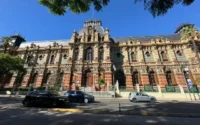
The Museo Nacional de Bellas Artes is a good-sized museum. By “good-sized,” I don’t mean especially large. I mean, it is a good size for me. That is to say, it is large enough that I didn’t think, “I made the effort to come here and this is all they’ve got?” At the same time, it is small enough that someone who is easily bored with art galleries, such as, say, oh, I don’t know, maybe me, can go through it and stay on the alert side of catatonic. Not all that far away from catatonic, but far enough.
The museum displays its art on two-and-a-bit floors. I didn’t look at all of the labels associated with the paintings, but based on the ones I did read, I think European artists have monopolized the ground floor.

I saw a few European paintings from the Renaissance Era, including a Tintoretto. By the way, I learned something from reading the labels. This just goes to prove how ignorant I am about art history. Until today, I had no idea that Tintoretto had any other name.
The label beside Tintoretto’s painting named him as “Jacopo Robusti (Tintoretto).” At first, I wondered, “Wait. Are there two Tintorettos?” So I Googled Jacopo Robusti. Nope, it’s the same person.
I know there’s at least one regular reader who would have known that. What bothers me is the possibility that I was the only person in the world who didn’t know that. How embarrassing that would be.
In addition, I spotted a Greek Renaissance painter, El Greco. Or as the associated placard said, “El Greco (Domenikos Theotocopoulos).” Damn. Why do all of these famous painters have to have nicknames? El Greco is another one whom I didn’t know until today was known as anything but El Greco.

So that’s two things I learned today. That’s seriously great. Based on the “you learn something every day” rule, I now don’t have to learn anything tomorrow as I banked one thing today.
Ha. I just realized that “I spotted” makes it sound like I saw the painting and immediately knew that it was an El Greco. Don’t be ridiculous. If I see an old Peanuts cartoon, I’ll know it was drawn by Charles Schulz, but beyond that, except for maybe a Van Gogh*, and a very small number of specific, very famous, old masters’ paintings, I don’t think I’d recognize many painters just by looking at the work. No, I just completely coincidentally happened to look at the placard beside the El Greco painting.
(*The gallery does have a Van Gogh, see below, and I’m proud to say that I immediately recognized it as such without looking at the label. Although, I have to admit that I was unconfident enough that I had to look at the label just to be sure.)

The gallery also has several more modern paintings from the French school, including Cézanne, Degas, Manet, Toulouse-Lautrec, and Van Gogh.
(Yeah, yeah. I know. Van Gogh was Dutch, not French. But I’ve been to Arles, France, and I know Van Gogh painted and convalesced there. Plus, the gallery put him with the French painters.)
The gallery also has several Rodin sculptures, including two castings of different sizes of one of his sculptures, The Kiss. The larger one looks like it’s carved from, possibly, marble, and the smaller one looks cast in bronze. Neither is the case. According to the accompanying signage, the larger one is made of plaster, and the smaller one is plaster and terracotta.
(In the picture near the top of this post, the much larger cast looks smaller than the much smaller one because the larger one is in the background.)

At least one of the castings came directly from the source. According to the signage, the first director of the Museo Nacional de Bellas Artes was so taken with the sculpture that Rodin donated a casting to the museum. I don’t know which one that is.
The second floor also has some European artists, and at least one American artist (Jackson Pollock), but is largely turned over to Argentinian artists from a few periods, mostly fairly modern.
One of the modern sculptures in the gallery was quite bizarre. It was a crucifix. But the cross was a U.S. military jet. Um. OK.
The top floor has a small gallery with a modern art exhibit that I think was temporary. Up there, there are also a couple of small terraces with a few sculptures each. The rest of the indoor space on the top floor is behind closed doors with the Spanish equivalent of “authorized personnel only” signs on them.
Cemeterio de la Recoleta

You know that old groaner of a joke about cemeteries that goes “people are dying to get in?” Well, the living aren’t dying to get into Cemetario de la Recoleta, but they are lining up and paying money to do so. It’s listed as one of the top attractions of Buenos Aires. A cemetery. Go figure.
The Cemeterio del la Recoleta is large and chock-a-block with crypts. I don’t think more than a very few of the people interred there are buried underground. And those tend to have large statues on top. The “streets” (pedestrian walkways) of the cemetery follow mostly a grid pattern, but there are two diagonal streets that intersect in a small square on the main street leading down through the centre of the cemetery from the entrance, almost, but not quite, to the far end of the Recoleta cemetery.
That centre street is slightly wider than the others. And it’s tree-lined, with a row of trees on either side of the street. None of the other streets had any trees that I saw.

The crypts vary considerably. Most are the equivalent of about two storeys high, but some are about one storey tall, and some are taller.
Most of the crypts at the Recoleta cemetery are of a somewhat classical style, but a few are thoroughly modern. At least one had severe, unadorned, highly polished stone (I think black marble) walls and full-height glass doors.
A few of the other crypts, including some of the classical ones, also had glass windows or doors out front. In some of them, I could see coffins sitting there. In others, there was just a table and maybe some ornaments, but no coffins that I could see. Maybe people get buried beneath the floors of those crypts. I don’t know.
Then there was a crypt at the corner of two streets that was more classic, but the door to it was in the curved corner. Were the crypt larger and not made of sombre marble, it would have looked like the perfect entrance for a funky old pub.

Oh, can you guess one of the famous people interred there? I’ll give you a hint. Don’t cry for her, Argentina.
Yes, that’s right. María Eva Duarte de Perón, commonly known as Evita. She’s interred in the Daurte family crypt.
The Recoleta cemetery appears to be full. If there’s room to place another crypt anywhere in it, I didn’t see it. Maybe they could cut down the trees in that small square and plunk a crypt down in it. But that would be about it.
So, if you die and you aren’t part of a family with an existing crypt with some space in it in the Recoleta cemetery, I don’t think you can be buried there.

Note to my executor: Don’t go to such bother to inter me after I die. The City of Toronto and environmentalists might complain, but if you want to have my body dumped into the Don River, I won’t care because, not to put too fine a point on it, I’ll be dead. (Please don’t dump my body anywhere if I’m not dead, thank you very much.)
The day is over. And, despite the title, no one died in the making of this journal entry. So, it was indeed a good day.

Discover more from Joel's Journeys & Jaunts
Subscribe to get the latest posts sent to your email.

That cemetery is quite the upscale neighbourhood. A lot of keeping up with the Jones’s (or with the Duarte’s) in the real estate department . A quiet, leafy area, perfect for a bit (or a lot) of respite. The art gallery also seems to be well provisioned. Good for you learning something new! All about broadening one’s horizons, isn’t it? Also, the weather is looking nice there. A lot better than the all-day rain working at eroding the hardened piles of snow here.
I like to hold my own in the world, but I’m not particularly one for keeping up with the Jones’s. And I’m very confident that I won’t give a darn about it when I become eligible for permanent residency in such a place. I guess it’s all about the family left behind.
Up to a point, I’m all for broadening one’s horizons. But they eat a lot of steak here and the portions are huge. I fear my horizons won’t be all that’s broadened by the end of this trip.
Until today, the weather has been great. Today started overcast and there were some sprinkles, and a few more are predicted, but there have also been some sunny breaks. Not bad, really.