Buen Dia Buenos Aires

Before today, I couldn’t say I’d ever alighted anywhere in South America, but here I am in Buenos Aires. So, as of the publication of this post, you’ll see a new continent, country, and city in the index of this travel journal: South America, Argentina, and Buenos Aires.
Concerning the title of this post, “Buen Dia Buenos Aires.” I wanted to call it “Buenos Dias Buenos Aires” to make it doubly buenos. However, Google Translate tells me that “buenos dias” is the Spanish for “good morning” and “buen dia” is the Spanish for “good day.” I didn’t land in Buenos Aires until about 2:30 in the afternoon. By the time I got through immigration, picked up my bag, got to my hotel, and was ready to hit the streets of Buenos Aires, it was a little after 4:00. So, “good morning” didn’t seem appropriate. Hence, I went with Buen Dia in the title.
Of course, there’s a chance that Google Translate isn’t perfect at Spanish, and “buenos dias” and “buen dia” are synonymous. I wouldn’t know. I have about five words of Spanish, and I’m not sure I have those words right. So, for all I know, “buenos dias” might have been appropriate in the title.
Right about now, you’re probably thinking, “Dammint, Joel. I don’t give a damn about why you chose that title. Just get the frig on with it.”
I don’t appreciate that language, but I will briefly explain why I gave you that background on the headline. I did mention that I didn’t get out until after 4:00, didn’t I? I didn’t have time to do much this afternoon, so if I didn’t pad it with excruciatingly boring claptrap, this journal entry would have been too short.
“Too short for what,” you ask?
“Shut up,” I reply. I’m a blathering old fool, so some mindless rambling is to be expected. Years ago, I was a blathering middle-aged fool, and before that, I was a blathering young fool. Change is good, sometimes even invigorating, but a little consistency in your life keeps you on an even keel. I have my blathering and foolishness for that.
Language in Buenos Aires
About those approximately five words of Spanish I have, they may not be enough here. Before coming, I’d read that English was scarce in Argentina. I took an Uber from the airport to the hotel. The Uber driver didn’t speak a word of English. So, what I read might be accurate.
In truth, that’s why I took an Uber. I can enter my destination and pay the fare through the app, without the need to communicate verbally with the driver, as may be necessary with a regular cab. There were a couple of other places where I asked for information today and needed assistance from Google Translate.
That being said, the people at the front desk of my hotel speak English, as did a guide on a tour I took this afternoon (see below). So it’s not entirely hopeless.
Then again, I haven’t been to a restaurant yet. We’ll see how that goes. I probably won’t post this until I get back from dinner. I’ll let you know.
Aside
Elsewhere in South America
Re that first time in South America thing, technically, I was in Brazil today in addition to Argentina.
My Air Canada flight from Toronto was a direct, but not non-stop flight. It stopped in São Paulo, Brazil. That wasn’t news to me. Air Canada spelled it out clearly to me in the flight information.
The email Air Canada sent me with my itinerary after booking my ticket told me that I might have to get off the plane in São Paulo. Note, might, not will. I did have to.
There was an announcement on the plane before landing in São Paulo saying that all passengers would have to leave the plane, take all of their personal belongings, and the people continuing to Buenos Aires would have to go through a secondary security screening before reboarding the plane.
So I got off and walked along a series of moving sidewalks. At the end of it, an airport employee was calling out my flight. I identified myself. He asked to see my boarding pass, which he verified against a list of passengers on my flight who were continuing to Buenos Aires. He then pointed me to a corridor toward a security checkpoint that didn’t seem nearly as thorough as the one I went through in Toronto.
There were only one or two other passengers at the checkpoint, and I didn’t have to take anything out of my carry-on, so it took almost no time to get through that checkpoint. I then had to walk all the way back to my gate at the far end of the long, straight terminal, where I had to wait to reboard my plane.
The same plane. The same boarding pass. The same seat.
That’s what I don’t get. Couldn’t they just let me stay on the plane?
The security screening in Toronto seemed much more thorough than the one in São Paulo. Did they think that I somehow was able to conjure up a dangerous device out of who knows what on the plane that wouldn’t have been caught in Toronto, but would have been caught in São Paulo?
Oh, by the way, changing the subject somewhat, when our plane landed in São Paulo, I saw another Air Canada plane parked at a gate at the airport. This shocked me because I didn’t think there’d be enough traffic for more than one flight a day from Canada to São Paulo. Apparently, there’s enough for at least two.
All of the places on my plane vacated by people leaving the flight in São Paulo were taken up by people transferring from an Air Canada flight from Montreal, along with people transferring from some other airlines, and possibly some São Paulo locals. I know this because before boarding, Air Canada called the names of several people to come to the gate for passport verification, but people from Air Canada’s flights from Toronto and Montreal were exempt from that.
Apropos of nothing, because Canada has two official languages, English and French, Air Canada always makes announcements in both of those languages on its flights. But on flights to a country where the mother tongue is neither English nor French, it always has a flight attendant on board who speaks that language and makes the announcements in that language as well.
The language of Brazil is Portuguese. The language of Argentina is Spanish. Because the flight I was on today made a stop in Brazil before landing in Argentina, all announcements were made in English, French, Spanish, and Portuguese. Announcements took a long time.
Palacio del Congreso
Not having a lot of time, I chose a sight close to my hotel to see this afternoon. One of my guidebooks recommended the Palacio del Congreso, which is a less than twenty-minute walk from my hotel, and said that it has free English and Spanish tours at 12:30 and 5:00 a few days a week, including Thursdays. Today is Thursday. Perfect.
When I got there, a couple ahead of me were speaking in Spanish to the couple of guys behind the desk. They were looking for the Spanish tour, or so I assumed. I have no idea what they said. You know, Spanish.

When I got my turn, I asked about the English tour. There wasn’t much English spoken on the other side of the desk, but I was able to determine that, yes, there was an English tour at five. Before I could go on it, they wanted to see my passport.
I left my passport in the safe in my hotel room (you need to be careful when it comes to passports). But they accepted my driver’s license instead, took a copy of that, took a picture of my face, and asked me to wait outside until five.
The Spanish couple were the only other people waiting. No other visitors turned up. At 5:00, two guides came out, one to lead the Spanish tour and the other to lead the English one. The couple went off with the former, and a few steps behind the Spanish tour, I went off with the latter.
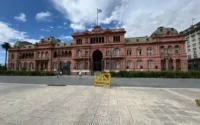
The Palacio del Congreso is the seat of the legislative branch of the Argentine federal government. The building is beautifully imposing and stately, with a large, green copper dome atop the centre of the structure (see the picture at the top of this post).

The 45-minute tour covered pretty much the whole first floor of the interior. It went into the chambers of the Senate and the House of Representatives, along with some associated and also impressive rooms.
There is a lot of marble in the rooms throughout the building, along with dark woods and a few stained-glass ceilings. It’s quite beautiful.
The guide gave a lot of facts, figures, and dates about the building, the political history of Argentina, and the structure of Argentina’s government as it is today.
It was all extremely interesting. At least, I remember it as being interesting despite forgetting most of the details.
Some things I do remember (without having to check on the internet, I’m proud to say) are the following:
The structure of the Argentine government is similar to that of the United States. The government has three branches: the executive, legislative, and judicial branches.
The executive branch is headed by an elected president. A vice president is elected on a ticket with the president.
The legislative branch has two elected chambers. The English names for them are, as I mentioned above, the Senate and the House of Representatives.
The Senate represents the provinces of Argentina. There are 24 provinces. Each gets three senators, no matter what their population. Hence, there are 72 senators.
The House of Representatives, on the other hand, represents the people and operates on a representation by population basis. There are currently 257 members, but as the population grows, the number of representatives grows. The House of Representatives is always presided over by the vice president, who can vote only to break a tie.

I’ve forgotten how the House of Representatives works, but like the U.S. Senate, the Argentine Senate is not all elected at the same time. Every two years, the term of one of the three senators from each province ends. There are no term limits.
Turning attention back to the building, that green dome atop the building? It took 50 years to construct. The dome originally wasn’t going to be copper. But they subsequently changed the plan. That slowed things down somewhat. Plus, there was a period of dictatorship in Argentina, which eliminated the need for the legislative branch and its structure during that time. In addition, two world wars slowed things down.
Both of the chamber rooms are stately and impressive, but some of the other rooms are also beautiful and/or noteworthy.
One of those rooms is referred to as the pink room in its English translation. There’s a backstory to it.
Before 1947, women were not allowed to be elected to either chamber of the legislative branch, nor were they allowed to vote. That law changed in 1947. But it took until 1951 before Argentina could put that change into force.

Why did it take four years? Before 1947, women did not have IDs. They were, effectively, non-people. It took four years to issue IDs to all of them.
Women (I forget how many) were elected to both chambers in the 1951 election. But even then, it seems, there was a segregation of the sexes. The women were seated in the chambers for legislative sessions, but the legislature gave women a separate room where they could gather to discuss policy. The men had their own such rooms.
The room was, and still is, decorated with chairs sporting pink upholstery and pink curtains framing the doors. Hence, the pink room.
The segregation ended, I forget when. Both men and women are now allowed to use the pink room, along with all of the other rooms in the Palacio del Congreso.
The other room I’ll mention is the one beneath the building’s dome. It has a huge, impressive chandelier. How huge? Three metric tons. That’s how huge. It’s why they switched the material of the dome to, not just copper, but quite thick copper. It needed to be able to support that weight.
That’s enough for one short afternoon. Catch you tomorrow.
Aside
Buenos Aires Language Update
I’m back from dinner. All of the signage, including the menus, in front of the restaurant that I chose through TripAdvisor was solely in Spanish. But I was, by holding up one finger, able to indicate that I wanted a table for one. I got one.
The waiter who served me spoke a little English, but not a lot. He brought me wine and food menus exclusively in Spanish, but as soon as I spoke my first word (which was in English), he asked me if I wanted an English menu. When I said yes, he brought me one exclusively in English. I had to point to the item for him to understand what I wanted to order. When I tried to just say it, he seemed hesitant. But in the end, I got what I wanted.
So far, so good. Things might work out for me here after all, despite my being a language ignoramus.
(I very much envy people who can speak several languages. I sometimes struggle with English, the only language that I have a working knowledge of, or as the case is now, a retired knowledge of.)
Discover more from Joel's Journeys & Jaunts
Subscribe to get the latest posts sent to your email.


You made it! Good to know you got right down to figuring out the political structure of the country before you started spending your money and time in it. Conscientious, too, I would say. And I think it was nice of Air Canada to give all the ongoing passengers a little exercise break in São Paulo. Always thinking of our health and well-being. About that pink room: it looks like they took an unused hallway (grand though it is), put in a bunch of pink chairs and curtains and called it the ladies’ room. Which gets one thinking. They would have to carve out a ladies’ room as well. So we should have somewhere to powder our noses. That’s me, I guess. Always thinking about the highest ideals of democracy. On the other hand, what is more democratic? Everyone needs to find a bathroom. Sorry, just a little interjection from a card-carrying member of the blathering old fool party. Enjoy your new continent, country and city! I look forward to hearing more.
That’s Air Canada, for sure. Always thinking of its customers’ health and wellbeing.
I think it might be the current situation vis a vis our neighbour, but I have a somewhat heightened interest in the workings of democracies these days.
There are public galleries in both chambers of the legislature. I don’t know if women were allowed in there before they became real people. If so, there might have already been women’s washrooms for the public even before women became real people. Everyone’s got to go from time to time.
The pink room is wider than the hallways in the building and it’s off one of the chambers (I forget which one). So I don’t think it’s a converted hallway. But, yeah, it does have a feel of being shoehorned in.
Glad you made it there safely! Enjoy your trip – I look forward to hearing all about it 🙂
Thanks!
The workings of languages, international airlines and airports, and governance — as if those topics weren’t interesting enough, you’ve given the reader the Pink Room and its denizens to ponder.
That is my goal, to give readers something to ponder. Or maybe to just ram words into a page. I’m not quite sure of my goal, to be honest.