Gyeongbokgung Palace
This morning in Seoul, I was off to the palace. Gyeongbokgung Palace, to be exact. Of the two of the most significant royal palaces in Seoul, Gyeongbokgung and Changdeokgung, Changdeokgung is closed on Mondays, and Gyeongbokgung is closed on Tuesdays.

Atypically for me, I had the good sense to check on that before starting my day. Today is Monday, so Gyeongbokgung it was.
I won’t be going to Changdeokgung tomorrow. There is what is rated as a must-see attraction within it that requires separate advance ticketing for strictly limited guided tours. Entry to that feature is only allowed via those guided tours. When I checked this morning, there was no availability for any of the English tours tomorrow. I have something booked for Wednesday, so I couldn’t go then. And there were only a few tickets left for just one of the English tours on Thursday. I snagged one of those.
But that wasn’t as easy as it should have been. I went to the site to buy tickets. You have to tell the site if you are Korean or a foreigner. There’s a notice on the site that says only foreigners can go on foreign-language tours unless they’re bringing a Korean guest or two (two, maximum) with them.

After saying if you’re foreign or domestic, it doesn’t tell you when the next time is available. You have to look at each day, and scan through the list of different tours in different languages on those days in the hope of there being one that says “available” rather than “sold out.”
When you find one, you click the buy button. But, wait. Not so fast. I don’t know if it told me elsewhere, and I missed it, but only after I clicked “buy” did it tell me that I needed to have an account and sign in before I could buy a ticket. Setting up an account involved providing my email address and verifying it with a code sent to me by email. That process failed a few times.
After I got it to work and signed in, the ticket I was trying to buy before setting up the account was not in any cart that was available to me. I had to go through the ticket selection again. I did, and successfully bought it. All that happened this morning, before setting off for the day. So I didn’t get as early a start as I might have otherwise, and I took in only Gyeongbokgung Palace this morning.
Gyeongbokgung Palace

My walking tour app tells me that Gyeongbokgung Palace is the oldest (built in 1395) and largest of the royal palaces in Seoul. There’s a fee to enter, but there are exceptions.
For example, you get in free if you’re under eighteen. I don’t even remember the days when I would have qualified for that. I’m sure I was younger than eighteen once. I just don’t remember those years except for a vague recollection of my Bar Mitzvah and more vividly traumatic memories of my grade one teacher.
Fortunately, people who are, figuratively speaking, as old as the hills can also enter without charge. I figure into that group. Both youngsters (or their guardians) and ancients (or maybe their caregivers) have to go to the ticket window and, at least in my case, show proof of age to get their gratis tickets.
However, there is another group that’s not age-bound who can also enter for free. And they don’t have to bother getting a ticket. They can just walk in through a separate unimpeded lane. I think this is true at all the royal palaces in Seoul. If you come dressed in traditional Korean garb, a hanbok, the palaces are your oysters, and you can just waltz right in.
(A couple of caveats: They aren’t really oysters. They’re palaces. It’s a paraphrased figure of speech. And, while I don’t imagine anyone would stop you if you waltz in, rather than walk in, many people might point and laugh at you. I’m far too polite to be one of them, but it would take all of my will not to join their laughter.)

The people wearing hanboks represented well less than a majority, but definitely more than a few of the large number of visitors to Gyeongbokgung Palace, including many people whose facial features didn’t suggest they were likely Korean. I think it might be a tourist thing. Not me. Other tourists.
There are places near the palaces that rent hanboks.
And it’s not just at the palaces. I also saw people wearing hanboks at other scenic spots around the city. There were a lot of people taking pictures of other people wearing hanboks.
Touring Gyeongbokgung Palace

You can wander around Gyeongbokgung Palace on your own. Or you can join a free tour available in different languages at different times. I arrived about half an hour before one of the three English tours today. So, I wandered around a bit and then joined the tour.
The tour lasted an hour. The guide took us around a fair chunk of the large grounds. She paused for a while in front of each of the more important buildings and gave a spiel about when it was built, what its purpose was, when it was destroyed by an invasion, when it was rebuilt, and when subsequent major restorations were done. The latest restoration was necessary because of more recent damage to the palace, some of which I think happened during the Japanese occupation of Korea, if I remember correctly what the guide said. (If you’re a student and that comes up as an exam question, you might fail if you rely on my recollection of anything.)
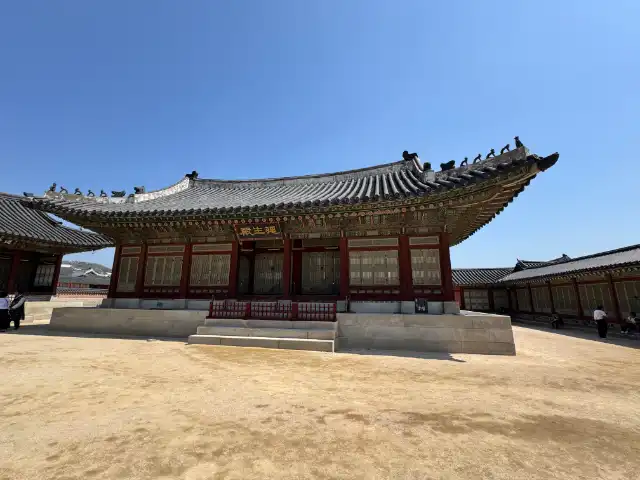
She also told a few interesting stories about customs and events related to the period of the palace’s use as a palace.
Of course, as usual, I’ve forgotten most of what she said. If you’re interested, there are some great inventions called the internet and search engines that will probably find the information for you.
One of the data points I do remember is the year that they reconstructed the main buildings of the palace. I remember it because it was also one of the most momentous years in the course of human history, 1867. Alright, it’s momentous primarily to Canadians. But, never mind.

There are approximately a lot of buildings at Gyeongbokgung Palace, give or take quite a few. They range from somewhat larger than what one would call minuscule to somewhat smaller than what one would call gargantuan. Of course, what that means depends on who is doing the calling, but that’s the best you’re going to get out of me. I didn’t have a measuring tape.
Although differing in size, most of the buildings shared similar design elements, with peaked, tiled roofs. On some of the buildings, at the corners of the roofs, a line of a few small, somewhat whimsical statues sits along a piece of a roof spine that runs diagonally back from the corner. They were quite attractive.

Visitors aren’t allowed inside the buildings, but some had open doors or open walls that I could look through to see the interior furnishings and decorations.
There’s a garden in the Gyeongbokgung Palace compound, behind the main buildings. The guide didn’t take us there, but she told us about it. I went to take a look. It’s not exquisite, but it’s very attractive. The garden has a little pond with a small island and a quaint wooden bridge over to it.
Nearby Lunch
By the time I finished with Gyeongbokgung Palace, it was lunchtime, and I was getting peckish. There are no eating establishments in the palace. The sight I planned to visit first after lunch is immediately beside Gyeongbokgung Palace. In fact, I think it might have been on land that was once part of the palace compound (but with a much newer building that did not attempt to match the palace style), but a fence divides it from the palace. There is a controlled gate in the fence, so you have to buy a ticket to enter the palace compound from there.
Most of that is irrelevant. I mentioned it solely to say that I didn’t want to go too far away for lunch. I used a local mapping app to find a nearby Korean cuisine restaurant that was only about a block on the other side of my afternoon’s destination.
On the Seoul Food Tour I took yesterday, I learned that portions at Seoul restaurants are often huge. It wasn’t the guide who said that. One of the other people on the tour asked the guide if doggie bags were a thing in Seoul. They’d been here for a few days already, and they found that there was always more food than they could finish.
The guide (who had gone to school in the U.S., so she was familiar with American portion sizes) said that, yes, the portions tend to be large, but, no, most people don’t ask for doggie bags. They usually finish everything. The guide said that if they have a container, the restaurateur would be accommodating, but it’s not something they usually do.
Because I only had a sandwich for lunch yesterday, my first full day here, and hadn’t been to a real Korean restaurant before, the food tour, I was unaware of any of that. After lunch at a Seoul restaurant today, I have a data point that adds evidence supporting the humongous portion contention.
I ordered a plate of Korean pancakes. There were four different kinds. All of them were delicious. But there wasn’t just one of each. There were four of each. And they weren’t appetizer size either. Having already heard about Seoul’s portion sizes, I ordered the regular-sized plate. There was also a large size. There was no small size.
Plus, they brought large plates of two different kinds of kimchi, something that comes free to every table.
I didn’t finish all of the kimchi. Looking at the tables around me, it looked like they brought the same size plates of kimchi to every table, no matter how many diners were seated at the table.
However, I did finish the pancakes. I was stuffed.
Let me skip ahead past my afternoon post, all the way to this evening. I’m not prescient. I can do that because I didn’t finish this entry until then.
I don’t know if it’s because of the room I booked at my hotel or because of the status level I’ve reached with the hotel group, but I was given access to an executive lounge with my room. I can get free breakfast, tea time, and happy hour in the lounge.
It’s not often, but I’ve been at hotels where I’ve had access to free happy hours. Usually, it involves wine or beer and a few small hors d’oeuvres. The food is rarely substantial.
I didn’t get to happy hour here yesterday because it was entirely during the times of the Seoul Food Tour I was on. So I didn’t know what to expect.
I went today.
It’s not like my previous experiences of happy hour.
There is a full buffet, with red meats, chicken dishes, shrimps, lox, salads, soup, bread, cheeses, desserts, wine, beer, and spirits. It’s all included in the free happy hour.
After my huge lunch, happy hour sufficed for dinner today. In fact, there is enough food that it would suffice even if I’d skipped lunch.
My current thinking is, unless I’m doing something that keeps me away during the happy-hour hours, I might only have lunches at restaurants and have dinner at happy hour. I’m in Seoul for eight nights. I then tour around Korea a bit and come back for one night in Seoul before catching my flight back to Toronto. That last night will be in a different hotel, in a hotel chain where I don’t have as high a status, so I probably won’t get a happy hour there.
Discover more from Joel's Journeys & Jaunts
Subscribe to get the latest posts sent to your email.


Ah, the joys of doing all the travel planning for yourself. Despite the hiccups, like wrestling the ticketing program into submission this morning, you have become quite expert at it. That happy hour thing sounds a real bonus. I find that when I am travelling and enjoy a leisurely lunch out, grabbing a snack in the evening is just the ticket, so to speak. Sounds like in this case you could do yourself some serious economizing with the heartiness of their buffet. Oh, and the sightseeing. Very attractive palace. And I can see why they allow people in for free in traditional dress. It looks good on social feeds, people find it picturesque, and tourists who like dress-up have a grand time.
I think some folks do some or most of their travel on organized tours where the organizer shepherds them around each day from sight to sight. I imagine the joy of not having to do things like make decisions and occasionally fight with recalcitrant technology to wrangle tickets has its benefits, but the thought of being herded in a large group on a precise schedule doesn’t appeal to me for other than the occasional day trip.
This might come as a surprise to you, but playing Mr. Dressup doesn’t hold a high appeal for me. But it is indeed colourful to see other people do it.