Szigliget Castle
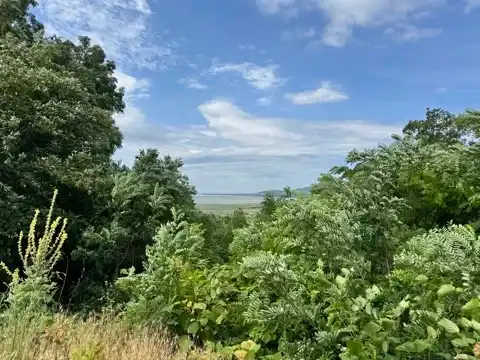
This morning saw me take a short trip from Keszthely, Hungary, to nearby Szigliget, specifically to Szigliget Castle. I hate it when day parts spy on me. But what are you going to do? Privacy is truly dead in this allegedly advanced modern age.
The trip was on a city bus that made regular stops to Szigliget. And it continued farther on after I got off. Including the walks to and from the bus, it took less than an hour for me to get to Szigliget Castle.
When I set out, the temperature was 21°C, and there was a stiff breeze. Breezes should learn to limber up before they exercise. Failing to do so can lead to stiffness like that.
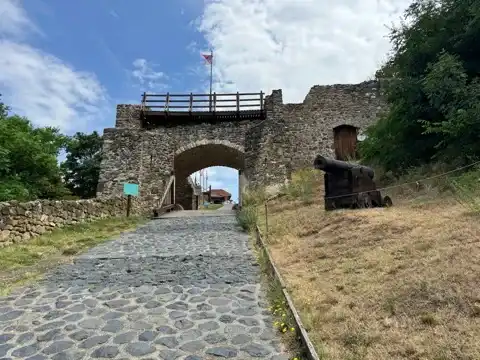
Compared to the mostly windless, humid, stifling weather I’ve had so far on this trip in Hungary, a breezy 21 almost borders on frigid. The less than 15-minute walk to the bus was refreshing.
The forecast high today is 29°. That’s still much warmer than I’d prefer, but I’ll take it. As if I have a choice.
Szigliget is a village that’s a little east of Keszthely on the shore of Lake Balaton. The tourists’ reason to go there is its castle. I’m a tourist. I went to the castle.
The official English name is Szigliget Castle, but it’s also commonly known as Balaton Castle. How arrogant! I learned from my visit to the Balaton Museum that several castles were built around Lake Balaton. The nerve of Szigliget Castle to snag that name for itself!
At Szigliget Castle
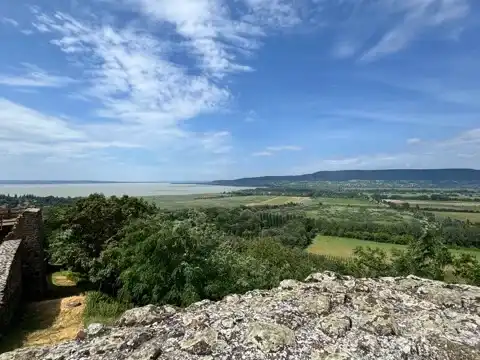
It’s a good thing that the temperature was still pleasant. I’ve visited enough castles in my travels that I should have remembered, but didn’t, that they generally gravitate to hilltops. Szigliget Castle, not wanting to be mocked by the fellowship of castles, honoured that tradition.
The climb wasn’t bad. I’ve ascended much higher hills in the hallowed pursuit of tourism. And the way was along a wide, gentle, cobblestone path and stairs.
Nevertheless, had this morning been as hot as the preceding part of this trip, I might have had to take advantage of my out-of-country health insurance policy. Possibly the clause that covers the return of my body to Canada should the Grim Reaper take me.
(Public service announcement: If the Grim Reaper comes for you and he’s not carrying a deity-issued scythe, demand to see official ID before you go with him. And check that ID at least twice. There are several nefarious imposters out there trying to scam you out of your life.)

On a plateau just below the bulk of Szigliget Castle, there’s a viewing platform, toilets (yay!), and a snack bar and souvenir shop in a building that had been part of the castle.
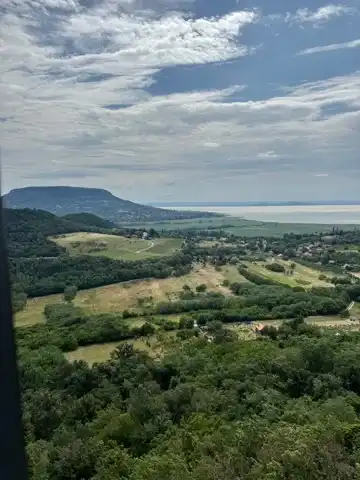
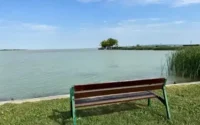
The viewing platform did not face the castle but rather looked out over Lake Balaton and the surrounding landscape. It was gorgeous.
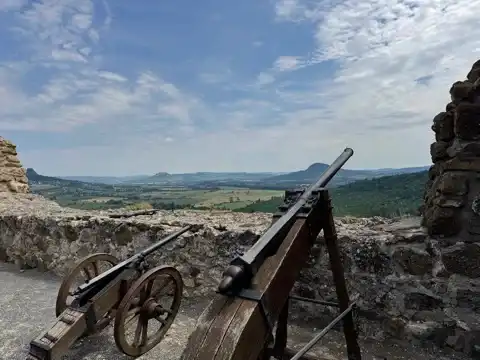
The vistas from higher up, on the parapet, low tower, and other viewing points of Szigliget Castle were even more spectacular. From the different spots, I could take in not just the lake, but also the hills and mountains 360 degrees around the castle.
On the plateau and in the open areas of the castle above it, the breeze had turned into a wind. At times, the gusts were strong as I stood at a high viewing point, sometimes with only a low wall or railing between me and a dangerous drop.
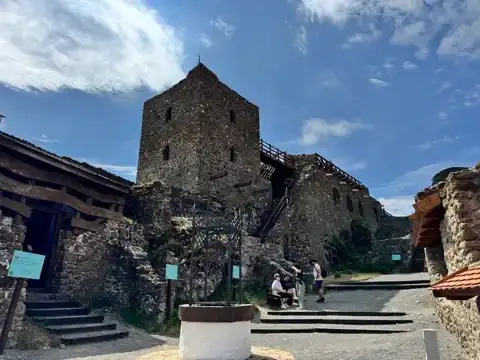
I don’t mind telling you that there were moments when I feared for the life of my iPhone as I held it up in the gusts to take pictures. Not for my own safety, of course. Never let the media say that I feared for my own safety. But the safety of my iPhone? Absolutely. I’m such a compassionate guy that I even care about the well-being of inanimate objects.
By the way, I’m pleased to report that the frame of my phone is sturdy enough to withstand the maximum force my fingers were able to exert on it to ensure that it didn’t fly away.
Although now that I’ve said that, it occurs to me that it may say more about my feebleness than about the strength of my phone’s frame. Nevertheless, I’m glad that my grip is still strong enough for me to keep the plundering wind from stealing my phone.
Szigliget Castle is now more than 750 years old. It’s a ruin today, but in relatively good shape for a castle of its age.
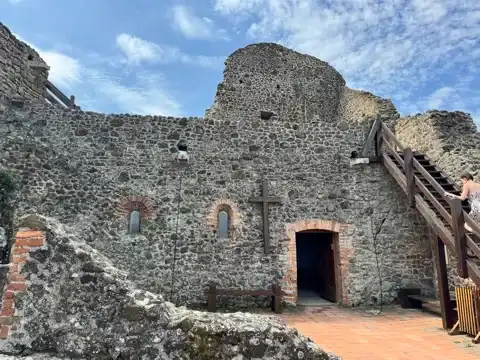
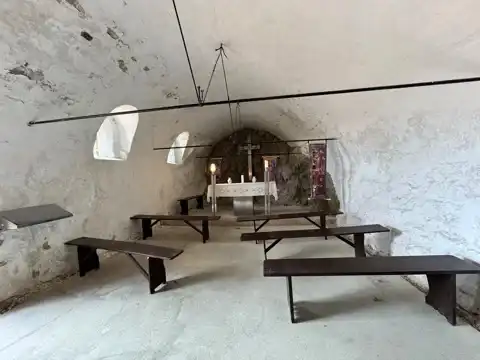
A couple of the rooms, including a small chapel, still have all of their walls and roofs. And there are large portions of many walls that are still standing.
Signs, which included English, in front of each room and other castle elements stated what it was and sometimes a bit about its history and former usage.
A sign in front of what, in English, is called the Benedictine Tower said it was one of the oldest parts of Szigliget Castle. It was built by the Benedictine order between 1260-62. The tower had three levels and a roof.
The Benedictine Tower is now a shadow of its former self. Not only does it no longer have a roof, but it currently has only one level. I climbed some stairs to take in the panorama.
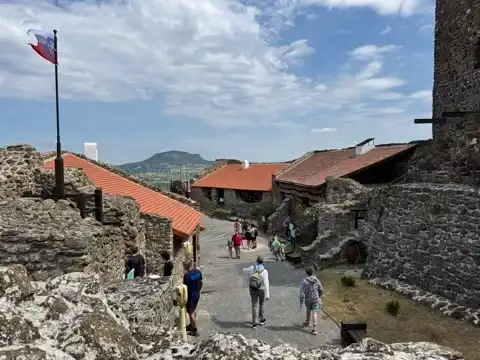
Oh, wait. This might explain the current height deprivation of the tower. The sign went on to say that it was, and I quote, “used for the storage of gunpowder and guns. In the years between 1678 and 1690, the tower exploded from a lightning stroke, and this was the beginning of the castle’s devastation.”
I’ve never thought of lightning as being gentle enough to stroke, as opposed to, say, strike, but the presence of gunpowder during the stroking was, no doubt, hazardous to the tower’s health.
In the small chapel, a sign said, “It is presumed by the researchers that this biggest vaulted room of the castle was a chapel, built by the Benedictine Order in 1260-62.” What? “It is presumed?” So it might not have been a chapel? I want precision, dammit.
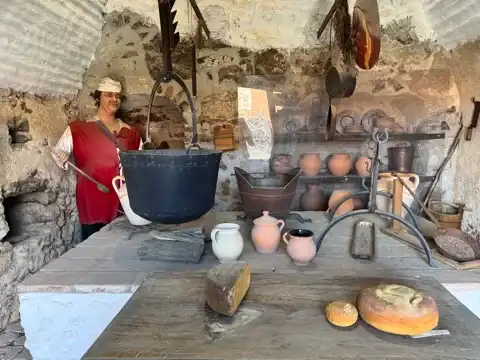
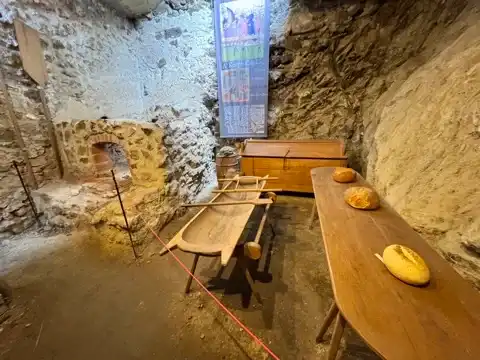
Three adjoining rooms were kitted out with furniture and furnishings to look like rooms of a particular function would look when the castle was in use as a castle, rather than a tourist attraction. One was set up as a bedroom. Beside that was a kitchen with a mannequin cook who looked like he enjoyed his food. The other was a bakery. One room for sleeping, two for food preparation. That sounds like a decent ratio to me. I don’t know if those specific rooms had been used for those specific purposes in the castle’s better days or if they merely represented rooms that would have existed somewhere in the castle.
In another room, there was a display of tools and a mannequin craftsman.
A sign in yet another room said that during excavations, they found everyday items like pots and urns. It explained that this was because, in addition to serving as fortresses, castles also served as households for their landlords.
Some of the rooms, often with a modern roof replacing the lost original, contained information panels that spoke of the history of the castle, its operation, and the battles it was involved in (particularly in the defence against the Turkish invasion).
One room provided information about the other castles around Lake Balaton.
In a room where the panels spoke of the history of Szigliget Castle, one panel was dedicated to the story of Imre Martonfalvay, who was born in 1510.
He was a faithful scribe who later became a bailiff and castellan of the Baron Török family. In 1530, the former scribe was so bold as to seize control of Szigliget Castle for the Török family.
Let that be a lesson to all writers and aspiring writers. Absolutely pursue your truly noble literary occupation or avocation, but know that there are other career paths, such as bailiff, castellan, or seizer of castles, that are open to you, simultaneously or subsequently, should you so desire.
I spent about an hour or so scrambling around the castle, or as close to scrambling as a man my age can get, which is more like shuffling. Then, it was time to catch the bus back to Keszthely in time to grab a bite for lunch. After all, lunch is one of the three most important meals of the day.
More photos from Szigliget Castle:



Discover more from Joel's Journeys & Jaunts
Subscribe to get the latest posts sent to your email.
I still wonder at what you can get up to in the morning. With my proclivities, and at this stage of my life, my perfect travel morning is: get up, have a bite to eat, go back to sleep for a little nap, get up, get ready, and figure out where to walk for lunch, and if I am diligent, to make sure that walk includes a sight. 2 hours travel time and scrambling around a castle, taking in the beautiful views BEFORE lunch. Now that is a morning!
Glad to hear that the weather is getting a little more bearable over there. The heat wave seems to have moved over here instead. You’re welcome.
My thinking is you can get up, have a bite to eat, go back to sleep for a little nap, get up, get ready, and figure out where to walk for lunch at home without spending a penny on airfare or accommodations. True, you won’t have a sight to quickly visit on the way to lunch that you haven’t seen before, but that’s an expensive sight.
Yes, the god of temperatures had mercy on me. I’m sorry to hear that he turned his wrathful gaze on you.
Imre Martonfalvy’s castellan captured my attention since (a) I’d never encountered the job title before; and (b) said castellan had significant responsibilities. Say the word, it seems, with the stress on first syllable “KASS” and deploy a schwa vowel sound in the two unstressed syllables that follow. The vestigial scribe in me needed to know those details. Methinks Imre’s erstwhile scribe may earned the ear and trust of his lordship by dint of a facility with language in a time when reading and writing was a rare enough skill. Maybe he knew the hungarumlaut. Just saying.
Imre Martonfalvy was a versatile fellow, wasn’t he? From writer to bailiff to keeper and winner of castles, or at least a castle.
I don’t know how the Hungarian language has evolved over the centuries, but if hungarumlauts exist in his time, I dare say he knew likely them.