Teatro Colón & More
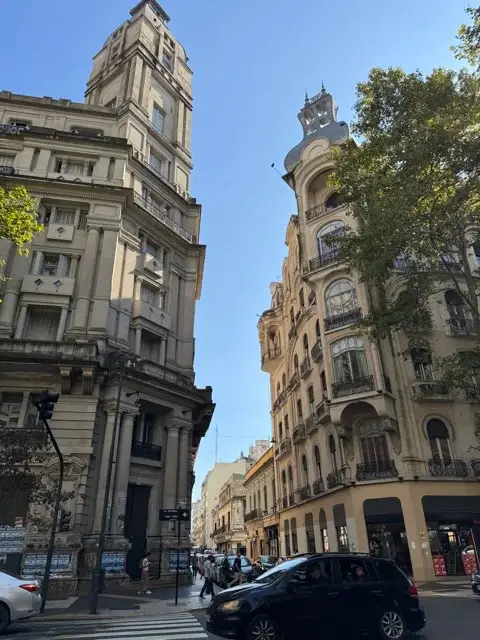
I titled this post “Teatro Colón & More,” but as you’ll soon learn, there’s not a lot more.
Teatro Colón is the only sight I’d decided with any certainty that I wanted to see this morning. As the name suggests, it’s a theatre. Obviously, you can get in to see inside if you buy a seat to a performance. For a reason that I might mention below if I feel so inclined, when an appropriate moment arises, I didn’t want to try to attend a performance.
Another way to venture inside Teatro Colón is to buy a ticket for a tour of the interior. I already knew that the first English-language tour was at 11:00 in the morning. I was going to buy a ticket online, but I found the buying interface to be extremely confusing. I’m easily confused, but it is what it is.
In lieu of an online purchase, I left my hotel at the crack of 9:45 and walked the short distance to the Teatro Colón in the hope that I’d get there early enough to buy a ticket for the first tour.
That hope was quickly realized, but that left me a little more than an hour before the tour.
The sight I wanted to see this afternoon also requires buying a ticket on a guided tour. The online ticketing for that was even more confusing. The site’s website didn’t offer online ticketing, but it offered links to two other sites that did.
Those sites provided conflicting information about English tour times and availability. Thwarted, before leaving my hotel this morning, I stopped at the front desk of my hotel and asked the guy there about booking a tour. He suggested that the best thing to do was to go to the kiosk in the lobby of that building. He said I couldn’t miss it.
All of that is a roundabout way of saying that I used some of my time before the Teatro Colón tour to walk the 15 minutes or so to the said kiosk and ask about their tours.
They have hourly bilingual Spanish/English tours in the morning, with the last one at noon. After a lunch break, they start the hourly tours again at 2:00. I bought a ticket for then.
That still left some time to do some walking before heading back to Teatro Colón. And, because there’s a restaurant in the building I’m touring this afternoon, I had time to stroll a little more after the Teatro Colón tour and grab some lunch before the afternoon tour too.
Walking Around
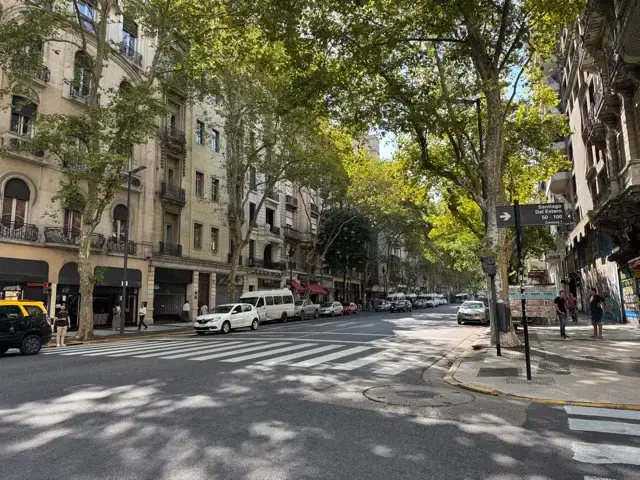
Except for a couple of super-sized, heavily trafficked streets, based on what I saw on my walks today, Buenos Aires operates at a relatively relaxed human scale.
At other times in my visit, I spotted at a distance a section of the city with some ultra-modern high rises, but where I walked today consisted mainly of low-rise and mid-rise buildings. None of them had the look of the age-old buildings of old Europe, but none that I recall were sparkling new either. Most were quietly charming with a few pockets of stunning architecture.
It’s quite an enjoyable city.
One of the sights I saw on my stroll was the …
Obelisco
Despite not being a Spanish speaker, I immediately guessed that Obelisco was the Spanish word for “giant grasshopper.” No, of course not, I guessed “obelisk.” And I was right.
In truth, I’d already seen the Obelisco several times during my time in Buenos Aires. It’s only a few blocks directly down a street from my hotel, and it dominates its surroundings. I didn’t think to mention it before for a variety of reasons. But it’s a recommended sight in my guidebooks and walking tour app. So this seemed like as good a place to note it as any.
Besides, I electronically highlighted it in one of those guidebooks (they’re e-books), and I wanted to give myself permission to take off the highlighting so its existence wouldn’t plague me.
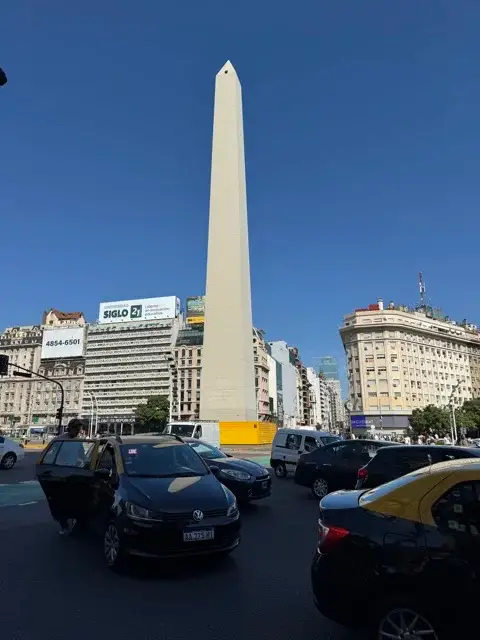
Part of the reason I didn’t mention it in any of my previous posts from Buenos Aires is that I don’t get obelisks in general. They’re usually tall sticks, typically made of stone or concrete, with four sides joined by right angles. The stick usually tapers slightly as it rises and then comes to a sharp point at the very top.
All of the ones I’m aware of are of the same generic design, or close to it, and usually totally unadorned.
They are often (always?) placed in a location where they stick out like a sore obelisk or a sore something.
I understand that they’re usually erected to commemorate a person, an event, or a jurisdiction. Buenos Aires’s Obelsco was erected on the 400th anniversary of the first Spanish settlement on the Rio de la Plata.
Okay. That’s not the part I don’t understand. What I don’t understand is, why an obelisk? After the first one was erected, wherever that was, the next ones typically lack anything beyond a modicum of creativity. To some eyes, they’re ugly. To my eyes, they’re just excruciatingly boring.
My point is, if someone ever feels the need to erect something to commemorate me, I’d rather it be, say, a giant plastic and neon smiley face sculpture than an obelisk.
The Obelisco sits on a traffic island not all that much larger than the base of the obelisk. The island is at the intersection of three or four streets.
I say three or four because I’m moderately confident two of them are each a single continued street. They’re perpendicular to each other and, when they have the necessary traffic light, drivers can continue straight through the street they’re on if they wish. One of those streets is a super-wide, soul-sapping thoroughfare.
However, there is also a diagonal street that crosses through the intersection, but I’m less confident that it’s considered to be a single street. It may be deemed to be two streets, one on either side of the intersection, each ending at the intersection. My guess is it’s the latter because drivers cannot continue from one side of the diagonal street to the other, they have to turn onto one of the other two streets.
If I weren’t so lazy, I could look at a map and settle that question. But, to be honest, I don’t care enough about it to bother.
There is a small window near the top of the Obelisco. This made me wonder if it’s possible to climb or, better yet, be elevated up to the top to get a look. But I don’t think so. There was a yellow, corrugated fence around the base. And, even if the fence weren’t there, there was no way that I could see of crossing over to the isolated obelisk in the middle of traffic without at least one, if not multiple, motorists making sure you cross over into the afterlife.
Teatro Colón

This brings me back to Teatro Colón. Aren’t you glad I finally made it back?
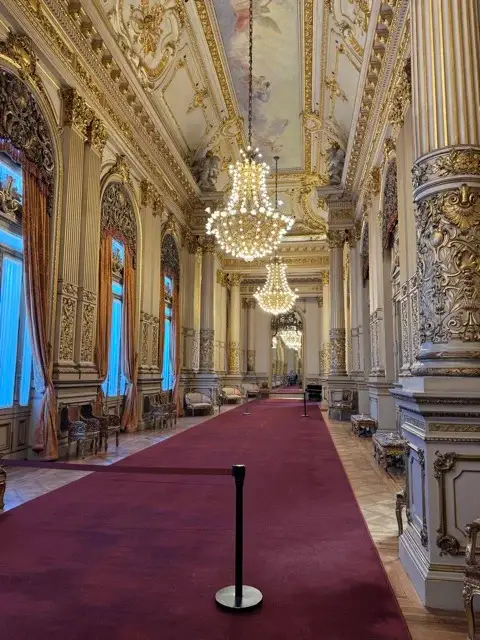
The exterior of Teatro Colón is stately, but not fantastic in my opinion. However, the interior is amazing. In the foyer and the concert hall lobby, orangey pink or maybe pinky orange stone and off-white stone dominate. (It looks more yellow in my picture.) In the foyer and lobby, there are beautiful stained glass windows and ceilings, sculptures, and large chandeliers.
One of the sculptures in Teatro Colón is a large one carved from a single block of Carrara marble. Called in English “The Secret,” it depicts Cupid whispering something to his mother, Venus, representing love and beauty.
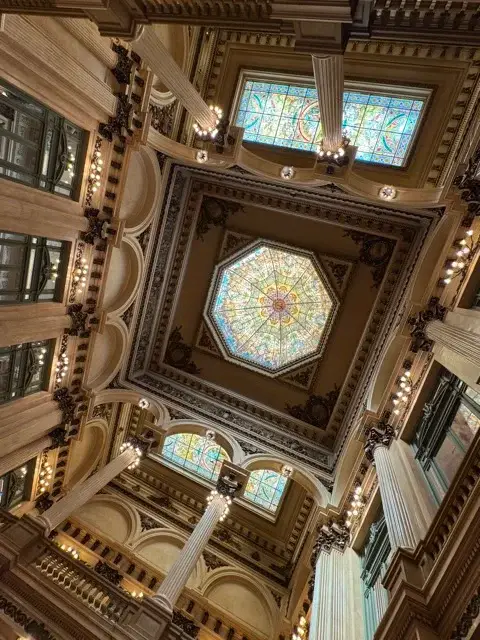
In addition, busts of famous composers hang from high up on the wall in the lobby.
The theatre also has a room known as the Golden Salon. Its pillars and portions of the walls by the ceiling are decorated in predominantly gold colours. According to the guide, on the lower level of the salon, the gold is just gold-coloured paint. But closer to the ceiling, away from reaching, grubby hands, it’s real gold leaf.
The Golden Salon also has some very big, beautiful, and heavy chandeliers. It all makes for a gorgeous room.
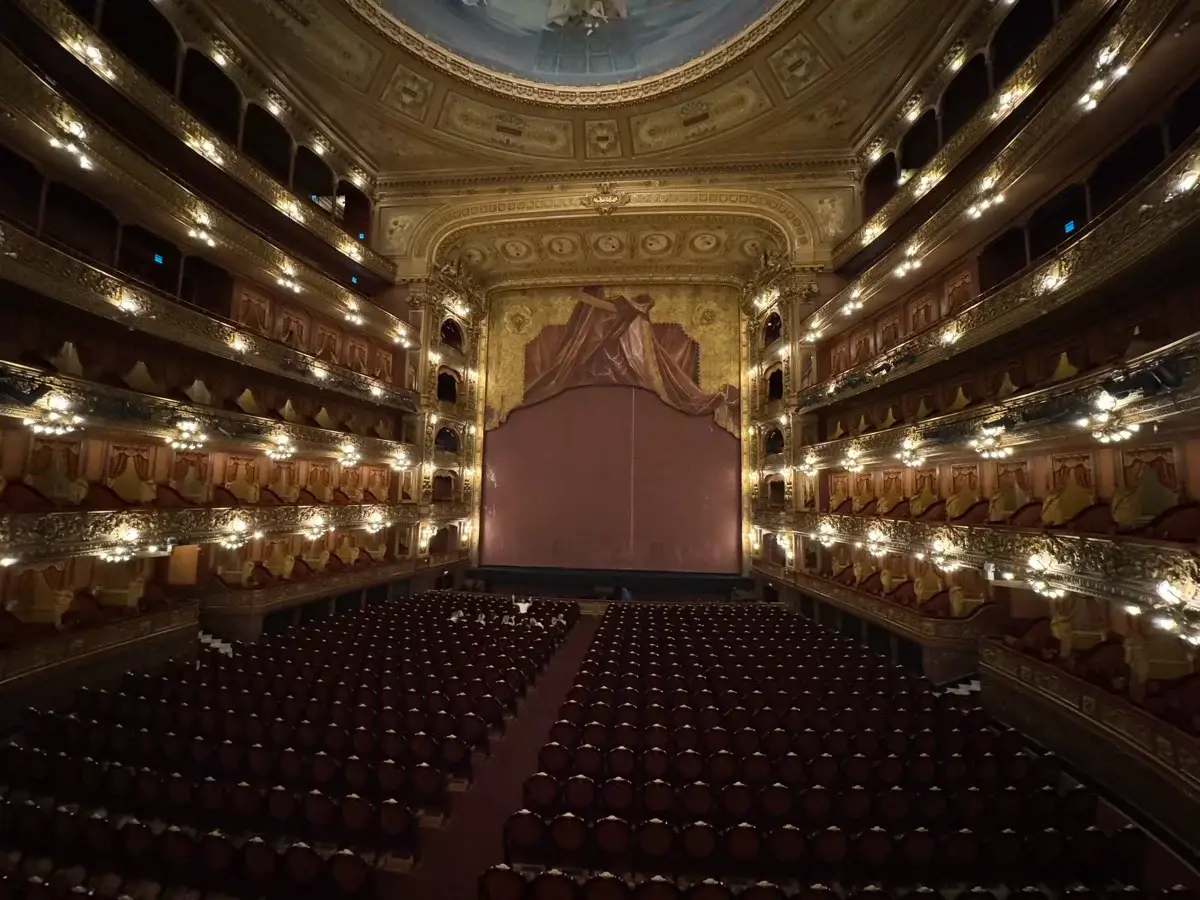
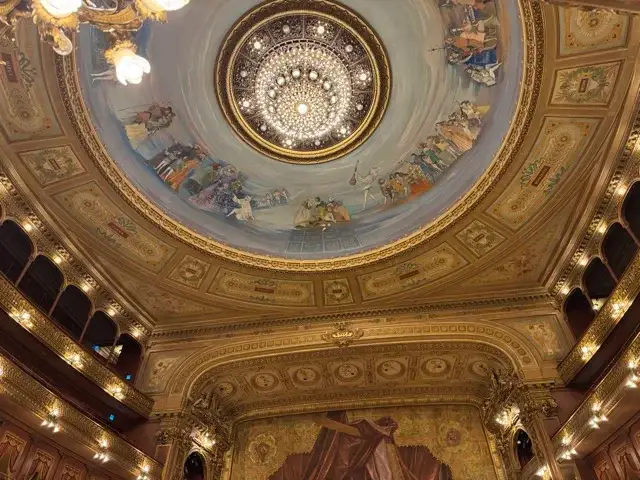
Theatre Colón’s concert hall is huge. There’s room for an audience of about 2,500 in seats and another 500 standing. Gold and red colours dominate the roughly horseshoe-shaped auditorium. In addition to the floor seating, there are, I think, four tiers of boxes. (It looks like five in the picture, but if I remember correctly what the guide said, I don’t think the top is for public seating.

The acoustics in the hall are reputed to be among the best in the world. Again according to the guide, experts say that the sound is better in the upper, less expensive tiers, although the view is obviously much worse.
Teatre Colón’s acoustics are such that performances don’t need microphones, but they can be heard well throughout the hall.
There are private boxes immediately beside either side of the stage. They angle slightly away from the stage, toward the audience. They are reserved for dignitaries. For example, the president and vice president each have one of these boxes reserved for them and their families. The mayor of Buenos Aires also has one of those boxes.

The guide conjectured that the reason these politicians want boxes angled a bit toward the audience and away from the stage is that they’re more interested in all of the audience being able to see them than in them being able to see the performance.
Teatro Colón is primarily an opera house with several opera seasons throughout the year. But it also stages ballet seasons, as well as some other concerts.
It’s now opera season. The opera currently in production is Aida. Therein lies the reason why I didn’t want to gain entry through buying a ticket to a performance. I’m not an opera fan. I don’t hate it, as such, but I don’t love it either. If that was as far as it went, I probably would have tried for a ticket, but there’s more. There is a particular operatic voice, which I haven’t isolated, that literally gives me a headache. And the headache can intensify greatly over time.
I can listen to some operas, or usually just sections of operas, that don’t induce a headache. I guess they don’t include that voice. So it’s not so much that I hate opera, per se, it’s that I hate splitting headaches.
I have a theory about that. I haven’t consulted anyone to try to determine if it makes any sense, but here it is. I’ve had perpetual tinnitus since my youth. It’s quite prominent, but I’ve kind of gotten used to it. My theory is that a certain operatic pitch sets up a resonant frequency with my tinnitus, which induces major headaches in me. Like I said, I have no idea if that’s true, but that’s the story I’m going to stick with.
Be that as it may, it probably wouldn’t have been an issue anyway because the guide said tickets are hard to come by and I’m not very good at planning anything far in advance. Obviously, the guide didn’t say that last part. How would he know about my tendencies? But taking those two factors together, I likely wouldn’t have been able to get a ticket even if I wanted one.
Despite not attending an opera, or maybe because I didn’t attend an opera, the visit to Teatro Colón was well worthwhile.
Discover more from Joel's Journeys & Jaunts
Subscribe to get the latest posts sent to your email.


What a comely building that theatre is! And the streets look very attractive as well. You got to see the Teatro Colón without all the grubby people filling it up for the opera, so that is something. But Aida is known for incorporating animals on stage – notably elephants. Now you will never know if they let them in, will you? Probably not. They are too much of a headache. Enjoy the next adventures. We, your faithful readers, are willing to bear the suspense to hear about them whenever is most convenient for you. You are on holiday, after all.
People spoil everything, don’t they?
Coincidentally, despite not seeing many operas, I did see Aida once, but it was probably about five decades ago. There was a performance of it when I was working at Ontario Place. I don’t remember much about it.
It was probably a stripped down version of it because I don’t remember elephants. I’m sure I would have remembered elephants if there were any. I particular would have remembered them trying to coax the elephants through the stage entrance hallway and onto the theatre-in-the-round stage of the Forum.
It was probably a performance without the staging. I don’t recall.
Thank you. I always feel silly saying I’m on holiday. To me, a holiday is a break from work. I’m retired. I’m on a break from vegetating on my couch.
A beautifully appointed interior indeed. And a fascinating theory about acoustic effects that trigger your headaches. I’m no ENT, but I’m persuaded.
It’s a theory. I’m not a ENT either. So, despite it being my own theory, I’m skeptical.