Central Buenos Aires
I spent this afternoon taking in a collection of sights in central Buenos Aires. Or, at least trying to take them in. In most cases, but not all, I succeeded.
Without further introduction, let’s get into it.
Central Buenos Aires Failure #1: Casa Rosada
The President of Argentina has his or her (currently his) office in Casa Rosada (Pink House), in central Buenos Aires. It’s from a balcony in Casa Rosada that Evita (of “Don’t Cry for Me” fame) addressed the masses of her supporters in Plaza de Mayo, which Casa Rosada faces.

My guidebook told me that they run an English tour in Casa Rosada on Sunday, and other days, at 2:30 in the afternoon. I finished lunch at about 2:00, and Google Maps told me Casa Rosada was only a fifteen-minute walk away, so there was plenty of time.
I recognized that, because my guidebook was at least a couple of years old, the tour times might have changed. However, try though I did, I couldn’t find any more up-to-date information online. So I decided to head over and take my chances.
I got to Casa Rosada and saw that there was a tall, black-post fence surrounding it. The only gate visible from the front of the building was firmly shut and guarded. To say the least, it did not look inviting. Threatening was more like it, as if it was forcefully trying to tell all and sundry, don’t even think about attempting to come in.
I started to walk on the sidewalk around the perimeter of the fence in case there was a less hostile entrance for visitors on another side of Casa Rosada.
When I got towards the back, I saw a sleek glass building. It sported signage that indicated, in Spanish, that it’s the museum of Casa Rosada.
I asked the attendant at the entrance about the English language tours. She told me in stilted English* that they stopped all of the tours a few years ago and never restarted them. She didn’t know why.
(* I always feel guilty when I say things like “stilted English” about speakers in countries where English isn’t the official language, such as here. Spanish is the language of Argentina. I was warned by guidebooks not to expect a lot of English here. I’m always greatly appreciative of any English I get, especially when I’m not expecting it. I mentioned the “stilted English” only to suggest there was some chance of miscommunication. Although I don’t think that was the case in this instance.)
So all I got to see of Casa Rosada was the exterior. It’s large, imposing, stately, and very pink. It got its name from the pink stone it’s constructed from.

Central Buenos Aires (Partial) Failure #12: Casa Rosada Museum
Since I was at the Casa Rosada Museum anyway and it was free, I decided to go in. The only thing it cost me was my time to put my cellphone on a conveyor so it could be x-rayed and for me to walk through a metal detector. There wasn’t any line, so that didn’t take long.
The exhibits are down a set of stairs in what I think is an archaeological excavation. Below the glass, there are some partial red-brick walls along with the other exhibits. The museum extends to an area that looks like a long, old, red-brick room with the wall missing between it and the adjacent glass-topped area.

There was lots of signage. None of it had any English. I used Google Translate on one of the panels, but gave up after that.
There was a collection of old vehicles that I assume had been presidential cars. But I’m not sure.
I spent a little time gawking at objects of which I didn’t know the significance. And then I left, not much more informed than when I had entered.
Success: Plaza de Mayo
I couldn’t help but visit Plaza de Mayo. It’s directly in front of Casa Rosada, and passing through it is the shortest route to the other sights I wanted to see this afternoon. (My itinerary expanded somewhat when given more time by the first two failures.)
The rest of my stops were successes as well, so I’ll stop prefixing the subheadings with “failure” or “success” hereafter.

Plaza de Mayo is Buenos Aires’s oldest and most central square, central to the politics that is. Gazing at a map, it looks fairly central on a north-south axis, but quite a bit east of the centre on the east-west axis. What I meant by saying it’s central is that I’ve read that most major demonstrations and celebrations are held there.
Fortunately, when I was in Plaza de Mayo, it was quite quiet, with no protests or celebrations of any kind. There were just a few people walking through or sitting on one of the available backless benches. (P.S.: I think I mentioned it elsewhere in these pages before. I hate backless benches. For I don’t remember how many years now, if I sit for too long on a backless bench, my back starts to hurt. And after a while, the pain becomes excruciating. I doubt I’m the only one. Urban planners, please take note.)
To be honest, I wasn’t overly impressed with Plaza de Mayo. It has a few trees, including palms, in some patches of grass, an obelisk, a flag, lots of paving stones, some of the previously noted backless benches, and not much else. If its primary purpose is to serve as a venue for large gatherings, it looks like it would serve that purpose well. But I didn’t find it terribly engaging or visually appealing. It’s not ugly in the least, just not beautiful to my eyes.

Catedral Metropolitana
The Catedral Metropolitana is right across the street toward one end of Plaza de Mayo. It doesn’t take a Spanish speaker to guess that it’s a cathedral.
To me, the exterior doesn’t look like a church. It looked more like a very much cleaned up ancient, columned Roman or Greek administrative building. (A certain reader will likely sneer at me for not knowing the difference between Greek and Roman columns.)
There are some religious symbols, but no cross that I saw.

Inside it does look like a classic church. There’s an arched ceiling with decorative moldings above the central nave. They’ve lit the ceiling to give it a golden hue.
There are some side chapels, including one that’s the mausoleum of General José de San Martín. He became a national hero when he led the nation to independence. But Argentina’s political history is complicated. There was chaos after independence and General José de San Martín self-exiled to France. His remains weren’t brought to Catedral Metropolitana until 30 years after his death.
Two ceremonially dressed guards stand unflinchingly at the entrance to the mausoleum, one on either side of the entryway. By complete coincidence, there was a changing of the guard ceremony when I was in the cathedral. Five similarly uniformed guards—two to replace the current guards and three escorts—precision marched in from the entrance of the cathedral to where the mausoleum guards were stationed. When they got there, there was some precision stomping before two new guards replaced the old ones, and the new group of five—escorts and replaced guards—precision marched out.

So, there was that.

Centro Cultural Kirchner

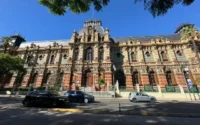
My guidebook recommended Central Buenos Aires’s Centro Cultural Kirchner strictly for its architecture. It’s in a former post office building modelled after New York City’s main post office. Néstor Kirchner, who first proposed the project, died before its completion.
As the name suggests, it’s a cultural centre. According to my guidebook, it hosts a very eclectic variety of cultural events. The book said that there are often free events that allow you to go inside to explore the architecture. I didn’t see any events open to me, but the building was open so I went in and took a brief gander.
The most dominant feature is a concert hall that allegedly has amazing acoustics. The hall wasn’t open, so I didn’t get to go inside. But even from the outside, it’s kind of amazing. It sits in a large carved out section of the building.
The concert hall is a large metal blob with a sloped bottom. That sloped bottom is to provide seat raking inside, I suppose. The blob floats on top of some large pillars and is entirely interior to the containing building.

Underneath the blob, there’s a usable performance space. When I was there, they were setting up some tables and chairs cabaret style with some musical instruments in front.
Cool place and very attractive.
But, as I often am, I’m a bit confused. The building is located where Google Maps says the Centro Cultural Kirchner building should be. The words “Centro Cultural Kirchner” are carved in stone in big letters near the top, front of the building. So I’m pretty sure that’s what it is.
But there were also large banners on either side of the entrance proclaiming it, “Palacio Libertad.” Another big sign just inside the entrance said the same thing. When I looked at Google Maps, it showed a Palacio Libertad a bit down the street from where it showed the Centro Cultural Kirchner and I were.
So, what is it? Did the Palacio Libertad move and take over the Centro Cultural Kirchner, but it was too expensive, or they hadn’t yet gotten around to removing the section of stone with the large chiselled label? Or is the Palacio Libertad now a subcomponent of the Centro Cultural Kirchner? I haven’t a clue.
Galerias Pacifico

Galerías Pacifico is a shopping mall in central Buenos Aires. I’m not into shopping malls, but it’s a beautiful and not overly big one. The mall corridors are three storeys tall, with one floor below ground level. Three of those four levels, below ground, ground, and the first level above ground level, have retail.
The top level looks like it contains offices. Rather than storefronts, that floor has arched windows it the stone walls, with no light shining through the windows. (Today is Sunday, so it would make sense that offices would have dark windows today.)
Most of the corridors are atriums that rise to the glass ceilings at the top of the building. The one exception is at the intersection of two corridors. There, there’s an opaque arched ceiling above the first floor. The underside of it is decorated with classical-style paintings.
The shops in the Galerías Pacifico were mostly mid- to upper-scale. Where I came in, there were some people peddling brand-name perfumes who were eager to spritz anyone who showed any interest whatsoever in being spritzed. I didn’t show such interest and wasn’t spritzed.

In addition to the famous-name perfumes, I spotted a few international brands on the stores, such as Lacoste and Chanel, but most were names I didn’t recognize. I don’t know if that meant that they are independent stores or just brands that haven’t made it to Toronto and don’t market internationally, so I’m not familiar with them.
I didn’t spend a lot of time in Galerias Pacifico because, as a rule, I hate malls—and shopping, in general. But, as malls go, it’s a very attractive one.
Wow. Busy afternoon in Central Buenos Aires. Time to call it quits.
Discover more from Joel's Journeys & Jaunts
Subscribe to get the latest posts sent to your email.


A lot of good gandering going on today. By the way, because the Romans wholly adopted the Greek architectural orders, you are perfectly in line wondering if the facade of the cathedral was Greek or Roman. It has a typical Greek temple front with Corinthian columns, which the Romans preferred. In Argentina, it would, of course, be Neoclassical, which could be inspired by either or both, so you are safe. Lesson over. But then, because all of the informational labels you saw were in a language you don’t speak, I feel duty bound to submit one of my own making.
Congratulations at being dour and agile enough to escape the spritzers. There should be a security warning about that.
Thanks for the information. Those Romans were so derivative, weren’t they?
I’m a less agile than I used to be and I was never all that agile, but I do my best to avoid spritzers, usually by not going into anywhere where they might be because that usually involves shopping.