Himeji Castle
Before I get into talking about Himeji Castle, I forgot to mention in my post on my arrival in Himeji yesterday that this is my first time in Himeji. I didn’t stop here during my one other trip to Japan. So, everything here was new to me.
I’m using three guidebooks on this Japan trip. I’m not happy with any of them. However, combined, they almost do the job, albeit inconveniently, as I have to switch back and forth between them. My walking tour app, which has usually been a secondary resource on other trips, has been more useful than the guidebooks on this trip. However, that’s only true when it has a tour for the city I’m in. It doesn’t have one for Himeji.
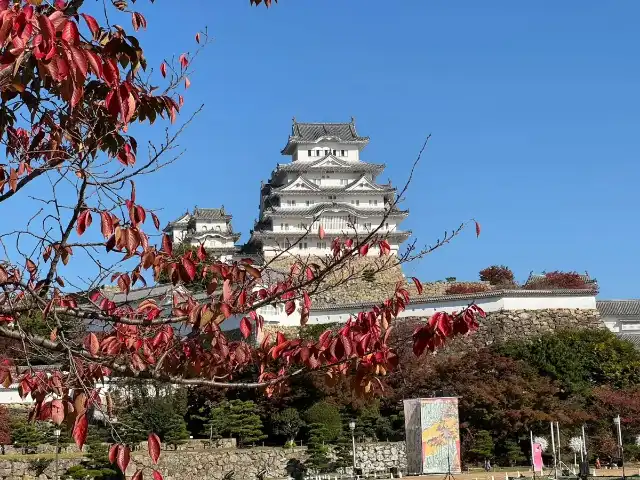
One of my guidebooks mentions three sights in Himeji. Another describes two of those three. The third lists just one. The one sight they all discuss, and all in glowing terms, is Himeji Castle. That’s where I spent this morning.
All of my guidebooks call it Himeji Castle. A brochure handed out at the site uses that as the name of the castle in its titles, headings and body copy. The brochure, but only one of my guidebooks, says that it is also known as “White Heron Castle.” The brochure explains that it is called that “for its soaring keep and brilliant white plaster walls.”
The brochure goes on to claim that it is Japan’s most-visited castle. I can believe that. There were a lot of people there. I suppose that’s to be expected when all Japan guidebooks highly recommend it, but little else in Himeji.
Many other old castles, temples, and shrines in Japan succumbed to fires, attacks, and/or bombs, some of them multiple times over their history. For them, what stands today as a place of worship for shrines and temples, and for tourists to gawk at in the case of those and castles too, is often a much more recent reproduction.
Not so Himeji Castle.
The brochure says that the main keep of the castle was built in 1601. It has gone through regular restoration since the early 1900s, but that’s to be expected. Buildings suffer wear, tear, and the other ravages of time. If I own my condo that long, I’ll probably hire someone to do some restoration work on it too after the first 300 years; 400, tops.
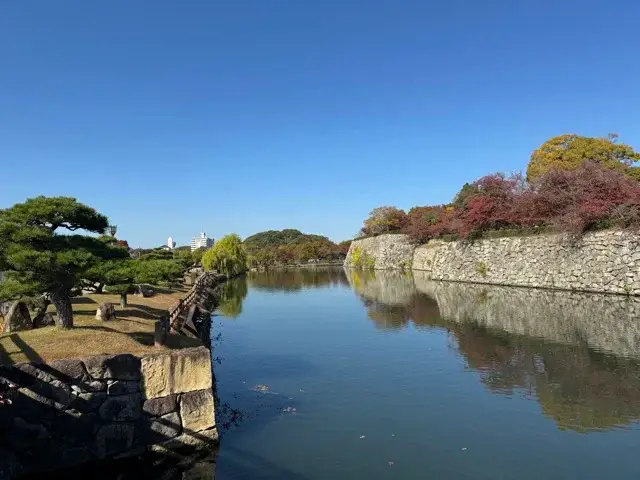
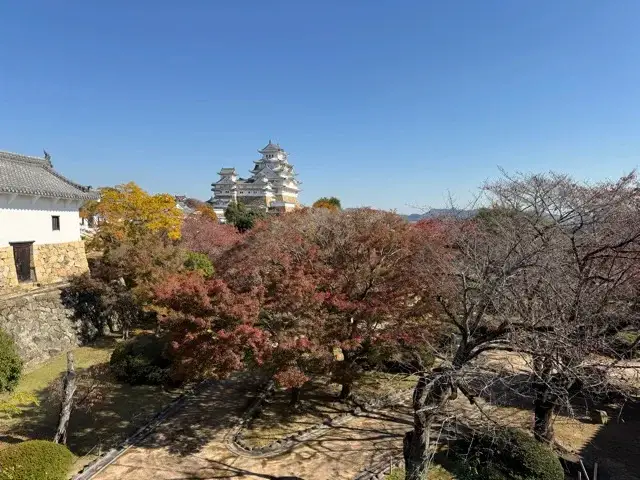
The Himeji Castle compound sits behind a moat and a stone wall fortification, as is the wont of castles in many places. There is also some charming parkland within the compound and beyond it.
Himeji Castle Main Keep
The eye-grabber of Himeji Castle is its main castle keep. It stands on a small hill within the compound because no seats were available. Rather than sitting on, say, a couch, it stands on an approximately two- or three-storey base made of unworked stone blocks mortared together.
The shape of the main keep is vaguely similar to the shape of the tower at Osaka Castle, which I saw just a couple of days ago. (Time is flying. I checked. It’s more like five days ago.) The building is tiered with roofs shaped close to what you’d find on a pagoda on each of the tiers.
The main keep of Himeji’s castle is more dazzling than the tower of Osaka’s castle. Sorry, Osaka. It just is. The Himeji keep soars more than Osaka’s tower. And the white of the walls is more brilliant. What’s more, other than the restoration work done over the years to keep it from falling apart and looking dingy, the Himeji Castle is the original. The Osaka Castle, on the other hand, was rebuilt a few times after the earlier versions were destroyed.
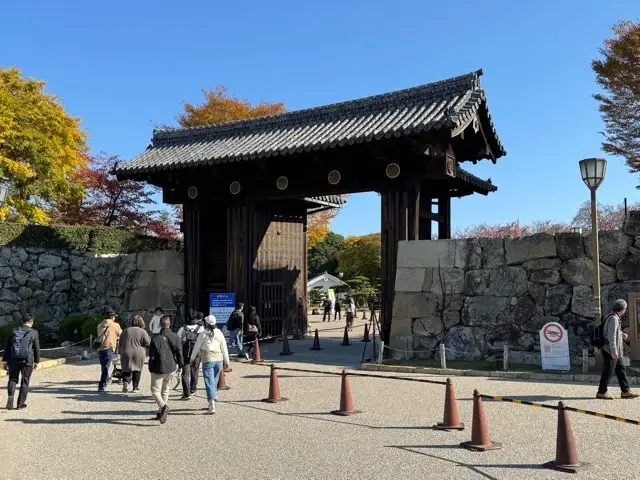
Paying customers are allowed into the main keep. Non-paying customers aren’t customers at all, just visitors, and they’re not allowed far into the castle compound.
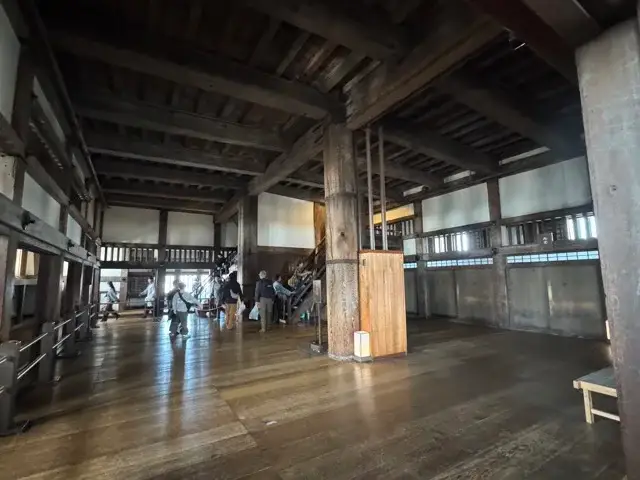
You have to take off your shoes before entering the main keep. They provide plastic bags for you to place your shoes in and carry them around with you as you tour through the keep on its wooden floors.
Inside, the keep is not furnished, but the walls, beams and pillars (both cuboid and cylindrical pillars) are made of dark, rich wood. It’s a very warm, handsome look.
The tourist route through the main keep of the Himeji Castle goes up one set of stairs to the top level, and then back down another set of stairs. There were too many people in the keep to let them just wander around higgledy-piggledy.
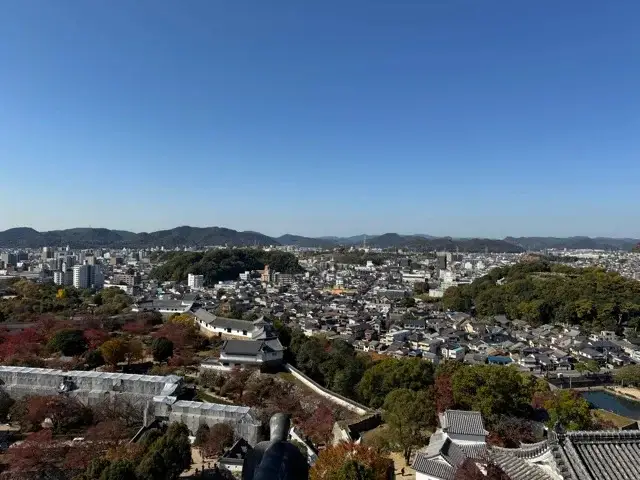
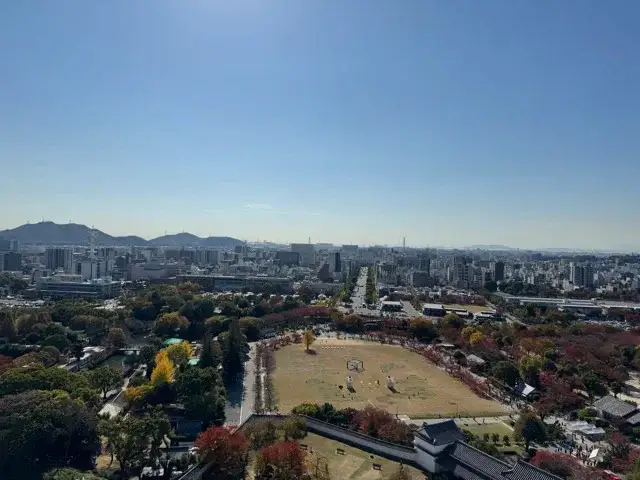
From the upper levels, the views of the surrounding area of Himeji are commanding.
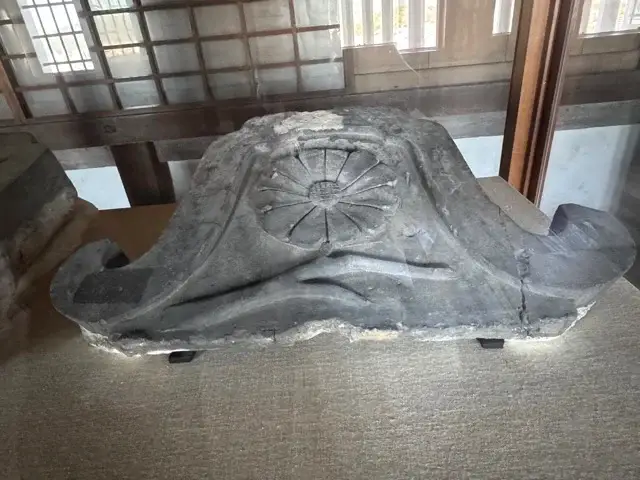
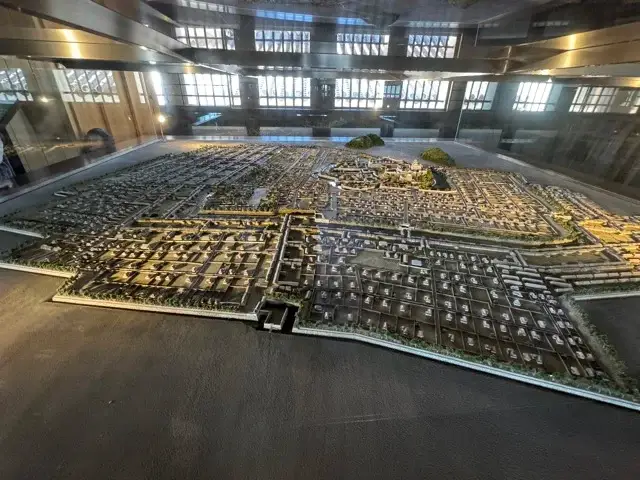
Near the exit of the main keep, there is an exhibit area with some decorative architectural elements that were, at one time, mounted on the castle. There is also a model of the castle compound and the old castle town that surrounded it. An accompanying sign explains that, “Himeji Castle’s original fortifications extended beyond the main castle grounds to include several neighborhoods (sic) protected by moats and earthen embankments. This entire area was often collectively referred to as Himeji Castle.”
Himeji Castle’s Long Bailey
Himeji Castle corrals visitors along a route through a portion of the grounds to the main keep, through the keep, and then out again.
You can also take a separate optional route, at no additional charge.
Damn, that was a silly thing to say. Not the “at no additional charge” part. That provides valuable information. But “separate optional route” might mislead you. Both routes are optional. You don’t have to come to Himeji at all. Or, if you come to Himeji, you don’t have to go to Himeji Castle. Or you can go to the castle, buy a ticket, throw it away, leave, and go for a drink instead. It’s up to you.
But if you don’t go on the castle keep route, then what the heck’s the point of coming to Himeji at all? The castle and its main keep are the star attractions here.
The two routes are not overlapping. The second one takes you to and through the castle’s Long Bailey. Both routes start near the entry/exit to the paid area of the castle compound. I walked along the keep route first, and then the shorter bailey route.
I often show my former deplorable ignorance in these pages. Then I learn something during my travels and become a little less ignorant. Then I forget it and become more ignorant again. It’s part of the circle of life or, at least, my life.
What I learned today is that a bailey is the outer wall of a castle. Himeji Castle has a bailey building on part of its defensive wall. It’s a long building. Hence, “Long Bailey.”
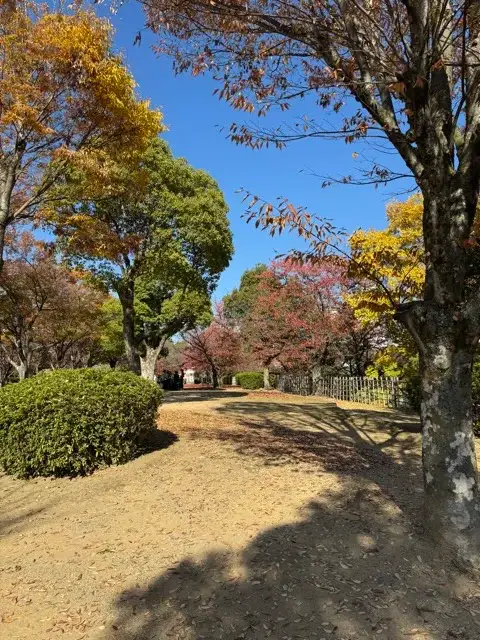
The bailey has some angles along its length, but few of them are right angles. On two sides, its walls border a lovely grass-and-trees garden.
Like at the main keep, paying visitors can walk through the Long Bailey. And also like at the main keep, visitors have to take off their shoes and carry them in a provided plastic bag as they walk through, entering at one end of the long, bendy hall and out the other.
Along the bailey, there are text panels in Japanese and English and a few displays. The panels provide information on:
- The history of Himeji Castle and its predecessor fortifications.
- The “Lords of Himeji” from the beginning of the 17th century up to well into the 19th century. It also provides the names of the clans from which those lords came at different times.
- The construction of the castle, including the materials and craftsmanship.
- The history of Princess Sen (1597–1666), who was the daughter of one of the Shoguns and who lived in the Long Bailey for some time. She was, according to what I read, much beloved.
After I finished going through the Long Bailey and admiring its garden, it was past time to head out and scavenge lunch outside of the castle compound. Food is not allowed inside the castle compound. You’re not allowed to carry any, and there aren’t any restaurants inside the castle compound walls. Damn. The residents of the castle back in the day must have starved to death if that was the rule then.
Discover more from Joel's Journeys & Jaunts
Subscribe to get the latest posts sent to your email.


Awesome castle, we visited during the Sakura and it was just beautiful.
I’ve read that the blossoms are spectacular. I’m sorry I missed the Sakura. Although, I imagine the crowds are enormous.
We were super lucky. Blossoms in Tokyo, finished in Kyoto and full blossom in Himeiji again. We came to the castle before it had opened in the morning and were first through the gates, had the top floor to ourselves, amazing.
A very impressive castle. Too bad a person gets driven out by hunger. One way to deal with crowd control. I don’t know about you, but at some point if I have been hungry for too long, I could lay waste to almost anything in my path. And without food, the castle is effectively under siege. The only thing to do for it is what you have done – bust out and reflect on your visit over lunch. Thankfully, that turned into a lovely post for us.
I found a restaurant across the street from the castle and I wasn’t going to go any farther no matter what the restaurant or its menu looked out. I imagine they get a lot of business that way. Turns out, the food was good—not tremendous, but good and not terribly expensive.