Hi, Himeji
I left Osaka this morning and moved on to Himeji, where I am now. My walking tour app doesn’t have a tour for Himeji. The advice I got elsewhere essentially said, stop at Himeji on the way between here and there, see the castle and perhaps one or two other attractions, then move on without overnighting in Himeji.
But I feared doing too much on this trip for a man my age and burning out. So, I’ve booked two nights here. There are things to see, but I don’t think it’ll be a hectic pace in Himeji. We’ll see.
The high-speed train I was on left Shin-Osaka (the separate train station in Osaka for Shinkansen trains) at 11:20. After a train trip of slightly less than half an hour, I was at my hotel across from the Himeji train station by noon.
My room wasn’t ready, so I checked my bags at the front desk, had some lunch in a restaurant a couple of minutes’ walk from my hotel, and headed out for a little sightseeing.
Rather than hitting the highlight of Himeji tourism, Himeji Castle, I decided to head to a literal high point of the city, Engyo-ji Temple.
Rising Above Himeji: Mount Shosha Ropeway
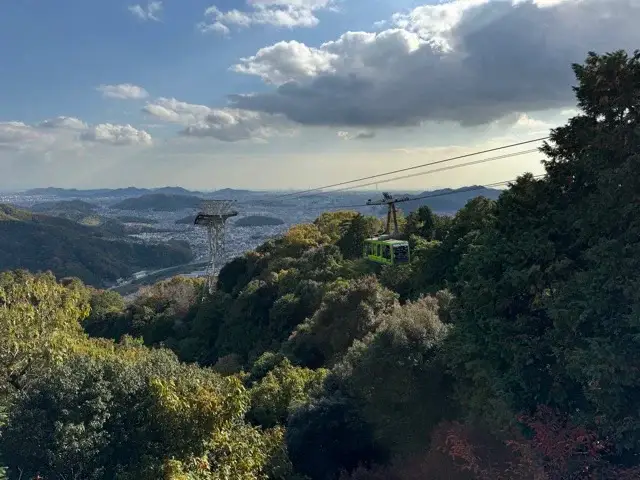
Engyo-ji is a Buddhist temple near the top of Himeji’s Mount Shosha.
Getting to Engyo-ji involved walking a couple of minutes from where I had lunch to a city bus stop and riding that bus for about half an hour to the end of its line.
The end of the line is the lower station of a ropeway up Mount Shosha.
I was hip to ropeways from my time in Hakone on this trip. I knew that, despite the name, they use heavy metal cables, not hemp or some other type of ropes. Well-constructed gondolas grasp those cables firmly to take you up or down a mountain.
So, I didn’t have the sort of fear I had the first time I heard the term “ropeway” and wasn’t yet familiar with the concept or, at least, that name for it.
But the Mount Shosha ropeway differs somewhat from the Hakone ropeways.
At Hakone, the gondolas stream by frequently. There are usually at least two gondolas in a station at any point in time. The first one is already loading when the next one offloads its passengers. In motion, there’s not a huge gap between one gondola and the next.
The gondolas stop for unloading and loading, but passengers are expected not to dally, so the stream of gondolas can keep flowing.
Each gondola in Hakone had a maximum capacity of maybe a dozen people, and they sat on benches.
In contrast, the Mount Shosha ropeway has only two, I won’t call them gondolas, but cabs. One cab goes up while the other goes down. Then, after a pause to unload people and load on new people, plus, I think to wait until a set time, they begin their next journey.
The Mount Shosha ropeway cabs aren’t much bigger than what I remember of the Hakone gondolas, but all passengers stand. The ropeway attendants squeezed about three dozen passengers on.
This raised a couple of questions in my mind. First, can those cables really hold all that weight? And second, how much disease is crammed into the cab?
Fortunately, the windows were open, and it took less than five minutes to reach the top.
During those almost five minutes, a recording spoke practically nonstop in Japanese. Just before the cab got to the top, it switched to English, in which it said little more than, ”It takes about 20 minutes to walk to the main temple building and two hours to see all the buildings in the compound.”
(On the way down, the recording spoke for about the same length of time in Japanese. Just before the bottom, it said in English something along the lines of, “Thank you for riding the Mount Shosha ropeway. There are some other sights in Himeji (the recording named a couple). We hope you’ll visit them and enjoy your time in Himeji.)
Engyo-ji Temple
Engyo-Ji is a large temple complex that looks down on Himeji. Literally.
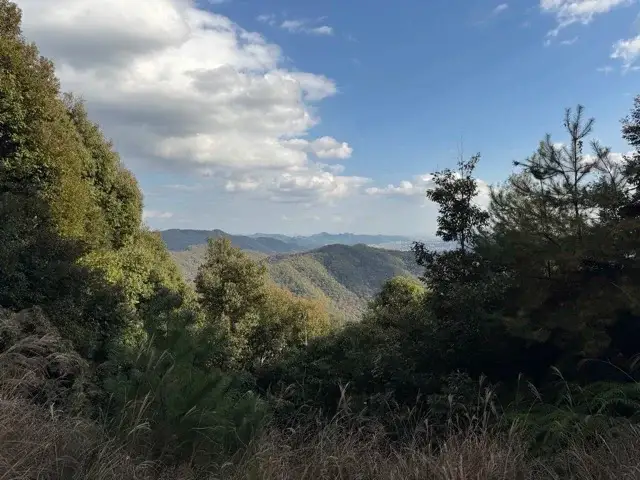
It’s in a well forested area on the top of Mount Shosha, so there aren’t a lot of clearings through which you can gaze out on the scene below, but there are a few. That includes one beside the upper station of the ropeway. And there are a couple of others elsewhere that also provide views.
And those views are spectacular. Himeji unfolded in front of me, with forests in the foreground and more mountains in the background. Cities are always better when they’re unfolded so people don’t get trapped inside.
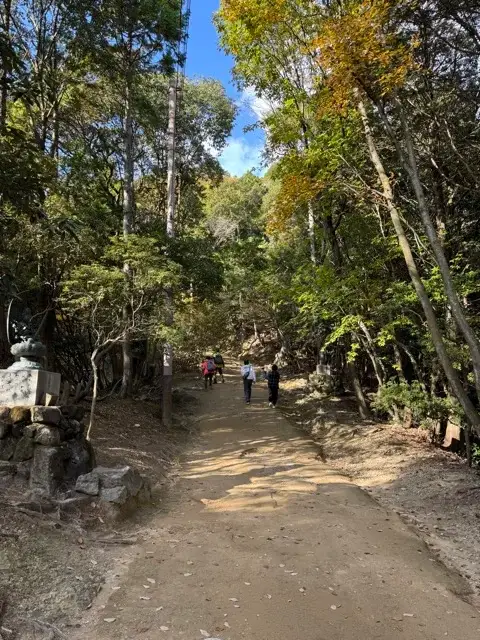
The walk from the ropeway station is on a hard-packed, rough, earthen road. I didn’t time it, but I think the announcement was approximately correct about it being a 20-minute walk to the main temple building. However, it’s a steady uphill climb starting just a little ways away from the station.
The gradient of the hill isn’t brutal, but it’s certainly noticeable. There is a shuttle minibus that runs from the station to the main building. It costs ¥500, which isn’t much, but I decided a walk in the woods would do me good. That, and I didn’t learn about the shuttle bus until I returned to the ropeway station later.
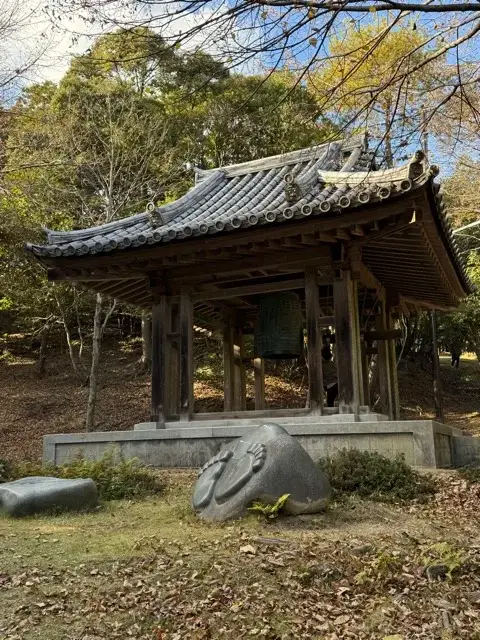
Just beyond the ropeway station, there’s a modest but handsome wooden structure with a large temple bell hanging from the ceiling. A swinging battering ram can be used to chime the bell. A sign by the bell names it as the “Bell of Benevolence.” Bonus points for alliteration.
It also says that, “While most temple bells are rung to mark the time or special occasions, this particular bell was dedicated to offer prayers for world peace and spread Buddha’s teachings.”
World peace. I’ll drink to that. Wait. I realized only just now that I have no idea what the Buddhist take on drinking is. Never mind.
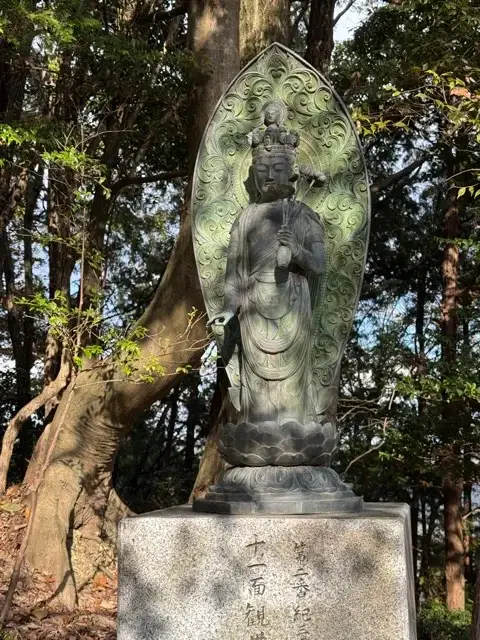
Along the road to the main building, at fairly regular intervals, off to one side of the road, and sometimes the other, there are small Buddhist statues on pedestals.

Also along the road, there was one of those clearings I mentioned that delivered an amazing vista. This one, however, wasn’t of Himeji but of some of the other forested mountains near Himeji.
Less than twenty minutes from the ropeway station, I came to the main temple gate. It’s a dark wood affair that’s simple, attractive, and serves its purpose of marking the entrance to the Engyo-ji Temple compound.
Beyond the gate, the regular roadside statues ended, but I passed some subsidiary temples and simple statues, all of it located along a rough road in gorgeous woods.
Maniden
(A note about names: I took the spellings of the building names from a leaflet handed out at Enjo-ji Temple. The temple’s website has hyphens in most of the building names, e.g. “Mani-den” and “Jogyo-do.” The leaflet doesn’t. The leaflet also spells the temple name, without a hyphen, “Engyoji Temple,” but the consensus everywhere else has a hyphen, so I placed one there. They’re transliterations of Japanese names, so who knows?)
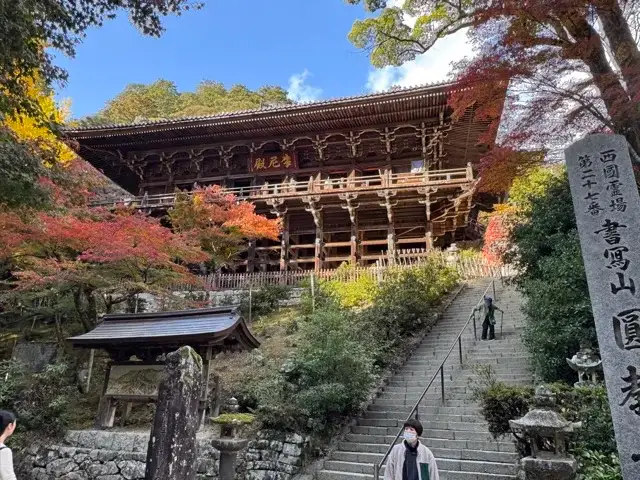
I think what the recording on the ropeway referred to as the main temple is Maniden. It was about twenty minutes from the ropeway station, and near the top of the mountain. So it fit the bill. Plus, it’s an absolutely grand building up a set of concrete stairs.

From the bottom of the stairs, it looks like a two-level building. But I think what looks like a lower level is the supports that allow the building to cantilever out over the hill.
Maniden was built in 970 CE. It stood until 1921, more than 950 years, when it burned down. The building standing there now was finished in 1932.
To enter the building, I had to take off my shoes. Inside, there was a lot of dark wood, an incense urn with sand at the bottom to hold the burning incense sticks upright, some Buddhist icons, and a large wooden box with a slotted top.
This is standard fare in the Buddhist temples I’ve been in here. The slotted box is always immediately in front of the inner sanctum of the temple, which is separated from the public area by a wall with large windows in it. In other temples, I’ve seen people briefly praying while facing the inner sanctum beyond the box and dropping coins into the slots. No one did that at Maniden when I was there.

Another activity that went on there that I’ve seen happen at most (all?) other Buddhist temples in Japan I’ve been to is people patiently lined up in front of windows in a booth. People on the other side of the booth windows painted calligraphy in notebooks or on small, light coloured wood planks available at the temple for the people in line.
I don’t know what that’s about. Considering that it’s a temple, I assume the calligraphy records a prayer or wish, but I don’t know. If anyone reading this knows, or wants to do the research, please let me know in the comments. Lazy enquiring minds want to know.
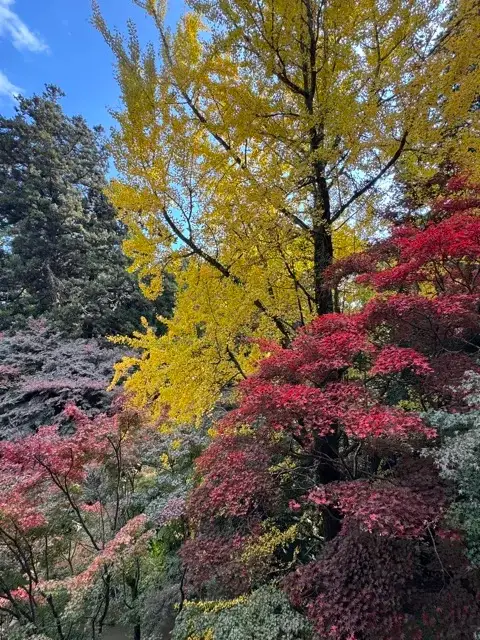
Outside the inner public area of Maniden, there’s a wooden platform surrounding part of the building. It doesn’t provide views of Himeji, but the view of another building and the surrounding forest is breathtaking, particularly at this time of year.
When I left Maniden, in a flat area beside the building, a busker couple was performing. They demarcated their performance area with a rope. And they had props and a recorded instrumental background. One of the performers didn’t do much performing, but she provided all of the commentary, exclusively in Japanese. And she coaxed her performance partner as necessary.
At least, I think they were buskers. I didn’t see a money receptacle. They were already into their performance when I spotted them, and I left before they finished. So one of them might have come around with a hat or something at the end of the show.
Oh, the other busker in the duo? It was a monkey dressed in a colourful shirt and shorts. It did some tricks, such as walking on stilts and leaping over a hurdle while still on the stilts. So, that happened.
Here’s a video of a small part of their show:
I didn’t notice it at the time, but when I watched that video again, I heard an audience member mention the word “dinero.” So I guess at least one other person was wondering if and when they’ll ask for money.
After I left the performance, which I stayed at for only a few minutes, I walked farther along the same rough road that took me to Maniden. After a while, including walking down a hill only to have to walk up another, I found another fabulous building. Or, rather, a cluster of three fabulous buildings.
Mitsunodo
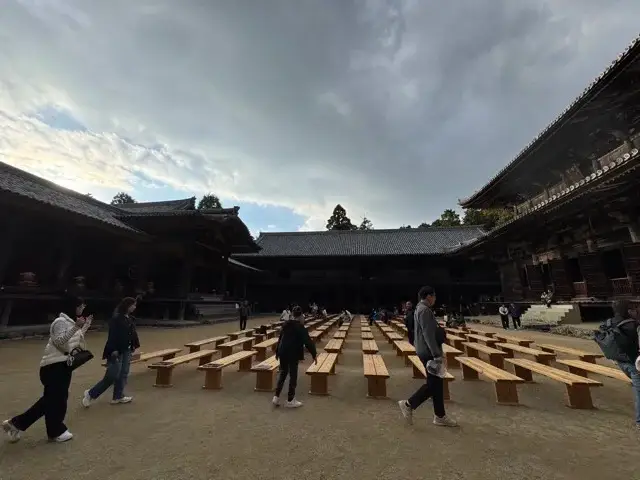
Collectively, the three beautiful wooden buildings are called Mitsunodo. They are arranged in a “U” shape, with the corners of the buildings close to each other. The three buildings are: Daikodo, a former auditorium used as a Buddhist training and learning centre; Jikido, which is believed to have been both a priest’s training centre and a boarding house; and Jogyodo, which was also a training hall.
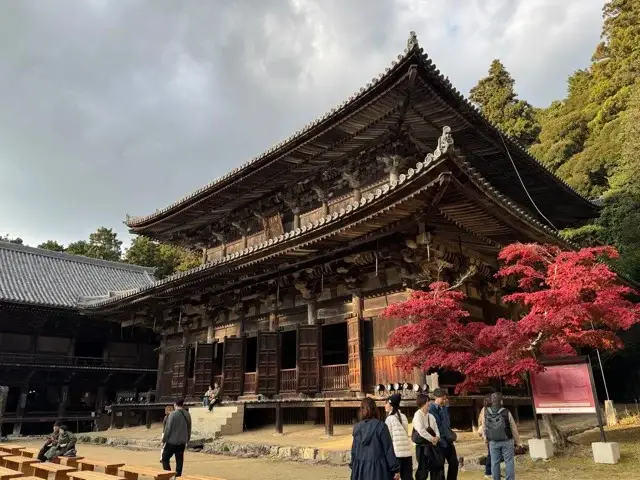
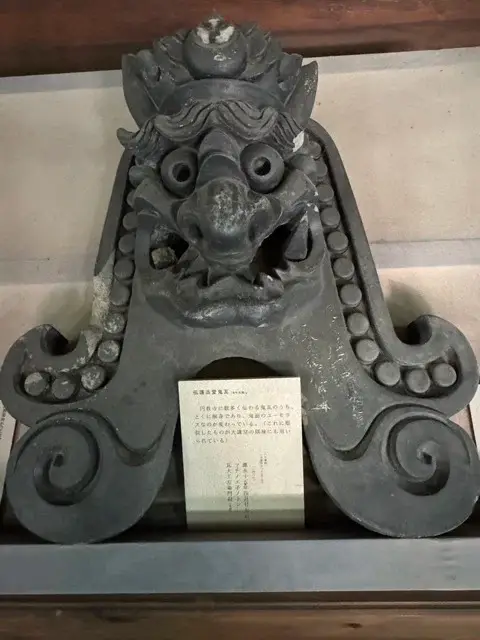
Jikido is the only building of the three that the public was allowed into (after taking off their shoes). There’s a museum inside containing various statues and statue fragments, including some that looked like they’d been attached to buildings.
There were no signs regarding the taking of photographs in the museum. That usually means photography is OK there. But, just to be on the safe side, I asked someone working there. He eagerly said yes. Hence, the pictures here.

Jikido forms the base of the “U” of buildings.
Jogyodo, on one of the sides of the “U,” has an open front, creating a covered stage facing the square in the middle of the “U.” Today, there was a row of big drums in a row on that stage. Several benches were set up in the square. I assume that there was going to be some sort of show. I don’t think that one would involve a monkey.
By the time I left, the benches were starting to fill up, and more people were coming up the road. I thought about sticking around to see what it was all about, but the sun was getting low in the sky, and I was getting ready to head back to my hotel in central Himeji after spending about three hours on top of Mount Shosha.
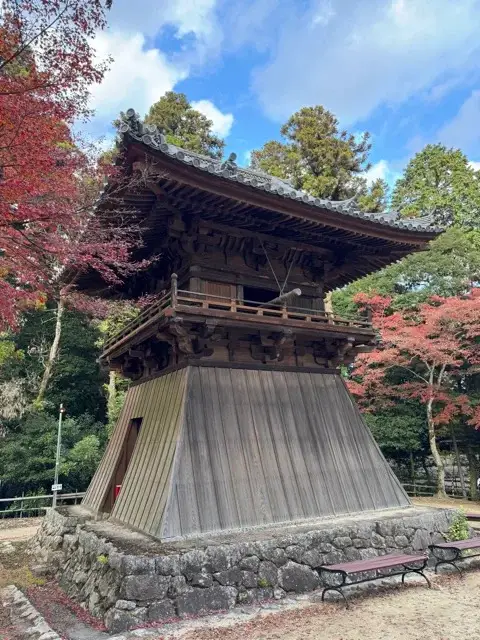
I did, however, walk a little farther along the road and came to an old wooden belfry building. Back before clocks became common, the bell in the belfry was rung every two hours so people could keep track of the time. It was also rung on special occasions.
That sight seen, it was time to head back to the ropeway and down to the Himeji city bus to end my day.
I’ll be in Himeji all day tomorrow. So, more to come.
Discover more from Joel's Journeys & Jaunts
Subscribe to get the latest posts sent to your email.


Holy Mackerel, that was a cool fish sculpture! Actually, my eyes got their fill of breathtaking beauty looking at the views with the gorgeous fall colours. Truly spectacular. Makes me feel sorry for those people who come in the summer. Hard to try and think away the colours back to variations of green, but I am sure the woods and grounds are beautiful then, too. What a lot of really compelling activities you get up to when you travel! I can understand if life feels dull after a while at home. You could always train a pet monkey to do tricks. Clever little thing. I hope it is well treated. As to the calligraphy that you saw, I felt duty bound to help you with the research (at least, unless you put up a paywall for your blogs, in which case you are on your own, buddy) and found out that it is a temple stamp that worshippers (and I suppose others) collect as mementos of the different shrines they visit, called goshuin. They are considered sacred. At least that is what this site told me: https://www.japan.travel/en/blog/collecting-goshuin-shrine-and-temple-stamps/. You’re welcome.
I thought you’d like the fish sculpture. I took more pictures of the sculptures than I posted, but I made sure to post that one.
I, too, can’t mentally roll back the colours of the leaves to all green, but I imagine it’s still beautiful with the mountain greenery and the city in the valley, just not quite as splendiferous.
“I hope it is well treated” is precisely what I was thinking while watching the monkey and the supporting actor, its handler. There were times when the handler had to gently coax the monkey with words and a gentle pat on the shoulder, and it never seemed particularly eager. Then again, I’m not a monkey psychologist, so maybe I was just misreading it. Had it not been for the thought “I hope it is well treated” repeating in my head, I might have stayed and watched longer.
Thanks for the information about the goshuin. So, now I know. If I ever put up a paywall on this (I can’t imagine that ever happening, EVER), I’ll be sure to give you a free pass for your efforts.