Isui-en Garden, a Temple, and a Shrine

Today was another day when I didn’t finish the post for my morning activities until late. I can’t wait until the next day to write a post because I’ll forget everything if I do. As a result, this entry is probably going to be another post that’s rushed, briefer than it deserves to be, and even more prone to typos than usual. Sorry about that.
In the afternoon, I continued my day trip to Nara from Osaka, which I started this morning. I had lunch today in a tearoom beside my first sight of the afternoon, Isui-en Garden. The lunch was a set menu, which included a cold potato soup with some greens and a raw egg on the side that I was told was to be stirred into the soup, some steamed rice, and some tasty morsels that were to be eaten with the rice. There was also a cup of tea on the tray with everything else when it was brought out to me.
My table looked out on Isui-en Garden. It was a delightful lunch.
After visiting Isui-en Garden, I then went to a temple and a shrine, both within Nara Park, before heading back to Osaka.
I leave Osaka tomorrow morning for my next destination. So, expect a summary at the end of this post. There’s an off chance that I might remember to put it there before I scurry off to bed to get some sleep.
Isui-en Garden
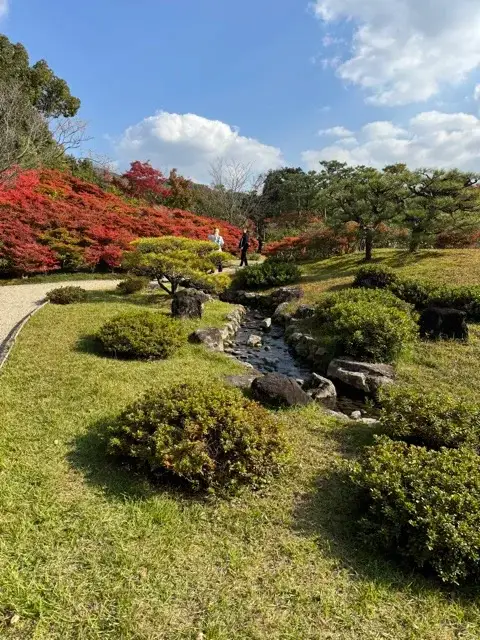
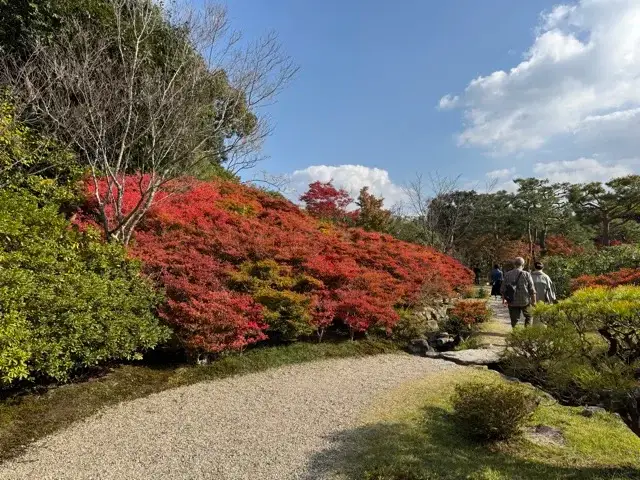
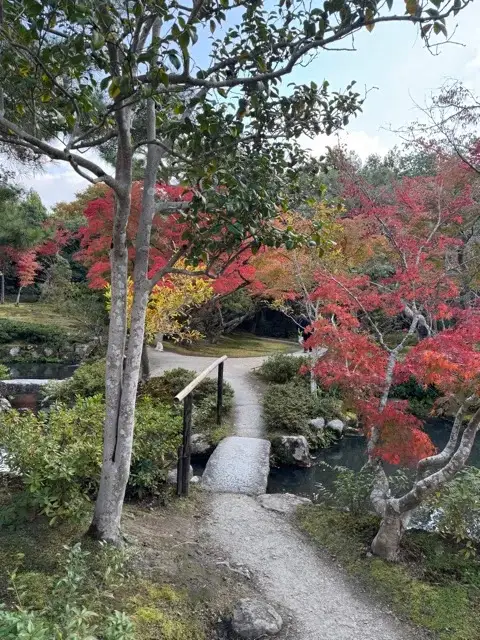
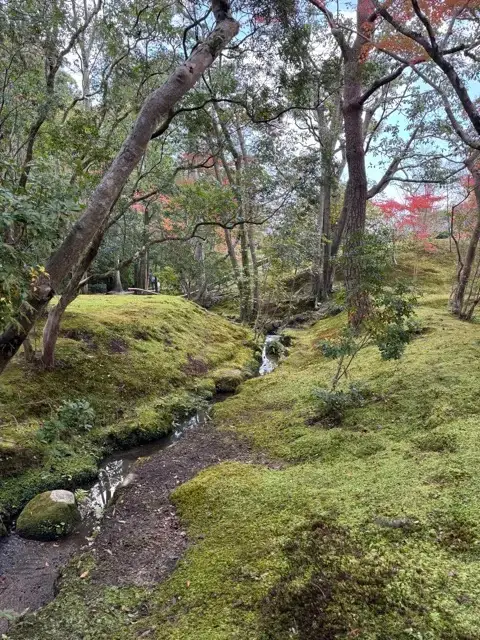
Isui-en Garden is a beautiful, traditional Japanese garden. A path wends through it around a couple of ponds, by a babbling stream that gurgles over some rocks and a tiny falls, by some stepping stones, through treed areas (some with moss floors), past some shrubs, and beyond a waterwheel that water turns.
Because of the season, namely fall here in mid-November, many of the trees and bushes had bright red leaves. It was gorgeous. In the interest of time (primarily mine), I’ll cut the description short and just let you enjoy the pictures below.

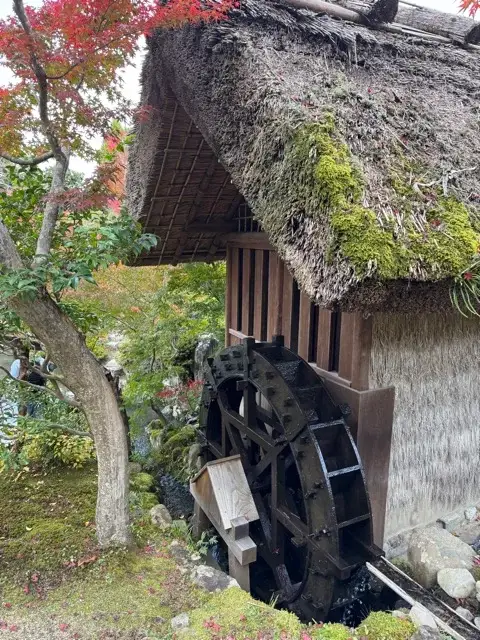
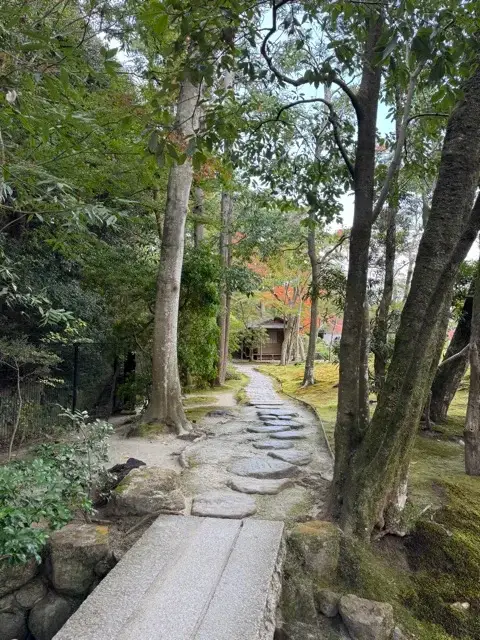


Todai-ji Temple
After Isui-en Garden, I headed to Todai-ji Temple, which is the big attraction in Nara. I mean big in two senses.

First, it draws the biggest crowds. A continuous throng flowed through it. None of the other sights I visited today were empty except for me. And some had some fair-sized crowds when I was there. But none were packed. Maybe it was just the timing resulting from the order in which I saw things. But, I don’t think so, because …
Second, it has some exceedingly large and notable elements.

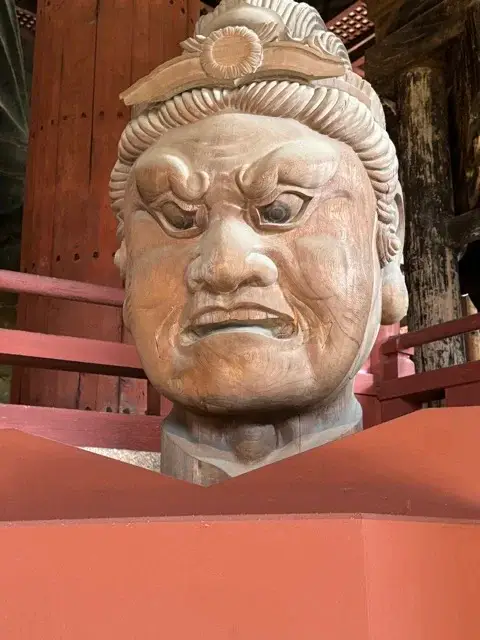
The two-tiered wooden entry gate building is massive and towers over its surroundings. In two opposing niches (is it right to call a really large cavity a niche?), stand gargantuan guardian statues. Unfortunately, the guardian statues are behind a mesh curtain, so they’re difficult to see and even more difficult to photograph. I took pictures of both and posted the one that came the closest to being almost visible.

Beyond the entry gate is the Great Buddha hall. It holds a giant Buddha statue that sits on a concrete platform. Not only are people allowed in the hall, but they’re allowed to take photographs.

It’s hard to get a sense of the Buddha’s size from the picture I took because there’s nothing in the picture to compare it to and show its scale.
On the side of the platform near the building exit, there’s a set of stairs leading to the top of the platform. A sign in English said that only groups invited by the temple could go up there. Just as I was leaving, a temple official was letting a small group onto the platform. If I’d been smart, I would have stayed until they were beside the Buddha and taken a picture of them there so you’d have some perspective. When have you ever known me to be smart? (That was a rhetorical question.)
The hall also contains some other large statues and a model of Todai-Ji Temple as it originally was.

Nigatsu-dō

The Todai-ji Temple complex holds some other buildings as well. Nigatsu-dō is up on a hill, right by the edge of the top of the hill. Standing on the platform in front of the prayer area within the Nigatsu-dō building provides gorgeous views of Nara and the surrounding landscape.
The Nigatsu-dō building is also impressive, but I was so eager to go up and see the views my guidebook promised me that I forgot to take a picture of the building, which could only be done from the bottom of the hill. Sorry about that.
But at least I remembered to take a picture of the view. So, you have that.
Hokke-dō

Hokke-dō is immediately beside Nigatsu-dō. It’s the oldest building in the Todai-ji Temple. Nigatsu-dō is an understated, handsome building. I paid a fee to go inside. In front of the prayer area, there are four large, fierce, standing guardian statues. Behind that is a serene standing Buddha statue and some other Buddhist statues, but I can’t tell you if they’re Buddha statues. I don’t know.
Pictures are forbidden inside Hokke-dō. So, that’s all I’ve got for it.
Kasuga-taisha Shrine
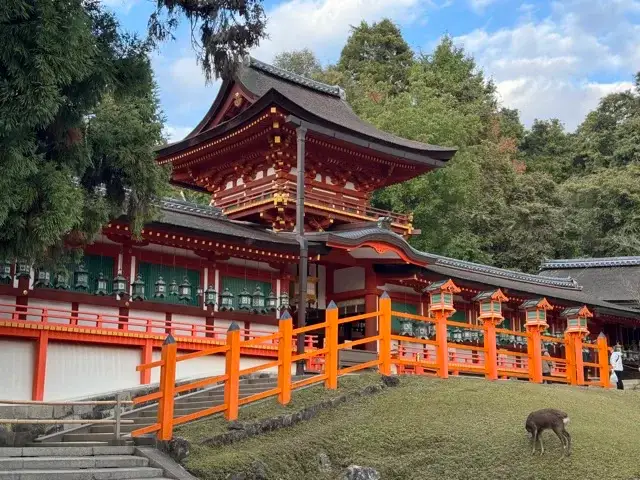
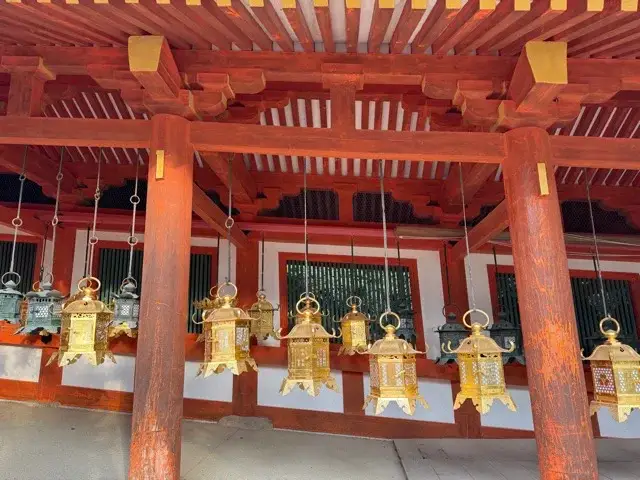
Kasuga-taisha Shrine is in the woods and a little walk away from Todai-ji Temple. One of my guidebooks tells me that Kasuga-taisha is Nara’s principal shrine. It’s a clustered collection of buildings, most of which are adorned with vermillion, green, and white colours. However, there is one gate building that’s a dark brown wood with some white panels just below the roof.
The roofs overhang the buildings. Hanging down from these porticos are one or two rows of lanterns that run the length of the buildings, with little space between the lanterns. It’s very attractive.
And then, it was time to walk back to the train station to catch a train back to Osaka and end my last day there.
More pictures from Kasuga-taisha Shrine:


Aside: Dinner
But first, an aside. I don’t usually talk about dinners in this journal. And I’m not going to describe tonight’s meal here. But there was one “interesting” aspect to it that I’ll mention.
I went to a Kobe beef teppanyaki restaurant for dinner. After I ordered the cut of meat I wanted and the size I wanted. The chef, who spoke only a little English, brought out a couple of plaques. I don’t know if they were awards for the beef, awards for his cooking, or one of each. One of the plaques had a cow’s head etched in relief. I assume that at least that one was an award for the beef. The chef told me what they were for, but I didn’t understand him.
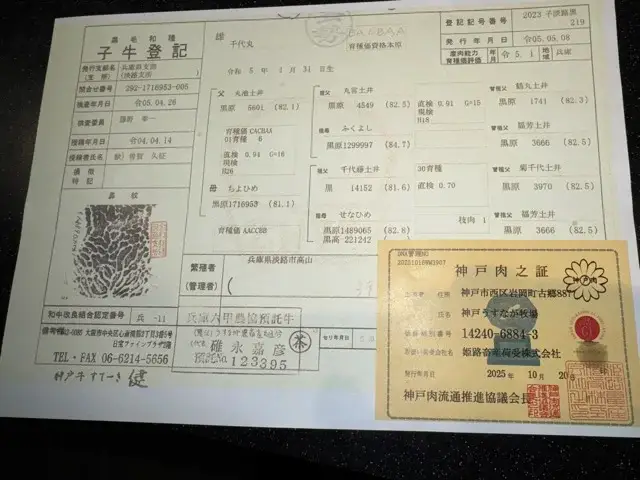
He then placed a letter-sized piece of paper in front of me and told me it was mine to take home. Everything on the page was in Japanese or numbers common to our languages.
There was what appeared to be an official seal on it and something that looked like an inked print of some marbled beef. In the bottom right, there was what appeared to be an official certificate that had been colour-copied onto the sheet.
Part of the page was a horizontal tree diagram. The chef pointed to elements of the tree diagram and said, “mother, father, grandmother, grandfather, grandmother, grandfather.” Apparently, it was the pedigree of the cow that I was about to eat a portion of.
(This tangentially brought to mind the late Douglas Adams’s “The Hitchhiker’s Guide to the Galaxy” and the sentient, talking cow that was bred to want to be eaten. It mocked Arthur Dent for being uncomfortable about eating it.)
Plus, before he cooked it, the chef plunked a plate containing my hunk of meat in front of it and pointed to it proudly.
To be honest, it might just be me, but none of that enhanced my dining experience.
I like to pretend that beef is something that you get at a restaurant or buy in a store to cook at home, and it has no prior living history. I know, rationally, that it was a living creature at one time. I just don’t want to think about it.
Being reminded not just of the cow’s former self, but also of its immediate family, rendered that impossible. The hunk of raw meat sitting in front of me for a while before being cooked, including while I was eating the appetizer that came with the meal (fish and shrimp), didn’t help either.
When I finished my meal and started to leave, I legitimately forgot to take the certificate with me. But before I got far from the table, the chef called out to me and reminded me to take it. I brought it back to my hotel, but that’s as far as it’s going to travel. However, I did take a photograph of it, which you can see here.
Osaka Summary
I think that Osaka was my least favourite of the places I’ve been to so far on this trip. Which is not to say it’s bad. It’s just that I truly loved the other places. Osaka, less so.
There aren’t a lot of interesting sights that the combination of my walking tour app and guidebooks told me about in Osaka. Did they leave anything out? Probably. But how would I know?
Those sources listed some sights that didn’t interest me. For example, there’s a Universal Studios Theme Park somewhere around Osaka. No, thank you. When I was younger, even a ways into young adulthood, I would have gone enthusiastically. Now, however, it holds no interest for me. If that’s something you would enjoy, then, by all means, go.
I might have enjoyed taking my grandkids there. But that would involve travelling back in time and having kids. There’s a ridiculous rule that prevents having grandchildren if you don’t have children first. I suppose I could adopt or hire some grandchildren.
I don’t want to come off sounding negative. There were sights I quite enjoyed in Osaka. The one that stands out the most in my mind is the Osaka Aquarium. It was great.
Were it not for Nara, my four nights in Osaka probably would have been a day too much for me. I could have done with three. I might have been bored with the extra day. But there is indeed the nearby Nara, and it was fabulous. So, four nights were probably perfect.
Discover more from Joel's Journeys & Jaunts
Subscribe to get the latest posts sent to your email.


I loved Nara. At least what you showed us of it. Lots of lovely shrines, and deer friends, too (pun intended). And I loved the garden, too. You had me at the first photo, with the lovely laid out garden, the pops of colour, and the reflecting pond. The rest did not disappoint. What a lovely time of year for parks, and I am sure that you have hit a low or at least shoulder season for tourism, despite the occasional crush. Really gorgeous stuff. Thanks for taking us there. The beef thing – well, I would have had the same reaction, although I am sure the beef was great. Especially had it been accompanied by a little more mystery.
I too was taken with Nara. My walking tour app doesn’t have a tour for it and my guidebooks didn’t have a lot of information on it, but I still didn’t have time to see everything they did mention. And I saw nothing of the city itself other than looking down on it from on a hill.
I forgot to mention it in my summary, but I would have liked more time there. Perhaps stay overnight or possibly two or three nights rather than just doing a day trip from Osaka.
The beef and the rest of the meal were delicious. My condolences to its family.