Now, Nara

Still operating from my Osaka base for today, I took a day trip to Nara. Including the walk to the nearby train station, getting to Nara from my hotel took well under an hour.
I hadn’t been to Nara on my only other trip to Japan, seven years ago. So this was something new. In my dim-witted opinion, it’s important to try a few new things every decade or so. Nara counts as one of mine. This time. But you can count an experience as new only once. Who came up with that stupid rule?
Nara was founded in 710, when it was named Japan’s first “permanent” capital. I got “permanent” from one of my guidebooks. The quotation marks are mine. I added them because, what the heck does permanent mean in this context? It’s not Japan’s capital now. That honour goes to Tokyo.
Nara was the capital only until 784, i.e., for about 74 years. Depending on which side of 74 it fell, that’s only between one and three years longer than I’ve been alive so far. If Nara was the permanent capital of Japan, then by that token, there’s a decent chance that I’ll have eternal life.
Nara Park
Most of the noted attractions of Nara—temples, a shrine, and a museum—are within Nara Park. I know that hardly sounds like a park, but those are clustered close to the city, just a short walk from the station at the end of the line for the train I took here.
But the park totals 1,300 acres. Looking at a map, it appears that the vast majority of that is pure green space. I imagine there are long hiking trails through it. I say I imagine because I didn’t get much past the major attractions just inside the city-side boundary of the park.
There’s also a traditional Japanese garden just outside the park. I’ll get to that this afternoon.v
Aside

The Deer of Nara
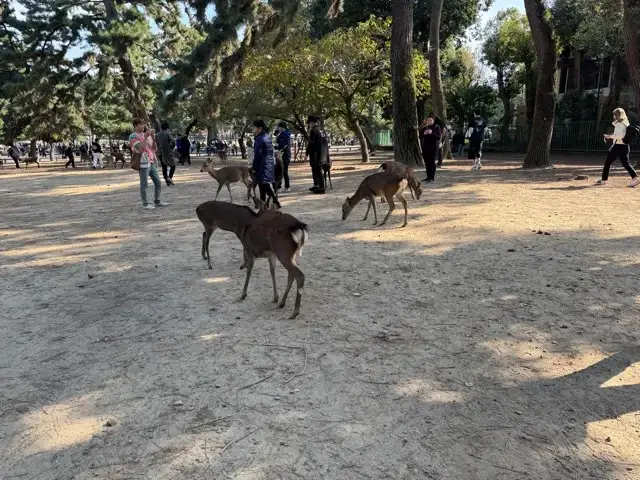
Nara is famous for its temples, particularly those just inside Nara Park. But it may be even more famous for its deer. They’re everywhere in the park. At least, everywhere where clusters of people are, such as by the temples and museums.
The Nara deer are quite tame. They’re not the least bit shy about coming up to you and begging for food with a nod or a gentle nuzzle.
That behaviour is probably well ingrained in the deer now because it’s often successful. Vendors sell bundles of about a half dozen circular deer food wafers for ¥200. I bought one.
The wafers are about the diameter of a hockey puck, but they’re much thinner, although not thin enough that they’d qualify as “wafer-thin.” They’re about the height of a normal Graham cracker, and roughly the same colour.
The deer come up casually to people who don’t have wafers in the hope that they do. But if you do, they and their friends become very persistent after you’ve given a wafer to one of the deer.
In my case, once I handed out one, some deer started tugging at the hem of the back of my jacket. I think they were saying, “Hey, I’m back here! I want one too, please.”
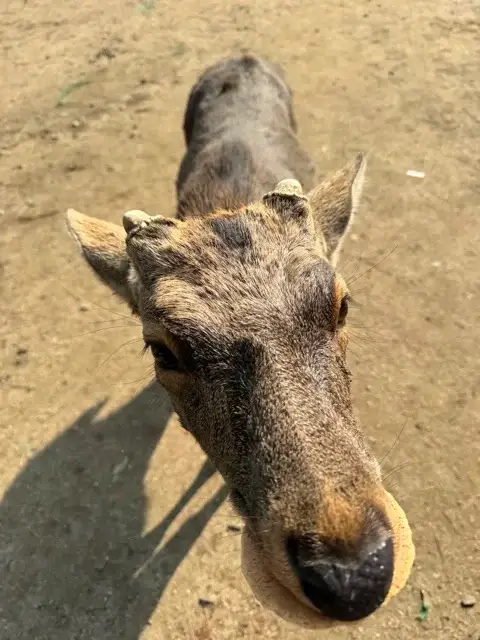
I’d read about this before coming to Nara, but I didn’t try it myself. Some people nod at the deer before giving them a wafer. Some, but not all, of the deer nod back before taking the food. It’s very cute.
Another thing I read before coming to Nara is that if you don’t want the deer to bother you, hold your empty hands out in front of you, with your palms facing out, so they can see you don’t have any food for them. I tried it often. It worked.
Of course, that requires that you have nothing in your hands when you do the gesture. If you have any wafers, you’re doomed.
I should note that with lots of well-fed deer around, you should look down while you walk. Here and there, there are clusters of pellets you might not want to step on.
Oh, about the deer being tame. Um, most are. But there are signs up by most of the tourist sights in Nara Park saying, “The deer of Nara Park are wild animals. They can occasionally attack people, so please be careful.”
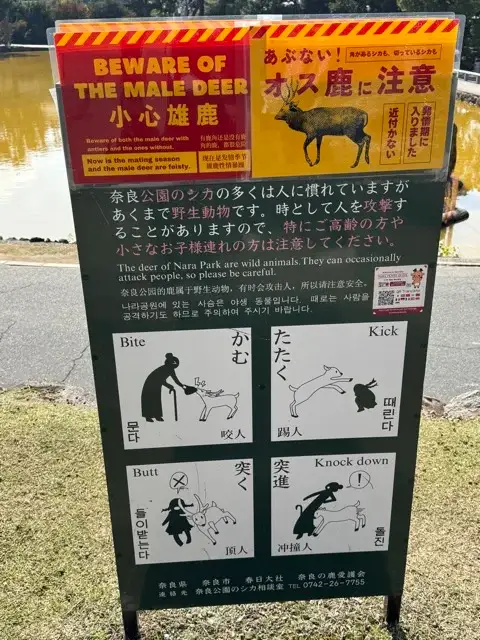
Below the Japanese and English text, there were also illustrations of a deer biting, kicking, butting and knocking down someone. Um. OK. Fortunately, it never happened to me.
But, wait. There’s more. At this time of year, for a limited time only, there was another temporary sign taped above the permanent one in every case. It was in bright, bold yellow and red.
It warned that this is mating season and the male deer, whether with or without horns, can be quite feisty. I didn’t have any run-ins with them, but I was a tad nervous about it for the entire time I was in Nara.

Kofuku-ji Temple
The Kofuku-ji Temple originally included more buildings in its compound than it does now. Some (most? all?) of the ones that are there now are recreations, not the originals.
A few of the present structures are highly acclaimed. One of them is a five-storey pagoda. Do you see the picture of the ugly, flat, windowless building somewhere nearby on this page? Yeah, that one. That’s not the five-storey pagoda. The pagoda is inside that temporary building.
With the help of the camera function of Apple Translate, I was able to learn that the pagoda is undergoing a major restoration that started in 2022 and won’t continue until 2034.

The lengths that some chapters of the DLJSSIA (Don’t Let Joel See Stuff International Association) go to astound even me.
As a consolation prize, they kindly left a lovely three-storey pagoda still visible.
And they didn’t close all of the other buildings for my visit either. There are a couple of round halls that I could view from the outside. And there are three buildings, described below, that I could enter for a fee. I paid the fee.
Central Golden Hall
Another acclaimed building is the Central Golden Hall. Kofuku-ji originally had three Golden Halls. The central one was the oldest and most important of them. According to the leaflet handed out at the hall, it was built between 710 and 714 CE.
The original Central Golden Hall at Kofuku-ji burned down. So did six subsequent ones. The last fire was in 1717. A new central hall was not completed until 1819, but it was intended as a temporary structure.

Over the years, leaking roof tiles caused considerable damage to the building. The temporary building was demolished, and in 2000, it was replaced with the currently standing replica of the original hall.
When I saw the name “Golden Hall,” I assumed it would be similar to the Golden Pavilion of Kinkaku-ji Temple in Kyoto. You know, a building with real gold leaf on the exterior that positively shimmers.
That’s not what it is. There are a couple of gold-coloured ornamentations on the roof, but the leaflet explains that “golden hall” is a structure on a temple complex that enshrines one or more Buddhist icons, not one with any gold on the exterior.
Nevertheless, the exterior of the Central Golden Hall is grand and impressive.
Inside, there are some beautiful Buddhist sculptures, with creation dates spanning 1202 to 1811. Pictures aren’t allowed in any of the buildings of Kofuku-ji Temple. So, imagine beautiful Buddhist images in your head.
Eastern Golden Hall
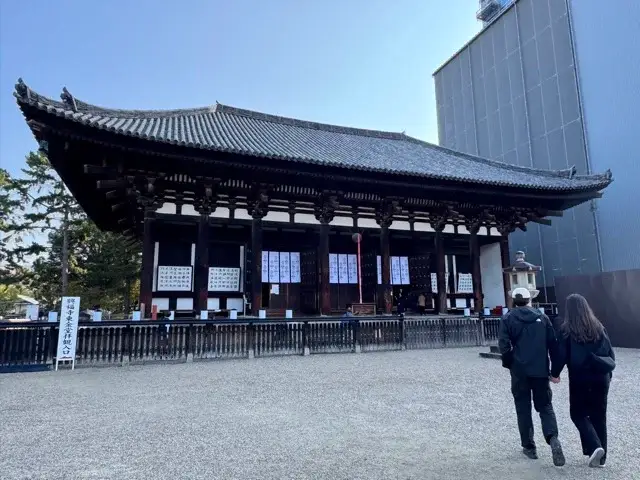
The Eastern Golden Hall of Kofuku-ji Temple has a story similar to that of the Central Golden Hall. (There was a western one, but that’s not there now.)
The Eastern Golden Hall was completed in 726. It wasn’t quite as unlucky as the Central Golden Hall. The eastern hall burned down only five times, instead of seven times.
Like the central hall, the eastern hall has Buddhist statues inside.
National Treasure Hall
The National Treasure Hall of Kofuku-ji Temple is in a rather plain-looking building. Inside, it contains several original Buddhist images. Most of them are statues. There are also a couple of portions of statues, including at least one that I remember was just a head from a formerly complete statue. There might have been more, but I don’t remember. Pictures weren’t allowed in the National Treasure Hall of Kofuku-ji Temple either.
Most of the items in the National Treasure Hall come from the old Western Golden Hall.
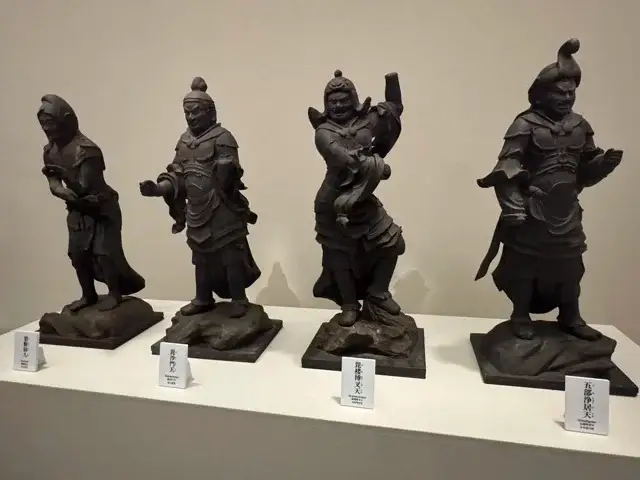
Kamakura period, 13th century
Wood with pigments (weathered appearance in its present state)
Nara National Museum
If you want to find the Nara National Museum, not to be confused with the National Treasure Hall above, picture the most stereotypical Japanese building you can imagine. Look for that. You won’t find it, but wandering around Nara Park while you vainly look for the museum will make for an enjoyable stroll.
Fortunately, I had already read that the Nara National Museum doesn’t look at all like that. Instead, head in the direction your mapping application sends you and then look for something that, except for the roof, looks like an old-style European building with Doric columns and French Renaissance styling. (No, I didn’t know that just from looking at it. Get serious. This is me we’re talking about, an ignoramus when it comes to that sort of thing. That’s what one of my guidebooks told me.)

Wood with pigments
Let me amend the above paragraphs. There is a new West Wing of the Nara National Museum. It looks much more modern. My guidebooks didn’t mention it. I learned about its existence only after I returned and visited the museum’s website to write this post.
Somehow, I didn’t see it at all when I was in Nara. And, considering the space that the exhibits I did see took up, I don’t think I was in it either. That sort of thing happens to me a lot.
The vast majority of the objects in the museum, or at least the part I saw of it, are statues, but there are also a small number of statue fragments, calligraphy scrolls, and paintings.
Beside each artifact, there is an icon indicating whether photos of that item are allowed or not. I think all of the Buddha statues had a “no photos” icon, and the majority of the others had a “photos OK” icon. But I’m not very good at identifying Buddhist images. So I might be wrong about that pattern.
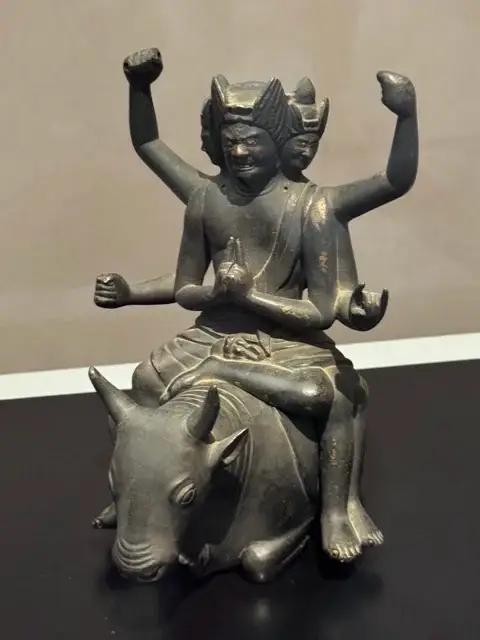
The statues ranged from much larger than human life-size to miniatures. Some were fierce beings. Others were gentle and serene.
The museum packed a lot of artifacts into a not overly large space. Or at least a not overly large space that I saw. The rest of it, if it exists? How the heck would I know?
I took pictures of several, but by no means all, of the objects I could. I posted some of them here. Unless you’re someone who stumbled on this site by some webby path (welcome!), I’ll show the rest to you the next time I see you if you want me to. If you don’t want me to, I won’t.
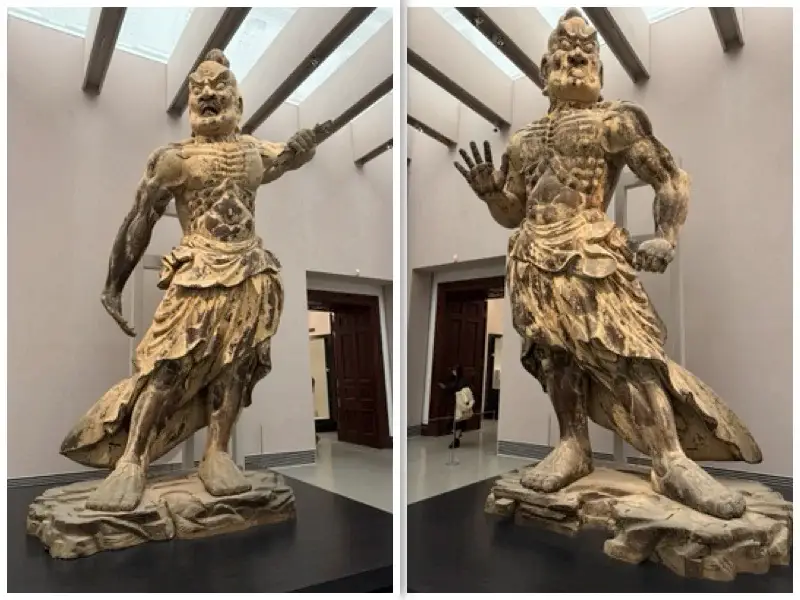
By Köjö (dates unknown)
Nanbokucho period, 1339 (Engen 4)
Wood with pigments
Height 505.8 cm (Open-mouthed Agy), 506.2 cm (Closed-mouthed Ungyõ)
Aside
Cash
When I travel to a foreign country (i.e., not Canada), I always try to take local cash with me in case I need it before I can get to an ATM. When I took my trip to Argentina, my bank didn’t have Argentine pesos, but I took some American cash, assuming correctly that there’d be someplace to exchange U.S. dollars even if they didn’t exchange Canadian dollars, and there wasn’t an ATM at the airport.
On another recent trip, I forget which one (I think it might have been Sweden), my bank also didn’t have the local currency. And I couldn’t find an ATM at the airport. I asked an airport employee. They told me there was no ATM at the airport.
It was days before I found an open ATM. It wasn’t a problem. They took credit cards everywhere.
On most of my other recent trips, when I was able to get the country’s currency before leaving home, I came back with almost all, or a couple of times all, of the currency I left with. I used credit cards exclusively.
My bank does carry Japanese yen. Before leaving on this trip, I hesitated about getting any. I figured, why get a bunch of Japanese yen that I’m only going to bring back to Canada when I come home?
However, being neurotic, I broke down and got some yen because I worried about not having any. The minimum my bank would sell me was ¥11,000, which translated to a little under $100 CDN. I’m glad I got it.
The vast majority of the temples, shrines, and formal gardens here charge a fee, and most don’t take credit cards. Most restaurants do take cards, but a few of the smaller, cheaper restaurants, like Ramen places, don’t. (I’ve found cards to be good at all of the major museums and other attractions, but not necessarily at the small museums in temples and shrines if they charge a separate fee for the museum.
The upshot is, I had to find an ATM here to get more cash. (They tend to hide them in convenience stores. 7-11 has its own bank.) I withdrew ¥10,000 at an ATM a few days ago. I topped it up with another ¥10,000 today. I don’t know if I’m going to need more before I leave Japan.
Discover more from Joel's Journeys & Jaunts
Subscribe to get the latest posts sent to your email.


Lovely artifacts, and I for one, would be interested in seeing the rest of your pictures. Loved that one of the deer with the wafer. Happy deer! Lucky deer! Nice to see Joel making friends abroad. No comment about having to pick up the tab for their repast, but you do what you have to do. Thanks for the tips about the cash. On a recent trip I also found the need for cash, which surprised me. I actually kept a change purse with me for bills and coins, because, otherwise, where you going to keep that stuff if you regularly don’t have pockets? Not something you have to worry about, I understand.
The deer probably didn’t need my generosity. There were plenty of other people keeping them fed. But it was nice to make a friend even if it was a shallow friendship based solely on food. Then again, food.
The need for cash did surprise me. It’s rare in my travels these days. I’ve been to other countries where I’d buy like a bottle of water from a food truck and the vendor automatically put the card machine in my direction expecting me to tap my card or phone. I don’t even know if they would have taken cash. Not so here.