Kinkaku-ji Temple and More Temples
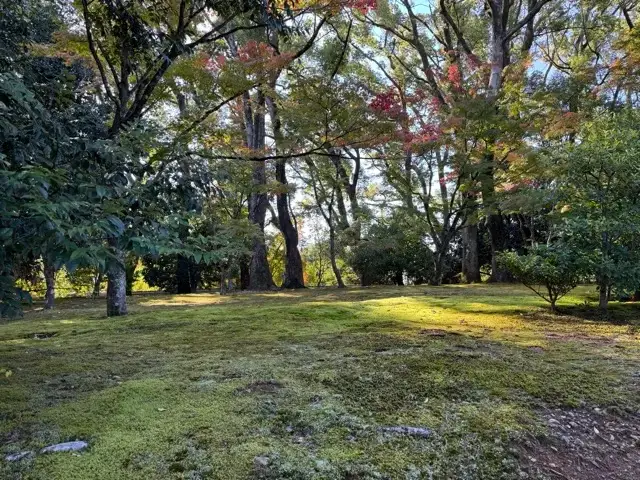
I started the morning of my first full day in Kyoto at one of the heavy hitters of Kyoto sights, Kinkaku-ji Temple. It’s in the north end of Kyoto.
It took about 45 minutes to get there from my hotel. Most of that was on a city bus. The remainder was a little walking. The starting bus stop was only a few blocks from my hotel. And I needed only the one bus, no transfers. So, that was easy.
After Kinkaku-ji Temple, I stuck with a theme and spent the rest of the morning, using quite an expanded definition of “morning,” in that end of Kyoto. It was an all-temple/shrine, all the time, morning.
By the way, if you are not interested in visiting temples or shrines of the various Buddhist sects, you might not appreciate Kyoto as much. The city is lousy with them.
What I know about Buddhism couldn’t fill a small index card, even using a 48-point font. And if I have a spiritual bone in my body, I must have fractured it at a young age. Either that or SickKids Hospital removed it when they operated on my bowel when I was a young child.
The point is, I’m not a religious person. But just as I find old European cathedrals and churches grand and/or glorious, I find many of the temples and shrines here interesting and/or beautiful.
Kinkaku-ji Temple
Kinkaku-ji Temple is famous. Or, rather, at least one element of it is famous.
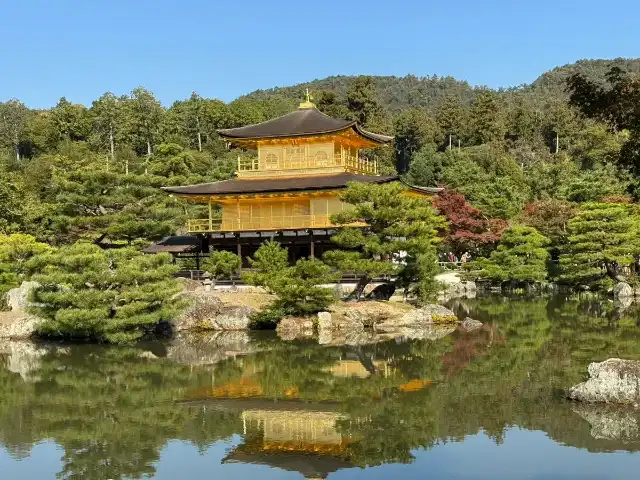
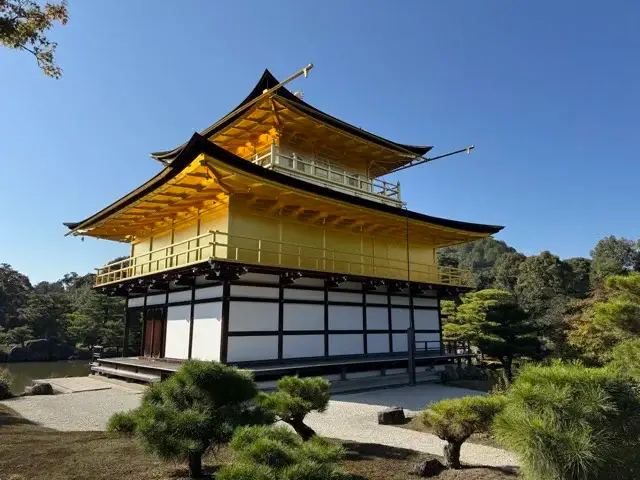
Even if you’ve never been on the same continent as Kinkaku-ji Temple, you’ve seen a picture of that component of it. That’s it at the top of this page. But you’ve likely seen a picture or two of it before now as well. It’s a globally iconic building. In fact, it might have been wallpaper on your computer at one point. The famous building is usually referred to in English as the Golden Pavilion or the Golden Temple. Often, one of those names is applied to all of Kinkaku-ji Temple as a kind of tourism shorthand.
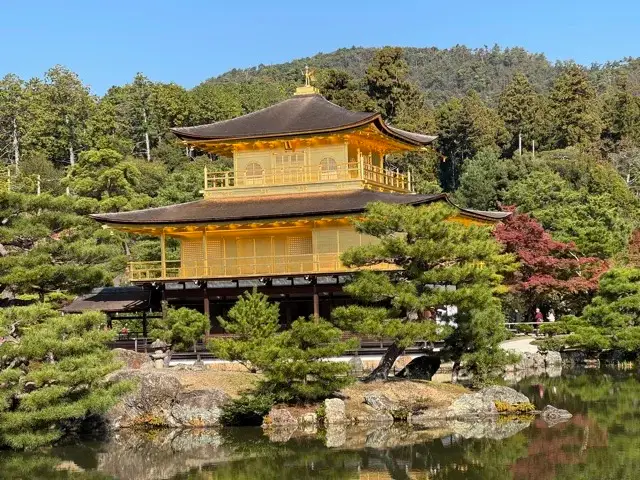
The Golden Pavilion’s upper floors shine a bright gold colour because they are coated with, you guessed it, gold leaf. I suspect they regularly polish it, because it does shine.
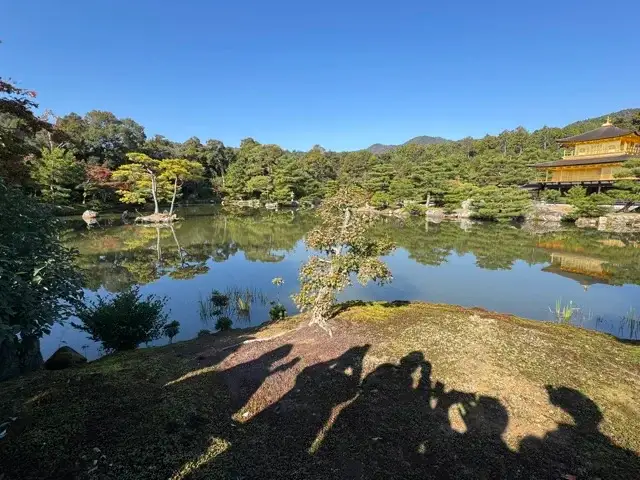
From the entrance of Kinkaku-ji Temple, you first see the Gold Pavilion from across a peaceful pond surrounded by lush vegetation. The pavilion’s gold shimmers as it’s reflected on the surface of the pond.
All visitors are required to follow a prescribed route around the grounds of Kinkaku-ji. There are signs saying that you can’t return along the path. And at the exit, there’s a sign saying you can’t re-enter.
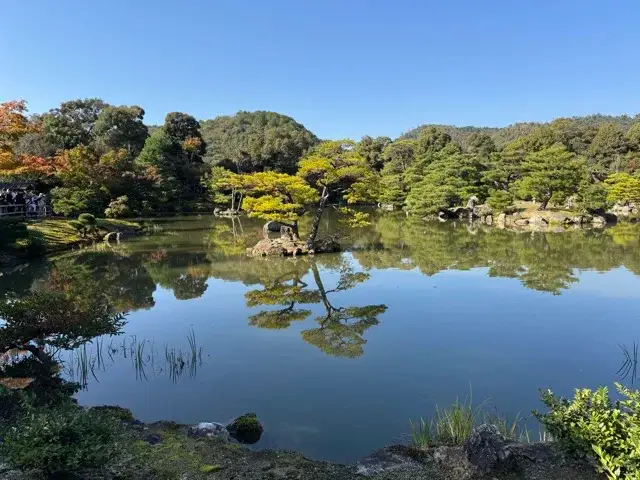
The prescribed route takes you behind the Golden Pavilion, where you get a closer look at the pavilion, but never right up to it.
This brings me to a sore point, not about Kinkaku-ji, but about my walking tour app. It describes what I’ll see on each floor of the pavilion. There’s just one problem. The public cannot get right next to the pavilion, let alone go inside it. I don’t know where the app got its information or if it’s accurate.
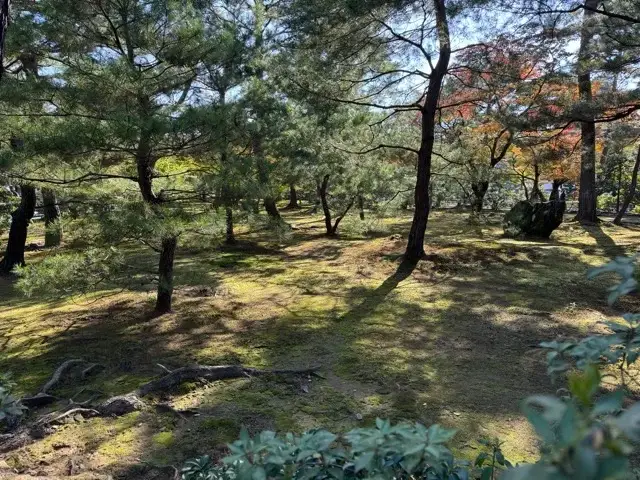
The route takes you through the gorgeous grounds of Kinkaku-ji before depositing you at the exit.
By the exit, there are some stalls, mostly selling souvenirs and food.
One stall offered free samples of what a sign said was sweet matcha tea with gold leaf. It tasted like sweet matcha tea, and there were a couple of specks of gold colour in it. But were they really flecks of gold leaf? The admission fee to Kinkaku-ji Temple is only ¥500, which, at the current market exchange rate as I write this, translates to just $4.57 CDN. Considering how low the admission price was, colour me not gold, but skeptical about the gold leaf in the tea. Then again, they were only tiny flecks, and I saw only one or two in the sample.
Having said that, the admission fee isn’t the only revenue source for the temple. At two points along the route through the grounds, there were three stones with heavily weathered Buddha figures on them. They sat on flat ground. In front of them was a small stone bowl.
All around the bowl, there was a large collection of coins. There were only a few coins in the bowl at each location.
I don’t know if people were just testing their tossing skills or if there is some legend about getting good luck if you successfully throw a coin into the cup in front of the Buddha stones. Whatever. I gave it a try. Heck, in the off-chance it would bring me good luck, why not? I used the smallest denomination coin I had, so I wasn’t out much.
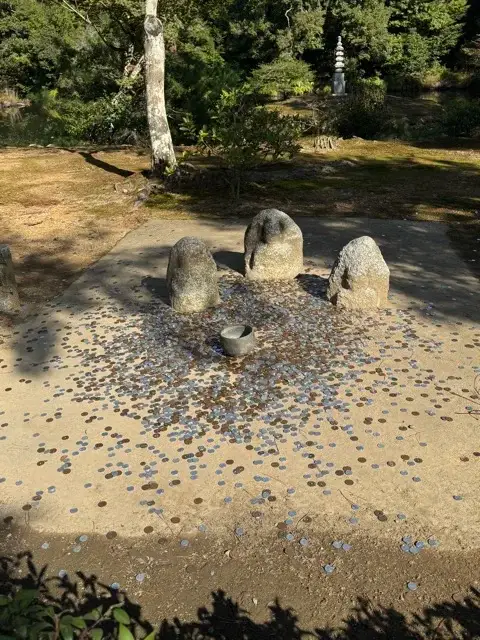
I tried it once at each location. I didn’t get it in the bowl either time, but I’m proud to say that both times, I got it closer to the bowl than anyone else who tried while I was there. And a lot of people tried. Yay, me.
I don’t know if it’s because today is Saturday, but Kinkaku-ji Temple was jammed today. Any good vantage point of the golden pavilion was thronged. I had to wait for my turn to get a spot to take a picture.
The Golden Temple is so popular with tourists that I doubt there’s any day when it’s not packed, but probably not as bad as weekends. I’m not a fan of crowds, but Kinkaku-ji is still worth seeing. You can view it in pictures, but there’s something viscerally missing unless you experience it in real-life 3D.
Hirano-jinja Shrine
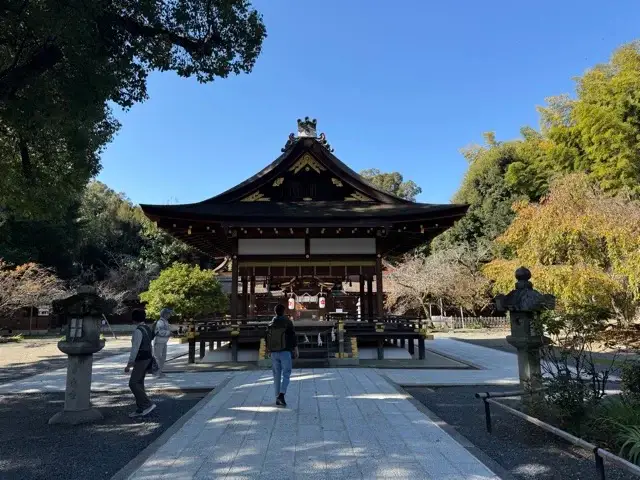
After I left Kinkaku-ji, I pulled out my walking tour app and used the “sort by distance” function to find the nearest recommended sight. I didn’t restrict it to “must-sees” because the app is not overly generous with those designations. There wasn’t another must-see within walking distance of Kinkaku-ji (which is rated as a must-see). Without the must-see filter on, the closest attraction was Hirano-jinja Shrine.
It’s a nice little shrine, but not spectacular. I don’t have much to say about it.
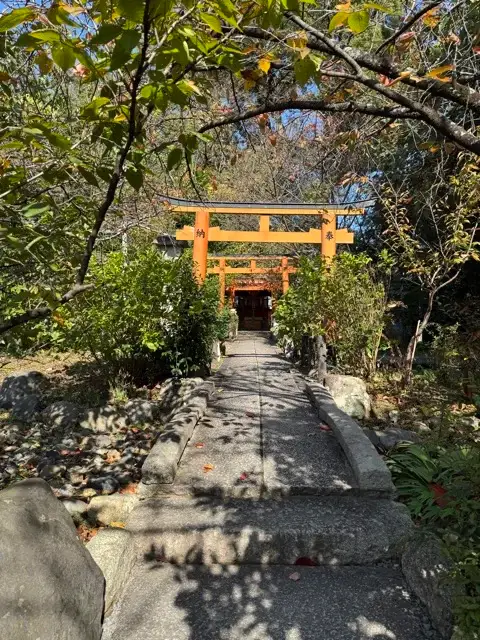
I had a little trouble finding it, though. Coming from Kinkaku-ji Temple, you have to walk through a park to get there. The shrine isn’t visible from the park, and Google Maps wasn’t very good about specifying the paths in the park.
Adding to the confusion, my walking tour app provides a picture with each sight entry, but only one picture. The one it uses for Hirano-jinja Shrine is dominated by a short row of towering, but simple, bright orangy-red torii, one behind the other.
I didn’t see them when I approached the shrine.
Then, I walked around some more, and there they were. They’re not towering. The picture must have been taken from quite close up. They’re not tiny, but they didn’t look nearly as big as they seemed in the picture.
That made me question whether what I thought was Hirano-jinja Shrine was indeed Hirano-jinja Shrine. It might have been an adjacent temple. Through the torii was a tiny shrine. That was probably it.
Toji-in Temple

Finally, a temple where I could experience some peaceful contemplation. Toji-in Temple isn’t nearly as popular and certainly not as famous as Kinkaku-ji Temple. Nor is it as big.
I wasn’t alone there. But the word “crowd” didn’t have any place at the temple.
There is a meditation room that looks out through one completely open side onto a Zen rock garden. The meditation room is closed to the public, but between it and the rock garden, there’s a wooden deck that visitors can sit on and contemplate the Zen of it all.
I sat. I tried to practice what little I know of Zen meditation.
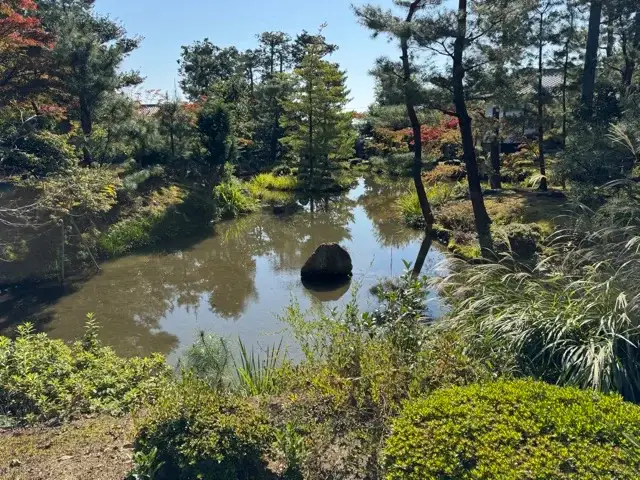
I attempted to shift my mind to a soft focus on the here. And the now. And just experiencing my breath. In… out… in… out… in … out.
My mind became filled with the experience of my breath. The experience of my breath and angst over what would happen if my breath stopped in a place where I don’t speak the language. Would I be able to communicate with the medical staff if I survived the stoppage of my breath? Would I have to fight with my out-of-country medical insurance provider to pay up?
I don’t think I’m cut out for Zen meditation.
Toji-in Temple also has a sit-on-the-floor tearoom with an open side that looks out onto a pond surrounded by beautiful trees and other vegetation. The tearoom is about the equivalent of a few steps above the level of the garden and pond.
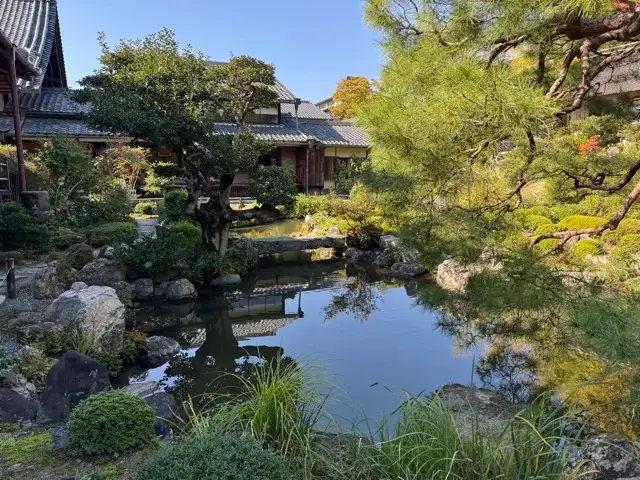
I sat on the floor, sipped some tea, and contemplated the garden and the pebbled path around it. I reflected on my desire to stroll peacefully around that path. I fretted about how I might do this.
I didn’t see any entrance from outside the temple. And from my perch on the floor, I couldn’t see any steps down to the garden from the tearoom.
Then there was another problem to contemplate. I had to take off my shoes and leave them in a cubbyhole at the temple entrance. As I said, the path around the garden was pebbled. There’s no way I was going to walk around it in my stockinged feet.
As I was having tea, I saw someone walk off the edge of the tearoom floor. Rather than leap down to the garden level, he made a stepped descent and paused for a bit before following the path. Later, I saw someone else returning. They removed some slippers and put them down, but I couldn’t see where.
When I finished my tea, I stood up and saw that there were indeed steps down to the garden. Pairs of light-brown, plastic loaner slippers, identical except for size, were lined up on the steps.

I walked to the steps, put on a pair of slippers, and followed the garden path.
I walked slowly and remained conscious of every step. This is the meditative way of walking, which seemed appropriate in a Zen Buddhist temple. It also seemed appropriate when walking on an uneven, gravelly path in hotel-style slippers, with no back to them to hold them on your feet. When I wasn’t careful, my feet started to slip out of the slippers. I hadn’t thought of it before now, but that might be why they’re called “slippers.”
It wasn’t the most comfortable way to walk in a beautiful garden, but it did slow me down in its loveliness, which is a fine way to experience beauty.
And, oh, good news. When I got up close to the pond, I saw that there was a fish meditatively swimming around in it. I only saw the one, but it seemed to be a contented fish.
Ryoan-ji Temple
Unlike Kinkaku-ji Temple, my walking tour app doesn’t give Ryoan-ji Temple a “must-see” rating. Nevertheless, it too has a famous, although admittedly less famous, element. Ryoan-ji Temple’s claim to fame is its Zen rock garden.
The rock garden hasn’t garnered nearly as many iconic photos as the Golden Pavilion, but there are enough floating around that you might have seen one before you saw the one I posted here.
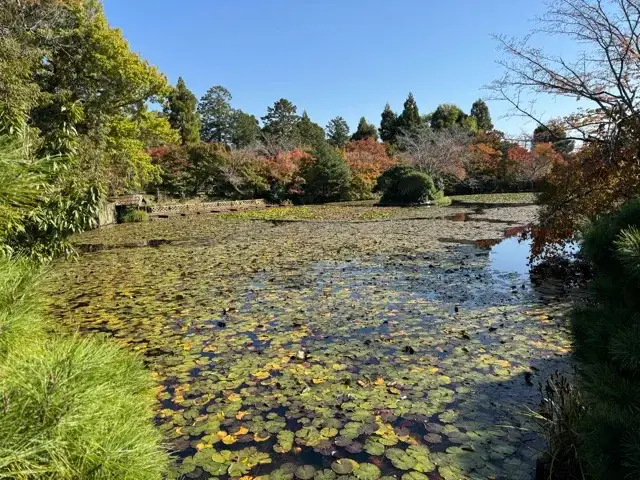
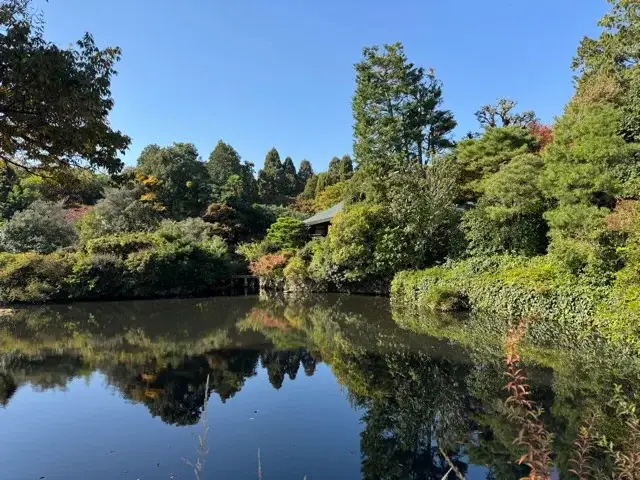
In addition to its rock garden, Ryoan-ji Temple is set in gorgeous surroundings, with a large pond with lilies covering at least half of it. (The lilies weren’t in bloom when I was there.)
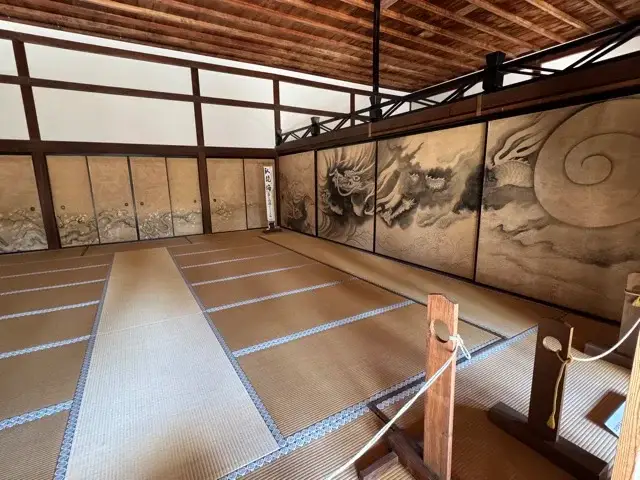
Set back from the rock garden, there are a couple of subtly and tastefully decorated meditation rooms. They have open front walls facing the rock garden.
The public wasn’t allowed into the mediation rooms, but because they were open, I could see in. They allow people to take pictures of the rooms as long as they don’t use flashes or tripods. Hence, you’ll find a picture here if I remember to post it.
Like at Toji-in Temple, there’s a wooden deck between the Zen rock garden and the meditation rooms. People were allowed to sit there and meditate. Or chat with the people they were with, as the case may be, which I don’t think is the purpose, but it was the most frequent practice today.
Ryoan-ji Temple was not nearly as crowded as Kinkaku-ji Temple, not by a long shot, but it was much more crowded than Toji-in Temple. Hence, with the chatter, it was much more difficult to meditate there. I did manage to find a spot to sit on the edge of the deck facing the rock garden.
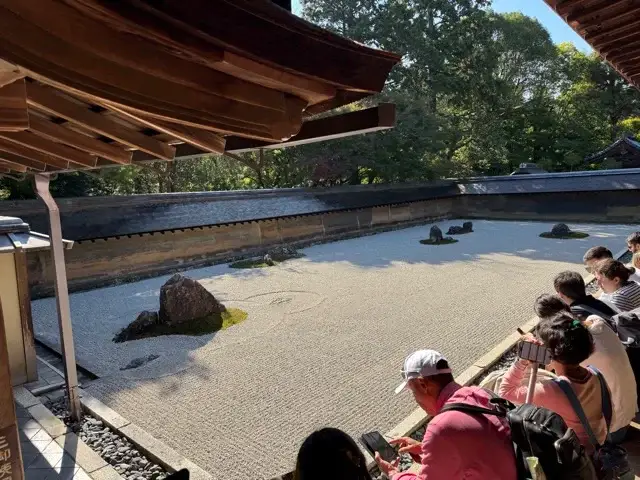
I tried to meditate, but wasn’t successful at focusing on my breath. However, I was able to wax philosophical somewhat. I meditated on that ancient question that’s plagued thinkers for ages: “What the heck makes this a garden? It’s some large, allegedly carefully placed rocks set in a field of precisely raked rows of stones. Where are the flowers? Where is the grass? Where are the trees?”
Did I mention that I don’t think I’m cut out for Zen meditation? Yes, I think I did mention that.
Templed out and well past my usual lunchtime, I stopped in a restaurant right by the exit, had some soup with soba noodles, and wrapped up my extended morning.
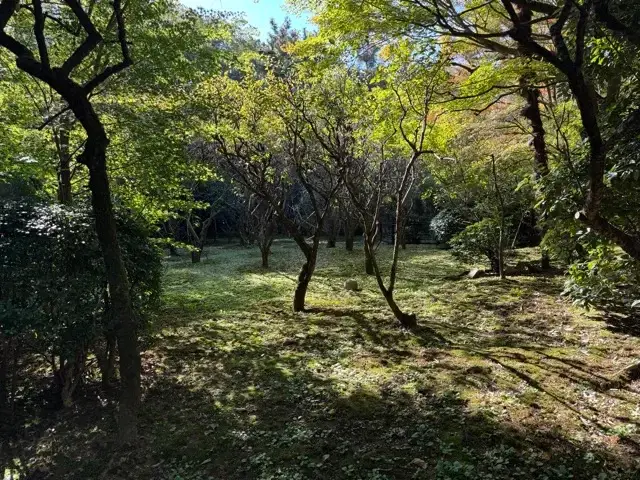
The grounds at Ryoan-ji Temple: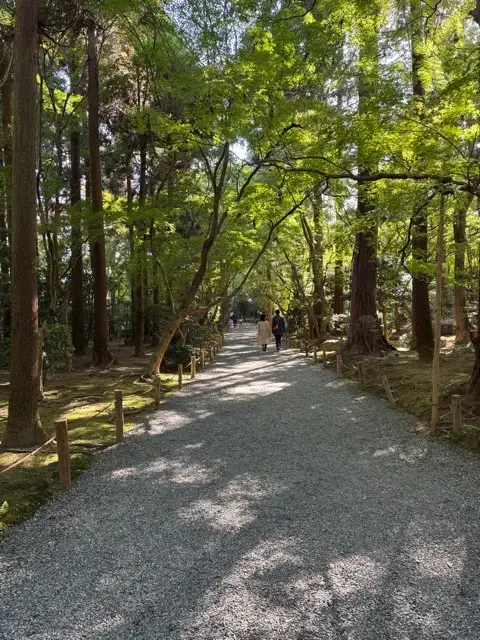
Discover more from Joel's Journeys & Jaunts
Subscribe to get the latest posts sent to your email.

The shadows of the photographers in your picture of the pond in front of temple makes your photo awesome! Thank you for sharing.
Thanks! And, you’re welcome.
Yes! You’ve got me. I once had an image of the Golden Temple as wallpaper image on my computer, and I also know the Ryoan-Ji Temple rock garden through images. I have always wanted to see both, in 3D as you put it. Lucky you. “Luck” that you shared with many others by the sounds of it. Looks like it was a lovely sunny day finally, so that’s something too. Oh, and a lucky fish! Speak of luck, if you get a coin really pretty close to a bowl will things go really pretty ok? I hope so.
They’re famous. In fact, it might have been you, after my last trip to Japan, who told me that the Golden Temple was used as wallpaper by Apple for one iteration or another of MAC OS. Or maybe I saw it myself seeing as though I’m in the Mac cult. I don’t remember. Whatever, it is gorgeous.
Yesterday was sunny too. Wouldn’t you know it, it was sunny with not a cloud in the sky when I left Hakone. Where were those clear skies when I wanted to see Mount Fuji while I was in Hakone?
I’m in Japan, enjoying traveling, in reasonably good health for a man my age, so maybe I already have my good luck.