Ginkaku-ji Temple and More

Yesterday, I didn’t finish writing my morning post about Kinkaku-ji Temple, et. al., until late. So, when I started writing my afternoon post, about Nijo Castle, et. al., it was so late that I was too tired to write as much as I otherwise would have written about it. It happened again. Today, I didn’t finish my morning post until even later. So, now I’m even more tired.
But we’ll get through it. Somehow. However, it might be even shorter and more typo-prone.
The highlight of my afternoon was the sight I started with, Ginkaku-ji Temple. I then moved on to take a look at a couple of streets that intersect each other in a “T,” Ninen-zaka & Sannen-zaka Streets. My walking tour app recommends them as must-sees.
Okay. That’s more than enough introduction. Let’s move on.
Ginkaku-ji Temple

Let’s get this point out of the way right at the start. Ginkaku-ji Temple is famous for a building that’s called the Silver Pavilion. You might remember from my post yesterday about the Golden Pavilion (aka the Golden Temple) at Kinkaku-ji Temple. The top floors of it are coated with gold leaf. They shine to look at directly and shimmer in a reflecting pond in front of the temple.
I knew the Silver Pavilion at Ginkaku-ji Temple wouldn’t be like that because my walking tour app told me that there’s not really any silver on the building. It said that, instead, “That glimmer you see is just moonlight flirting with its once-black lacquered walls.” But I was looking for something that at least looked somewhat silverish.

“That glimmer you see?” Um, no. A time traveller who goes back in time to look at the building might see it. But I don’t think anyone today would.
Ginkaku-ji Temple requires visitors to follow a prescribed route through its grounds. I kept my eye peeled for a silverish building. I didn’t see one.
I completed the route, stopping several times along the way to take in the amazing scenery, but I saw nada in the way of a Silver Pavilion.

Back near the entrance/exit, I pulled out my iPhone and opened up the Ginkaku-ji Temple website. There, I saw a picture of the Silver Pavilion. It was a building close to the entrance/exit. I could see the building from where I stopped to look at the webpage. It was nothing special. And it didn’t have a hint of silver colouring.
The building has a lot of dark brown wood. It also has pure white portions, including some arched windows on the second floor. That about describes it.
And, really. It only had the appearance of a silver pavilion when it had the black lacquer that’s no longer there? The lacquer is gone. Get over it. And only in the moonlight? Even if the lacquer were still there, Ginkaku-ji Temple is closed to the public at night. No one is going to see it in the moonlight.
Maybe it’s time to rename the Silver Pavilion to “The Structure Formerly Known as the Silver Pavilion.” Just a suggestion.
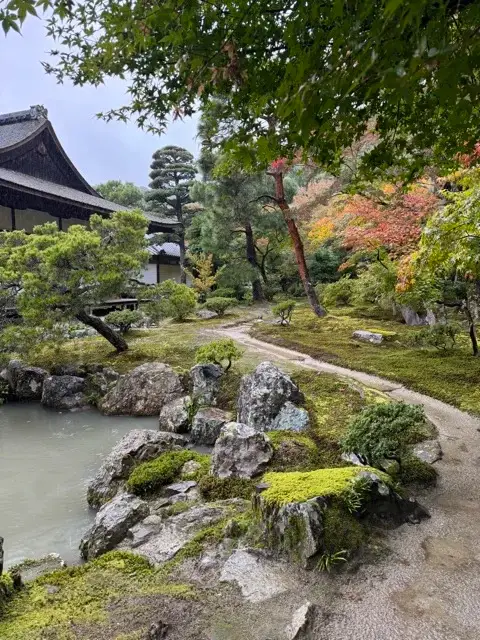
I was disappointed with the Silver Pavilion, but not at all about Ginkaku-ji Temple. Its grounds are spectacular, made even more so by the fall foliage. Some of the forests in the grounds have moss floors, which adds to their beauty. It was enchanting.
The grounds also have a beautiful pond. (Sorry, I didn’t see any fish.)
Plus, there’s at least one element that I’m pretty sure is a zen rock garden. It’s a curved area of meticulously raked stones, with a big rock in the middle of it. But there’s also another area of sand that’s meticulously raked into patterns.
In addition, there’s a sand castle that looks like a giant, upturned thimble sitting in the middle of a large area of fine-grained stones raked into circles around the thimble.
The Ginkaku-ji Temple buildings are all at the base of a mountain. Unlike at Eikan-do Temple, which I saw this morning, the buildings of Ginkaku-ji Temple do not climb up the mountain. But the property does.

The forested mountain is gorgeous, particularly, as I said, at this time of year. And there’s a path that goes partway (a small part) up the mountain. It’s an optional component of the prescribed route. At the high point of the path, there’s a viewing area that allows you to look down on the rest of Ginkaku-ji Temple and beyond, farther into Kyoto.
As happened when I wrote in yesterday’s post about the sites I saw then, there is a lot more I should be saying about Ginkaku-ji Temple, but I’m too tired to articulate it. However, all of those things I’m not stating were positive. Let’s just leave it at saying that Ginkaku-ji Temple is a gorgeous sight to see.

Ninen-zaka & Sannen-zaka Streets

After I left Ginkaku-ji Temple, I took a bus toward a neighbourhood with two intersecting streets that my walking tour app recommended as must-sees, Ninen-zaka & Sannen-zaka Streets. Actually, they’re more like paths than streets, in one way. In fact, if you start typing either into Google Maps, it will autocomplete them with Path, not Street. But they’re as wide as a single-lane one-way street.
The streets are mostly pedestrianized. Cars couldn’t drive on Ninen-zaka if their drivers wanted to because a part of it is a set of stairs. I said mostly pedestrianized because the occasional rickshaw plies Sannen-zaka, which doesn’t have any stairs.

From where I approached Sannen-zaka, near the beginning of the interesting section, there is a large, old Buddhist temple that’s a five-storey pagoda. It looms up at a bend in the street and is very picturesque.
Ninen-zaka & Sannen-zaka Streets/Paths are paved with thick, pebbly paving blocks.
Small shops in quaint old wooden buildings line both sides of both streets. I don’t know, but looking at the buildings, I suspect that they once held low-end stores, but the area has since been gentrified. However, that’s only the feeling I got. I don’t know the history of the streets.
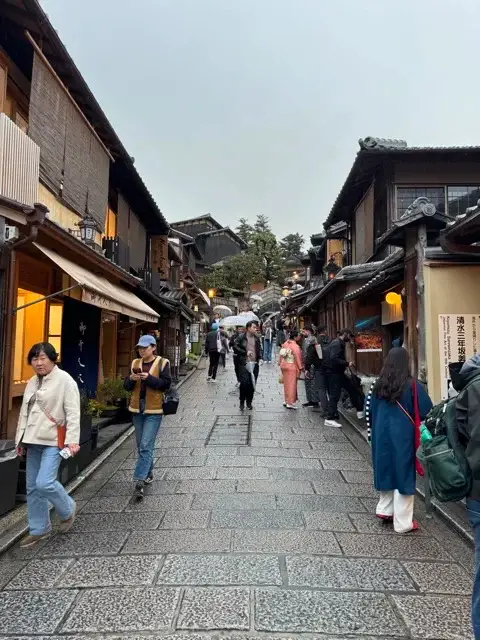
The stores included souvenir shops, teahouses, bakeries, sweets shops, restaurants, cafes, street food vendors, and probably more I’m forgetting. Oh, and if you’re ever in Kyoto and you have a hankering for soft-serve ice cream—vanilla, matcha, or swirled vanilla and matcha, those are the streets to go to. Stores selling soft-serve ice cream seemed to me to be over-represented there.
When I was there in the late afternoon today, a Sunday, the streets were crowded. And crowds were my cue to call it a day and head back to my hotel.
And here we are, at the end of this post.

Discover more from Joel's Journeys & Jaunts
Subscribe to get the latest posts sent to your email.
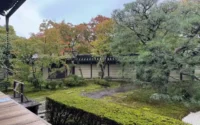

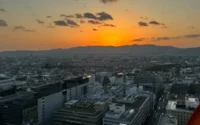
The grounds of the Ginkaku-Ji Temple are indeed spectacular, and so are your photographs of them, so don’t worry in this case about feeling too tired for words. It looks too beautiful for words, anyways. I imagine a nice soft-serve ice cream could provide a needed lift of energy at the end of the day if one so desired. I think if one wasn’t looking for a poetically described Silver Temple, the deceptively named Silver Temple would impress as a lot more charming than it did. Thanks for the post!
I loved the grounds of Ginkaku-ji, but even if I wasn’t looking for a temple that had a silver hue, I’ve seen enough temples now that I’d probably still say “meh” when I saw the Silver Temple.
I didn’t have a soft-serve ice cream, but I will admit to a matcha smoothie.
You’re welcome.