Nijo Castle and Nishiki Market
After finishing a long morning filled with visiting only temples and shrines, I was a little templed out. I enjoyed them very much, but man does not live by temples and shrines alone.
Well, come to think of it, unless he’s a monk. Then he might live by temples and shrines alone. But never mind that. I’m not a monk. If “monk” was more than a four-letter word, I probably couldn’t even spell it.
The point is, I decided it was time for something different this afternoon. I settled on a sight highly recommended by my guidebooks and walking tour app, Nijo Castle.
I then went to the sight that my walking tour app said was closest to Nijo Castle, and that would still be open for a while when I got there. That was Nishiki Market.
Because my morning included four sights, it took me longer to write that post than normal. It’s now late. And I’m tired. I fear I won’t do either Niko Castle or Nishiki Market justice in this entry. Sorry about that.
Nijo Castle
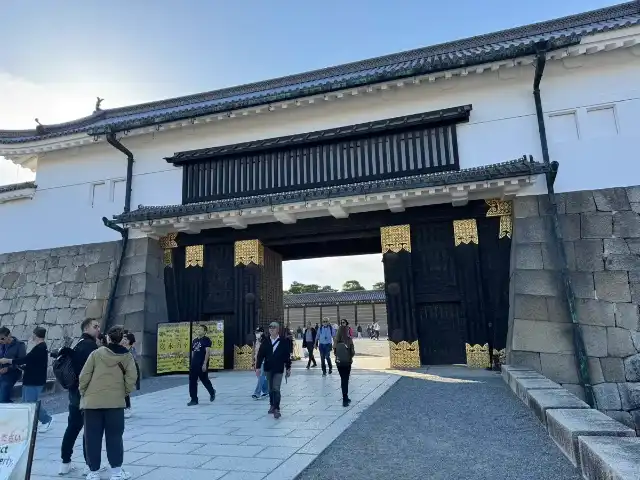
Nijo Castle is almost smack dab in the centre of Kyoto. Its impressive dark wood entrance sits in a long wall that’s constructed of stone blocks on the bottom, topped with a white wall that boldly faces a wide, busy street of Kyoto.
The castle was completed in 1603 on the orders of the first Shogun of the Tokugawa Shogunate, Tokugawa Ieyasu. There are two separate palaces within the walls of the Nijo Castle, Honmaru-goten Palace and Ninomaru-goten Palace.
At the ticket booth, I was offered a choice of one of two tickets. The cheaper one would have gotten me into just the grounds of Nijo Castle, but neither of the palaces. The other ticket would have gotten me into the grounds and the Ninomaru-goten Palace, but not the Honmaru-goten Palace. I chose the latter.
To get into the Honmaru-goten Palace, I would have had to buy a timed ticket online, but they were sold out for today by the time I got there. That’s the problem with not carefully planning your day and, instead, selecting a starting point only at breakfast that day, and then playing it by ear after that. You’re going to miss out on some stuff. Or, rather, I should say, I’m going to miss out on some stuff.
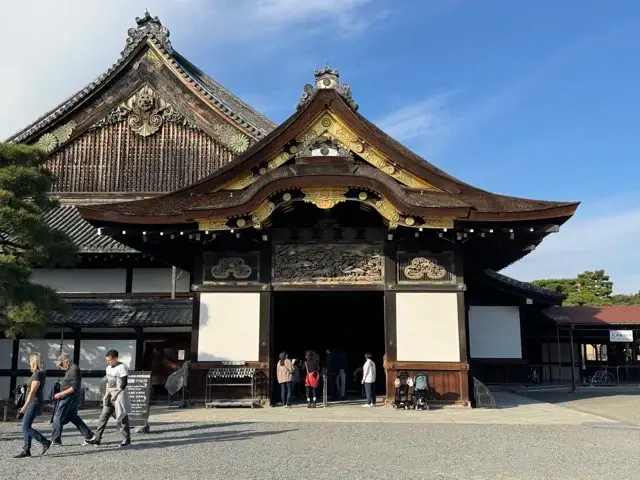
Obviously, I can’t tell you about what’s in Honmaru-goten Palace, but Ninomaru-goten Palace is impressive. The exterior has peaked roofs, with fronts that are adorned simply, but elegantly.
Before entering, I had to take off my shoes, as is the case in most shrines, palaces, some restaurants, and, I’m told, homes in Japan. (I’ve never been into a private home in Japan, so that’s second-hand information.)
Aside: I knew about the shoe-removing custom in Japan before I left for this trip. I also knew about it before I came to Japan for the first and, so far, only other time I’ve been to Japan. That first time, because I knew I’d have to take off and put on my shoes a lot, I brought slip-on shoes. They were awful. There was too much play in the shoe, so there was a lot of rubbing of my foot against my shoe when I walked around. I developed blisters the size of a small towns on that trip.
This time, I bought some slip-on running shoes with good, permanently tied, but elastic shoe laces that do a much better job of holding the shoes snug on my feet, while still allowing me to slip them off and on easily. So far, no blisters. Then again, I’m doing less walking this time. So, who knows if it’s the shoes?

All photography is strictly forbidden inside Nijo Castle’s Ninomaru-goten Palace, so you won’t see any interior pictures here. It also means that this narrative is dependent on my memory. Heaven help us.
Inside, there is a hallway that hugs the outer wall of the palace. Visitors are restricted to that hallway. But there are large openings between all of the rooms and the hallway.
The rooms themselves are simple, with no furniture that I remember.
All of the walls in the rooms are completely covered with elegant murals. The background on all of them is gold-coloured.

In a couple of the rooms, tigers and some sparse trees dominated the murals. A sign explained that there were no tigers in Japan at the time. The paintings were based on tiger hides that had been imported into the country and on some sketches. The sketches, in turn, were thought to have been based on Chinese paintings.
The theme of the murals in some of the other rooms leaned heavily on Japanese pine trees. I forgot what the other mural themes were.
In one room, there was a series of kneeling mannequins positioned throughout the room. A sign said that the appearance of the mannequins and their positioning in the room closely mirror a particular painting.
Another room had more mannequins and a sign that said they were intended to represent typical activity at the palace at the time of the Shoguns.
The palace was very impressive. There’s probably a lot more I should be saying about it, but between not being able to take pictures and, therefore, forgetting a lot, and me being super-tired as I write this, that’s all you’re going to get about the interior of Ninomaru-goten Palace. Sorry about that.
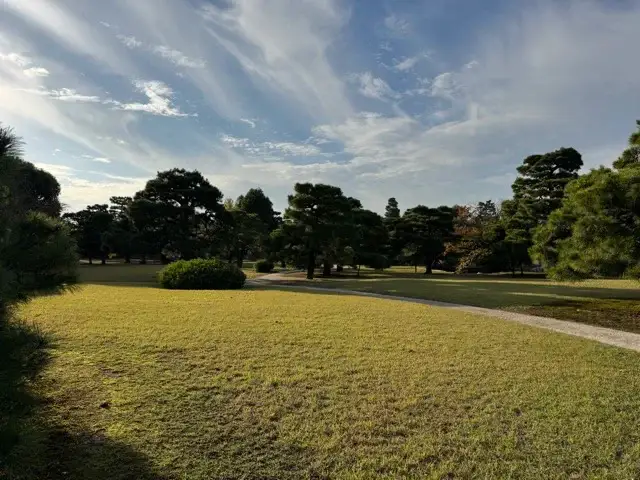
The grounds of Nijo Castle are quite large and quite beautiful. However, the public is restricted as to where it can venture in the garden. Some paths were blocked off. And the castle has a lovely pond, but I couldn’t get close enough to it to see if it had fish.
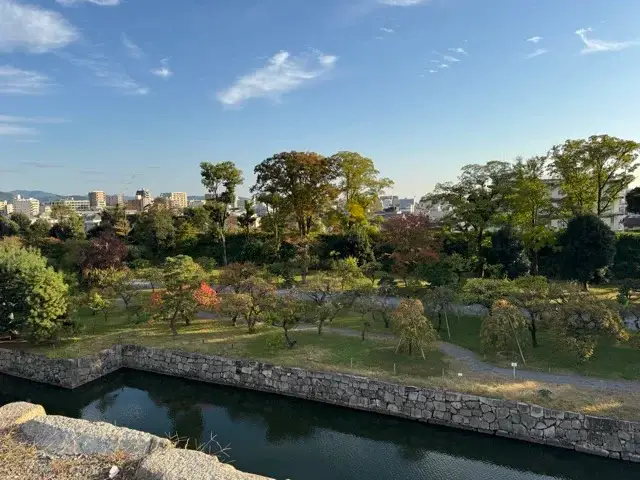
Nijo Castle has an outer moat. But it also has an inner moat that surrounds Honmaru-goten Palace. While I couldn’t go into Honmaru-goten Palace, I didn’t need a ticket to cross the bridge over its moat and look at its gardens.
As I crossed the moat bridge, I looked down and, lo and behold, fish were swimming around in it.
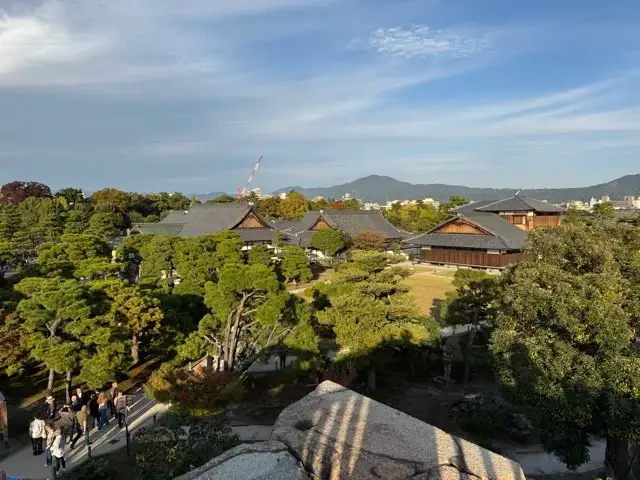
I don’t know if it’s a recreation or the original, but the base of Nijo Castle’s old castle keep is in the grounds. The base is the equivalent of probably two or three storeys tall. Modern steps lead to the top. From up there, I got a nice overview perspective of Nijo Castle before heading for the exit and over to Nishi Market.

Nishiki Market
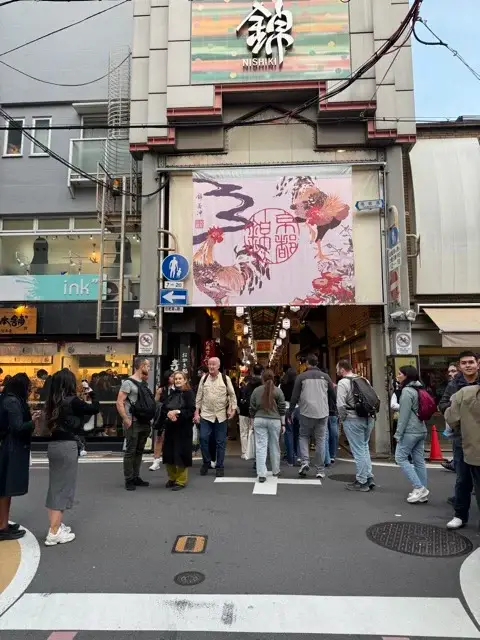
A somewhat narrow street dead-ends at a cross street. On the other side of the cross street, Nishiki Market continues straight on, at the same width, from that street. At least, that’s the way it is at the end I entered from.
Nishiki Market continues from there as a covered arcade for about a half a dozen blocks.
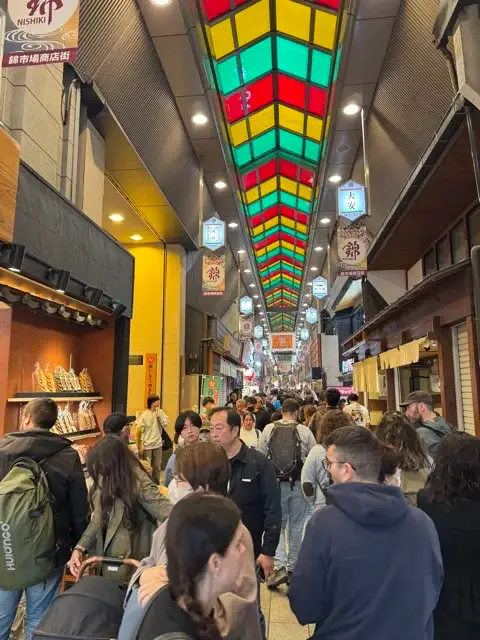
Nishiki Market’s roof is peaked along its entire length. The roof is constructed of alternating red, yellow, and green glass panels. It’s brutally attractive.
Cross streets pass through the market, but the roof continues over them.
The stores along both sides of Nishiki Market are fairly narrow. The majority of them sell foodstuffs for eating there. There’s sushi, grilled meats, sweets, drinks, yakatori, and a variety of other foods, mostly of Japanese cuisine.
They have a strict rule in Nishiki Market and at many places in Japan where they sell prepared “street” food. You can’t eat while walking. You have to stand at the stall while eating food from it. I’ve seen signs, not just at Nishiki Market, but also elsewhere in Japan, stating that rule in English. At Nishiki Market, some of the vendors also verbalized it in English to any of their customers who looked like they might not be familiar with the rule. I don’t know if that’s just custom and etiquette in Japan or if there’s a law. The signage and vendors were so insistent about not eating and walking—and I’ve encountered the same thing elsewhere in Japan—that there might indeed be a regulation.
In addition to the stores selling food to eat in Nishiki Market, there are also some souvenir shops, unprepared foods to take home, and at least one convenience store.
I only walked about half the length of the market. Probably because it is Saturday, it was very crowded. And I was very tired by then. I figured that, after half of it, I’d gotten the gist of Nishiki Market, so I headed back to my hotel to close down the day.
Discover more from Joel's Journeys & Jaunts
Subscribe to get the latest posts sent to your email.



One whole heck of a lot of loveliness in Kyoto, isn’t there? And generous hospitality for fish. I am getting a little peckish at the moment, so I have been very interested in your description of the market. I could stop at one of those counters right now and try some yummy food. I’d be ok staying in place to do it. Yup. You’ve had an ambitious day sightseeing, so of course you are tired. Good thing you didn’t go through the second castle too, isn’t it? May you be sleeping well. Catch up with you tomorrow.
Your “One whole heck of a lot of loveliness” comment got me to thinking. If you just wander around the streets of Kyoto, without visiting any of the sights, it’s kind of a meh city. Not bad, but not great. But if you do take in the sights then there is indeed a whole heck of a lot of loveliness here.
I picked a bad time to visit Nishiki Market. I had a late lunch and, because I had a hard time getting into a restaurant the day before, I had made a dinner reservation. So I didn’t eat anything at the market. But I was sorely tempted.