Tsutenkaku Tower and More
Today, I started my first full day in Osaka by going up a tower, the Tsutenkaku Tower. I followed that with some nearby sights, a garden, a pond in a park, and a temple.
Tsutenkaku Tower
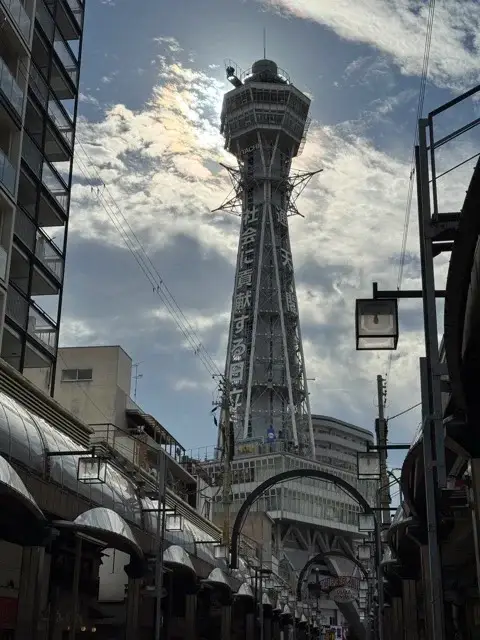
I was at the top of the Osaka Castle tower yesterday. But that’s only eight stories tall. I wanted something taller to get a broader perspective of Osaka. For that, I went to the Tsutenkaku Tower.
In the pantheon of world towers, Tsutenkaku Tower is something of a pipsqueak. Its main observation deck is only 91 metres high. But that’s still a heck of a lot taller than the Osaka Castle tower.
My walking tour app tells me that the Tsutenkaku Tower is not the first tower to have stood on the site. A previous tower was built there in 1912. The app says it was designed to resemble the Eiffel Tower sitting on the Arc de Triomphe.
There was a picture of the old tower at the current one. I can confirm that it looked generally like those two famous Paris landmarks, one on top of the other. Kind of weird, if you ask me. Then again, you didn’t ask me.
But it is no longer there. Why, you ask? According to my app, the old tower was heavily damaged in a fire. It was disassembled, and the materials were recycled in other buildings. What is it with towers burning in Osaka? The Osaka Castle tower burned down a couple of times.
The current tower, the Tsutenkaku Tower, was completed in 1956. At least one terrific occurrence happened in 1956*, but, to my mind, the completion of the Tsutenkaku Tower wasn’t it.
(One reader will smile at the 1956 reference.)
Sorry, Osaka. I understand you’re proud of your tower, but I don’t find it graceful, breathtaking, beautiful, or inspiring. It had a Meccano set feel for me. (Are Meccano sets still a thing in this great and glorious video game and virtual reality world? If not, and if you’re too young to know what they were, there are these newfangled things the kids are talking about called Google and AI. They can probably help you.)
Don’t take it hard, Osaka, it’s probably me, not you. Lots of people likely love your Tsutenkaku Tower.
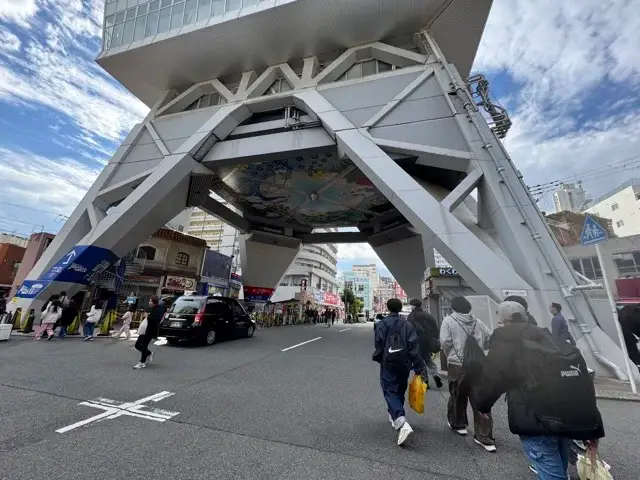
Look at the picture of the tower’s base. That big tower is sitting on four slanted stilts. Admittedly, they’re big stilts. But, still, I hope they had excellent engineers involved in its design.
To go up the tower, first you have to go down to the basement. From there, you get an elevator to the second floor. They use the same floor numbering as in North America here. That is, the first floor is the ground floor, and the next floor up is the second floor, not the first, as is the case in Europe.
I wasn’t paying attention, but there’s a large cylinder hanging off the side of the tower, up to the structure immediately above the stilts. I assume that must contain the elevator shaft. Otherwise, it was magic because the stilts aren’t straight, nor are they wide enough to hold an elevator.
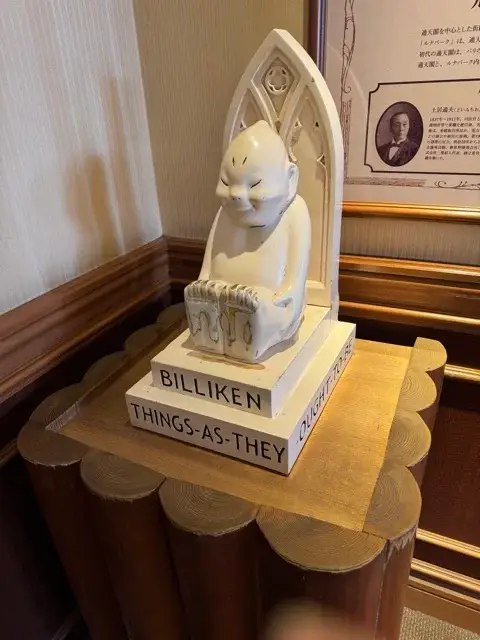
The second floor is the lower level of the two-floor square building above the stilts. From there, you pass a station where tower employees offer to take your picture beside a large Billiken doll. The photos are available for sale. I asked them not to take my picture. It probably goes against the rules of the witness protection program to knowingly have your picture taken in such situations. I’m not in the witness protection program. I’m just saying.
I don’t know if I’m the only one, but I’d never heard of Billiken. In its Tsutenkaku Tower entry, my walking tour app, GPSmyCity, says, “A unique aspect of Tsutenkaku is its connection to Billiken, the God of Happiness or ‘things as they ought to be.’ Originally enshrined within Luna Park, a replica of Billiken was placed in the tower in 1979 to revive its historical significance. The statue is now a popular attraction, with visitors often touching its feet and making donations in hopes of receiving good luck.”

A god of happiness, now that’s a god I want to get on the good side of.
That’s all the app says about Billiken. It sounds like it’s a Japanese deity, right? Um, I don’t know. Wikipedia’s entry on Billiken, for whatever that’s worth, has a section on its presence in Japan. But it starts by saying, “The Billiken is a charm doll created by an American art teacher and illustrator, Florence Pretz of Kansas City, Missouri, who is said to have seen the mysterious figure in a dream. It is believed that Pretz found the name Billiken in Bliss Carman’s 1896 poem, ‘Mr. Moon: A Song Of The Little People.’ In 1908, she obtained a design patent on the ornamental design of the Billiken…”
So, I don’t know.
I probably just missed it, but I didn’t see the original, foot-rubbed Billiken statue. But there was at least one plastic model in addition to the bigger version used for picture-taking.
The square podium of the tower also has a spiral slide that people can pay to slide down from the second of the two levels of the podium. If you inferred from my use of “people can pay to slide down” that I didn’t, you’d be right.
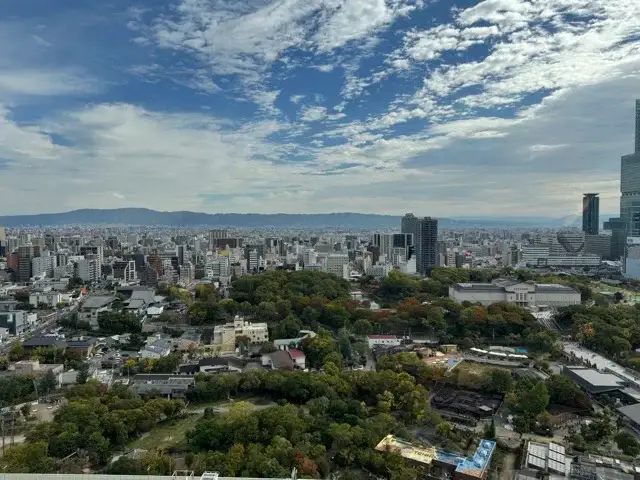
Getting back on track. Past the Billiken picture-taking position, there’s another elevator up to the main observation deck. Floor-to-ceiling windows provide expansive views of Osaka. The main observation deck has two levels. They let you off at the top floor, but you have to walk down to the lower level to get the elevator back down. That way, people exiting the elevator don’t have to fight past people in the narrow elevator waiting space.

However, before that …
There is another observation deck on the roof of the main one. You have to pay ¥300 to climb up the stairs to it. The upper observation deck is outside.
This deck also has two levels. The lower one has wire mesh fencing surrounding it, making it difficult to take pictures from there. On this level, there’s a protusion that sticks out a bit from the tower. It too has a wire mesh fence surrounding it.
You’d expect that to have a glass floor, because that’s the sort of thing these places do. They didn’t do that here. Instead, it has a metal grate floor. You can see down through the grating. Um, no. I didn’t go on it.
The second level of the upper observation deck doesn’t have the wire mesh fencing that the first level has. It has a solid, horizontal railing that’s about chest-high for someone of my lack of stature. Below the railing is a glass wall. This was sufficient so as not to trigger my acrophobia.

But … The floor of that observation deck level consists of a narrow circular walkway around the square core of the building. The walls of the core are solid, except for the door to the stairwell, so you can’t easily duck in at any point if you’re feeling uncomfortable. The circular walkway has a glass floor. It’s opaque, frosted glass. But, still, my brain knew full well it was glass. That caused some discomfort. And by “some,” I mean a lot.
Beside each of the four flat parts of the walls of the square core, there is a solid floor to fill in the space between the square and the circular walkway. But at the corners, each corner reaches right out to the circular walkway, leaving me no choice but to walk on the glass.
I didn’t enjoy that experience. But it did allow me to take a few pictures without any intervening glass before I quickly scrambled down to safety.
Then I took the elevator down and left the Tsutenkaku Tower.

Keitakuen Garden
Keitakuen Garden is a little more than a ten-minute walk from the Tsutenkaku Tower. It’s a traditional Japanese garden with an irregularly shaped pond at its centre.
There are two or three small islands in the pond. (Yes, I can count up to three. But I forgot if it was two or three. Hell, it might have even been four. Don’t be snarky.)
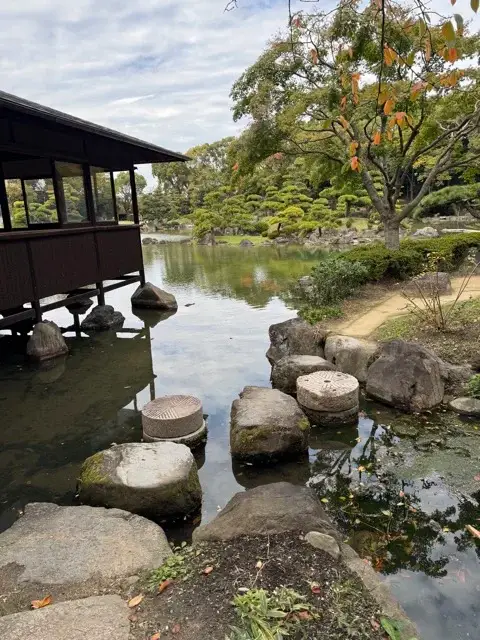
The islands have to be small because the pond itself isn’t huge. If the islands were too big, there wouldn’t be enough room for water. And if there were no room for water, the International Pond Certification Board would strip it of its pond status. Then where would it be?
However, the islands are big enough to have at least one tree on them. And one island has a few. All of the trees are of the topiary persuasion.
At some points where there are small inlets off the pond, stepping stones or stone planks ford the inlets. They do so just because they can. That, and I think there’s supposed to be a meditative quality to it. As it walked across one of the stone planks, I meditated on the concept of not falling off.

There is a path that runs all the way around the outside of the pond, so plank walking and stepping stone walking are not strictly necessary.
On one side of the pond, there is a simple wood structure. It has large front windows overlooking the pond. There are tables with benches in inside and a row of benches looking out through the windows toward the pond. I think the building might be used at times for tea service, or possibly even a formal tea ceremony, but there was no sign of tea serving when I was there.
Off to one side of the pond, opposite that building, there’s a small wooded area that climbs up a slight hill. There is a peaceful path through the trees. It’s quite pleasant.
Keitakuen Garden is not big, but it is a splendid garden.

Kawazokoike Pond
As I walked to my next destination, I passed another pond immediately beside Keitakuen Garden. This one isn’t listed in my walking tour app. It’s larger and more rectangular than the pond in Keitakuen Garden.
A directional sign and Google Maps listed it as Kawazokoike Pond. A straight, red bridge bisects the pond.

The side where I approached the pond is open water with a fountain jetting out of it. Some ducks were paddling around that side of the pond.
On the concrete edge of the pond stood what Apple Photos told me was a grey heron. It stood there calmly in a commanding pose. I thought herons eat fish, but I didn’t see any fish in the pond. Maybe there were some before the heron arrived. I thought it had a contented smile on its face.
On the other side of the red bridge, tall aquatic vegetation choked the pond. Apple Photos told me they were lotus plants, but it couldn’t decide on the variety. It gave me a choice of two. The lotuses weren’t in bloom. So I didn’t have a lot to go on.

There’s a wooded park immediately beside the pond, on the other side from Keitakuen Garden. I didn’t see a directional sign providing a name for it, nor could Google Maps come up with a name, but it was charming.

Isshinji Temple
The sight I was on my way to see before I was so pleasantly interrupted by Kawazokoike Pond and its adjoining park was Isshinji Temple. It’s a mildly attractive temple on the outside, but I couldn’t go inside. I’m not entirely upset about that. Despite it being what drew me there, I’m not sure I really wanted to go in because, well, it seemed rather macabre to me.

A sign in front of the temple building said that it was only for people saying memorial prayers for the dead.
There’s a cemetery in the temple compound. A sign in front of the cemetery was more blunt. It said tourists can’t enter. While I couldn’t go into the cemetery, I could look through the entrance to it. The tombstones were, as was the case at what I think was a cemetery on the mountain at Fushimi Inari Taisha Shine in Kyoto, too tightly packed for them to possibly mark graves for full corpses. Perhaps just ashes are buried there.
“So, what’s the macabre part?” you ask. “People die all the time. There are lots of cemeteries. People, as the old joke goes, are dying to get into them.”
Here’s the macabre part. According to my walking tour app, there are Buddha statues in the shrine. But they’re not your average Buddha sculptures. They were formed from the ashes of everyday folks whose families left their corpses there to be cremated.
This raised the question in my mind, a question I don’t have an answer for: why is the cemetery there? Do some ashes get turned into Buddha sculptures, while others are interred in the cemetery? Or are the tombstones solely memorials, not marking the spot of any remains? The latter sounds superfluous to me. If your ashes are now a Buddha statue that devout people pray to, I’d think that should be more than enough of a memorial, shouldn’t it?
And that, I would say, was more than enough for one morning.
Discover more from Joel's Journeys & Jaunts
Subscribe to get the latest posts sent to your email.


Why, I be blushing about your 1956 reference. Terrific did you say? You sure you meant terrific, not terrifying? Speaking of terrifying, congratulations on your glass floor traversing and precarious pond fording. What an adventurer! Loved those ponds and parks. Nothing like topiary to enhance itty bitty islands, I say. Nice photos. Too bad about the fish. Would I like my mortal remains to be turned into a Buddha statue? Probably better than the alternatives.
You joke about your memory even more than I do, but if you blushed about the 1956 reference, your memory is not totally shot.
They don’t call me Mr. Adventurer for nothing. I have to pay them for that. They would charge less to call me Mr. Tedium, but I think it’s worth the extra cost.
I guess, as you say, a Buddha statue is better than some of the alternatives. Then again, I’d prefer to not be dead if I had a choice.