Villefranche-sur-Mer

I took a half-day trip to Villefranche-sur-Mer from its neighbour, Nice, my base, this morning.
I like a town that tells you what it is right in its name. Ville is French for city.
Apple Translate tells me that franche means free zone. Google Translate, on the other hand, says it means frank. Apple Translate wins that round, at least on a historical basis. Then again, maybe the people of Villefranche-sur-Mer have a reputation for frankness. I don’t know.
Sur mer means on the sea.
So, Villefranche-sur-Mer is a free zone city on the sea. To state the obvious, it is not so much on the sea as beside it. Villefranche-sur-Mer is not a floating city. And, as I said, the free zone is more historical than current, but the residents of Villefranche-sur-Mer have all the freedoms afforded to all the citizens of France.
Wikipedia, for what that’s worth, tells me that, “In 1295, Charles II, Duke of Anjou, then Count of Provence, enticed the inhabitants of Montolivo and surroundings to settle closer to the coastline in order to secure the area from pirates. By charter, he established Villefranche as a “free port”, thus the name, granting tax privileges and port fee rights that lasted well into the 18th century.”
So, now you know. Maybe one of you can remind me when I forget.
To be honest, I think “city” gives a larger impression of Villefranche-sur-Mer than its reality. “Large town” paints a more accurate picture in my mind.
I read about Villefranche-sur-Mer in one of my guidebooks before coming on this journey. The section on it was brief, but it sounded like somewhere I’d enjoy visiting.
And yesterday, I saw it from out on the bay that it sits beside on my “Mediterranean Cruise” yesterday. It looked gorgeous from that vantage point.
Depending on which train you take, Villefranche-sur-Mer is only a seven or eight-minute train ride from Nice’s main station, which is beside my hotel. And the trains are very frequent. So Villefranche-sur-Mer made for an easy half-day trip from Nice.
And here I am.
In Villefranche-sur-Mer

Based on what I read in my guidebook, there aren’t a lot of specific sights to see in Villefranche-sur-Mer. I think the idea is just to wander around the Old Town, enjoy the sea, sit a spell, and, in general, take in its immense beauty. That’s what I did.
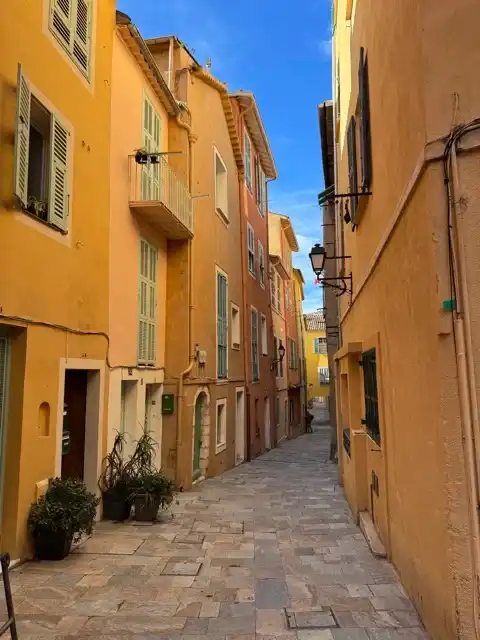
The old town section of Villefranche-sur-Mer is splendid. The streets accommodate only pedestrians. Buildings on either side reach no higher than three or four storeys. Each picks one colour from a dark pastel palette that favours the yellow to mustard to orangey to orangey-brown range of the spectrum.
The windows of the buildings all have shutters of colours that are contrasting, but complementary to the colours of the buildings. The buildings immediately across the street from and facing the sea are particularly enchanting.
Speaking of Villefranche-sur-Mer’s pedestrian town streets, the ones that run roughly parallel to the bay-front are fairly flat. However, Villefranche-sur-Mer is built up the side of a hill that has only a narrow band of flat land near sea level. For all I know, that could be landfill.

Thus, each of those pedestrian streets running roughly parallel to the contour of the bay is higher than the preceding one as you go up the hill. Going from one street to the next usually involves stairs, not a normal street. That being said, in old, carless towns built on hills, that’s not unusual.
There is one street in the old part of Villefranche-sur-Mer that’s not especially attractive, but it is somewhat unique. Rue Obscure, Dark Street in English, lives up to its name. It’s hard for a street to get much natural light when it tunnels through buildings, with only the occasional light well. That’s Rue Obscure.
There is something similar in Lyon, France. I’ve forgotten what they are called. I was in Lyon before I started this journal, so I can’t look it up here. But it should be easy to find it on the internet if you’re interested and less lazy than I am.

There are more of them in Lyon, put there so people wouldn’t have to walk all the way to the end of old Lyon’s exceptionally long blocks. The ones in Lyon are narrower than Rue Obscure, and they have a closer relationship to the buildings they tunnel through.
There are other significant differences. I was about to get into them, but then I remembered that this is a journal entry about Villefranche-sur-Mer, not Lyon. And the latter is only a memory for me and, therefore, not to be relied upon.
Where the old town of Villefranche-sur-Mer reaches the sea, la mer (Oh, no; the earworm has returned), there is a cobblestone street that accepts vehicles, but, at least at this time of year, vehicles only very rarely drive along it.

There is a string of restaurants facing the sea along that stretch of the road. One of them has some tables on a cobblestone walkway that’s on the other side of the road, immediately beside the sea. The walkway is wider in front of that particular restaurant, so it has the room to do that.
It all paints a very quaint seaside picture.
As I said, there aren’t a lot of named sights to see in the old town, just general loveliness. But I did see a couple.
The Citadel is an old fort. There’s not much to see there, but Villefranche-sur-Mer’s small, unassuming, but charming city hall is in the Citadel.
Years before I came on this trip, I already knew that hôtel de ville is French for city hall. Apparently, a lot of anglophone tourists don’t know that. When I was there, a sign that was computer-printed on plain paper was taped to the glass door of the Hôtel de Ville. It said, in English:
Ladies and Gentlemen,
« Hôtel de Ville »
In French means
« Town Hall-Administrative Center »
And not « Hotel -Resort »
Thank you and Welcome to Villefranche-sur-Mer
I guess the city hall staff got tired of answering people who came in to ask if there were any rooms available.

Another specific sight I saw was Église Saint-Michel. It’s partway up a hill. The front facade is dainty and painted pink, mustard (Dijon, I think), and white. A side wall is bare stone, but with an adjoining clock-and-bell tower that’s the same mustard colour as is on the front of the church.
The Église Saint-Michel, which was built in 1790, is bigger than I might have thought for a city/town of Villefranche-sur-Mer’s size.
Inside, there are lots of that Dijon mustard colour, along with some stone and white arches.
There are a couple of sculptures of note in the church.

One of them depicts Saint Roch (there’s a Saint Roch?) with a dog who’s bringing him a frisbee. At least it looked like the dog was bringing him a frisbee, but that seemed unlikely because of the age of the statue and the vintage of the saint.
A sign beside the statue explained it (with the help of the camera function of Google Translate). The translated French text said, “SAINT ROCH. Roch gives his fortune to the poor and takes up the pilgrim’s staff…. On the road to Rome, he cares for the plague-suffering, contracts the plague, and then lives as a hermit. A dog supplies him with bread.”

Isn’t that just like a god? Roch forfeits his fortune to the poor and takes care of the desperately sick. And what does whichever god it was who was in control do to reward him? He gives Roch the plague. That’s what.
Well, at least the god sent Roch a dog to fetch bread for Roch. It’s a shame that the dog brought only bread. Couldn’t he bring some nice foie gras, as well? And maybe a bottle of fine wine? Or champagne would pair nicely with foie gras. But, no, the god gives Roch the plague and bread. Roch should have gotten himself another god.

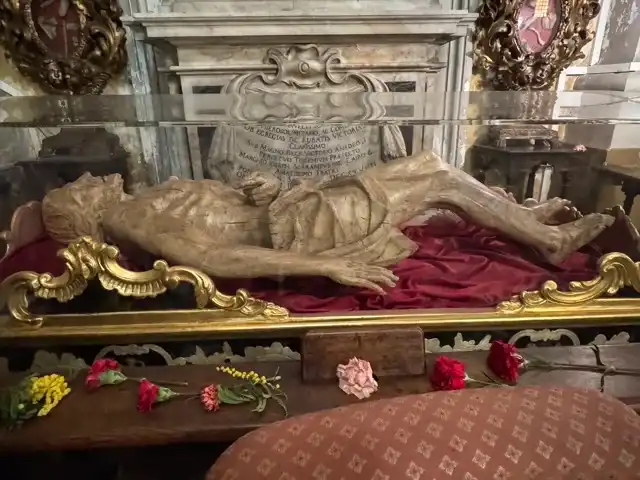
The other statue of note is one of a dead Jesus lying in repose. The translation of the sign beside it said that it was carved out of a single block of fig wood by an anonymous galley slave in the 16th century.
Leaving the church and the old town behind, there is a seaside path that passes through Villefranche-sur-Mer. It’s possible to walk along it all the way to Nice in about an hour and a half. In his guidebook, Rick Steves recommends against walking the whole way. He says that at one point, it turns to very rough cobblestones and becomes narrower. He recommends walking along it for as far as you feel comfortable and then doubling back.
A little past the old town, there’s a pretentious marina that calls itself “Port Royal de la Darse.” Google Translate translates it from “Port Royal de la Darse” in French into “Port Royal de la Darse” in English. Oh, come on, Google Translate. You can do better than that. Is that really your best work?
Even I know that “de la” is French for “of the.” I didn’t know what “darse” means, but when I asked Google Translate to translate only that, without the “Port Royal de la,” it told me that it means “dock” in English. So, why couldn’t Google Translate translate it to “Port Royal of the Dock,” or maybe “Royal Port of the Dock”

The reason I say it’s more like a marina than a port is that, while there were a lot of boats moored there, all of them appeared to be private pleasure craft, and many of those were quite small. There were a few yachts, but not of the size that anyone would associate with the especially rich and famous.
I walked along the seaside path until I reached the edge of my comfort zone, before the treacherous trail (treacherous in my mind) triggered at least two or three of my major fears. I then took the advice and doubled back.
By the time I got back to the old town, it was at the point when any sane mind would naturally be invaded by more-than-idle thoughts of lunch. That’s where my mind went too.

Lunch in Villefranche-sur-Mer

I mentioned above a restaurant in the old town with tables on a cobblestone walkway immediately beside the sea. That’s where I ate lunch. Like yesterday, I was able to enjoy my midday repast seaside. I got a table as close to the sea as possible without a serious risk of falling in.
Fortunately, the restaurant didn’t place tables any closer. I might have taken one as a result of a fear of missing out. FOMO is far from my greatest fear, but it may be the death of me one day.
Unlike yesterday, I didn’t take a picture of my meal today (fish soup, scallops risotto, and a glass of wine). But I did take a picture of the view from my seat at my table. It was again a pleasant place for lunch.
When I finished, I took the train back to Nice, where I spent the afternoon.
Discover more from Joel's Journeys & Jaunts
Subscribe to get the latest posts sent to your email.

Monte Carlo Casino, Other Stuff, and Some Failures
Palais Lascaris and a Last Wander in Nice
Very picturesque! And so many opportunities to take a picturesque topple into the sea. But of course, I am pleased that you did not, and instead turned back on your trail and finished your seaside lunch. Absolutely lovely side trip and a sparkling day, it looks like.
I can’t tell you how much I enjoyed Villefranche. (We’re on a first name basis now, so I’m allowed to drop the “sur-Mer”). That was a ridiculous thing to say. Of course I can tell you. I enjoyed it a lot.