Cathédrale Saint-Nicolas; Musée des Beaux Arts
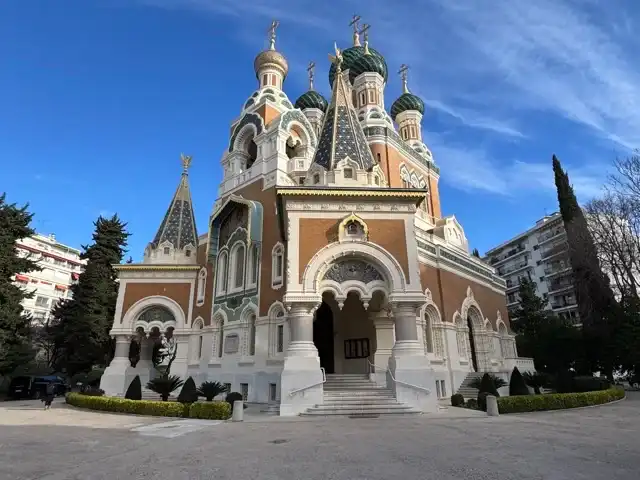
After my primarily technological frustrations of yesterday afternoon on my day trip to Monte Carlo, Monaco, I decided to stay in Nice, my current base, for today. I started at Cathédrale Saint-Nicolas, moved on to Musée des Beaux-Arts, and then headed for lunch.
I wrote this and the preceding paragraph after ordering lunch, while waiting for it to arrive. There is a very strong possibility I’ll have a word or two to say about lunch, regardless of the quality of the food. In fact, I can guarantee it. Wait for that unless the idea of envying me disgusts you. In that case, you’ll probably want to surf away from this page before you reach the last section.
Cathédrale Saint-Nicolas
Cathédrale Saint-Nicolas is a fairytale sort of church. Although it may have a fairytale quality only for an admittedly very large segment of the world’s population, Russians might consider it to be a fine church, but not of a particularly fairytale-like design.
It’s a Russian Orthodox Christian church.
I spent far longer than I expected, and that I normally would have in a church of its size and nature. I’ll get to why shortly.
Cathédrale Saint-Nicolas is topped by five onion-shaped domes covered in glazed tiles. On four of the domes, the tiles were two tones of green, light and dark.
I couldn’t quite tell the colours of the fifth dome. They looked different when I viewed them from different points around Cathédrale Saint-Nicolas. At first, I thought it was two shades of grey. Later, it looked like there was some gold and maybe tinges of grey in the mix.
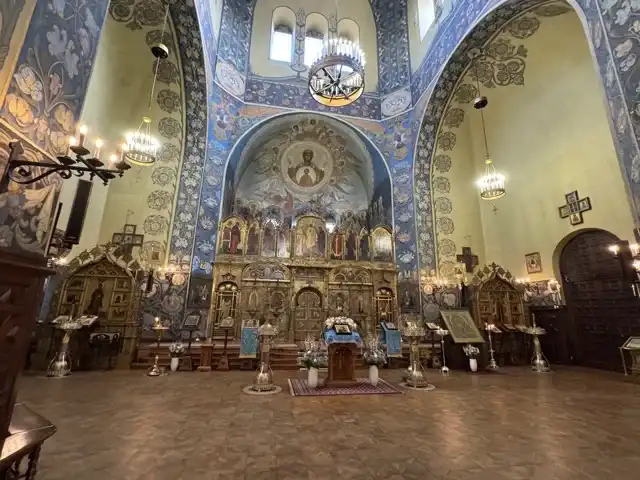
The interior of Cathédrale Saint-Nicolas is very attractive, with arches around the church leading up to half-domes. The arches are painted with subdued, multi-coloured patterns, with blue predominating. There are also painted patterns on the walls beside the arches.
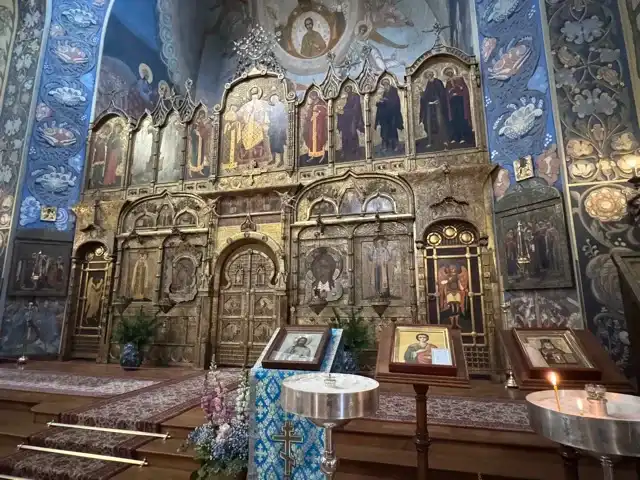
The altarpiece fills the back wall with what looks like gilded carved wood and embedded paintings.
So, why did I spend longer than I expected in Cathédrale Saint-Nicolas? Walking into the back area of the church is free. You can see the whole sanctuary of the church from there. However, if you want to walk past the barrier to see things closer up, it costs €5. But that €5 also includes a museum in the basement.
The ticket seller told me there’s French and English down there, including a short film. I splurged.
It’s a small museum. The text beside most of the items is not just in French and English, but also in Russian. There were also three sets, one in each of three languages—again, French, English and Russian—of three exceptionally large stapled sheets of paper sitting on a desk in the museum available for reading or photographing there. The sheets provided information about the history and construction of the church.

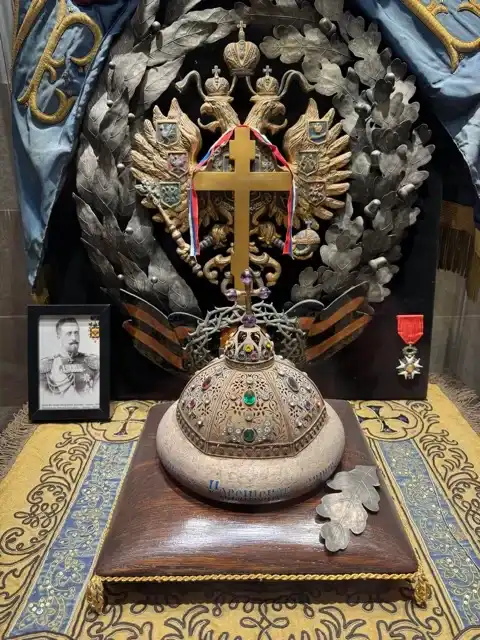
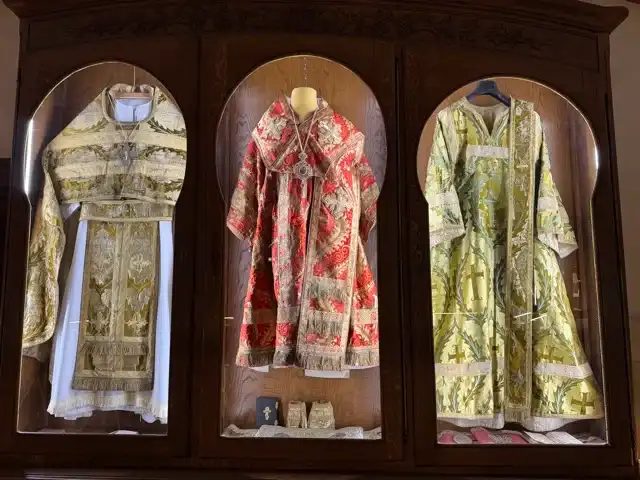
Items on display included religious garb, crowns, and other religious artifacts.
There’s also a video that plays in the museum. When I came in, it had already started, and there were a few people watching it. The soundtrack was in Russian, but with French subtitles. I started to leave.
The attendant cornered me and said something to the effect of, “You speak English?” Yes. “I can start again in English. In 25 minutes. While you wait, you can see information about church on computer.”
She then took me over to a computer, pulled up an English version of some of its contents and plunked me down at the screen. It displayed images of several elements of the exterior of the Cathédrale Saint-Nicolas. I could click on each picture and get more information about that element. I went through them all. There were only a few words on each, so it didn’t take me anywhere near 25 minutes.
I started to leave.
“Very interesting film. You should watch. You take a walk around and come back?”
There’s a small park surrounding Cathédrale Saint-Nicolas that’s part of the church grounds. I took a slow walk around it, sitting on a bench for a while. I came back to the museum, and the film was still playing.
While I was there, most of the audience left. Only one woman remained. I don’t know if she’d been there from the start of the film or if she walked in shortly before I returned, but she appeared to be watching it intently from the front row. The attendant went up to her and asked her if she minded if the attendant restarted the film with English subtitles. The woman agreed.
After all of the trouble the attendant and the poor audience member went through, I felt I had to watch the film right to the end. It lasted 30 minutes.
Much of the film was narrated by the church’s current priest. He provided a history of the church and of the Russian population in Nice.
The highly abbreviated version is that the mother of the emperor Alexander II of Russia, a widowed empress herself, came to Nice one winter in the mid-19th century. She liked it. Alexander II and his wife, the then-current Empress, started coming in the winter. (Wintering in the south of France? What a concept.)
Russian nobility thought that if it was good enough for the emperor, it was good enough for them. So they came too. Some other Russians started moving permanently to Nice and a couple of nearby seaside towns. Hence, a fair Russian population built up there. And there is still a large Russian community in the area today.
To serve the religious needs of the community, the Cathédrale Saint-Nicolas was built. It was consecrated in 1912. (A smaller Russian Orthodox chapel preceded it.) The then Russian emperor transferred ownership of the church to the Russian Orthodox Church.
After the Soviet socialist revolution, things got dicey for Russian churches. To keep it safe, the Russian Orthodox Church entrusted it to the Greek Orthodox Church. The Russian Orthodox Church then got it back. But there was a lease (I’m not clear on who the lessor and lessee were) that expired in the early 21st century. At the end of the lease, the Russian state tried to claim ownership. It succeeded in getting it in 2013. Hence, the church and the land it’s on is now the property of Russia.
I wonder if it will get seized for reparations to Ukraine.
Musée des Beaux Arts
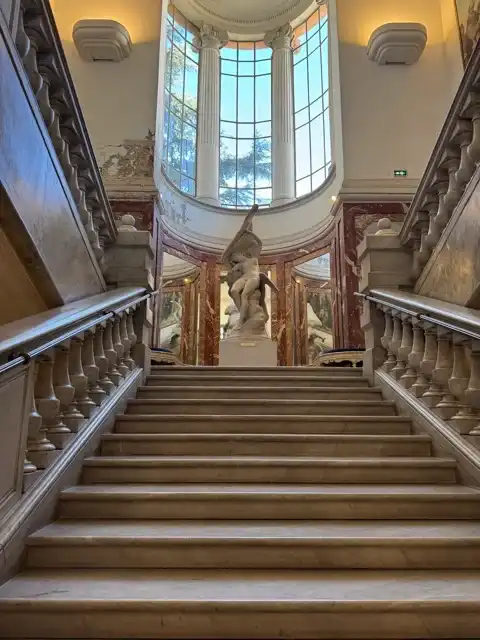
The Musée des Beaux Arts is a small art gallery in what was formerly a large home with a grand staircase. When I was there, they had a special exhibition of the works of Maurice Denis (1870-1943). It focuses on his works during his stays in the south of France, but also displays works he did elsewhere.
The exhibition had signage with considerable information about Denis, the cities where he worked, his painting style and where he drew his inspiration. That text was in French, English and Italian. Placards beside the paintings, often providing a paragraph about the piece, were only in French.
Auguste Rodin
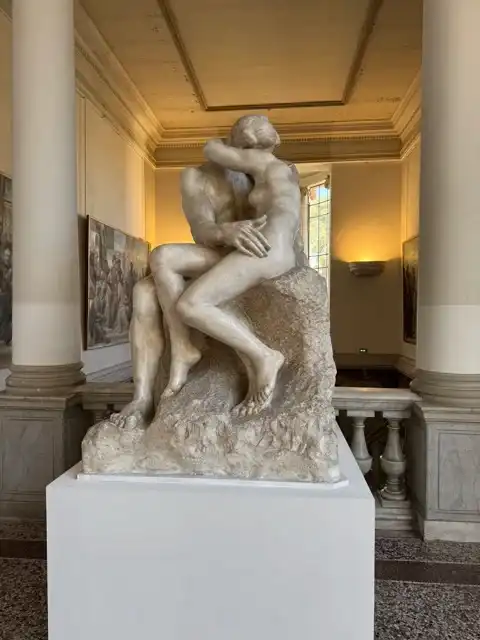
Circa 1927, reproduced from an 1886 piece
The permanent collection of the museum includes a copy of a Rodin sculpture made in 1927. The original was made in 1886. It also contains paintings and sculptures by various artists, mostly from the mid-19th century to the mid-20th century.
My walking tour app tells me the Musée des Beaux Arts has works from the 13th to 20th centuries. I might have missed one or two, but I didn’t see anything before the 19th century. Perhaps they are normally in the rooms currently holding the temporary Denis exhibition. There was also a small room that looked like it was undergoing renovations. Maybe they’re normally in there.
You know me, I can talk in-depth about art only to mock it. I’d do that here, but it’s getting close to supper time. I made a reservation, because some restaurants are closed this time of year. The open ones can be difficult to get into. I want to post this before I go to dinner. So I’ll end this here.
But, before I do, what’s the important event of the day that occurs some hours before supper time? …
Maurice Denis
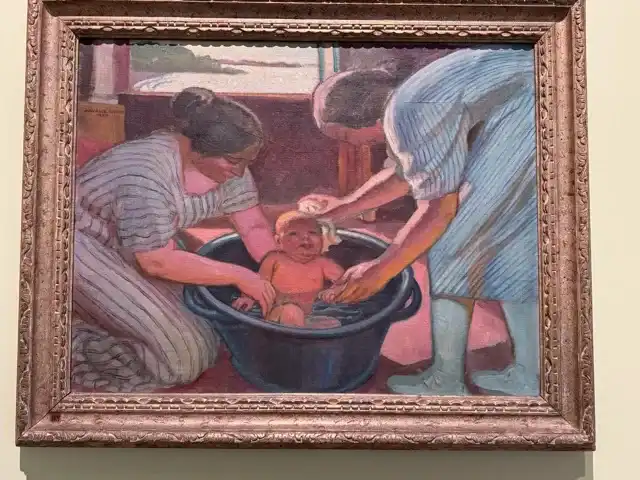
1923
Déjeuner sur la Plage
I already knew the above words before coming on this trip, but for the benefit of those who are even more ignorant of French than I am, “déjeuner” is French for “lunch.” “sur la” means “on the.” And “plage” is “beach.”
Yes, this is the section you might want to skip if you don’t want to envy me. There’s nothing in this post after this section. So, you can leave now. I’m perfectly fine with talking to myself.
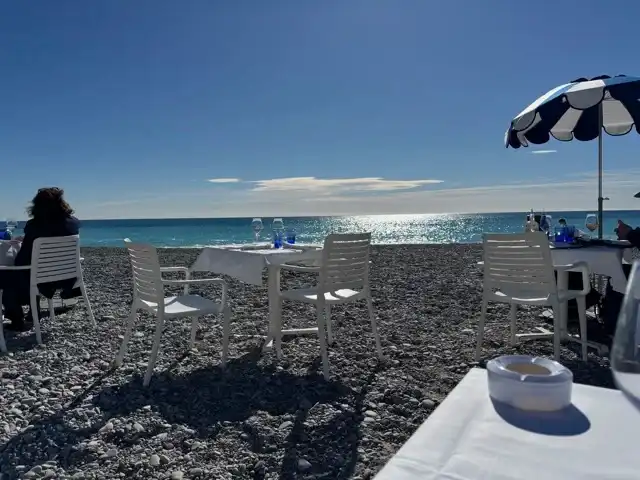
The restaurant I ate at wasn’t just by the beach. Its tables, with their white tablecloths, were on the beach.
Sitting at my table, the scene that unfolded before me started with more of the beach, followed by two hues of the Mediterranean Sea, pale blue close to the shore, followed by a dark blue-green sea all the way out to the horizon.
The sky was sky-blue, because what other kind of blue would it be, with only a few small clouds.
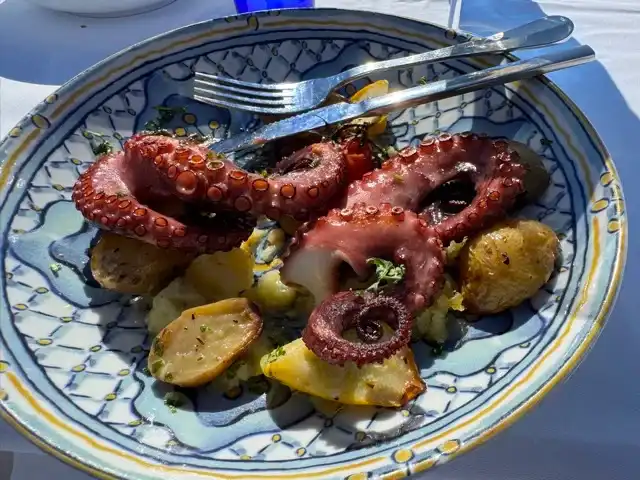
I ordered grilled octopus and a glass of wine. It was delicious and beautifully presented. Underneath the octopus were potatoes and other roasted vegetables. I thoroughly enjoyed it.
I felt bad because I didn’t imagine that the octopus appreciated the shared experience as much as I did. But sacrifices must be made, fortunately, not by me.
I didn’t think to take a picture of my plate until I’d already eaten some of it. My apologies for a picture of a partially eaten meal. Think of the partially eaten meal as intentionally philosophically symbolic of some deep human condition or state of the universe, but I can’t for the life of me think of what.
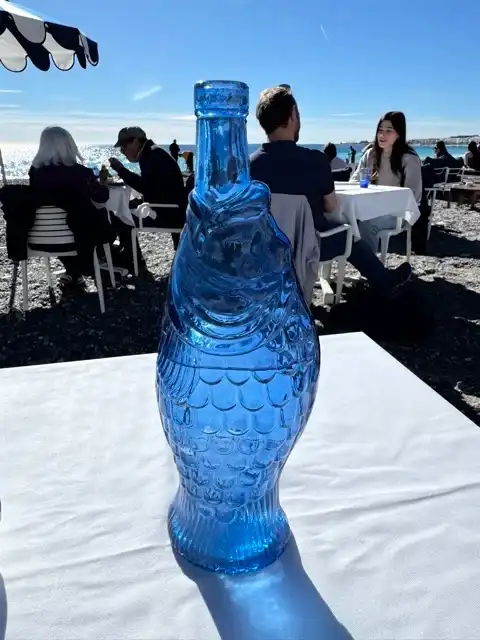
As a bonus, the water pitcher they placed on my table was made of blue, translucent glass in the shape of a fish.
I spent well over an hour enjoying the food, the wine, and the coffee I had afterwards, all while listening to calming waves rhythmically washing upon the shore.
Spending that long over lunch meant that I didn’t have as much time to do stuff during the rest of the day, and I already had something booked for mid-afternoon. But doing less in the afternoon to more fully enjoy lunch was the sacrifice I made.
Vive la joie de vivre!
Discover more from Joel's Journeys & Jaunts
Subscribe to get the latest posts sent to your email.


Yes I am envious. Of all of it. Although I would not have liked to have been the octopus. However, if I had abandoned the blog early so as not to suffer through envy of your idyllic lunch on the beach in the south of France, I would not have gotten to the fish bottle at the end, would I? That would have been cruel. I am happy for you. Envious, but happy.
It was a perfect lunch. The food was great. The location was even greater. And the water bottle completed the perfection.
The nice beach lunch in Nice reminds me of similarly charmed lunches elsewhere on the Mediterranean. Sensuous.
Lunch is good. The Mediterranean is good. Lunch by the Mediterranean on a beautiful day is glorious.