Musée Matisse, Archaeology, and More

I started the afternoon in Nice by visiting an old church. I followed that with a visit to Musée Matisse, a museum dedicated to, as the name suggests, Henri Matisse. I ended the afternoon at an archaeological museum. All three of those are clustered around a park in the Cimiez district of Nice, where I had lunch earlier.
Monastère de Cimiez
The only things I saw that I could get into at the Monastère de Cimiez were its attached church and a beautiful garden. The seminary building itself didn’t appear to be publicly accessible, but I could see an attractive cloistered courtyard through a locked gate.

According to my walking tour app, there’s supposed to be a museum that’s open to the public, which is associated with the monastery. If there is, I couldn’t find it. Then again, I didn’t look particularly hard. Religious museums don’t tend to excite me in a positive way.
There’s also a cemetery associated with Monastère de Cimiez, but I didn’t look for it at all. It’s of note because among the renowned deceased occupants is Henri Matisse. Paying my respects to him might have made for an appropriate prelude to my visit to the Musée Matisse to come. But I didn’t.
The garden was, as I said, beautiful. There were trees, bushes, grass, and a long bed of blooming flowers. I’ll call pretty much any garden with blooming flowers in February beautiful. There’s also a wide, L-shaped pergola. And, because it’s at the top of Cimiez hill, there are nice views of the landscape below through some gaps in the trees and bushes.

The church, Notre-Dame-de-l’Assomption, had, to my eyes, a handsome but somewhat plain facade, with a row of columns supporting simple arches.
The interior was very attractive. The segmented, arched and ribbed ceiling was painted with religious imagery.
There were also some paintings on the walls. My walking tour app told me that three of them were “major paintings by Nice painter Louis Bréa” that comprised the majority of his activity for 40 years. Not a very productive artist, was he? How could he earn a comfortable living like that? Maybe he also waited tables to make ends meet.

I hadn’t heard of Louis Bréa before. I Google him. His English-language page on Wikipedia and an English page on the Nice Musée des Beaux-Arts spell his name without the accent, i.e, Brea, not Bréa.
And the Wikipedia page disagrees with my walking tour app about him being a Nice painter. It says he was an Italian Renaissance painter, active mainly in and near Genoa. Genoa isn’t all that far from Nice, but it’s not Nice, nor France. So I don’t know what to believe.

Musée Matisse

The Musée Matisse is in a jolly, but dignified, red and yellow building. My walking tour app tells me it is a 17th-century Genoese villa that belonged to the Guernatis family. Wait. Genoese? I’m so confused. When did I leave Nice? Did Genoa extend all the way from that city, along the western part of the Ligurian coast, through what’s now Monaco, and over to Nice?
Whatever. It’s a handsome villa. I wouldn’t mind having a pile like that. It’s atop the Cimiez hill, and beside the big, beautiful Cimiez Arenes Garden. Location! Location! Location!
Henri Matisse
1909, 1913, 1913-1914, and 1930
My walking tour app says that the Musée Matisse “is a must-visit destination for art enthusiasts visiting Nice.” A must-visit for art enthusiasts. How could I not go? Let me count the ways. Nevertheless, it was right there, and it offers a combination pass that includes the almost next-door Musée Archéologique de Nice-Cimiez. So I went in.
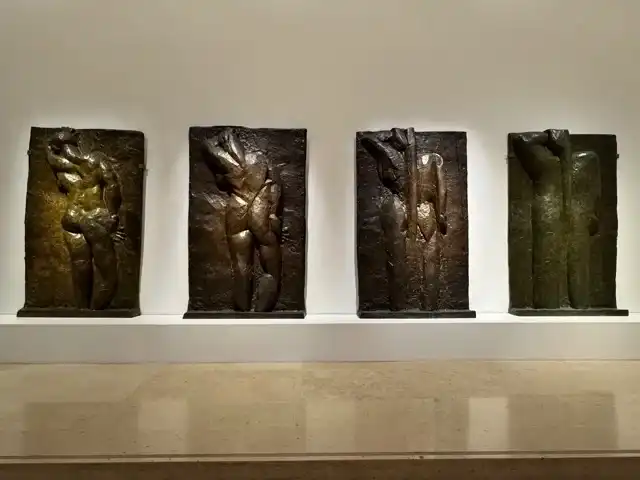
To get to the entrance of the Musée Matisse, you have to walk down a set of external stairs to one level below what would normally be the ground floor of the former villa. Inside, on that floor, in addition to the ticket booth, there are four large bronze relief sculptures. Each is of a person’s back. Matisse completed the first in 1909 and the last in 1930.

Henri Matisse
1893
Apart from the spread in the years of completion of the back sculptures, the lower level contains mainly his earlier works.
The upper levels of the museum hold some of Matisse’s more recent works, including paintings, sculptures, drawings, and some models he used when designing the art for a chapel, The Chapel of Vence.
In addition to Matisse’s works, the Musée Matisse also contains some items related to or that were owned by Matisse. For example, there are some black and white photographs of him at work, a photograph of his wife, who predeceased him by several years, and some antique furniture that had been in his collection.

Henri Matisse
1909
Bronze cast, 1948
The availability of English in the Musée Matisse was varied. Most of the rooms contained panels discussing his life, work, and/or the subject matter of the works in the room. Those all had French and English text. But many of the placards beside the individual pieces had a paragraph discussing the piece. Some had English translations, but probably more than half didn’t.
I tried using the camera function of Google Translate on some of them. But, for one, that’s a cumbersome process that sometimes requires pointing the camera just so for the finicky Google Translate camera function to be able to translate it. And, second, there were a few spots in the lower level of Musée Matisse where I didn’t have cellphone coverage. And I couldn’t find an open wifi. Even if you download a language for offline use, I’ve found that the camera function won’t work without an internet connection.
The Musée Matisse is not huge, but not small either. It was just about the right size for me, not exactly an art enthusiast to enjoy.

Henri Matisse
1923
Musée Archéologique de Nice-Cimiez

As I said, the Musée Archéologique de Nice-Cimiez is almost right beside the Musée Matisse. I don’t need to tell you that the former is an archaeological museum. I don’t need to tell you that, but I will. It’s an archaeological museum. There, I told you.
There are two parts to it: One indoors and one outdoors.
The indoor museum is what you’d expect. There are archaeological relics, including pottery, columns, blocks from walls, stelae, sarcophagi, including one with a large piece missing, exposing a skeleton inside, and more.

The outside museum is an in situ archaeological site. It encompasses part of what was once the ancient city of Cemenelum, which was built primarily between the first and fourth centuries CE. There’s one building that’s missing its front wall and roof, but has substantial portions of its back and side walls. I don’t know how much taller the building was during those first few centuries of the Common Era.
The rest of the buildings represented in the ruins are little more than outlines, with their walls rising only a little way above the ground. What remains is only a portion of Cemenelum. A large chunk of what’s in the museum’s grounds had been part of Cemenelum’s thermal baths.

Huh. This entry ended up a lot shorter than I thought it would be. If you’d like, I can prattle on for another eight or nine thousand words about the evolutionary tree that eventually led to the modern-day platypus. I know nothing about that, which gives me the creative freedom I need to make it a fanciful and fun-filled romp through a fictional timeline from single-celled organisms up to the platypus. But, maybe not.
Instead, I’ll leave it here. Class dismissed.
Some of the ruins of Cemenelum:


Discover more from Joel's Journeys & Jaunts
Subscribe to get the latest posts sent to your email.
Palais Lascaris and a Last Wander in Nice

Mediterranean Cruise and Nice Wandering

The blog entry may have been shorter than usual, but your afternoon was long on sights, and chronological range. From antiquity, medieval, Renaissance, and up to modern, you covered it all. Turns out that Louis Bréa, known as Ludovico Brea in Italian, was indeed from Nice, but worked a lot in Liguria and was quite influenced by Italian Renaissance style, although his style seemed to be fairly cosmopolitan. Like you after all your travel and culture – a cosmopolitan guy.
You know me, they don’t call me Mister Cosmopolitan for nothing. I have to pay them to say that.
Thanks for the information about Louis Bréa/Ludovico Brea. I knew I could count on you for that.