Musée National Marc Chagall and More

“Noah’s Ark”
Marc Chagall
1961-1966, Oil on canvas
(Musée National Marc Chagall)
This morning in Nice was not a busy one for me. I visited Musée National Marc Chagall and some Roman ruins. C’est tout.
(Don’t worry. This isn’t going to turn into un blog français. I’ve probably already used in the entries on this trip almost half of the French words I know how to spell. I know how to say more French words than I can spell, but this is a written account. And even if I started including self-created French audio files, “know how to say” is a euphemism for “totally screw up the pronunciation to the point of bare recognition by Francophones, if that, and completely mangle the grammar.” So, that wouldn’t work.)
The point is, parce que c’est tout, this will be a short entry.
Including the one this morning, I’ll probably visit three museums today, two of which should, by my preferred taxonomy, be rightfully called art galleries.
Tuesday is the day when most of the museums close in Nice. Today is Monday. I have a tentative idea of spending at least one, and possibly two, of the remaining three days I have in Nice on day trips. So, today became my museum day, including Musée National Marc Chagall this morning.
Musée National Marc Chagall

Marc Chagall
1960-1966, Oil on canvas
(Musée National Marc Chagall)
Musée National Marc Chagall is less than a fifteen-minute walk from my hotel. I arrived at the museum right at the opening time, 10:00 in the morning. There was already a small line of people waiting to get in. As happens in many places these days, there was security to go through.
By the front gate to the courtyard in front of the museum, there was a bag check station. Across the courtyard and inside the building, there was a metal detector to go through. I’ve found the metal detectors in the museums that have them here (a minority of the museums) to be more sensitive than the ones at airports these days. Recently, at most airports, I can walk through the metal detector with my belt on and not set it off. On this trip, after emptying my pockets of any metal (my iPhone and a separate battery charger I sometimes carry), I’ve set the metal detectors off three times in museums solely because of my belt.
After security, I presented myself at the Musée National Marc Chagall ticket desk. The ticket seller told me it was free today because some of the rooms were closed. Because, of course, they were. I was there. But, at least it was free.
It was strange, though. There were a couple of small rooms that were blocked off with stanchions and the snap-in thick ribbons of unknown material, like they use to form queues at many places. While I couldn’t go into the rooms, I could easily look into the otherwise unobstructed entrance. And the rooms were small enough that I could easily see all of the works in them.

Marc Chagall
1961, Oil on canvas
(Musée National Marc Chagall)
I don’t think there were any other closed-off rooms, possibly behind discreet walls. The rooms I could get into or see into appeared to fill the whole museum, other than some administrative space.
I have no idea why those rooms were closed. There weren’t any special groups in them when I was there. There wasn’t any restoration or other equipment in the rooms. The walls looked like they were as fully occupied with paintings as they are ever likely to be. But they still wouldn’t let people into them for some reason. I have a theory. I think they, on a whim, decided today would be a free day, but they wanted an excuse for it. I’m probably wrong about that, but who knows?
The largest exhibition room in the Musée National Marc Chagall contained twelve large, vivid paintings, all on Old Testament themes. Marc Chagall was a Russian-born Hassidic Jew, so it’s not surprising that he would paint Old Testament themes rather than, say, Jesus-related paintings. Although, having said that …

Marc Chagall
1960-1966, Oil on canvas
(Musée National Marc Chagall)
Beside each of these large paintings was an information panel. The panels provided brief descriptions of the paintings in French, English, and Italian. Each panel also contained a QR code that took me to a web page containing an audio guide in even more languages about the associated painting. The audio guide provided more in-depth information about the painting.
Here comes the “although having said that …” part: The audio guide associated with the painting titled “Noah’s Ark” suggested that a mother holding a baby in the lower right of the painting prefigures Christ and symbolizes the tsuris he’ll bring the Jewish people. The audio guide didn’t say “tsuris.” I translated that from “future unhappiness.”
I took pictures of a few of the other paintings in this series, but I won’t describe them further. However, I’ll list them below so I can attach links to the associated audio guides:
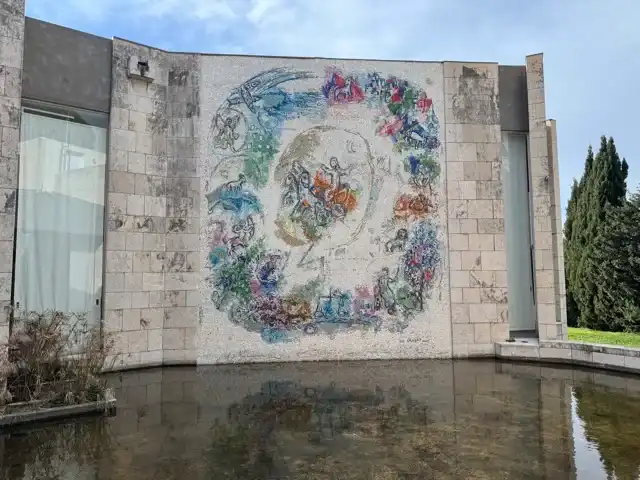
Marc Chagall
1971, Mosaic
(Musée National Marc Chagall)
The museum also had some of Chagall’s other paintings and sculptures.
Probably the biggest piece displayed at Musée National Marc Chagall is not inside the building. It’s a mosaic, “Le Char d’Élie,” on an outer wall. The museum was built while Chagall was still alive. It was the first museum dedicated solely to a living artist that was financed by France. He had a lot to do with the design of the museum, including creating a large mural for one of its walls. Chagall was 80 years old when he created the mosaic. So he designed it, but he had someone else go up on the scaffolding to install it on the wall from the mosaic tiles while he closely supervised.

Marc Chagall
1945
The public can’t get to a spot outside where Le Char d’Élie is visible. Instead, it’s viewed through a window inside the museum, with a reflecting pond between the window and the mosaic.
I don’t know why, but until today, when I thought of Marc Chagall, I thought primarily of stained glass windows.
There are three of them at Musée National Marc Chagall, on the side wall of an auditorium. (It’s possible that the largest is larger than “Le Char d’Élie.” I don’t know. That’s why I said “probably the biggest” above.)
The public wasn’t allowed into the auditorium today, but the wide door across from the windows was open, leaving the windows easily visible.
The museum also dedicated considerable space to Marc Chagall’s creation of costumes, sets, backdrops and curtains for the opera “L’Oiseau de feu.”
Arènes de Cimiez

It was more than a twenty-minute walk from the Musée National Marc Chagall to the Arènes de Cimiez. Almost all of it was uphill. True, it never increased beyond a moderate slope, but it was relentless.
Cimiez is a neighbourhood of Nice. Or maybe it’s its own municipality. I don’t know. But if they’re separate municipalities, I couldn’t see where one ended and the other began.
I chose to make the walk to Arènes de Cimiez this morning because it was too early for lunch after I left Musée National Marc Chagall, and Arènes de Cimiez is beside a park. Some sights I wanted to see this afternoon are clustered just beyond the edges of that park.

There’s not a lot left of the Arènes de Cimiez (Cimiez Amphitheatre), just some remnants of walls and arches. None of the seating remains. I read that it wasn’t among the largest of Roman amphitheatres. I couldn’t tell how much higher the walls were in Roman times. But there was enough there to extrapolate where its perimeter was. And, yes, it wasn’t enormous as Roman amphitheatres go.
As I mentioned, Arènes de Cimiez is beside a park. In that park, there’s a kiosk that fashions itself as a restaurant. Its tables consisted of some heavy wooden picnic tables and some cheap, plastic patio furniture. It calls itself a restaurant because it has sandwiches, salads, and ravioli, along with wine and beer. And, though you order from the kiosk, they bring it to the table you chose and come by later to ask if you want dessert or coffee.
The weather today was almost perfect for a picnic, so I ate there.
By the way, about the ravioli, Rick Steves claims that it’s said that ravioli was invented in Nice. I don’t know. I’ve always thought of ravioli as Italian. So I haven’t had any here yet. Maybe I will another time before I leave Nice. We’ll see, dear.
Discover more from Joel's Journeys & Jaunts
Subscribe to get the latest posts sent to your email.


Lovely Chagall museum. Seems you got a good deal on the entrance non-fee. They were probably down one security guard so closed off a couple of rooms to the public, in such a way that you could see, but not touch, deface, or swipe the art, or whatever nefarious thing one needs guards to guard against. And I have seen more complete amphitheaters, but I have seen more ruinous ones too, so all in all, not a bad morning. Topped off with a picnic on a lovely day. Pas mal.
The possibility of a guard deficiency hadn’t occurred to me, but it sounds plausible. However, I don’t discount the possibility that they were simply meeting the minimum requirement to maintain their membership in DLJSSIA. (By the way, if you search “DLJSSIA” and tell the search engine to not use the substitution it thinks you really mean, it will find some of my pages.)
Be that as it may, as you say, the price was right. And, despite being art, I enjoyed the Chagall museum and wouldn’t have minded paying the €8 euro fee.