Morning in Monaco
Today, I took a day trip from Nice to Monaco, mostly to Monte Carlo.
First, a housekeeping note. I don’t know how many readers notice, but I categorize these pages with indices for continents, sub-indices for countries, and sub-sub-indices for municipalities. Those index and sub-index pages are accessible from menus available in a couple of places on each page.
As I understand it, Monaco is a sovereign city-state, effectively a country. Monte Carlo is the major city in Monaco. But when speaking of Monte Carlo, it also informally includes the surrounding wards.
I’m breaking with tradition a bit by not including a sub-sub-index page for Monte Carlo. Because Monaco is small and because, while I was there, I probably didn’t know if I had gone beyond the formal or informal boundaries of Monte Carlo, I’ll lump everything under “Monaco.” My sincerest apologies if that causes any offence.
That note out of the way, let’s begin. The train from Nice to Monte Carlo, Monaco, is frequent and takes less than 25 minutes.
Monte Carlo Harbour
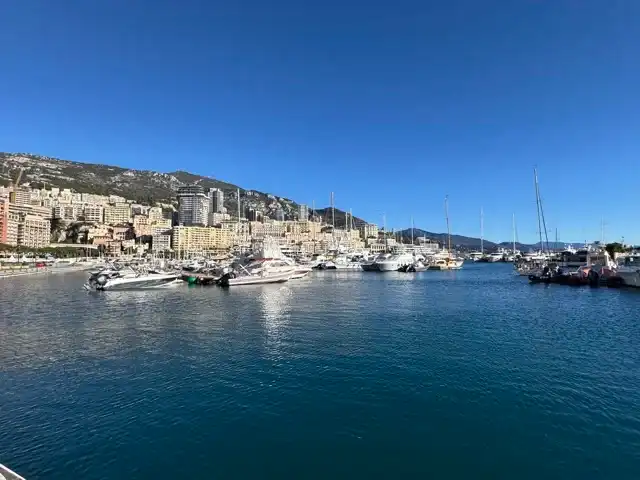
There are a few exits from the Monaco Monte Carlo train station. I’m not sure I chose the best one. I don’t think so.
I chose the exit marked “Port.” My e-book and app references refer to this as the Monte Carlo Harbour. But, hey, tomato, tomato. (The toe-may-toe, toe-mah-toe thing doesn’t quite land in print with correct spelling, does it? Never mind. You get the point.)
The harbour is pretty with a profusion of boats, including a few large yachts. And the bright, big blue sea lies beyond them.
What did I spot on a flat piece of land behind the harbour? Or is that in front of the harbour? Whatever. It was flat land, not water. So, what did I see?
Come on, people. I’m waiting for you to respond. I haven’t got all day.
Oh, alright. I’ll tell you. I saw a skating rink. Yes, a skating rink. And there were some kids playing hockey on it.
And when I say skating rink, I don’t mean some sort of petrochemical product surface or whatever they make those things out of. There were skate grooves in the ice and some ice shavings on the surface.
I was there around 9:30 in the morning. It was already 14°C. That’s 14°C above the point where water is naturally inclined to turn itself into ice without assistance from humans. If it was indeed real frozen water, I’m surprised that anyone anywhere in the world can get enough power to do crypto or AI, considering the power the rink must draw to keep its water frozen.
They really didn’t have to go to the trouble of putting a skating rink there, and playing hockey on it, just because there was a Canadian present, but thanks.
There isn’t much land close to sea level around the harbour. A horseshoe of mountains and hills rises sharply around it. The city climbs up them.
To get to the harbour from the station, I had to take a few escalators down. But what I wanted to see next was at the top of one of the hills beside the harbour. It was considerably shorter than the mountain on the other side of the harbour. Getting to my next destination involved walking up a bit of an incline on a road and climbing a lot of stairs, which is why I’m not sure I took the most convenient exit out of the station. But I got some great views of the harbour and the mountains on the way up.
Prince’s Palace of Monaco

What I wanted to see was the Prince’s Palace of Monaco. Wikipedia tells me that Monaco is a semi-constitutional monarchy. The reigning monarch is not a king, but a prince, currently Prince Albert II. The reason it says it’s a semi-constitutional, rather than a constitutional monarchy, is that Monaco has a parliament, with a Prime Minister who is the head of government, but the prince retains considerable power.
Don’t ask me why the title of the reigning monarch is a prince, not a king. He just is.

I checked the palace’s website before going, and I knew I was going to see only the exterior of the palace. The website told me that it does have tours of the “Grands Appartements,” but not when I’m there. Alright, it wasn’t that rude. It didn’t mention me specifically as the cause of its closing. It said that the tours are closed until March 30, 2026. Today is February 17th.
I figure they set the reopening day that far off because they wanted to make sure that, even if I extended my stay in Monaco for a few weeks, I still wouldn’t be able to get in.
The exterior of the Prince’s Palace is not particularly lavish, but it is stately and, well, palatial.

Moving on, or rather not moving on, from the palace, the Jardin Exotique de Monaco (Exotic Garden of Monaco) is highly rated and doesn’t look like a long walk from the palace. But I didn’t go, so I don’t know how much, if any, of an elevation change would have been required to get there.
The reason I didn’t go to Jardin Exotique de Monaco, despite liking the concept of an exotic garden, is that I’d also checked its website before even setting out for Monaco. The site had a pop-up message on top of its home page that said, “The Jardin Exotique is closed for renovation work and to make the site safer. Reopening in the first quarter of 2026.”
This is the middle of the first quarter of 2026, but it’s not open. The same message said that there is a greenhouse that’s open and free, but I didn’t think it was worth it just for that. So, I didn’t go.
I’m displeased to see that the DLJSSIA (Don’t Let Joel See Stuff International Association) is growing geographically and in its fervour.
Cathédrale de Monaco

Roughly on the same level as the palace, and a few blocks away from it, is Cathédrale de Monaco. Getting from the palace to the cathedral took me along some gorgeous, old, mostly pedestrian streets with brilliantly clean buildings of pastel hues. They were delightful to stroll through.
The cathedral is comparatively new (compared to old European cathedrals), built between 1873 and 1903. But it was intended to look old. A limestone construction is designed in, to quote “Rick Steves Provence & the French Riviera,” “a romantic faux-medieval style.”
The interior displays its bare stone with a soaring, vaulted, ribbed ceiling. Graceful pillars with arches between them run along both sides of the main apse. There are side aisles on either side of that.
The cathedral is decorated with some paintings and stained glass windows.
A semi-circle aisle joins the two side aisles of the cathedral. The floor of that aisle holds the burial places of some famous personages of Monaco, including Prince Rainier III and Princess Grace.
Some photo's from inside Cathédrale de Monaco, including Princess Grace's burial spot:


Musée océanographique de Monaco

A little way over from the cathedral is a large, grand building that houses the Musée océanographique de Monaco. Opened in 1910, it was commissioned by Prince Albert I. He took a great interest in and studied oceanography.
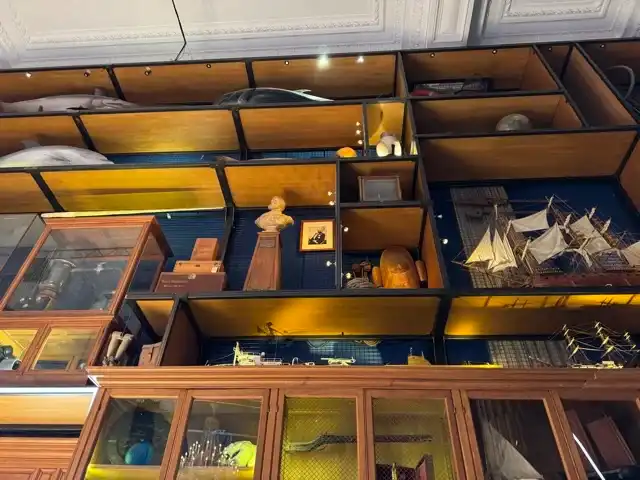
The museum is built into the side of a hill. You enter on level zero, where there is also the gift shop and some exhibit space. On level +1, there are oceanography exhibits, including equipment from one of Prince Albert’s oceanographic yachts, and exhibits about the aquatic ecology of the Mediterranean. There was also a temporary exhibit titled “Méditerranean 2050,” which projects an optimistic look ahead to the future of the Mediterranean in 2050, 20 years after the hopeful endpoint of a worldwide initiative to protect 30 percent of the land and sea by 2030.
The biggest part of that exhibition is a video. But not just any video. It is presented in a large atrium with high ceilings, the equivalent of two tall storeys high. And there’s not just one screen, there are about two dozen video screens in two rows, one above the other, on the front wall and the two long side walls.
The upper-level screens on the side walls are in what appear to be arched windows. They fill up the whole window. The lower-level screens are in polygons. I don’t know what’s behind them when the video screens aren’t there, but they too fill up the whole polygons.

The premise of the video is that it’s a submarine voyage, on a vessel that’s highly advanced to avoid collisions with any of the cetaceans and other life and obstacles, travelling through the cleaned-up Mediterranean of 2050, which is then teeming with sea life that’s recovered from some of the ecological damage of the past. The imagery is stunning.

The video screens don’t display the same thing simultaneously. The sealife flows from screen to screen as they swim past the vessel or the vessel streams through them. It was spectacular. I walked in when the video had already started. The soundtrack was entirely in English. After the video ended, it started again almost immediately, but this time, the soundtrack was in French. I didn’t stick around to see what I’d missed.
On level +2 of the Musée océanographique de Monaco, there’s a terrace and a restaurant. I didn’t go up there.

Level -1 holds something (probably temporary) that’s referred to as an escape game. There’s also some educational space and an aquarium tank. I got to that level only on my way back up to the exit because I took an elevator down to the bottom level, level -2.
That lower level is entirely devoted to an aquarium. It’s not huge, but it’s far from tiny, too. They pack in a lot of tanks, including one fairly large one and a lot of smaller ones. Today is Tuesday, in the middle of February. But the aquarium was packed. And not with school groups. There were mostly individual families with children in tow. Why weren’t the parents at work and the kids in school, nursery school, or kindergarten, dammit? It got a little cramped at times.

Regular readers are waiting to hear my report on whether or not the aquarium at Musée océanographique de Monaco has jellyfish. You probably correctly guessed from the above pictures.
Most aquariums tend to put them in the middle or near the back of their buildings, leading me to dread the possibility that they don’t have any. The elevator I took down to the aquarium put me smack dab halfway between the two ends of the floor. Right there to greet me was a large, cylindrical tank filled with large Moon Jellyfish. They were glorious.

Elsewhere, there was a tank with some fascinating Australian Spotted Jellyfish. Day, made.
Of course, there were also lots of other beautiful fish throughout the aquarium. Often in aquariums, I’ll find one type of fish that particularly intrigues me. At Musée océanographique de Monaco, it was the Longspined Porcupine Fish.
The porcupine fish was aptly named. Its body bears porcupine-like quills. I first saw it from its side. Then it turned around, faced me and stared at me with a look on its face that said, “Are you looking at me? I said, ARE YOU LOOKING AT ME?!” I quite enjoyed it, and the whole aquarium.
It wasn’t quite lunchtime when I left the museum. I planned to take in one more sight before lunch, but…
I’ll save that for my afternoon post.

Discover more from Joel's Journeys & Jaunts
Subscribe to get the latest posts sent to your email.

Vieux-Nice and More
Cathédrale Saint-Nicolas; Musée des Beaux Arts
You know you had me in a state of excitable suspense when you said “oceanographic museum.”
Will it have an aquarium? Will it? I tried to be happy wth the lovely images of sea creatures in the projections and then – wait for it – fish! Loved that Longspined Porcupine fish. Loved that guy. Made my day. What did you see before? Oh ya – palace, cathedral, beautiful town, harbour. All looking really good with a nice dollop of fish to top it all off. Well done. A good morning. Happy reader.
And it did have an aquarium! I knew you’s be thrilled about that. I saw some nice stuff this morning, the aquarium definitely wasn’t the least of it. Au contraire.