Jeonju Hyanggyo, Intangible Culture, and More
I hadn’t planned for Jeonju Hyanggyo to be the first stop of the day. When I started this morning, I headed for the Jeonju Traditional Hanji Centre. At least I thought I did.
Hanji is traditional Korean paper. According to what I read, the centre provides information about and demonstrations of Hanji making.
Of the sights listed in at least one of my guidebooks or an article in my walking tour app, it seemed the most interesting one I hadn’t yet been to in Jeonju, and that wasn’t so far away or difficult to get to as to not appear worth going. Only one of my guidebooks mentioned it, and it said that it was right in the Jeonju Hanok Village. The article in my walking tour app provided a “go there” link to an embedded online mapping facility that gave me a route to it in, but on the edge of the village.
When I got to where it directed me, it even beeped to let me know I was there. The building on the site was a performance hall of some sort, not performances of paper making. I wandered around a bit in case the map was a little off, but I couldn’t find the Jeonju Traditional Hanji Centre.
Let me back up a bit. Before I left the hotel, I also looked for Jeonju Traditional Hanji Centre on one of the Korean mapping apps I have. It couldn’t find it. I use the English interface to the app. I can enter English names, and it will often find what I’m looking for. But not always. That’s a big part of why I upgraded to the articles mapping subscription for my walking tours app.
Sometimes, the English name that the Korean mapping app knows a sight by is not the name my guidebooks give for it. The official name is in Korean. The English name is an unofficial translation and may vary depending on who is doing the translation.
I tried entering just “Hanji” into the mapping app and looked at the list of places it returned, which, because I’m using the English interface, is, fortunately, in English. There was a Jeonju Hanji Museum on the list.
Some map users had submitted photos of the museum’s interior. The activities pictured looked somewhat like what was described in my guidebook. But the museum was nowhere near where my guidebook said it was, and where my walking-tours app showed that it was.
On the contrary, the mapping app said it was more than an hour and a half walk away or about 40 minutes by bus. My best guess is that it moved, and my guidebook and the article in my walking tour app are out of date. But maybe it was where it should be, but I couldn’t find it. That sort of thing has happened to me before.
There’s a lesson in that for my future travels. If anyone knows what that lesson is, please tell me.
I knew that Jeonju Hyanggyo was just a couple of blocks from where the Jeonju Traditional Hanji Centre was supposed to be, and it sounded interesting. So I already expected to go there this morning.
But, before I did, close to where the Jeonju Traditional Hanji Centre was supposed to be, there is a museum that is peripherally related to the subject of the Hanji centre. I know that only because I stumbled on it. Not that I saw it listed anywhere.
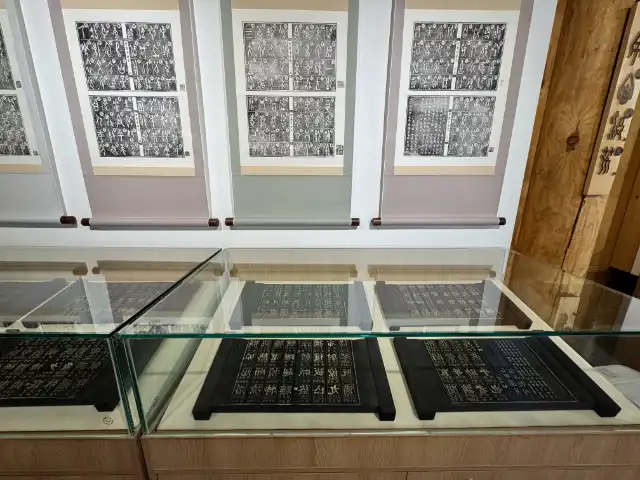
It’s a small, one-room museum on the woodblock printing process. I know this in part because a bilingual sign out front told me that, “In the Joseon Dynasty, Jeonju was a publication center (sic) as well as Seoul and Daegu. As Jeonju had a great high-quality hanji paper industry, publishing businesses (like woodblock engravers and publishers), and bookstores operated and flourished in the city. Jeonju was originally called Wansan; therefore, Jeonju’s old books were known as Wanpanbon.”
There was no English signage inside, but woodblocks with raised type sat under glass or hung on the walls along with books or sheets of paper printed using woodblock presses and, presumably, the woodblock typefaces on display.
Oh, by the way, I have no idea what the name of the museum is. There is a tall, simple sculpture designed to look like an open book beside the museum door. It has text printed vertically on the left side of the left page. It was only in Korean. There is also a sign immediately above the sculpture, written horizontally, but it too is only in Korean.
Figuring it was the name of the museum, I used Google Translate to translate the Korean into English for me. They both said the same thing. Google’s English Translation was: “Completed Cultural Centre.”
I’m thrilled that the cultural centre is completed, but what’s its name? Or is this one of those “who’s on first” situations?
After spending a few minutes in the whatever museum, it was on to Jeonju Hyanggyo.
Jeonju Hyanggyo
Neither of the guidebooks I’m using on this Korean trip mentions Jeonju Hyanggyo. I found it in an article in my walking tour app. However, one of my guidebooks does define a hyanggyo as something not specific to Jeonju, but rather a regional Confucian school in traditional times.
When I got back to my hotel later this afternoon, before I started to write this section of this entry, I did a web search for Jeonju Hyanggyo. For what it’s worth, I found a Wikipedia article on the Jeonju Hyanggyo that I linked to here.
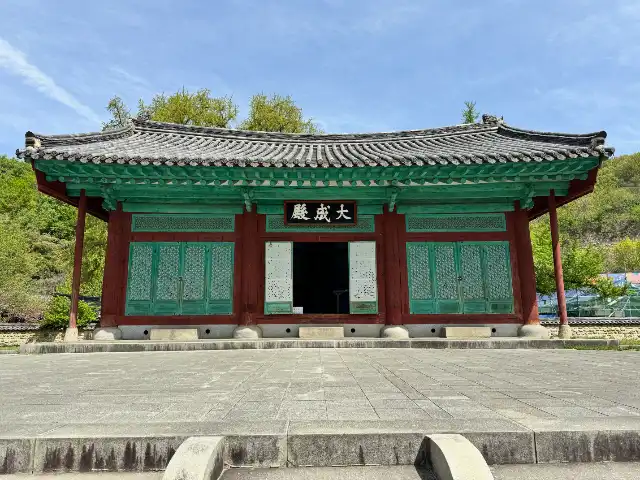
Hyanggyos (is that the correct plural? Or is it hyangggyoes? Or something else?) have a shrine in them. According to a bilingual sign at the site, Jeonju Hanggyo’s main shrine is a Daeseongjeon Shrine, which means “Hall of the Great Sage.” It honours Confucius and other Confucian sages.

I’d like to see a hall that pays tribute to confused stooges rather than Confucian sages. I long to be honoured too. But never mind that.
According to the sign, “It is believed that during the performance of veneration rituals, the spirits of the sages come to the shrine and temporarily reside in the wooden spirit tablets that are kept inside.”
It’s a shame that the spirits can’t find permanent housing and have to move from shrine to shrine. I hope that shrines coordinate their veneration ceremony times such that there’s always one happening every minute of every day. Otherwise, the spirits will be unhoused for at least some of the time.
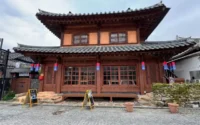
The main shrine of Jeonju Hyanggyo is handsomely understated. The exterior walls are mostly light green, with dark wood framing. It sits on a two-tier stone pedestal, set back considerably from the front of the lower tier of the pedestal.
Inside, the ceiling is green, and the decorations are quite simple. Plain black tables sat on either side of the room, but they looked moveable and possibly temporary. On the wall directly opposite the door hangs a simple painting of I don’t know whom. Probably Confucius or a Confucian sage.
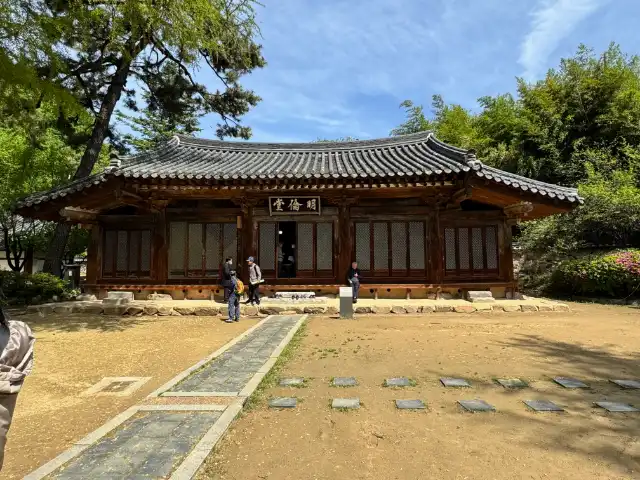
It’s not a large building. I saw the interior from the threshold. I think I could have gone in if I had taken my shoes off. Nothing was blocking the door, and I didn’t see any signage that might have prohibited entry. But the room is small enough to get the full sweep of it from the door. So, to be safe and to avoid having to take off my shoes and then put them on again, I stayed at the threshold.
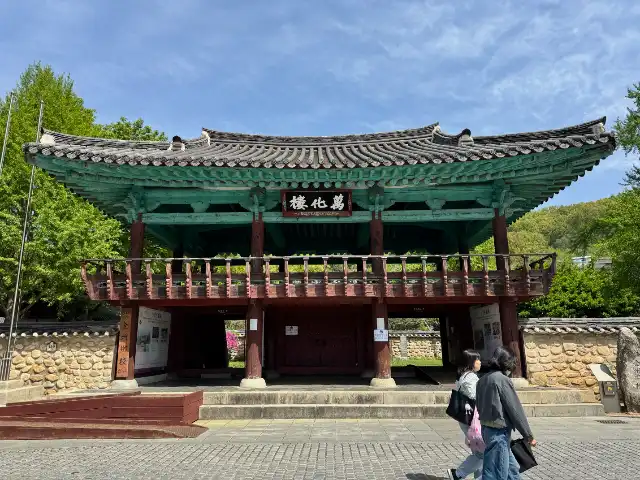
The Jeonju Hyanggyo compound has several buildings of broadly similar design. The one with the most decorations, but still not a lot (I learned at the National Museum of Korea that Confucianism venerates simplicity), is the gate building. It is taller than the main shrine and has a somewhat more peaked, slightly upturned roof.
There seems to be an open-sided mezzanine level immediately below the roof. I don’t think it’s accessible to the general public. Nor do I know if it’s accessible to anyone.
National Intangible Heritage Centre

The National Intangible Heritage Centre is a short walk over a bridge across the river and a couple of blocks more from Jeonju Hyanggyo. It wasn’t easy to find.
It is in a complex of modern buildings with only right angles. The buildings are joined by open-sided walkways up at about the third-floor level. I at first didn’t see any signage indicating that it’s the National Intangible Heritage Centre. I saw big signs with Korean and English that announced the functions of buildings, like a conference centre, on some of the buildings. But I saw nothing that said “National Intangible Heritage Centre.”

Then I noticed something that looked promising. Off in the distance from where I saw them, three side-by-side, upright glass cases looked like they held posters of some sort. However, I couldn’t tell what the posters said from that distance. But I could read the identical English at the top of each of them. There was just one English word and what looked like one Korean word, probably the same word in both languages. The English succinctly said: “Information.”
That looked promising. Display cases promising in English that they had information for me.
I moved closer to the display cases. Each one contained an illustration of a cartoonish character—a different character in each case.
However, near the bottom of each poster, in smallish print, it said “National Intangible Heritage Center (sic).” Well, at least I knew that this, somewhere, was the place.
I wandered around a little and saw a post with English and Korean. There was an arrow angled off in one direction. The English version of the words pointed me to the permanent exhibitions. I made the assumption it was the permanent exhibitions of the intangible culture centre, but I wasn’t sure.
I tried to go where I thought the arrow was pointing me.
I have to admit something embarrassing. When I see that sort of signpost, with an angled arrow not pointing directly at a site, I sometimes slightly misinterpret where it wants to send me. No. That’s a lie. I usually greatly misinterpret where it wants to send me.
I went off in the wrong direction at first, but quickly saw that I had to be mistaken. I then found the museum.
The exhibits are in two moderately sized galleries, one on each of two levels.
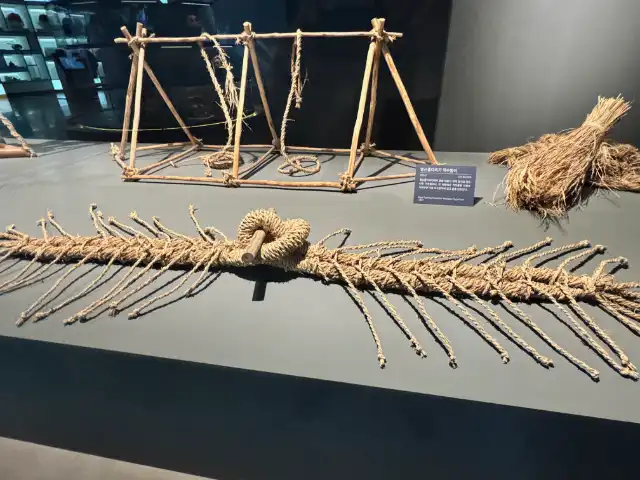
The exhibits are mostly dedicated to what the museum labels intangible culture, such as song and dance. Okay. I can see why they call song and dance intangible.
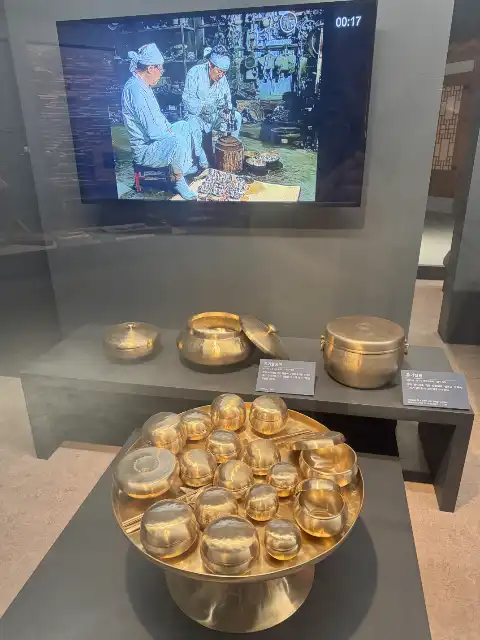
But there were also displays of artisan crafts, such as metalworking. Metal bowls seem quite tangible to me.
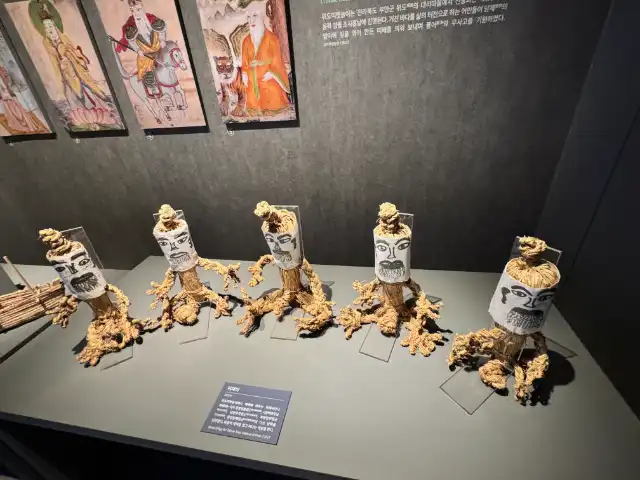
Straw Effigy for Ttibae Boat Festival of Wido / 2021
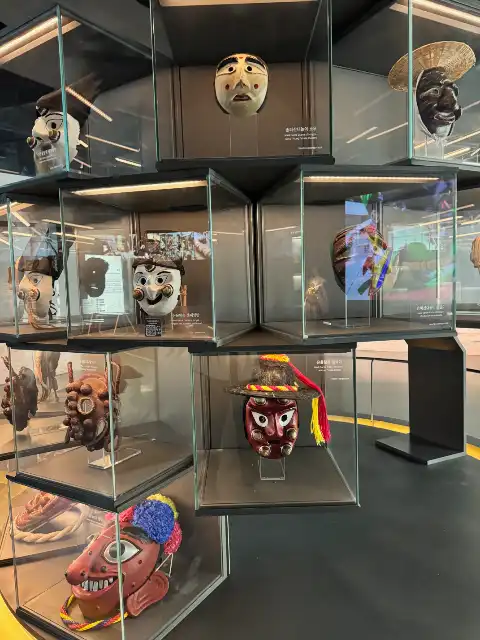
The exhibits included several videos of people singing and dancing, and craftspeople making crafts. On display, there were some old musical instruments, the output of some craftwork, a collection of masks used in dance dramas, and much more.
Throughout the museum, there were general narrative information panels on the subject of each area. Those panels had both Korean and English.

Placards beside each item on display named the item in English, but in Korean, they both did that and provided a descriptive paragraph.
I didn’t bother using a translation app to try to get translations of most of those placards. However, one intrigued me. It looked like a large puppet. The English title said, “Equipment for Foot Mask Theater (sic) | 1990’s.” A foot mask theatre? What the what?
I used Google Translate on the paragraph accompanying that. It translated to: “Bal-tal is a lightweight instrument used by the holder of the small tradition, Lee Dong-an-hu (1906–1995). In Bal-tal, a mask is attached to the foot, and the performer manipulates a half-body puppet during the performance. It consists of an upper body frame symbolizing the mask, jacket, and vest, and a handle used to manipulate the puppet.”

So now you know. There was also a line drawing on the placard showing how it was used.
It was getting close to noon when I finished with the National Intangible Heritage Centre. So I decided to have lunch in the centre’s cafe. There wasn’t much food on the menu. I felt a little guilty about getting a bagel and cream cheese in Korea; it hardly sounds Korean.
But then I remembered that the guide on the Seoul Food Tour I was on took us past a bagel shop. She didn’t take us in there, but she pointed it out. Another customer on the tour asked her if bagels were a thing in Korea. She replied that, yes, they’ve become quite popular here.
So, I guess my bagel and a schmeer is now Korean food.
Discover more from Joel's Journeys & Jaunts
Subscribe to get the latest posts sent to your email.

Joel in Jeonju, South Korea

Jeonju Hanok Village History Museum and More
Good on you for stumbling your way through impish tourist maps, devious directional signs and intangible heritage in a country that speaks a language you do not understand – and coming out on top with interesting sights. And good on you for trying Korean food of the more adventurous type. May it fortify you for a pleasant afternoon.
You know me, highly adaptable and highly adventurous. (Snort.)
Sometimes you just have to go with the flow and other times you have to figure things out.
Intangibles!
Hyanggyos!