Jeonju Hanok Village History Museum and More
I didn’t have a lot of time to see sights this morning because I had to worry all morning about catching my train to my next destination at 1:18 in the afternoon. But I did take in a couple of tiny museums, the Jeonju Hanok Village History Museum and the Fan Culture Centre, and a small monument, Imokdae.
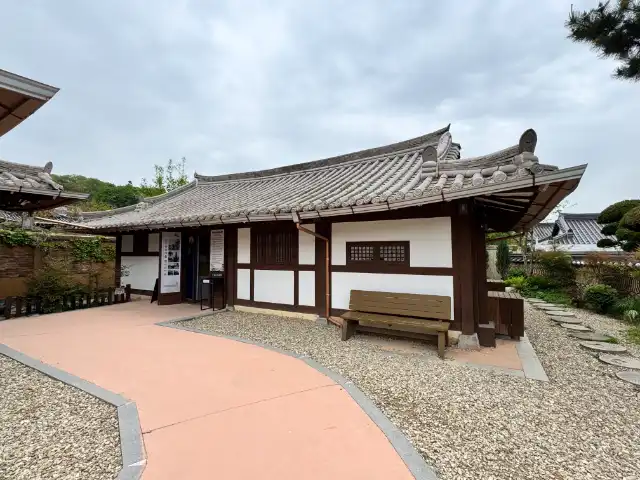
The museums were in the Jeonju Hanok Village, which I’d been to a couple of times already while in Jeonju. The monument was only a little way beyond it.
The only reason I had time in Jeonju today is that when I booked the trains for this trip, I couldn’t find one that wasn’t ridiculously early, but left in the morning.
That variation of worrying isn’t just a today thing for me. If I venture out in the morning on a travel day, I invariably worry about returning to my hotel and getting to the station in time to catch my train. So I always try to get morning trains as long as they leave after the appropriate god flips the switch to turn on the day. But it didn’t work out this time. (I don’t remember if there was a pre-start-of-real-day train, but that’s not relevant, is it?)
Because this is my last entry from Jeonju, I’ll post a summary of my time in Jeonju below.
Jeonju Hanok Village History Museum
The Jeonju Hanok Village History Museum is a) a museum, and b) about the Jeonju Hanok Village history. Are you keeping up with me so far?
Before I get to that, a brief tangential aside.
Aside
Jeonju Hanok Village Lodging
I didn’t stay in one, but in the Jeonju Hanok Village, several hanok houses are rented out to tourists for stays. I think they operate like Airbnbs. Maybe some or all of them are even listed on Airbnb. I don’t know. I didn’t look.
I’d read that the stay hanok houses tend to be furnished as traditional hanok houses, which means sleeping on the floor.
When I travel, I try to eat local cuisine as much as possible. But when it comes to living accommodations, I want a Western-style bed (and toilet and shower, of course). Just to be clear, the thought of sleeping on the floor never appealed to me, even when I was younger. Now that I’m older, the thought of trying to haul myself up from a prone position on the floor when I have to, for example, go pee in the middle of the night, is not something I’m willing to consider.
But that’s not why I brought this up.
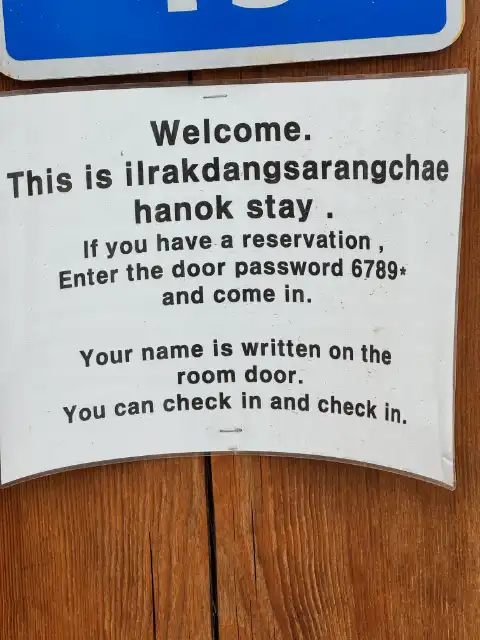
Near the Jeonju Hanok Village History Museum, I passed one of those hanok stays. A door with an electronic lock was in a wooden frame in the wall protecting the property. A computer-printed, black-and-white sign with large-print text was stapled to the frame. It was easily visible to anyone passing by. In fact, it easily arrested my eye as I walked past the building.
I’ll ignore the fact that the sign specified that guests can both check in and check in. I guess that, unlike Hotel California, you can never check out. I hope you can leave, though.
But that’s not what attracted my attention. In addition to naming the establishment and providing other check-in information, the sign said, “If you have a reservation, enter the door password 6789* and come in.“
What was the point of locking a door if you’re just going to divulge the password to everyone who gets anywhere close to it? Why not just leave it unlocked?
Weird.
But enough about the security of the hanok stay, this is about the Jeonju Hanok Village History Museum. There’s not a lot to say. It’s in two small rooms spread across two small hanok buildings.
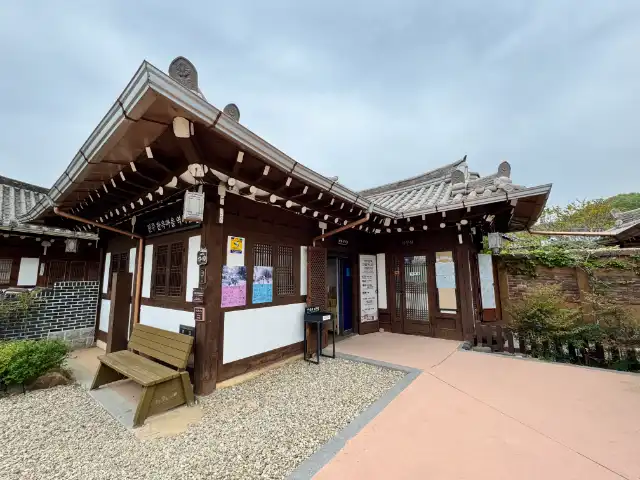
One room contains some pictures, illustrations, and text about, not surprisingly, the Hanok Village history. The text is bilingual, Korean and English.
The Hanok Village history is not a long one, as histories go, but it is an interesting one. At one time, the Upper class of Jeonju lived inside the city walls, while the hoi polloi lived outside. But when the Japanese occupied Jeonju, they tore down the walls, which occurred between 1907 and 1911.
The local folk moved in and wanted to show their independence from Japan, so they built traditional Korean homes, hanocks. The Hanock Village was a wealthy area until the 1970s. But then, companies moved their businesses to industrial complexes farther away. People moved with them in search of jobs.
Some Western-style buildings began to be built in the Hanok Village. The city got worried about the village losing its identity, so it imposed strict development restrictions. Because owners and developers couldn’t do any work on the structures, they started to fall into severe disrepair.
In 1987, the city “re-categorized the Hanok Conservation Area into a ‘Type 4’ zone with significant aesthetic value and eased the construction restrictions accordingly.”
In 1997, they removed even the Type 4 classification, allowing more development. Some more Western-style structures were built. However, they had the bad/good fortune to be hit by a sluggish housing market and an Asian financial crisis at that time, so there was little additional development. And, hence, a significant hanok village remained.
In 2002, Korea hosted the World Cup, with Jeonju as one of the host cities. To impress the resulting crowds, leading up to that, the city passed new conservation ordinances and provided funding for the repair and restoration of the hanok buildings. Additional projects in subsequent years further built the Jeonju Hanok Village into the proud tourist attraction it is today.
And that, dear reader, is the abridged Jeonju Hanok Village history.
The other room of the Jeonju Hanok Village History Museum contained a few old photographs of buildings in the hanok village and in the immediately surrounding area.
Fan Culture Centre
Jeonju was a major centre of fan-making at one time. I’m obviously not talking about fans of celebrities. Nor am I referring to electric fans. I’m talking about handheld fans that are often richly decorated. To recognize that history, Jeonju has a Fan Culture Centre, which is in the hanok village, just a few blocks from the Jeonju Hanok Village History Museum.
Inside the centre, there’s a small, one-room museum. The text is mostly in Korean, but there is a smattering of English. I used Google Translate to translate a paragraph from one of the Korean panels just to see the subject matter of the text.
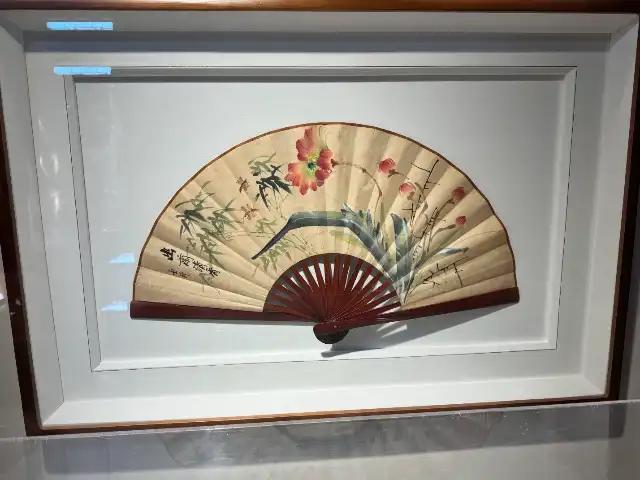
The paragraph I happened to translate told me that, “The oldest surviving artifact is a golden feather fan handle found in the pyramid of Tutankhamen in Egypt in the 14th century BC, and its origin in the East, which can be confirmed through literature, dates back to the era of Yao and Shun in China.” So, that was interesting.
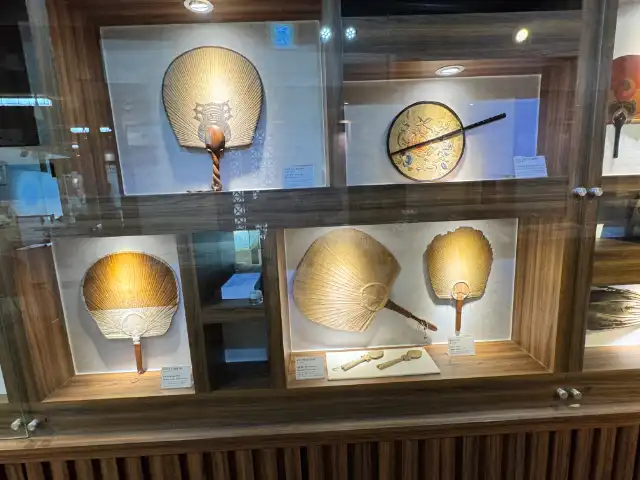
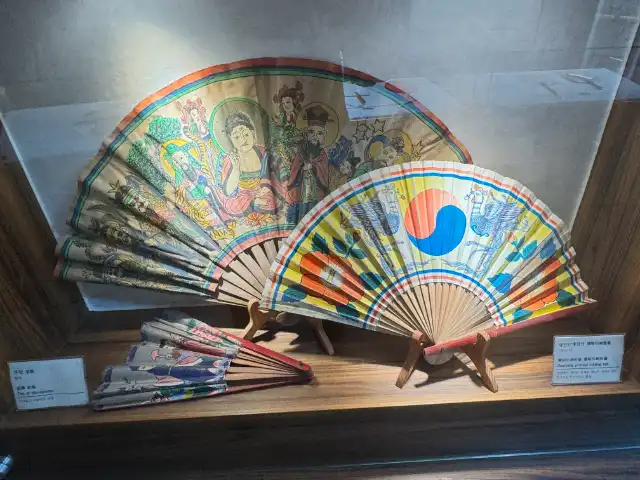
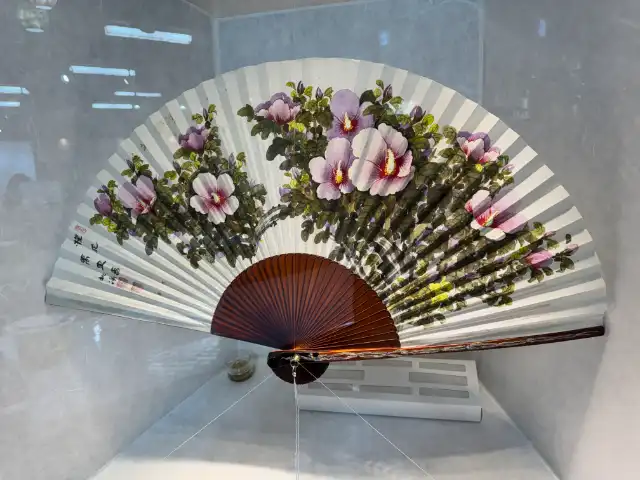
As evidenced by that text, the museum doesn’t restrict itself to fans and fan-making in Jeonju. Its display cases held several decorated fans. In addition to Korean fans, there were Chinese, Japanese and Spanish fans. (Most of the placards in the display cases had the origin of the fans in English and Korean, while almost all of the other text was solely in Korean.) I might have missed a nationality or two on display in the museum.
More fans at the museum in the Fan Culture Centre:
Imokdae
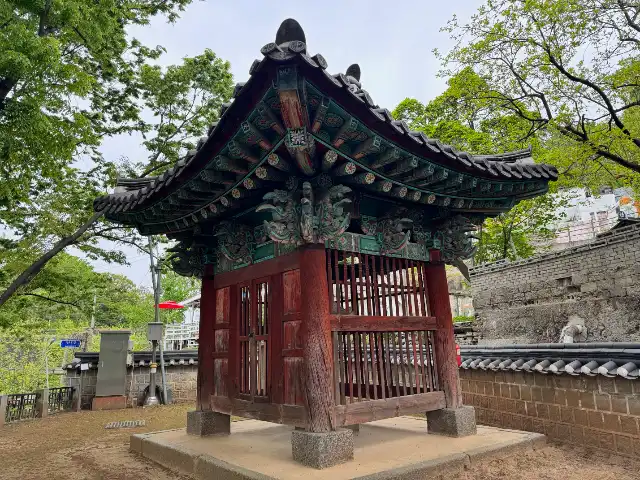
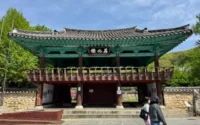
The other day, when I visited the Omokdae monument, I mentioned Imokdae because a sign at Omokdae noted it. Imokdae is currently slightly up a hill on the other side of a busy street (almost a highway) from Omokdae. It’s right beside the Jaman Mural Village that I also visited earlier in my time in Jeonju.
I anticipated something different. Because it’s a bit up a hill, I expected to see a vista. I got a view of the street. I also expected the monument to be grander. It’s a nice enough, but it’s not an unspectacular, wood pavilion with a handsome roof.
According to a sign at Imokdae, “Imokdae is reported as the place in which Mojo Yi An-sa, a great-great-grandfather of Yi Seong-gye, was born. Members of Jeonju Yi Clan lived here and then they moved to Hamgyeong province. In 1900, the monument was erected, on which King Gojong himself wrote the inscription, ‹Mokjodaewanggugeoyuji>. Imokdae was originally on the high ground of the east of the Omokdae, but it was moved here because of road construction.”
With that sight seen, I had just enough time to stop in at the lovely hanok house cum cafe, Haengwon, that I was at a couple of days ago, to have another of their calming ginger teas before heading back to my hotel and making my way to the train station.
Jeonju Summary
I liked Jeonju. I didn’t absolutely love it, but I very much liked it.
Once I got past the more garish part of its hanok village, and the crowds that were present on my first day visiting it, a Sunday, dissipated on Monday, I grew to enjoy the village.
The city also has some other interesting sights. And the walks on either bank of its river make for pleasant strolls. I have no idea how far the riverwalks go. I didn’t arrive at or spy in the distance the ends in either direction, despite two walks along different parts of it.
The star of my visit, by far, was Wansan Park. However, what elevated it to a spectacular level was pure dumb luck on my part. I had no idea that its flower mountain was so densely covered with flowering trees as it is. Nor did I have any idea that this was the time for the blooms.
Wansan Park is still a beautiful, lush mountain park worth a visit, even without the peak blossoms on its flower hill. But that made it absolutely incredible.
I spent pretty much three full days in Jeonju. I arrived early afternoon and had a half day then. Then I had two full days between the three nights I spent there and another half day before I left today.
I think that was about the right amount of time. I saw all of the sights I knew about in the core. There are some more recommended parks and a shrine a piece away that I didn’t see. I suppose I could have figured out the bus system in Jeonju or taken an Uber to see them, requiring another day or two. But to be honest, they didn’t trigger my frequently present fear of missing out.
Bottom line: I’m glad I came to Jeonju. If you’re ever in Korea and you have enough time, I’d recommend visiting it. But I won’t completely rave about it unless you can manage to be there when the blossoms on Wasan Flower Hill are in peak bloom, as I was by pure coincidence, without even having any prior knowledge of the flower hill and its profuse blossoms. If you can be there when that’s happening, rave isn’t nearly a strong enough word for my praise.
Discover more from Joel's Journeys & Jaunts
Subscribe to get the latest posts sent to your email.

Jaman Mural Village and More

Joel in Jeonju, South Korea
I’m a fan of the sort of fans celebrated at the Fan Culture place. Can never have too many fans. I am not a fan of security access codes posted for all to see. What are they thinking?!
A fan of fans, fantastic.
Yeah, I got a chuckle out of the publicly posted password. Too bad they didn’t post their bank information too.
Thanks for the recap. Nice when a place grows on you, and nicer when it grows wild profusions of blossoming trees. Thanks to your blog, perhaps generative AI itineraries will bump up Jeonju a jot. I had to believe about the rental that there was another code inside, maybe a proper lockbox, or else, as Debra said so aptly, “What are they thinking?!
You’re welcome.
Of course generative AI will use my writing to “inform” people. There’s nothing more artificial than my intelligence.