Gee, I’m in Gyeongju
I moved on from Jeonju, Korea, today. I’m now in Gyeongju, still in Korea.
If you read my last post from Jeonju, which was about my activities this morning, you’ll know that I didn’t leave Jeonju until after one in the afternoon, 1:18, to be exact. I had to transfer trains along the way, and I arrived at the Gyeongju station after 4:00 in the afternoon.
Gyeongju station is quite a piece from the centre of town. In fact, the Uber driver had to drive through a tunnel under a mountain and along a highway to get me to my hotel.
It was just after 4:30 when I checked into the hotel in Gyeongju. It then took me some time to figure out my hotel room and what it didn’t have and did have.
What it didn’t have was a luggage stand, a room safe, or much space to hang stuff up.
I like luggage stands. I’m getting too old to bend down to grab stuff out of my bag open on the floor of my room. I asked at the front desk if they had any. They don’t.
I like hotel room safes. Being a worrier, I fret about stuff being stolen out of my room. So, when I go out, I lock up my computer, my iPad, one of my three credit cards, and one of my two debit cards in the safe. If I’m in a country where I know I’m not required to carry around my passport, I put that in there too. With the spare debit card and credit card in the safe, I worry less knowing that I’ll be able to pay for things even if I’m pickpocketed.
As to not having a lot of space to hang stuff up, that was largely the fault of something the room does have …
Aside
Tromm styler
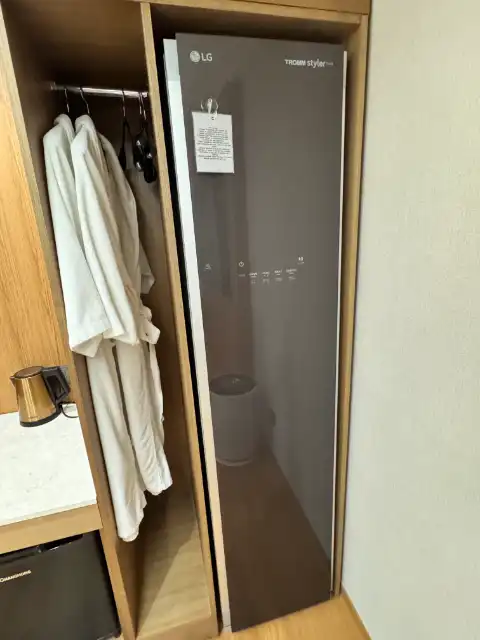
Taking up more than half of what would otherwise probably be a closet is something called an LG Tromm styler ThinQ. ThinQ is the branding that LG applies to all of its appliances that it considers smart in some way. I know this because, at home, I have an LG combination washer/dryer that’s also branded with “ThinQ.”
I included a picture of the Tromm styler to the right. You can see how little clothes-hanging space there is relative to the space the Tromm styler takes up.
This is Korea. “LG Tromm styler ThinQ” is in English, but all of the controls on it are in Korean.
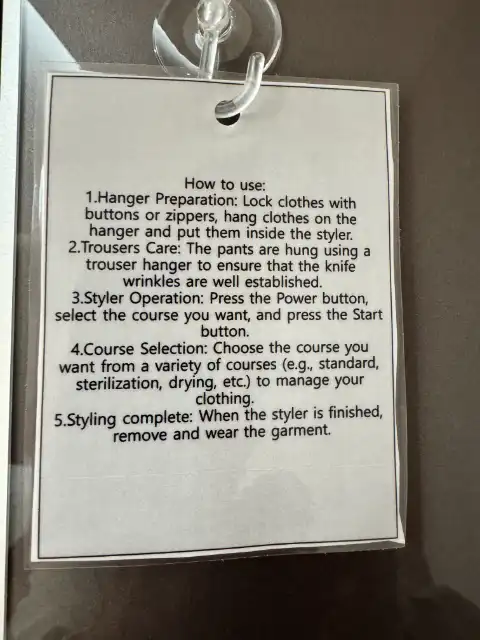
The hotel thoughtfully attached the sheet of paper pictured to the left on the front of the styler with a suction cup. It gives instructions on how to use the styler. Sort of.
1. Hanger Preparation: Lock clothes with buttons or zippers, hang clothes on the hanger and put them inside the styler.
I suppose that means I’m supposed to put the clothes on hangers with the buttons or zippers done up. Seems straightforward enough.
2. Trousers Care: The pants are hung using a trouser hanger to ensure that the knife wrinkles are well established.
What the heck are knife wrinkles? And why do I want to establish them well in my pants?
3. Styler Operation: Press the Power button, select the course you want, and press the Start button.
The power and start buttons are pretty obvious. They’re icons. But, “select the course?” Um. All the text is in Korean.
Oh, wait. Here’s some more information.
4. Course Selection: Choose the course you want from a variety of courses (e.g., standard, sterilization, drying, etc.) to manage your clothing.
Oh, great. I have a bunch of selections, but which is which? Did I mention it’s all in Korean? I used Google Translate on the controls, but I’m still not sure what each cycle will do to my clothes. Giving them some style might be nice, and managing my clothes would be good too, but not if it shrinks them into nothingness.
5. Styling complete: When the styler is finished, remove and wear the garment.
Oh, great. I get to wear my garment.
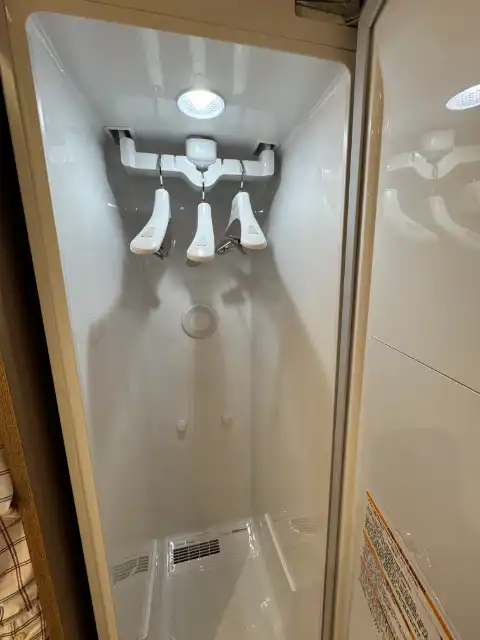
Opening up the styler, I saw that the inner walls are made of what looks like the same material they make the inner walls of refrigerators out of. And there are three empty hangers in there hanging on a bar. I may just use it as a clothes closet and forget the styling.
By the time I finished trying to appraise and figure out my room, it was about 5:00. So I didn’t have a lot of time to explore Gyeongju. A river, the Hyeongsan River, runs through Gyeongju. It’s two or three blocks from my hotel. I decided to start my time in Gyeongju by walking along it.
A River Runs Through Gyeongju
To get to the river, I had to cross a seven- or eight-lane, limited-access road that runs parallel to the Hyeongsan River as it traverses through Gyeongju. Fortunately, I had to walk only a couple of blocks along that street to get to one of its very few crossing lights.
That light is there, not so much for pedestrians, but to control traffic going into and out of a long, wide parking lot that fronts right up against the river. For the length of the parking lot, there is no walkway beside the river.
The lot entrance is close to one end of the lot. I walked to that end. Just beyond it, there is a path beside the river. The lot and the path are down a short embankment from the street.
Between the path and the street, there’s a scruffy grassy area that continues almost as far as I went along the path. If I had to guess, I’d say the scruffy grass area was about the width of a regulation football field. Then again, I’m not a sports fan, so that might not be an accurate measure.
Even with this grass buffer and the embankment, the noise from the street while walking along the path was still quite loud, which reduced the pleasantness of the walk.
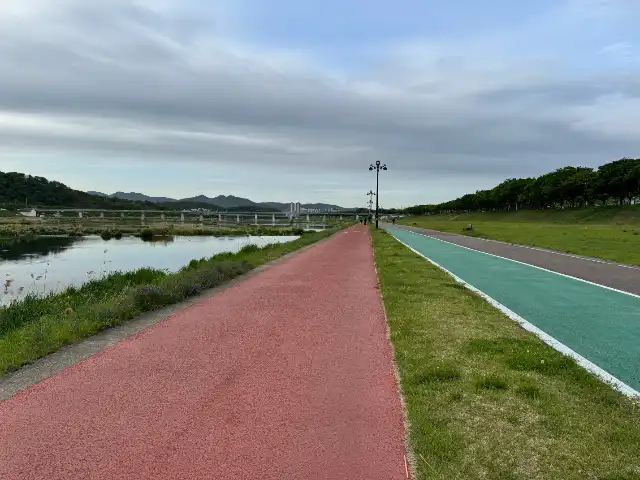
I’ve been calling it a path, but that’s misleading. It is a non-vehicular divided superhighway. It is divided into three sections. All of them are paved with asphalt, but two of them are painted.
The lane closest to the river is painted reddish brown. At infrequent intervals, there are white stencils painted on the surface. Some have an icon representing pedestrians. Some have two arrows, one on either side of the lane, pointing in opposite directions, showing which way you should be walking on each side of the lane. Some have some Korean text. And some have a combination of two or three of them in the same location.
I didn’t use a translator app on the text, so I don’t know what it says. For all I know, it could have said, “all those who walk here are marked for sudden death.” I don’t think so, but if that is what it says, I’ve dodged the curse. So far.
Beside the red lane, on the side away from the river, there’s a narrow grass and shrub median.
On the other side of the median, there’s a lane painted green. I don’t know what its purpose is.
Beside the green median, there’s a lane of asphalt that’s unpainted except for a faint, dashed white line down the centre. That lane is for cyclists.
It’s not exactly a quaint, rustic little trail.
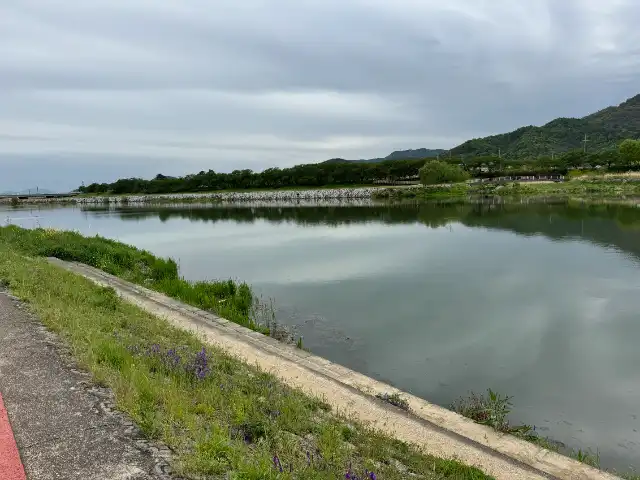
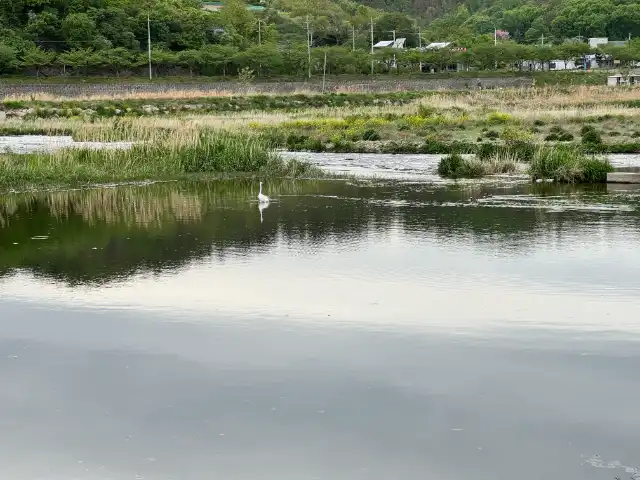
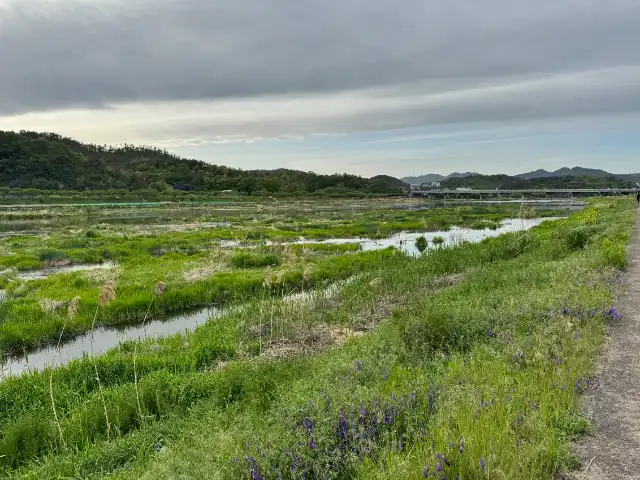
As it passes through Gyeongju, the Hyeongsan River is fairly wide and kind of lazy. There are several grassy sandbars in it. The river is reasonably attractive.
At one point, a pedestrian bridge crosses over the path and the river, starting at the street level. The bridge’s support pillars sport murals with Korean themes.
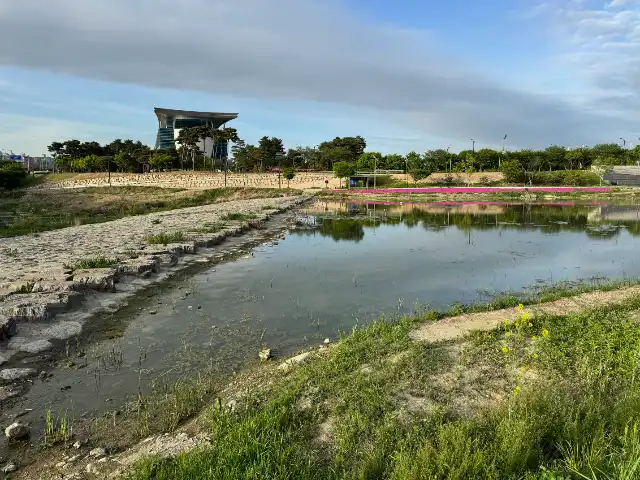
I walked along the trail for probably about half an hour when it turned away from the river and toward the core of Gyeongju. When I got to the bend, I saw that there was another body of water that intersected with the Hyeongsan River. The path proceeded along that.
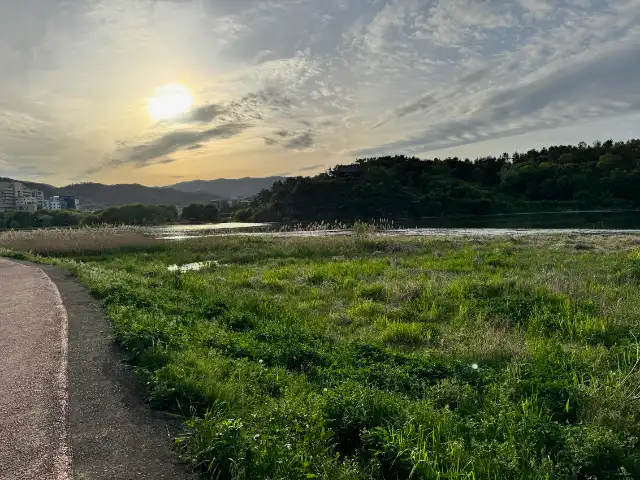
Looking at a map, I saw that it’s a tributary that comes out of a lake a little way farther. I think that’s somewhere I’ll be going to during my time in Gyeongju.
I said that the tributary intersects with the river. That’s not true. At least not in a way that’s visible.
At the river end of the tributary, there’s a low, wide dam made of large rocks and concrete grouting. People can and do use the dam to walk to the other side of the tributary. I didn’t do it, but from where I stood, it looked like the river path continued on the other side of the tributary.
After I reached the tributary and I turned the bend just to get a look, I turned around and headed back to my hotel.
I’ll be in Gyeongju for another three full days. So, more to come.
Discover more from Joel's Journeys & Jaunts
Subscribe to get the latest posts sent to your email.
Gyochon Village & Woljeonggyo Bridge

Donggung Palace and Woji Pond, Gyeongju National Museum, and More
Welcome to your next adventure! That smart styling closet has a lot of very enigmatic potential. It would be infinite degrees cooler if it were a transporter (beam me up!), or even a replicator (Earl Grey tea, hot). As it stands, I would do the same thing. Hang up your clothes, and for goodness’ sake, don’t press any buttons! Despite the reports of the major highway, the wide, controlled paths and the glimpse here and there of structures, the river looks quite rural in the photos. What, pray tell, does Gyeongju look like? Let’s just see tomorrow, shall we?
Oooh, I like the idea of a transporter or a replicator. I like trains but getting to my next destination instantly would be great. And I probably wouldn’t use the replicator to make Earl Grey tea. I have had more horrible espressos than decent ones, and no great ones, in Korea so far. They have Starbucks here but, so far, I’ve refused to patronize them.
The river is pretty if you ignore the road noise and choose your photo shots carefully to avoid the encroaching city. Otherwise, the river doesn’t look or sound particularly rural.
Knife pleats – sent me down the “grabbit” hole (portmanteau Google and [bunny] rabbit, of course). Kilts are likely to have knife pleats. Trousers may have crisp, sharp creases. Travelers may not need sharp creases in their long pants. They may sport packing wrinkles. And with that said, I move on from closet-hogging style contraption to a second Grabbit-hole note. I searched Korean maps to get a better idea of where Gyeongju is. One result shows place names translated into English. Cheonan (a 2-3 hour fast train away) shows up as Heavenly Peace. A promise of a silent night and excellent sleep?
So many rabbit holes. So little time. Thanks for the info. Although, I’ll probably continue to just wear my pants unpleated.
English versions of Korean names don’t seem to be standardized and can have a few variations. Heavenly Peace sounds nice.