Daereungwon Ancient Tomb Complex
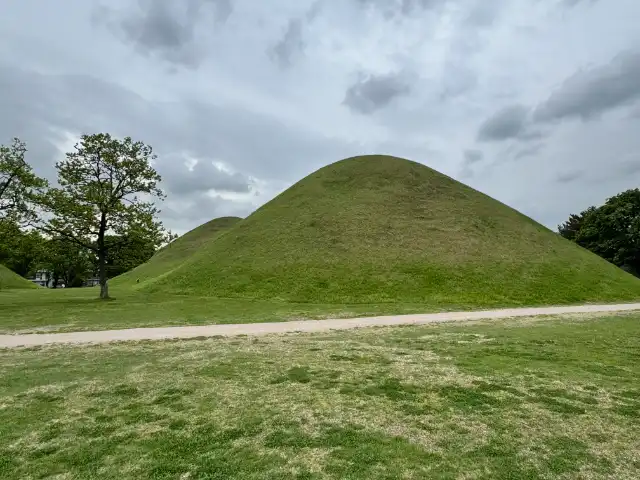
Not far from the older centre of Gyeongju, sits one end of the Daereungwon Ancient Tomb Complex. I visited it this morning.
A string of three parks, separated by roads, contains a collection of burial mounds. Although, to be honest, I’m not sure if all three are part of the Daereungwon Ancient Tomb Complex. It’s possible that one or two fall under a different name.
Wikipedia, for what it’s worth, has an entry for Daereungwon. The entry title is just that, “Daereungwon,” not “Daereungwon Ancient Tomb Complex.” But within the entry, it lists the official name as “Daereungwon Ancient Tomb Complex, Gyeongju.”
Wikipedia says there are “23 tombs of kings, queens, and nobles from the Silla period of Korean history.”
I didn’t count them, but none of the parks, alone, looked like they contained nearly 23 burial mounds. This bolsters my theory that either the Daereungwon Ancient Tomb Complex is the combination of all three parks or Wikipedia is full of it. I’m willing to believe either.
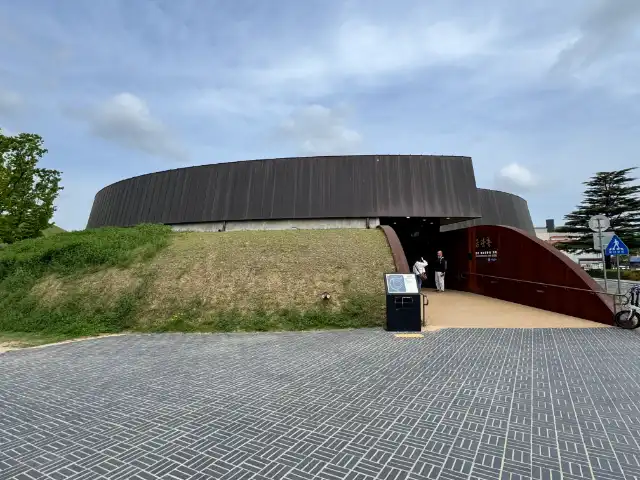
I got only to a small portion of the farthest of the three parks this morning, so it’s theoretically possible it contains 23 mounds, but I don’t think so.
The mapping app I’m using puts a Daereungwon Ancient Tomb Complex dot only in the middle park. But it might parsimoniously restrict each site to a limit of one dot, and it selected the middle park as the logical choice.
Whatever the truth, herein, I’m going to refer to the three parks combined as the Daereungwon Ancient Tomb Complex or, for brevity, sometimes just Daereungwon.
As an aside, when I walked into Daereungwon, the experience immediately reminded me that this was not the first time I’d seen a collection of large burial mounds in my travels. However, for the life of me, I couldn’t remember where the other place was. A search of this journal told me that it was in Gamla Uppsala in Sweden.
I can’t think of two places more culturally different, not to mention quite geographically distant, than Sweden and Korea, but there you are. It is a small world after all.
Touring Not Quite All of Daereungwon
The smallest of the parks is the closest to my hotel. That’s where I started.
In that park, no barriers separate the public from the mounds, but …
Aside #1
Look, but don’t climb
Regular readers know that, despite my advanced age and decrepitude, I still like to clamber (or is that struggle?) up hills to see the view from up top. The slopes of the burial mounds are steep, but probably not too steep to climb even for me. So you likely imagine that I was tempted to walk up some of them.
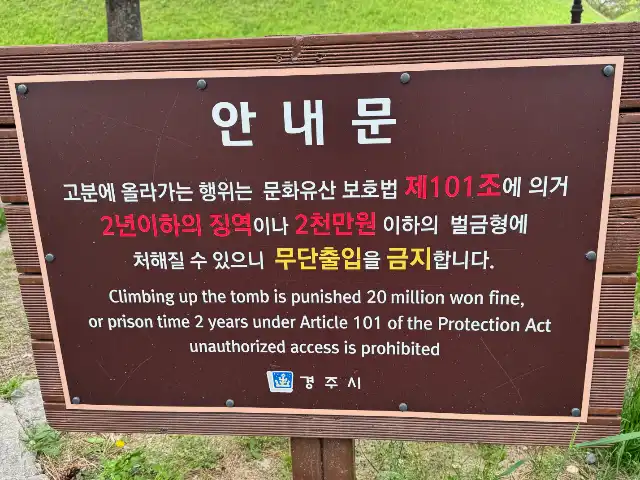
In truth, I was—for about a second. But there was a sign at the entrance I went through into the first park in the Daereungwon complex that strongly and effectively dissuaded me. That sign was repeated a few times in the park.
It told me in no uncertain terms that unauthorized access is prohibited and, “Climbing up the tomb is punished 20 million won fine, or prison time 2 years.”
The deficient grammar notwithstanding, I wasn’t about to break that regulation.
Twenty million won sounds worse than it is. Currently, 20-million won converts to less than $18,439 (CDN). Nevertheless, that’s a trip expense that’s at least an order of magnitude larger than I want to incur for an incidental.
And, two years in prison? Um, no.
As much as I like to be king of the castle, so to speak, I don’t think it’s worth that price just to climb some hills. I can climb plenty of hills for free, without risking jail time.
Getting a bit ahead of myself, there were low, dignified, wood pillar and post fences around the burial mounds in the next park over. I did spot one of the above signs in that park, too, but more prevalent were smaller, less threatening signs.
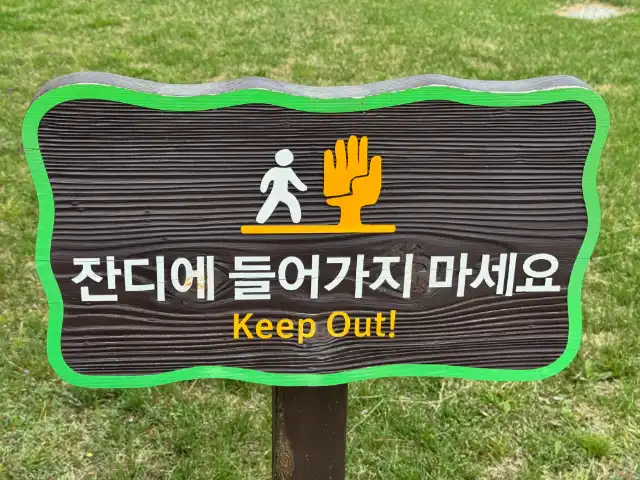
These signs had Korean and English. The English said only, “Keep out!”
However, there was a pictogram providing the reason why it was important not to advance onto the burial mounds. It clearly indicated that if you did, you’d put yourself in danger of being swatted by a giant hand. It’s a hand that is larger than your whole body, and it has a very threatening lifeline on its palm. You don’t want to mess with that.
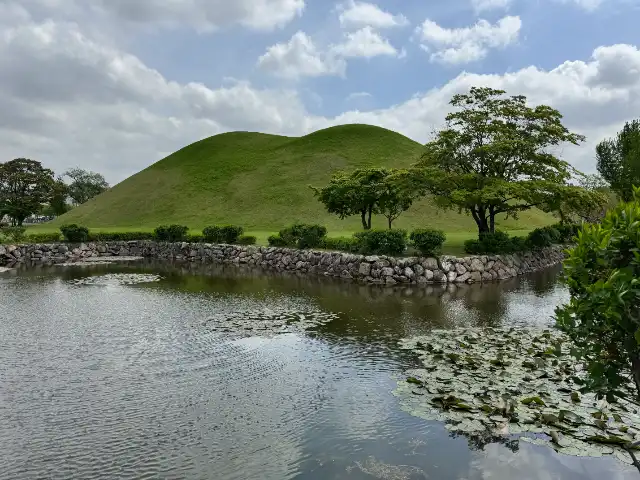
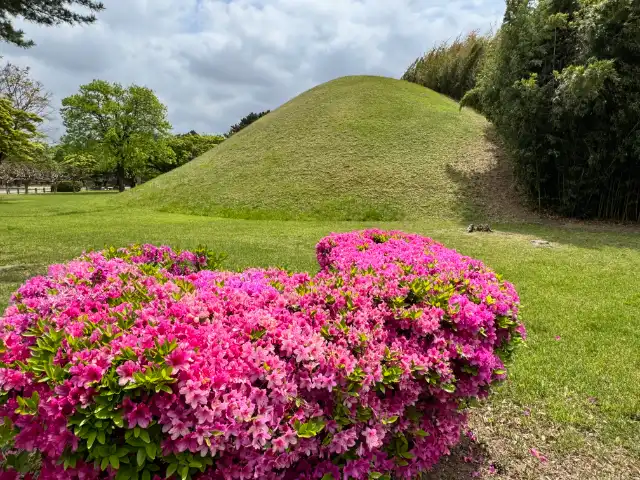
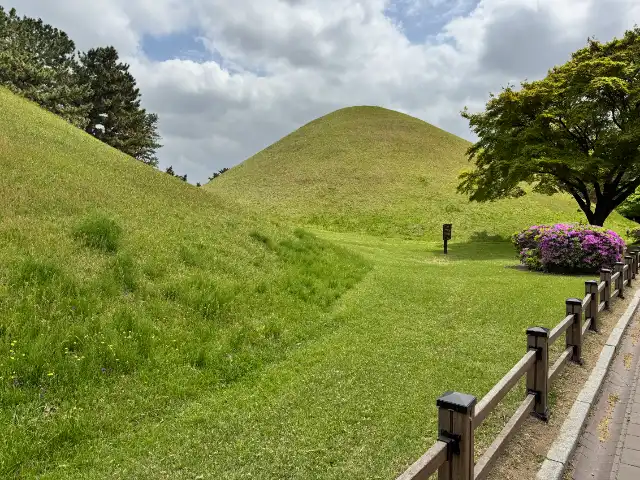
Most of the mounds in the first park (and all of the ones that I saw in the other two parks) are cone-shaped, but with a gently rounded top, rather than a pointy one.
However, in the first park, there were two or three that were basically low cylinders with flat tops. I don’t know if that low, flat shape was their historical shape or due to subsequent excavations.
I think that many (most? all?) of the mounds in all three Daereungwon parks have been excavated at some time to see what’s inside and to recover relics to display in, hopefully, museums. I think most of the mounds that were excavated were then returned to their previous mound shapes. But, possibly, some weren’t. I don’t know.
One of the tombs that certainly had its top chopped off, Geumgwanchong Tomb, is currently topped by a cylindrical structure. There’s a museum inside.
It normally costs 3000 won to go in. But it was free today because there’s an information centre next door that’s included in the fee. That centre is closed today. According to a sign that was computer-printed on plain paper and posted in front of the other building, it was closed for maintenance. Only today. It opens again tomorrow.
Clearly, they didn’t get the DLJSSIA (Don’t Let Joel See Stuff International Association) memo. DLJSSIA policy plainly states that members must keep whatever they normally have on offer closed until after I leave their city.
I’ll be in Gyeongju for another two days after today. If I have time, maybe I’ll go back and take a look. That’ll teach them.
But I did go into and take a look inside the Geumgwanchong Tomb structure.
It contains replicas of cutaways of the interior structure of the tomb. The museum also offers text panels describing the construction. And there are interactive display screens where I could get more information on elements of the tombs in the language of my choice. There are also a couple of screens that play videos about the tombs, their construction, and the burial customs.
The video screens were meant to be watched by multiple people at once. Each screen had a button to start the video with audio in the button-pusher’s choice of one of a few languages. In both cases, the video was already playing when I got there. And in both cases, the button-pusher had chosen English. I think Gyeongju gets a lot of tourists.
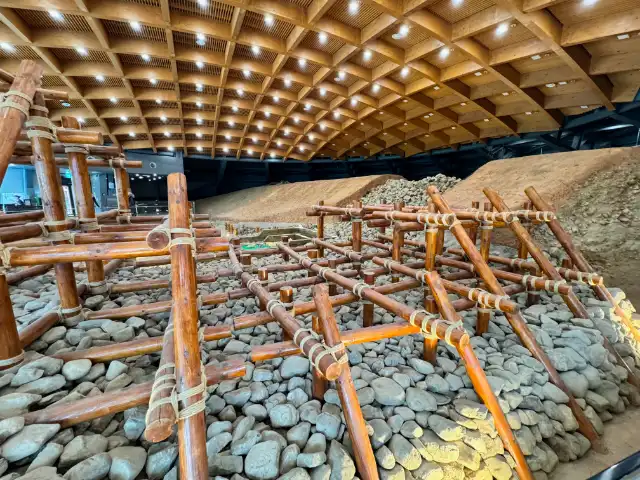
The construction of the tombs was interesting. (I’m writing this mostly from memory, so you know, have your grain of salt at hand) First, they dug a rectangular pit and filled it with river stones back up to ground level. Then they stuck a series of vertical poles in a circle around the pit, with a series of concentric circles of vertical poles out from that, at decreasing heights in each of a pair of concentric circles. They also affixed horizontal cross-beams to the vertical beams. Then they filled in the areas between the poles with stones.
At some point, I forget when, they built a two-chamber wooden box over the rectangular base of stones. The larger of the chambers was for the body, plus some treasures buried with him. The smaller one contained only burial objects.
After the burial, a domed clay structure was constructed above it, and vegetation grew over it. I’ve probably forgotten a few steps, gotten a few somewhat wrong, and gotten some out of order, but basically, that was it.
I never want to be completely accurate in these sorts of narratives because I’m convinced that if I ever am, that will be the day I die.
Aside #2
Pronouncing Gyeongju
I titled my introductory post for Gyeongju, which I published yesterday after arriving here, “Gee, I’m in Gyeongju.” I thought, based admittedly on ignorance, that “Gee” was an alliteration with “Gyeongju.”
Unfortunately, I’d never heard Gyeongju pronounced other than in my head. My head doesn’t speak Korean.
The videos in Geumgwanchong Tomb mention Gyeongju frequently. It’s not alliterative with Gee.
I don’t entirely trust my ears to accurately hear the phonemes in a foreign language, but the start of Gyeongju definitely doesn’t sound at all like “gee.” First, the “G” is hard, not soft. And, the “Y” sound is very pronounced, as in the start of “you.” I barely heard the “E” at all. The rest of Gyeongju sounded exactly as I expected it to sound. So, if you mangle transliterations in the same way I do, then you should have no problem pronouncing the “ongju” part of Gyeongju.
Then again, my ears might have misheard the phonemes. And I might be steering you wrong. If so, sorry about that.
The next park over in the Daereungwon Ancient Tomb Complex was somewhat more manicured. Whereas in the first park, there were mostly trees and just some somewhat scruffy grass in addition to the mounds, in the second park, the grass was better kept, and there were flowers, a pond, a small forested area, and those handsome, low fences I mentioned in the first aside above.
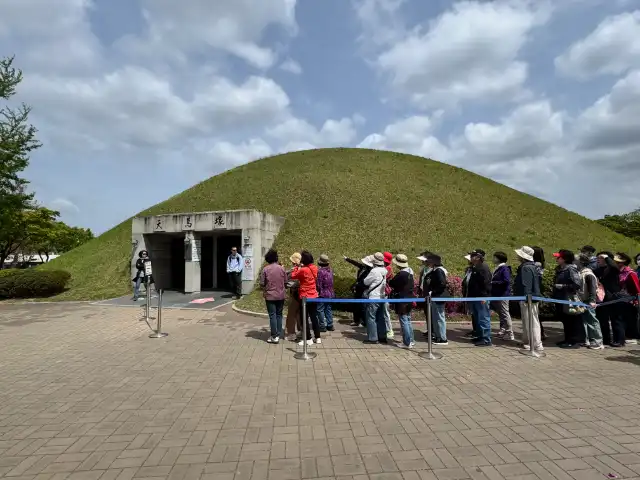
Also, in the second park, one of the tombs, Cheonmachong Tomb, had an entrance where, for a fee, visitors can, and I did, go inside.
Apart from the entranceway carved into it, Cheonmachong appeared from the outside to be a fully formed burial mound.
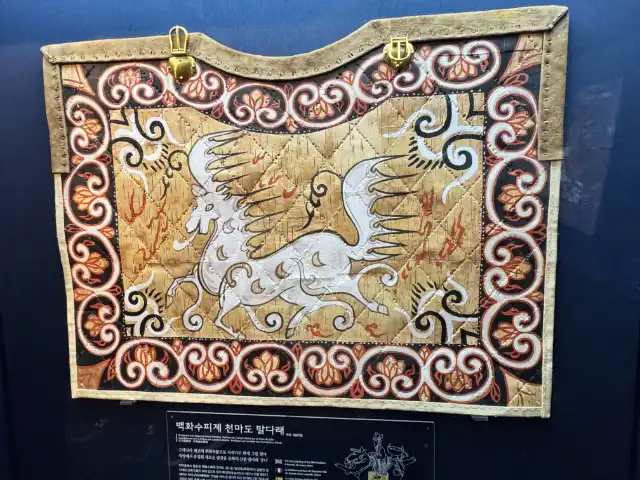
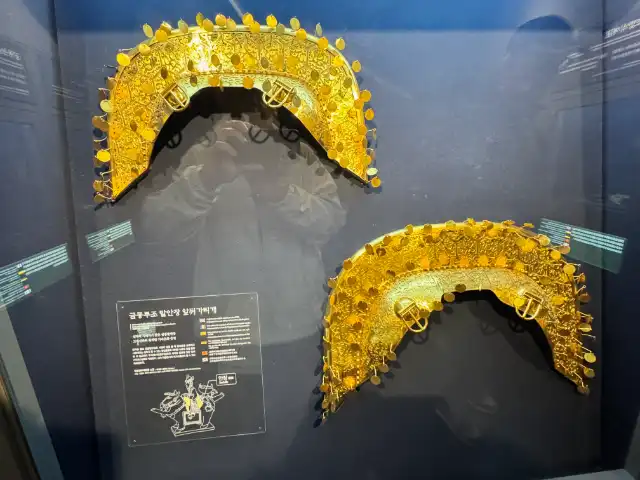
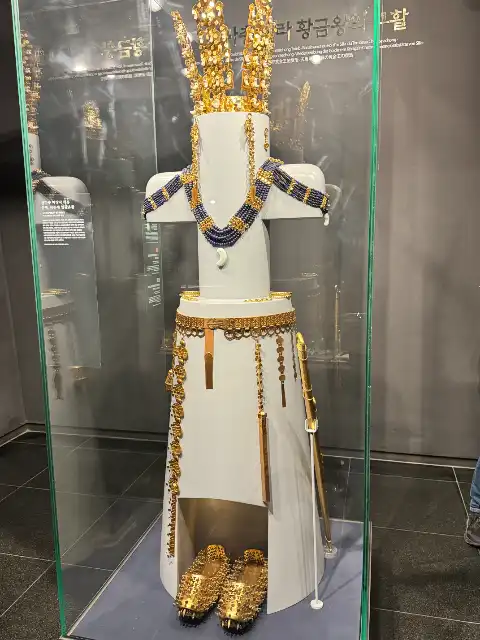
Inside, there was a portion of a real stone wall from inside a tomb. The sign just said “a stone-mound wall,” not necessarily Cheonmachong’s real internal wall. Also on display were relics recovered from some mounds, including gold and gilt-bronze ornaments worn by the person buried in Cheonmachong. In addition to that, there were gold pieces from a horse saddle, a painting that the accompanying text said was “The best painting of the Silla Kingdom,” among other objects.
Inside Cheonmachong, in addition to some text panels, there was an interactive video screen where I could get more information. From that, I learned that until the practice was banned in 502, there were sacrificial burials wherein the living were buried with the deceased monarch. It didn’t say who had that honour, but I assume it was people who served the king and maybe some loved ones. So, if you think you’ve had a tough boss or family member, well, think again.
After visiting Cheonmachong and wandering through the second park of the Daereungwon Ancient Tomb Complex, I walked a bit into the third.
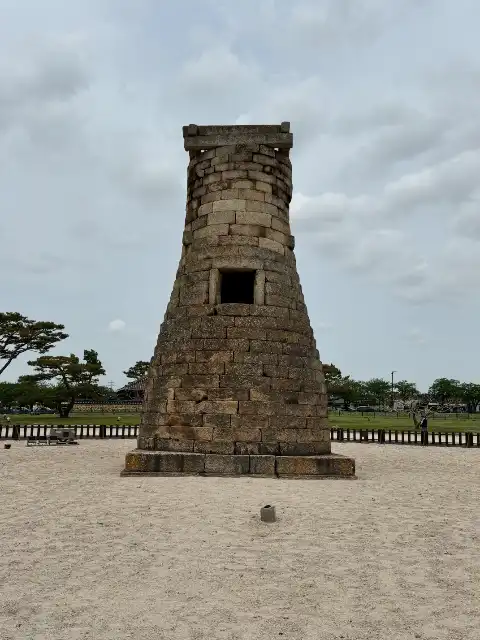
I didn’t get far into it, the largest of the three parks. But I did go far enough to see Cheomseongdae, a stone astronomical observatory built between 632 and 646 CE. It has twelve stones at its base for the twelve months of the year. It is thirty layers high to match the number of days in the month. And 366 stones in total, to correlate approximately with the number of days in a year. Cool, eh?
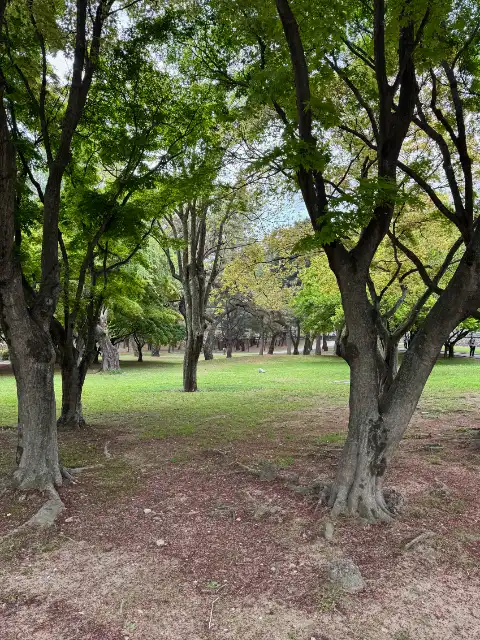
After seeing Cheomseongdae, I was getting hungry for lunch. Between the second and third parks (I’ve been numbering them based on proximity to my hotel, not by any official numbering system), there’s a cluster of restaurants and snack bars. I went back there and had a bulgogi (Korean marinated meat) lunch.
Okay. You can stop reading now. It’s lunchtime. Enough said.
Discover more from Joel's Journeys & Jaunts
Subscribe to get the latest posts sent to your email.
Thank you for the pronunciation primer. I feel better knowing how my head should talk to me about what I am reading here. You don’t want to know about the other things my head is saying while I am reading it. All good, when not floating away into some irrelevant distraction and then there is no accounting for what goes on. A captivating morning. I am professionally gratified to have been shown an image of the best painting of the Silla Kingdom. I look forward to seeing more this afternoon.
As I suggested, I’m pretty sure I’m still not pronouncing it correctly, but better than before.
It was a much more picturesque and absorbing morning than I was expecting for a bunch of hilly tombs.
Maybe some of the sacrificial denizens of the tombs were folks who ignored clearly posted signs, overstepping their authority, and were summarily penalized. Dispatched at a tomb when they failed to cough up the steep fine.
Tombs built to entomb breakers of the tomb rules. That’s too meta for me. I’m glad obeyed the rules.