Donggung Palace and Woji Pond, Gyeongju National Museum, and More

This afternoon in Gyeongju, Korea, I visited Donggung Palace (sort of) and its Woji Pond, the Gyeongju National Museum, and some ground before and in between.
Note: I didn’t finish my post about this morning’s activities until much later than normal. Consequently, it’s now late, and I’m really tired. So this post will probably be greatly abbreviated and more error-ridden than normal. I’ll push through and see how much I can put on paper electrons.
My afternoon activities deserve much more and much better narrative than they’re going to get. Sorry about that.
Earlier on Joel’s Journeys and Jaunts, namely my post on this morning’s activities, I explored the first two of the three parks in the Daereungwon Ancient Tomb Complex. But I’d only gone a bit into the third before I doubled back to a restaurant between the second and third park to have lunch.
There. You’re caught up.

On to this afternoon’s activities.
I intended to make the Gyeongju National Museum my primary focus this afternoon. It’s just beyond the far end of the third park. So, after lunch, I headed back into that park and explored it a bit deeper.
Just beyond the point I got to before lunch, I came to three fields side by side, separated by paths. There were identical bilingual signs at most of the corners of those fields. The English said, and I quote, “Please Keep off the flower.”
This left me confused. Never mind the capitalization of “Keep.” It’s the flower that I’m confused about.

The fields appeared to be mostly weeds and grass. There were some tiny yellow blooms on a small proportion of the seemingly weeds, but nothing that I would think of as a flower in the normal florist sense of the word. But even if you are willing to consider them flowers, which, technically, they were, the sign said “flower,” not “flowers.” How was I to know which flower I was supposed to keep off of?
Not far from those fields, there were a few beds of tulips. Some were past their prime, but many of the flowers still held their own. They didn’t need a sign to tell me to keep off one, two, or all of them. I did that without being told.
Donggung Palace and Woji Pond
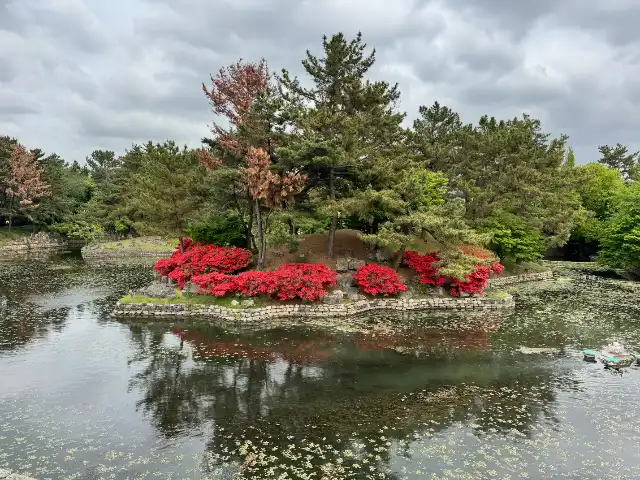
Donggung Palace is on the other side of the road from one side of the third park of the Daereungwon Ancient Tomb Complex, not much deeper into the park than the fields. If I wanted to see it, and I did, geography dictated that it made sense to duck out of the park and over to the palace before heading back into the park and pushing through to the Gyeongju National Museum. So that’s what I did.
In my introductory paragraph in this entry, I appended “(sort of)” to Donggung Palace because none of the palace’s buildings remain. There are three recent (1970s, if I remember) reconstructions of the I don’t know how many original buildings. Those reconstructed buildings are all open-sided pavilions with what I’ve come to think of on this trip as traditional Korean roofs.
The pavilions are all beside a lovely pond, namely Woji Pond. Woji Pond has a small island in it. There’s also a section of the shore that juts out a bit into the pond, sporting a profusion of bright red flowers, at least at this time of year.

There is also a small forested area on the grounds. It’s all quite beautiful.
There was a fenced-off part of the grounds where ongoing archaeological excavations were happening. When I was there, most of the area was covered in blue tarps. But there were a couple of square sections within it that were exposed. In one, someone was taking close-up photographs of, I suppose, some excavated item. I couldn’t see what it was she was photographing, but she was bent over and had the long lens of her camera close to the ground.
There was also someone in the other exposed section, but they were too far away for me to see what they were doing.
Okay. It’s getting later, and I’m getting more tired. Enough about Donggung Palace and Woji Pond. Let’s move on.
Back into the Daereungwon Complex

As I said, the Gyeongju National Museum is beyond the far end of what I’ve been labelling the third park of the Daereungwon Ancient Tomb Complex. So, I crossed back over to the park and ventured deeper into it.
Walking through, I passed by another fenced-in archaeological excavation area. Again, much of it was covered in tarps. But there was an open section where people were carefully, meticulously digging with small implements and brushing off what they found.
The back section of the park is not burial mounds, but rather a forested area. It was beautiful and serene. Plus, unlike around the burial mounds, there were no restrictions as to where I could walk. At least, none that I saw. If there were, I might have broken the rules.

This forested area is up a little bit from the rest of the park and above the lowest level, the river level, of the city. At one edge of the forest, I looked past the edge of the hill and saw a lovely bucolic urban scene.
Is “bucolic urban” an oxymoron? If so, I don’t care. That’s what I’m going with. There was a river (I think a tributary of the main river through Gyeongju, the Hyeongsan River, a road, a road bridge, a bus, a trail, and a few buildings. But there was also a lot of greenery. In fact, the greenery dominated.
It was beautiful.
Alright, we’re out of the Daereungwon Ancient Tomb Complex and into the home stretch of this post. I’ll power through (quickly) to the end.

Gyeongju National Museum

The Gyeongju National Museum is a cluster of buildings, with several artifacts outside as well. Apart from a coffee shop and a small traditional building that I didn’t get close enough to to see what it was used for, if anything, I think only three of the buildings were open to the public today. At least, I went into only three.
The first building I visited was the Silla History Exhibition Hall. It contained artifacts not just from the Silla period (57 BCE to 935 CE), but also from the Paleolithic Period and the Bronze Age. There were pottery, stone hammers, axes and other implements and tools from the Paleolithic Period.
From the Bronze Age, there were bronze daggers and other tools.
After that, if I remember correctly, they moved into the Silla times. There were a lot of artifacts from then, including jewelry, vessels for liquids, and tools, among others. Many of those items were recovered from burial tombs. Royal deceased needed to take stuff with them to use in the afterlife, I guess.

One type of artifact that tickled my fancy was bird-shaped vessels. The museum had a few samples. I managed to capture two of them in one picture. You’ll find it here somewhere.
I’m too tired to try to compose a description of them. But, fortunately, I took a picture of the sign beside them. I can use the character recognition feature of Apple Photos to copy and paste that. Here it is:
“In approximately the middle of the 3rd century, bird-shaped vessels appeared burials of Saroguk and the area of the Nakdonggang River. The body of the vessel is empty and the vessel back and tail has openings through which liquid can be poured. After these vessels were used in funerary rituals they were placed in burials. It is assumed that individuals wished to fly to heaven after death in the bird-shaped vessel.”

There was more to say about Silla society, but it’s almost midnight. I want to finish this. So let’s move on.
Another building I went into was the Wolji Exhibition Hall. That’s “Woji” as in “Woji Pond,” which I visited earlier in the afternoon. It seems there’s more to it than I realized when I was at the palace and pond. The exhibits in this building tell some of that story.
According to the “History of the Three Kingdoms,” Silla built a pond inside the grounds of a palace. That palace was extensively renovated into Donggung Palace.

The Wolji Exhibition Hall contains some original building elements of the palace, along with other artifacts.
According to some text in the museum, the area around Woji Pond was originally waterlogged. Water-related rituals were often held there until the mid-7th century. Consequently, a lot of ritual objects were excavated from the pond. Some of them are now in the Woji Exhibition Hall.
The third building I visited was the Silla Art Exhibition Hall. It contained several works of art from the Silla Period. The ones I remember are free-standing statues, stone relief sculptures, and reliquaries from wooden pagodas. There was a lot more, but I don’t remember them, and I’m too tired to try to troll my memory to snag any others.
However, I do remember that one room contained almost entirely stone statues, many, if not all, of Buddhist themes. However, in a niche off to one side of the room, there was a lone metallic sculpture. The sign didn’t say what the material was. What it did say, in part, was “The Bhaishajyaguru Buddha was considered to be a Buddha who could cure all diseases, extend life, and benefit all aspects of human life. This Bhaisha-jyaguru Buddha is a large statue with a height of nearly 180 cm and is exceptionally regarded for its outstanding sculptural beauty.”

Huh. Cure all diseases, extend life, and benefit all aspects of human life. Isn’t that always the way? There’s never a Bhaishajyaguru Buddha around when you need one.
I mentioned that the museum also has artifacts outside. Among them was a big, old temple bell, The Divine Bell of King Seongdeok, which served to commemorate the spirit of King Seongdeok of Silla, who reigned from 702 to 737. There were also some stone statues, panels from a temple’s stone pagoda, a turtle-themed stele pedestal, some steles, a three-storey stone pagoda, and other items I’ve forgotten.
The museum complex also has a pretty pond, but I’ve already talked about one pond in this entry. One pond should be enough for you. Don’t be greedy.
Thankfully, this post is now done. Good night, all.
Some of the outdoor artifacts at the Gyeongju National Museum:


Discover more from Joel's Journeys & Jaunts
Subscribe to get the latest posts sent to your email.
Five Royal Tombs, a Stream Walk, and Backtracking
Gee, I’m in Gyeongju
Lots of cool stuff in that museum and pretty landscape before that. I was also taken with those bird vessels. Very sweet. And thanks for the slide show of the outdoor artifacts. That is one big bell! I also liked the idea of a cure-all Buddha. No need to go searching around for just the right one when you are in need. Got it covered. Finally, thanks for beetling through the blog for us after such a long day. Admirable altruism, that’s what I call it.
I forgot to mention it, but I very much liked the museum. None of the buildings were overly large, but they packed in a lot of interesting and/or beautiful objects into them, without it feeling as though they were the least bit crammed in there. And walking around on a reasonably pleasant day looking at outdoor artifacts was also enjoyable. It was nice of them to arrange for a reasonably pleasant day for me.
A one-stop-shopping Buddha does sound like a brilliant idea, doesn’t it.
You’re welcome,
I’m just glad you didn’t walk on the flower.
I know! Who knows what would have befallen me if I had? I might have been in jail now. But which is the verboten flower?