Bulguksa & Seokguram & More
This morning in Gyeongju, I visited Bulguksa and Seokguram.
At least that was the plan when I started the day. I knew that seeing Bulguksa and Seokguram would take me to well past noon, but I figured I’d be back from them early enough to have a moderately full afternoon to post about.
However, you know what Robert Burns said about the best laid plans of mice and men, “The best-laid schemes o’ mice an’ men gang aft agley.”
I have no idea what that means. And I’m skeptical about the capacity of mice to plan in any meaningful sense of the word. If they could, we’d be wise to elect them to government. So I don’t know why I brought that up. Forget I ever said it. It was inane of me.
The point I was trying to make is that my broader plan for the day didn’t come to fruition in its entirety. I had little time in the afternoon after returning from Bulguksa and Seokguram. So I will include the two additional brief afternoon sights in this single post for the whole day, rather than my usual separate morning and afternoon entries.
I apologize to my loyal reader(s) for not doing more today. There are multiple reasons for that.
For one, I was very tired this morning after being up late last night posting here. Consequently, I had a slow start to the day.
For another, my hotel comes with breakfast, but the breakfast room is small. I had to wait for a table to open up. What’s more, including short walks on either end, it took a little more than an hour to get from my hotel to Bulguksa Temple by bus. The bus isn’t very frequent, so I had a bit of a wait, although not as long as if I’d just missed one. What’s more, because Bulguksa and Seokguram are a fair distance from anything else I wanted to see, I had that journey to complete as well.
Other reasons will make themselves apparent in the following narrative.
Being one article rather than two, this will be longer than normal despite seeing fewer sights than usual in the course of the day.
One quick note before proceeding. My guidebooks list my first stop as Bulguk-sa, not Bulguksa. But my Korean mapping app couldn’t find it as that. It did find it when I removed the hyphen, and that is how it shows up on the map.
My guidebooks aren’t Korean. The mapping app is. So I’ll go with the mapping app’s English spelling.
Bulguksa
According to one of my guidebooks, Bulguksa is Korea’s most famous temple. Not one of Korea’s most famous temples, mind you, but Korea’s most famous temple.
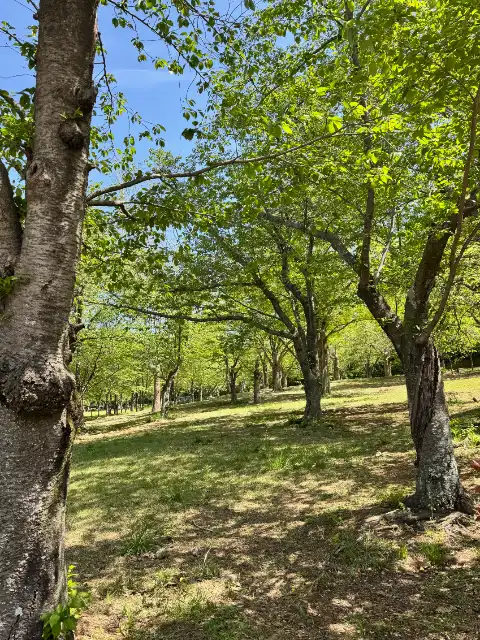
Bulguksa, a temple at the foot of Mt. Tohamsan, is a little walk from the bus stop and parking lot behind it, but not far. It was a pleasant stroll along paths through a wooded area.
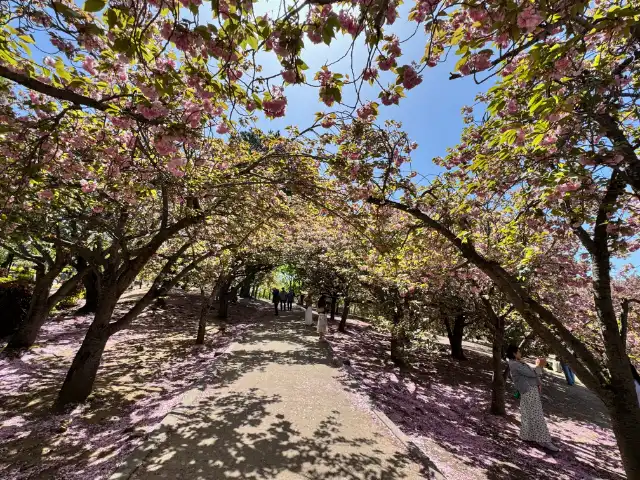
Some sections of the trees had pink blossoms, I assume cherry. Many people posed there to take pictures.
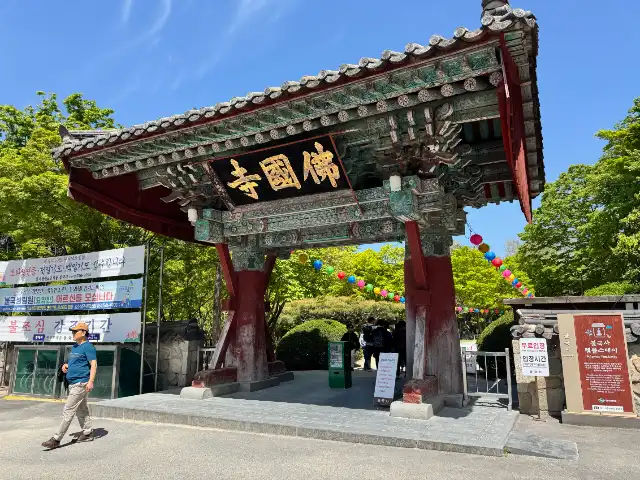
There are two formal entrance gate structures at the Bulguska compound, one a short distance past the other.
The first gate structure is relatively simple. It’s a traditional, decorated Korean roof atop two fat, cylindrical wooden pillars.
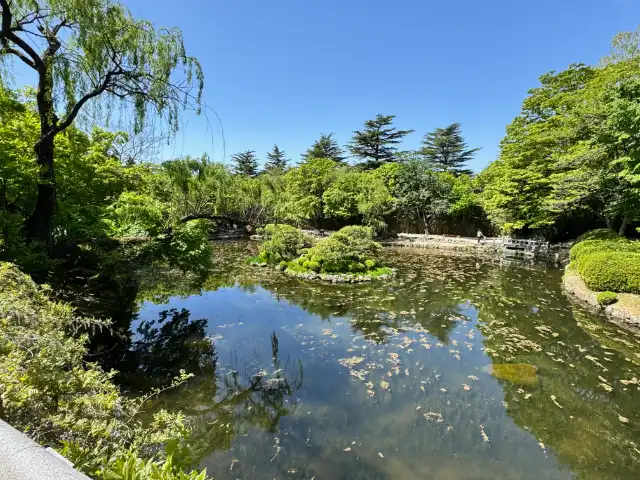
The walk between the two gates is pleasantly wooded. The path proceeds over two handsome stone bridges and past a lovely pond.
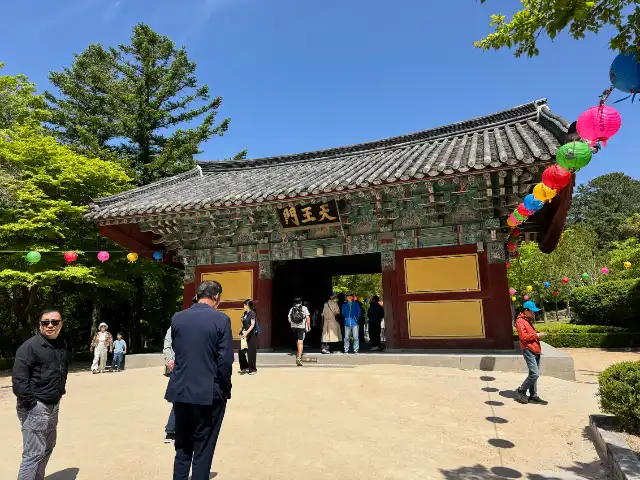
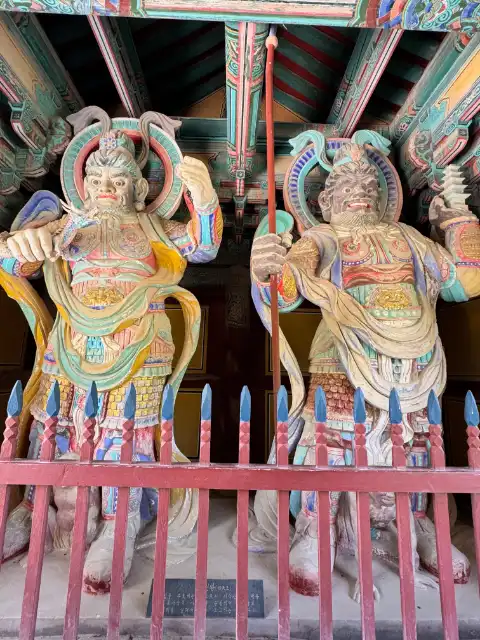
The second gate structure is more substantial. Rather than sitting on two pillars, it rests on two three-sided small rooms. The open side of each room faces the one on the other side of the entrance walkway. Inside each of the rooms stand two determined-looking, but only slightly fierce-looking, colourful, tall wooden statues. Each statue has a halo behind its head and some sort of flowing decorations flying out from its noggin.
Just inside the compound, there’s a small museum. In front of the museum, there was a trilingual sign. The English told a delightful story about the history of Bulguksa.
“After a thousand years passed since Shakyamuni Buddha lightened the world with the light of truth in India, a pure lotus flower became in full bloom at the western foot of Mt. Tohamsan that stood high at the edge of the continent that had vast space between India and it. The lotus flower of the Truth, Bulguksa Temple, stands beautifully today like it has been for the last thousand years.”
I didn’t see any lotus flowers, truthful or not. So, maybe after a thousand years, it finally died. A shame, that.
It’s not a large museum. Its first small area has a timeline posted on the wall. Fortunately, there were no prohibitions on taking photos in that area. Hence, I captured some of it so I could report it accurately here.
I could, but it, or at least the start of it, was confusing. It begins by stating that someone built the Bulguksa Temple in the fifth century. Then, it says someone else built it in 528. There are then some other dates for the construction of individual buildings. Only one person is listed as being responsible for the construction of each building and only once. The dates for the subsequent buildings were in the seventh and eighth centuries.
The timeline then continues with dates for various renovations, repairs and upgrades over time.
At the entrance to the next section, and throughout the rest of the building, the museum bears several prominent “no photography” icons, X-ing out both cameras and phones. Hence, I don’t have any memory aids for the museum contents or pictures to show you.
I remember there are text panels that include English describing aspects of the Bulguksa Temple and its history. There are also several relics recovered from the temple that are displayed behind glass. That’s all I remember.
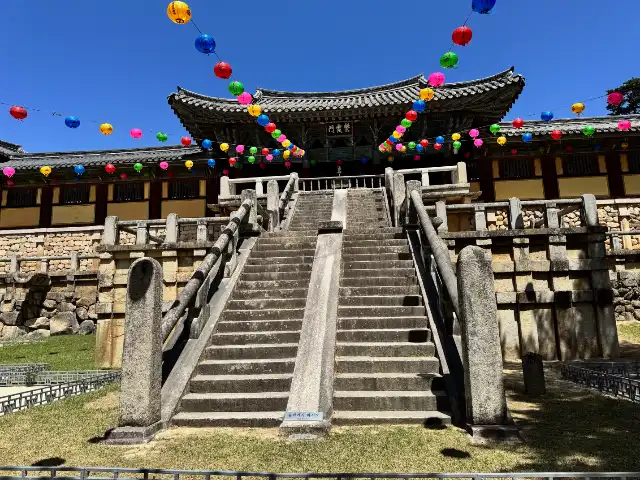
The main buildings of Bulguksa are up a set of grand-looking stone stairs, but they’re blocked off. The entrance is on the side. At this point, I no longer remember if I had to climb stairs or walk up a slope to get into the primary building cluster.
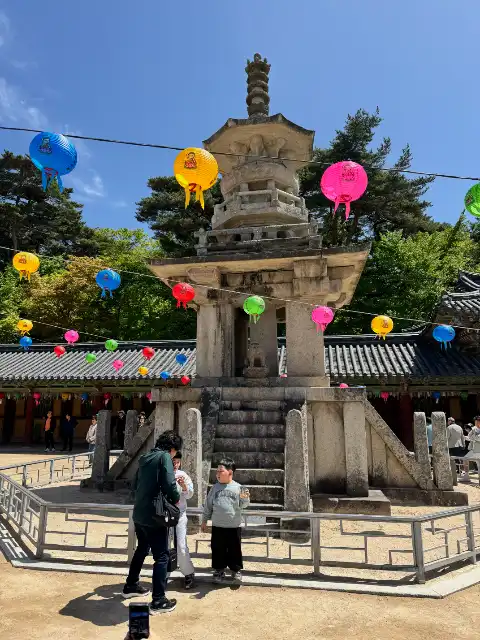
Bulguksa is probably most famous for the two stone pagodas in the courtyard of the building cluster. They are originals. Even before coming to Bulguksa, I’d already seen replicas of the famous pagodas. They’re on display on the grounds of the Gyeongju National Museum, which I visited yesterday.
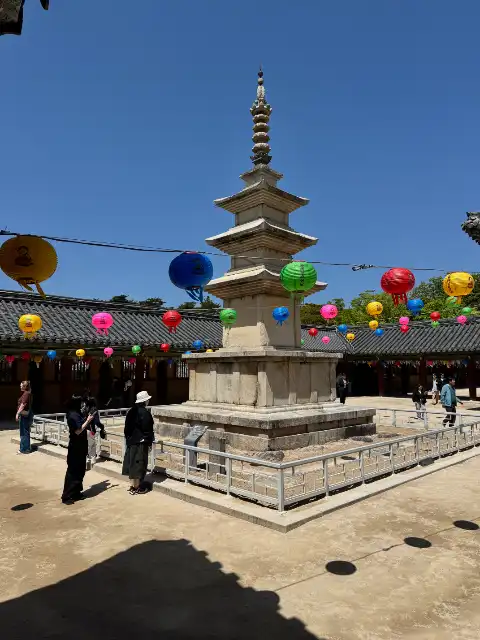
The originals have been restored over the years. According to my guidebook, when one of them was restored in 1966, the restorers found inside a copy of an 8th-century sutra. It’s one of the oldest woodblock print books in the world.
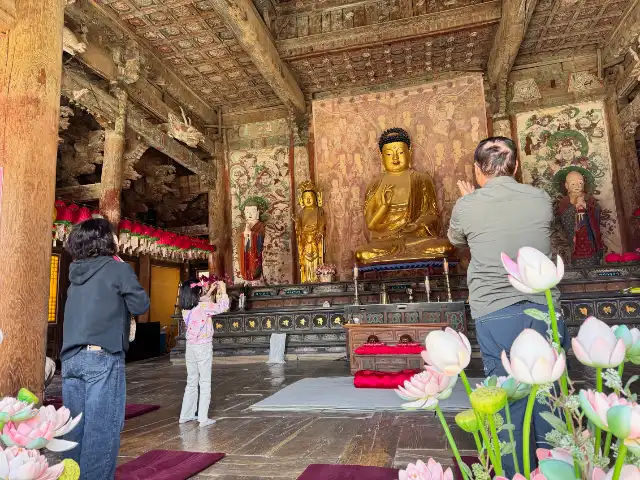
Photos of the pagodas and the outside of the buildings in the cluster around the courtyard are allowed. But pictures inside the buildings are prohibited. I was able to get a picture from well outside of the main hall through the doors of the Buddha inside. I don’t know if that broke the rules, possibly so. If so, I apologize.
In my defence, while I was there, a young girl was right inside taking a picture of the Buddha. So I’m going to blame her and her parents for corrupting me.
The public is allowed into the main hall and, if I remember correctly, one or more of the other buildings after they remove their shoes.
I only looked in from the thresholds because a) the buildings were small enough that I could see everything inside from there, b) the few people that did go inside appeared to be worshipping devoutly, doing the appropriate bowing and genuflecting, and c) I didn’t want to take off my shoes and then put them back on.
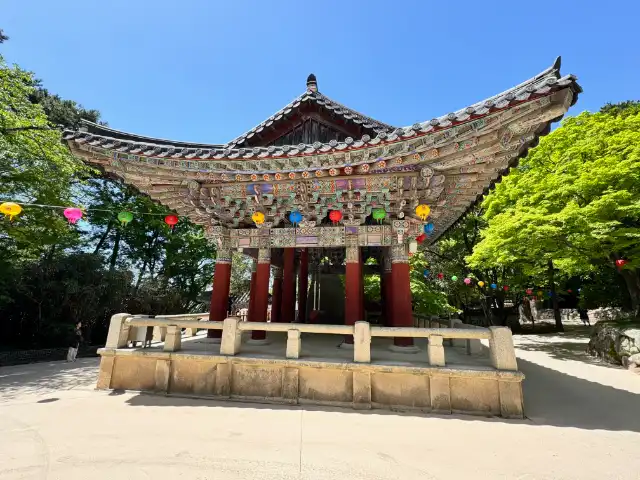
More pictures from Bulguksa:
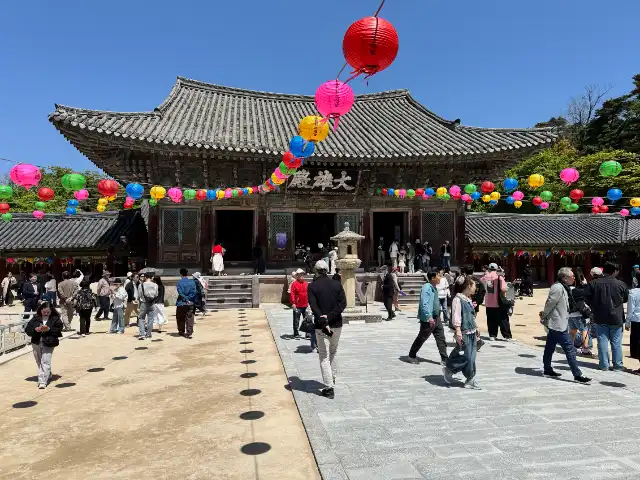
Bulguksa to Seokguram
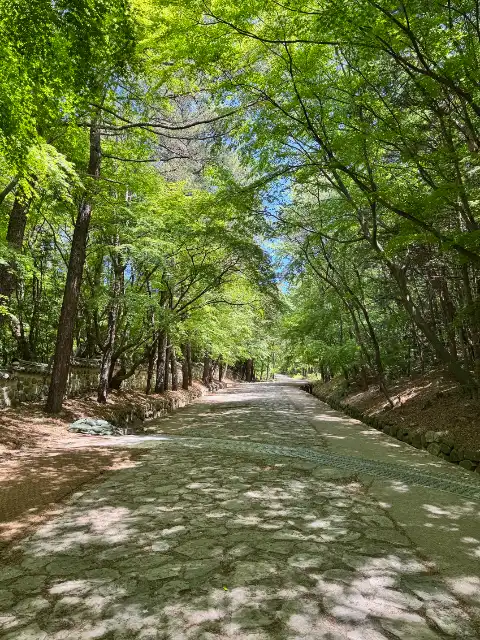
Outside the Bulguksa compound, a bit before its entrance gate, there’s a sign pointing to the path from Bulguksa to Seokguran. The latter is at the top of Mt. Tohamsan. Affixed to the front of a booth beside the road, there was a sign that included some English saying that it would be about a one-hour uphill walk to Seokguram. The sign didn’t lie.
For somewhat less than the first half of the way, the path is about the width of a normal one-way city street, or perhaps a little wider. But you wouldn’t want to drive up it even if you were allowed to (you’re not). If you tried, your car wouldn’t have a functioning suspension when you were done.
Most of this section of the path is paved with somewhat, but not entirely, flat-topped rocks. However, these are not rocks cut to fit together evenly. I don’t know if their tops were planed at all, but they are otherwise natural rock shapes. So adjoining rocks don’t fit together perfectly. There is considerable cement grouting, but it forms indentations.
On both sides of this rock paving, there is a lane, probably somewhat narrower than a standard city sidewalk, that is earthen. But for most of the way, it’s topped with a matted, thick rope runner. I’ve seen that before on trails in Korea. They seem to use it in many places that might get muddy or slippery in the rain. I’ve never walked on one in the rain, but they look like they’d likely be quite effective.
Outside these matted lanes, on either side of the road, there are narrow, shallow channels with sharply horizontal stone walls. I assume they are for channelling rainwater, but they were dry when I was there.
The first part of the way between Bulguksa and Seokguran has slopes varying from gentle to moderate.
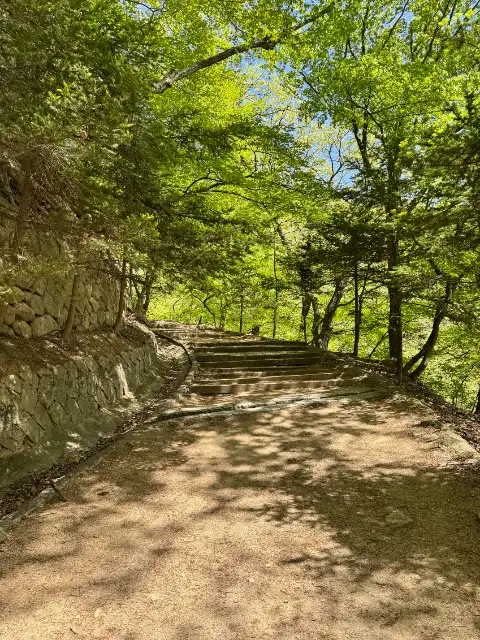
There’s another reason why you wouldn’t want to drive on it if you could. The almost-road lasts for less than half the way to Seokguran. It then narrows into a path about a sidewalk’s width. And here, the slope varies all the way from gentle to somewhat steep. At the somewhat steep sections, there are flat-stone steps to make it easier to climb without losing your footing.
At some points along the way, there are sturdy I-beams anchored into the ground on the mountain side of the path. Heavy horizontal, twisted-wire cables run through the I-beams. And chain-link fencing is attached to the I-beams. This is to protect against rocks falling off the mountain and injuring or killing people. Very thoughtful of them, I’d say.
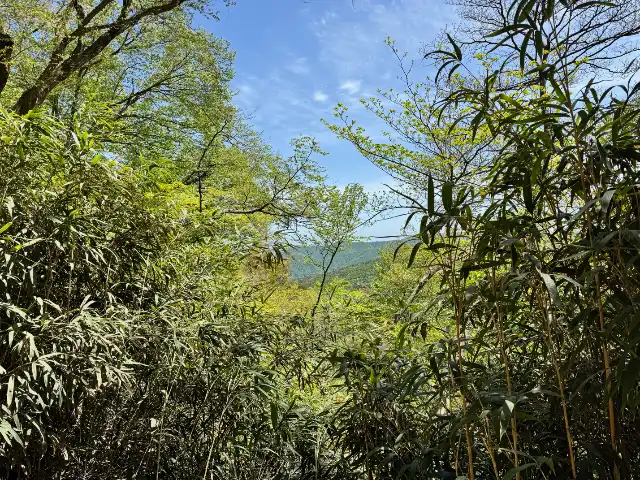
Almost all the way up to Seokguram is through an unspoiled forest. Unspoiled, that is, except for the path, some handrails where there were cliffs on one side of the path, and the falling-rock-protection apparatus. Oh, and on a small plateau on the way up, there was a building with toilets. And there were occasionally some benches. Okay. Maybe somewhat spoiled. But not much. It was a gorgeous walk, but exhausting.
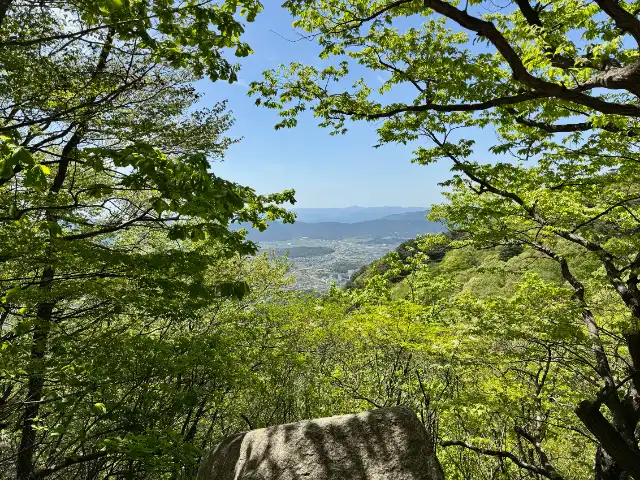
You’d think that being high up a mountain would provide stunning vistas beyond and down the mountain. There were a few, but for the most part, those sorts of views were obscured by the trees. So I could generally see the forest and the trees, but not the vistas beyond.
Seokguram
When I reached the summit of the mountain, what did I see?
Take your time. I’ll wait for you to formulate an answer. I’m retired. I have time.
No, I didn’t see Seokguram. Guess again. I’ll give you more time.
Give up? Just beyond the crest, on the other side of the mountain from the side I walked up, down a few steps, I saw a large parking lot filled with cars and one tour bus.
Because the road to it is on the other side of the mountain, I had no idea that there would be cars up there.
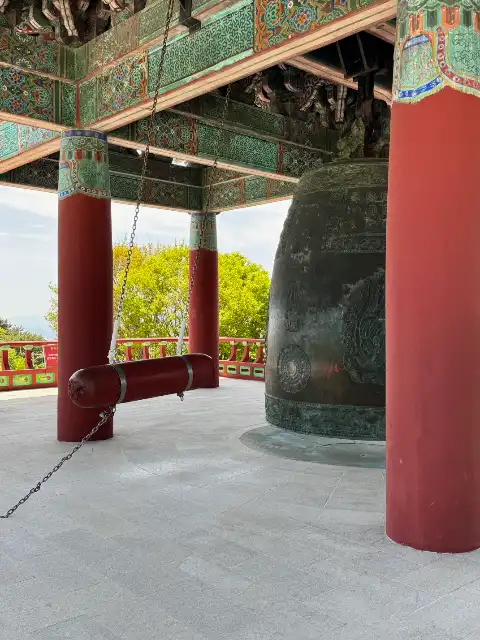
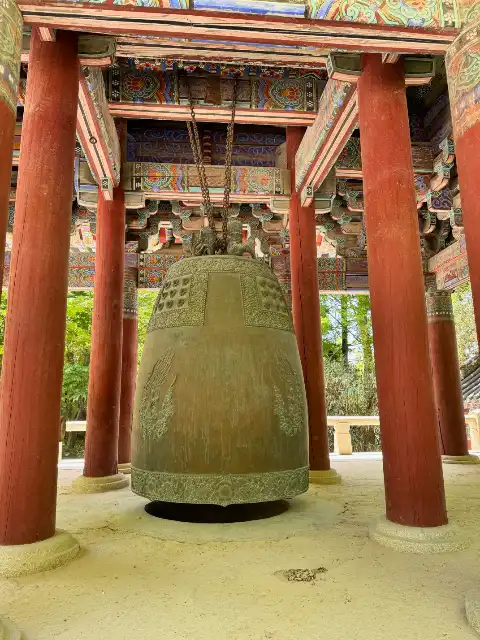
At the summit, beside the short set of stairs leading down to the parking lot, there’s an open-sided building cantilevered over the slope that contains a very big bell. I know little about Buddhism, but Buddhists, at least Korean Buddhists, appear to like big, beautiful bells. I’ve seen a few of them in my short time so far here in Korea. That’s fortunate, because “big, beautiful, Buddhist bell” is great alliteration.
Seokguram is not right at the summit. To get there, I had to walk down a gently sloped, wide earthen path and then back up some of that elevation along the same sort of path. The walk from the summit to Seokguram took about fifteen minutes. There are some stairs to climb within Seokguram to its main, pretty much only, attraction.
So what is Seokguram? It was a seminary, but now the primary reason to go is to see a grotto that contains a very large, very smoothly carved and polished seated Buddha sculpted from stone.
But, here’s the thing. Because they had trouble keeping the crowds from doing damage to the grotto and Buddha, you now have to view the beautiful statue from inside a small, open-fronted building immediately adjoining the grotto, with glass blocking off the entrance to the grotto.
It’s clear glass, with a sign asking people not to touch it so they don’t smudge it, but it’s no longer possible to get up close and personal with Buddha.
At the entrance to the building, and inside it, there are several textual signs, with both Korean and English, saying you can’t take photographs in there. So, don’t bother looking for Buddha images here. Their website has some pictures, so you can see it there.
And I wouldn’t be surprised if some people with less respect for rules than I have snuck some pictures and posted them on the web. I haven’t made any attempt to search them out. Why would I? Heck, I saw the real thing. I just can’t prove it.
After I finished looking at Seokguram, rather than walking all the way back to Bulguksa to catch the bus, I asked my Korean mapping app for a transit route to my next destination. Rather than sending me back to Bulguksa, it told me that there’s a city bus that does a shuttle between Seokguram and Bulguksa. I could get a bus from the latter to my destination.
Now it tells me. If I knew that before I made the hike up to Seokguram, my legs would still want to be friends with me.
The shuttle bus, which winds back and forth through hairpin turns down the mountain, runs only once every hour. I had to wait 25 minutes for it, which was another reason why I didn’t see as much as I normally would have this afternoon. Then again, that was still less time than walking for an hour back to Bulguksa.
Bunhwangsa
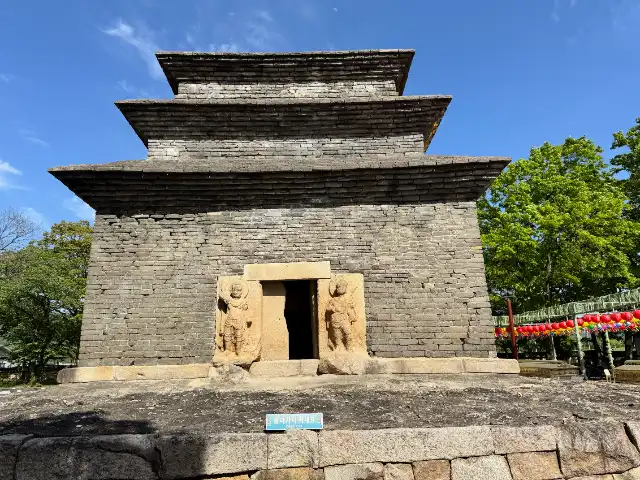
My next stop was Bunhwangsa, Korea’s oldest datable pagoda, originating from the mid-seventh century. What makes it rare is that it’s not made of carved stone blocks, but of bricks. On all four sides, there are doors into the pagoda. The public isn’t allowed in or even onto the pedestal the pagoda rests on.
On either side of each door, there are guardian statues of somewhat fierce-looking figures. I say “somewhat” because their features are heavily weathered.
On all four corners of the pedestal, there are lion sculptures that are even more weather-worn. I would have recognized them as four-legged animals, but not necessarily lions, if I hadn’t read that.
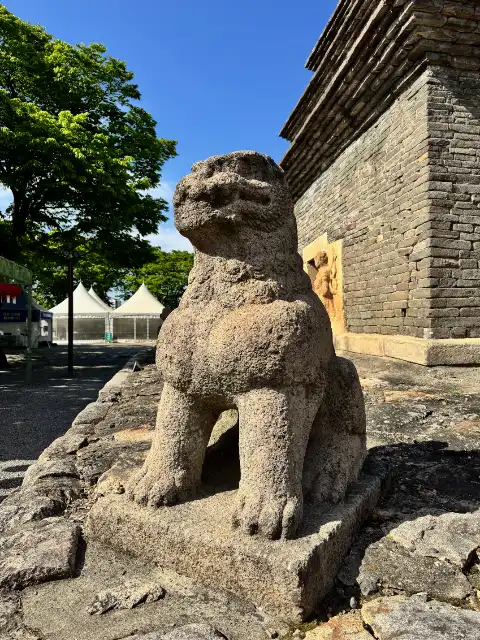
The pagoda that’s there today is a shadow of its former self. A sign beside it says that it is presumed that the currently three-storey high pagoda was originally seven or nine storeys. However, some of it collapsed and was overgrown with grass. In 1915, during the Japanese occupation, authorities dismantled it, cleaned the bricks, and reassembled it as the three-storey pagoda that’s there today.
During the renovation, they found a reliquary containing several objects.
Near the pagoda, there is a centuries-old stone well that, according to a sign by the well, is still in good enough condition that it could be used today.
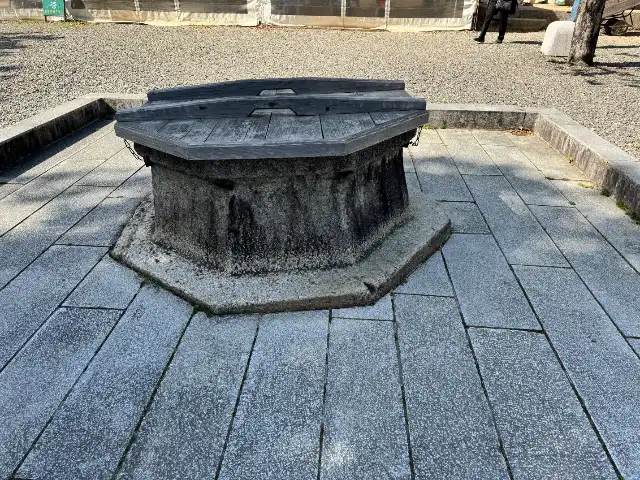
The sign aksi says that, “A legend about this well is told in the Memorabilia of the Three Kingdoms (Samguk yusa). It is said that there were three guardian dragons who protected the Silla kingdom. One lived in this well, and the other two lived in wells at Dongcheonsa Temple on the slope of Geumhaksan Mountain. In 795, an envoy of Tang China visited Silla and used a magic spell to transform the dragons into fish and capture them. Two women, who were the wives of the dragons, came before King Wonseong (r. 785-798) of Silla and pleaded that their husbands be found. The king ordered that the fish be returned to their wells. Upon their return water spurted out of the well and the dragons jumped with joy, causing the Tang people to admire the king’s wisdom.”
I don’t know. I’m skeptical. I thought dragons were lifelong bachelors and bachelorettes.
Also on the grounds, there’s another big, beautiful Buddhist bell.
Hwangnyongsa
Hwangnyongsa is almost immediately across the street from Bunhwangsa. Although “was” rather than “is” is more appropriate. Hwangnyongsa, built in the 6th century, was the largest Buddhist temple in the country. But the Mongols burnt it to the ground in 1238.
Today, a few rows of stones mark some of the outlines of the temple, but that’s about it. One section of the site is blocked off for some ongoing archaeological excavations.
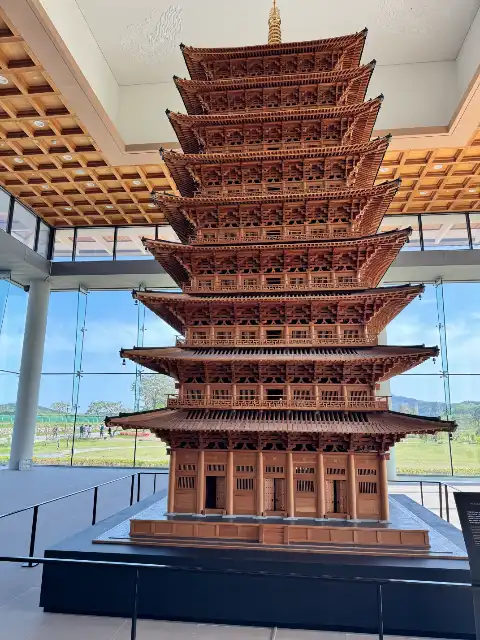
Uniquely and notably, Hwangnyongsa had a nine-storey, 80-metre-tall wooden pagoda. It, of course, is no longer there.
There is a small on-site museum at Hwangnyongsa. Inside, there’s a scale model of the pagoda.
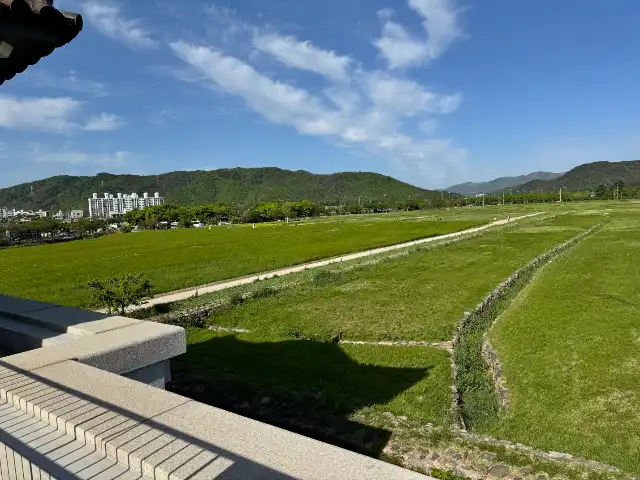
The museum also has cut-away models of the construction of the pagoda, information about the temple and its pagoda, along with some relics found on the site.
The museum has a second-floor observation deck from which I could look out on the site.
So ended my day’s activities.
Dinner
When I say “activities” in this journal, I’m typically referring to sightseeing activities, not meals, unless I go on a food tour.
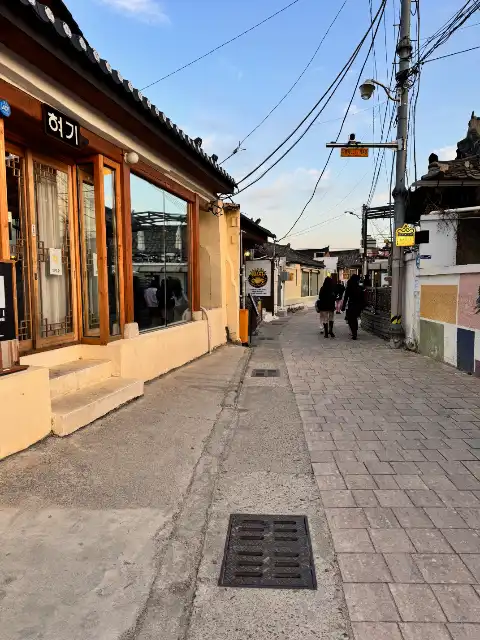
The title of this section notwithstanding, this is not an exception to that. This is not about dinner, but rather the area I had dinner in.
Despite being greatly impressed with the sights I’ve seen in Gyeongju so far, I’ve not been terribly impressed with the city as an urban area. For the most part, what I’ve seen in the city are mundane buildings. They haven’t had the age or traditional architecture to be particularly interesting or characterful.
However, I went to dinner in a part of town I hadn’t been to before. It’s populated mostly with hanbok homes that have been converted into restaurants and cafes. The main street fronting the neighbourhood isn’t primarily hanbok, but it has cheerful buildings. And the whole area was lively. I was impressed.
Legal note: The two pictures of clocks above were free images available to all users of WordPress blogging software. I don’t own any rights to them. However, all the other images in this post, and pretty well everywhere in this journal, are pictures I took myself on my travels. If you want to steal them, attributing them to this journal, with a link to the page you stole them from, would be appreciated.
Discover more from Joel's Journeys & Jaunts
Subscribe to get the latest posts sent to your email.
Gyochon Village & Woljeonggyo Bridge

Donggung Palace and Woji Pond, Gyeongju National Museum, and More
What an intrepid day! An ambitious exploration and another impressive hike for a man of a certain age. I took a look at pictures of the Seokguram Buddha and was quite blown away. Too bad I can’t be sure you were there, but sure I believe you were there. Lucky you. Looks like it was a gorgeous day there. May you have many more.
A man my age tends to get one day older every single day. These treks don’t get any easier.
Sure you believe me about seeing the Seokguram Buddha. Sure you do. But believe me or not, I did.
Thank you for that embedded link you included. First, you scaled the mountain on foot and deserved — perhaps more so than visitors who arrived in vehicles — to prove you’d arrived, says I . Second, what a beautiful path Buddha. It’s simple lines seem imbued with beatific serenity. A sight to behold, barring smudges on the protective glass or lack of WIFI.
You’re welcome.
It was beautiful and worth the hike. To be honest, it would have been even more worth the bus ride had I known about that option.
* delete path