Budapest Museum of Fine Arts and Műcsarnok
Previously on Joel’s Journeys and Jaunts, I visited Heroes’ Square and the next-door City Park, including its zoo and botanical garden.

The Budapest Museum of Fine Arts and the Műcsarnok are art galleries on opposite sides and just across a street from Heroes’ Square. I stayed in the area to visit them both this afternoon.
Budapest Museum of Fine Arts
People who know me know that I’m not exactly an art lover and/or connoisseur, but rather an art tolerator and philistine.
Because of this, when I visit art galleries on my travels, people who know me sometimes ask me why I go, considering my relationship with art. With good reason, society labels people who ask such questions as “rational.”
Be that as it may, I had a perfectly good reason to visit the Budapest Museum of Fine Arts today. I can sum it up in two words: “air” and “conditioning.” It was hot today. The gallery is close to where I was this morning, and art galleries are usually air-conditioned. Therefore, the Budapest Museum of Fine Arts was perfect, even if it primarily presents art.

The front of the museum is classically attractive. Pillars hold up a peaked roof with a triangular facade in front of the roofline. It looks to me like it’s a copy of ancient Greek architecture, but my eye is untrained in such things. If a reader, you know who you are, could look at the picture and correct me if I’m wrong about that, I’d greatly appreciate it.
Portions of the interior are stunning. In addition to the normal, more mundane exhibition spaces, three beautiful halls are visually stunning. Just past the entrance, there’s a large, two-storey hall with cloisters done in a Renaissance style. Today, it was empty of any exhibits. I don’t know if there are ever any in there.
Off to the side of the Renaissance hall, there’s a Romanesque hall. When I peeked inside, there were some chairs set up, but no exhibits.
The museum’s website also mentions and provides an image of a Baroque Hall. I don’t remember seeing it. However, there was a hall on the ground floor that exhibited sculptures mostly from Northern Italy, none of a contemporary vintage. It’s possible that it was the Baroque hall, but I didn’t notice the hall for the art. So, I don’t know.
The museum has galleries on, if I remember correctly, three levels above ground. The Budapest Museum of Fine Arts organizes its collection geographically, and by medium and date on these levels: European art from 1250 to 1800, European sculpture from 1350 to 1800, and Baroque art specifically from Hungary.

In the basement of the Budapest Museum of Fine Arts, there are antiquities galleries with ancient artifacts from Egypt, Rome, and the eastern Mediterranean in general.
On the ground floor, I took in a temporary exhibit. It was dedicated to the work of Victor Vasarely (1906-1997). According to a sign just inside the temporary exhibition, he was “one of the most influential proponents of geometric abstraction and is regarded by art historians as the father of Op art.”
As suggested by that description, most of his works on display were paintings of geometric shapes. Most of them were also flowing, very intricate, and very expansive.
The museum also had another temporary exhibition that I didn’t pop into. It includes prints and drawings and is titled, “Apocalypse. Biblical Prophecies from Dürer to Béla Kondor.”
The Museum is fairly, but not overly, large. I didn’t start to zone out until I came toward the end of plowing through it. However, it helped that I stopped in its café for an espresso and a piece of cake.
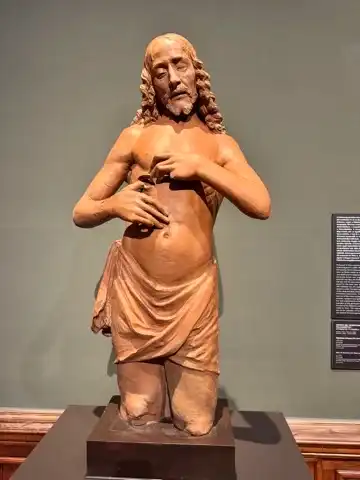
Other photos from inside the Budapest Museum of Fine Arts:


Műcsarnok

Műcsarnok is a modern art gallery. By that, I mean the art is modern. The building looked old, but I don’t know if it’s real old or faux old.
You may be wondering why, after approaching my normal eyes-glazed-over museum state in the Budapest Museum of Fine Arts, I would go to another gallery after it, close though that other gallery may be. You might particularly wonder about that if you knew that I usually, but not always, enjoy modern art less than I enjoy classical art.
Here’s the thing. Recently, I’ve increasingly been thinking about technology’s impact on the human experience. We have, for some time, allowed technology to govern, or if not govern, mediate our human interactions to some extent. More and more, AI is capturing one side of our connections with enterprises and pretending to be human.
And now AI is muscling into the creative realm, taking over writing assignments, including, in some cases, creative writing, and generating “artistic” images that used to be the exclusive domain of human creators.

As AI moves into the creative realm, even if its output is indistinguishable from human art (including writing), it strips the art of its humanity. And on a more practical level, as AI moves deeper into the arts and letters, it will, to one extent or another, crowd out human creators in the “marketplace” of creative endeavours.
With that in mind, I think it’s important to foster a greater appreciation of air-conditioned human art. Then again, an air-conditioned empty room would be good in this heat, too. I’ll go back to my hotel immediately after visiting Műcsarnok. But first, Műcsarnok.
The facade of Műcsarnok is roughly similar to that of the Budapest Museum of Fine Arts, but the triangle of the roof peak is more acute. I again had a possibly flawed impression of Greek-style architecture.
I went to the ticket desk and asked what was on. They had four exhibits. I think they were all temporary. Three of them displayed photography. The fourth was sculpture.

I asked the ticket seller for a ticket. She asked if I wanted a ticket for each exhibition or a combination ticket for all of them. “Oh,” I said, “they’re individually ticketed.” “Yes, or you can get the combo ticket.”
I asked for the combo ticket because, as I said, it was hot outside and the gallery was air-conditioned. More is more.
She asked me if I qualified for any discounts. I told her that I was a senior, but not from the EU. (The Budapest Museum of Fine Arts had a seniors discount, but only for seniors from the EU.) She told me, “It doesn’t matter where you’re from, it’s free for you.”
She asked to see my passport or another proof of age. Apparently, just looking at my hair and visage wasn’t good enough for her. I suppose I should be pleased about that. When I showed her my passport, she printed off a free ticket for me. Free is good.

The photographs in the three exhibits were evocative, pretty, and/or provocative. Some were photographs from news photographers. Some were prize winners and finalists from a particular award over the years. To be honest, the three exhibits, which were in adjacent spaces, blended in my mind. I somewhat appreciated them, but was not overly excited by them.
The sculpture space was in the basement and was quite small. It contained mostly very abstract pieces. However, there was one sculpture that was a study of a hand that looked like a normal hand. It had four fingers and one thumb that looked like four normal fingers and a normal thumb, and a normal back of the hand. The palm was facing down, so I don’t know if it was normal or even sculpted as a palm at all.
Okay. That’s enough about art for one day. After I left Műcsarnok, I walked back to my hotel and enjoyed the air-conditioning there.
Discover more from Joel's Journeys & Jaunts
Subscribe to get the latest posts sent to your email.


The facades of the museums were based on classical (meaning ancient Greek and by adoption ancient Roman) temple fronts. Not flawed, rather perfectly neoclassical (that is, not ancient). People loved that stuff. Especially for art galleries. And banks. Congratulations for your efforts in supporting human culture. We need to support what is human in humanity under its current threat. Now if we can get you to enjoy the art part of it, that would be cooler than AC.
Thanks for the info.
Cooler than AC is a goal to shoot for, I guess.