Hungarian National Museum, Parliament, and More
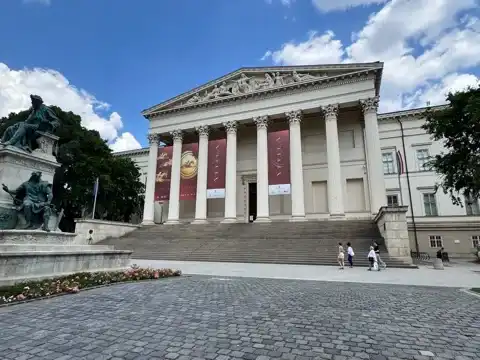
This afternoon in Budapest, I visited the Hungarian National Museum and the Hungarian Parliament building, with a walk through Liberty Square along the route between them.
But first, a weather report.
Before I set off this morning, I checked the forecast. It said there was a chance of thunderstorms later this afternoon. But it was clear in the morning. And, back home in Toronto, it seems meteorologists, as a matter of course, put “a chance of thunderstorms” into the forecast on all hot and humid days, such as it was here today in Budapest. But back home, thunderstorms arrive in only a very small fraction of the times they’re forecast on those sorts of days.
Consequently, I ignored the prediction of possible thunderstorms and intentionally left my umbrella at my hotel.
The morning remained mostly sunny, with only a few clouds. It continued as such through to and after lunch, as well as when I left the Hungarian National Museum later.
As I walked from the museum to Liberty Square, some dark clouds formed, but still, there was more clear sky than cloud.
As I got closer to Liberty Square, I heard a clap of thunder but saw no lightning, and there was no rain. The claps of thunder repeated occasionally, along with a few rolling thunder episodes right up until I arrived and entered the parliament building. But still I saw no lightning and felt no rain.
Close to the parliament, a cooler wind came along, providing some relief from the heat. But still, despite the forecast, it remained dry.
When I left the parliament building, it was partly cloudy, but I heard no more thunder, and there was still no precipitation.
However, when I got to within a few blocks of my hotel, the rain started. The drops were fat. But they were dispersed enough, and I was able to take advantage of enough building overhangs, that I stayed largely dry. So, that was good. The heat, on the other hand, was not so good.
Hungarian National Museum
I don’t have a lot to say about the Hungarian National Museum. It is a decent museum, but there wasn’t a lot to it. And what was there could have been presented better. The exhibits are on two floors. But the layout threw me a bit. In most European buildings, you enter through the ground floor, usually labelled as “zero.”
But to enter the Hungarian National Museum, you have to climb a long set of external stairs. Thus, the entrance and ticket desk are on the first floor, which is the second floor by Canadian and U.S. (and I’m not sure where else) floor-numbering standards. But I kept thinking that the entrance was floor zero. So, when I saw a map showing exhibit space on floors one and two, I thought I had to go up a flight to get to the first exhibits. I went up the stairs, but, of course, the stairs didn’t go higher.
Floor two contained two large galleries displaying the permanent collection, and another that presented a temporary exhibit.
Both of the permanent galleries exclusively presented Hungarian history. One covered the period from 1000 to 1686. The other covered the period between 1700 and 1990. I guess Hungary shut down between 1687 and 1699.
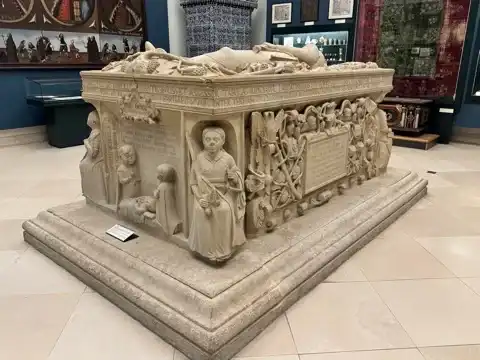
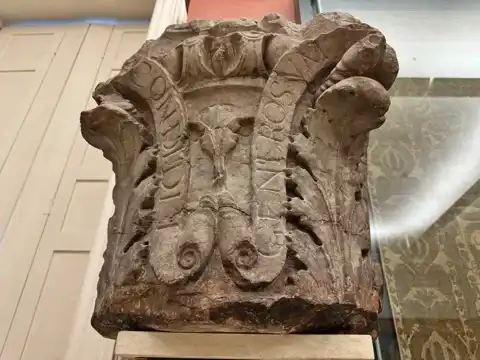
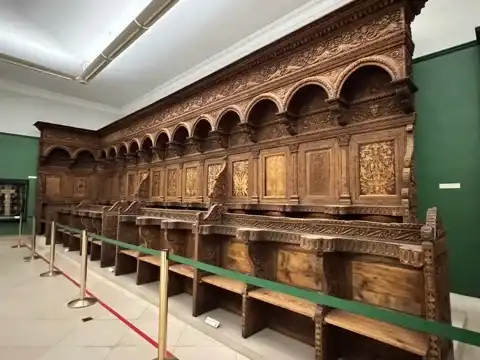
The exhibits were artifact-heavy, but description-light. Artifacts included paintings and sculptures (some of them copies), architectural elements, a sepulchre decorated with relief sculptures, clothing, furniture, swords, pottery, housewares, and a variety of other odds and ends.
What little descriptive text there was in the exhibit space was in both Hungarian and English. Interactive video screens would likely have made the material much more comprehensive and engaging, but, alas, there was nothing like that.
The temporary exhibit, for which I bought a ticket and visited, was on Attila the Hun. Attila the Hun has become a metaphor for brutality in modern times. However, he carries that reputation in our minds only because he was a ruthless, brutal marauder of neighbouring lands.
Nevertheless, according to the exhibit, he treated his subjects well, and they liked and respected him as a father figure. I’m proud to say that my father was not a ruthless, brutal marauder of neighbouring lands. He was a mench. Sorry, but I prefer my father figure to Attila.
The exhibit also said that Attila was considered the forefather of the Austro-Hungarian Empire’s subsequent kings. To be honest, considering Attila’s external reputation, I don’t know that’s something I’d go spreading around.
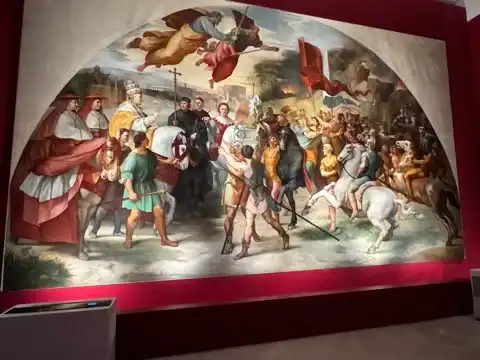
The Attila exhibit had several artifacts from the period. I found it interesting.
When I realized my mistake about the floor numbering, I went back downstairs and looked for the one open gallery there. There are normally other galleries on floor one, but the map handed out at the front desk said they were closed because I was there. That’s not really what it said. It said that they were closed for renovations. But, come on, the renovations excuse is getting old. Be honest and admit you’re closing because I’m in town.
The one gallery that was open when I was there is fairly large and contains the museum’s archaeological collection. It covers the period in the Carpathian basin from 400,000 BCE to 1000 CE. Obviously, there weren’t any artifacts from the earliest part of that history, but there were lots of different pieces from more recent times. (More recent being up to 1000 CE.)
The Hungarian National Museum has a good, and reasonably large, archaeological exhibition, but, to be honest, I didn’t get much out of it. Maybe the heat is frying my brain, as opposed to its normal parbroiled state.
Liberty Square
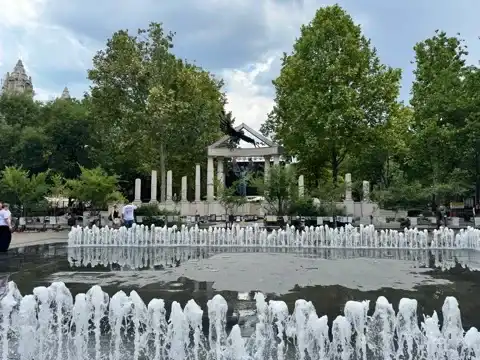
I chose to visit Liberty Square because it’s not all that far off a decent route from the Hungarian National Museum and the Hungarian Parliament. At that point, I was the proud holder of a ticket to tour the parliament, so I was definitely going there.
Where I entered the square, there’s a fountain with two parallel rows of water jets. Behind that, there’s a statue with some columns, a stone triangle resting on some of the columns, a large statue of an angel, and a statue of an exceptionally large bird above her. It’s a monument to the Hungarian victims of the Nazis.
Liberty Square is not huge, but it has trees and open spaces. When I was there, the square also had a giant video screen showing matches from the World Cup. I’m not a sports fan, so I wasn’t interested. The only thing I wanted to learn about this World Cup, or any World Cup for that matter, is whether the matches held in Toronto go off without a hitch and reflect well on my hometown.
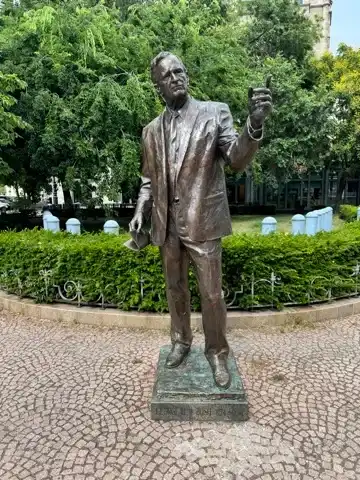
The square also has statues of humans. I saw three. All of them were of American figures. One was a statue of Harry Hill Bandholtz, whom I’d never heard of before. According to Wikipedia, he was a United States Army officer and a major figure in World War I. I don’t know why he’s honoured in the square.
The other two statues I saw were of George H.W. Bush and Ronald Reagan.
Bush is there because he was the first sitting U.S. president to visit Hungary. Ronald Reagan is in Liberty Square because of his famous call for Gorbachev to tear down the Berlin Wall.
Hungarian Parliament Building
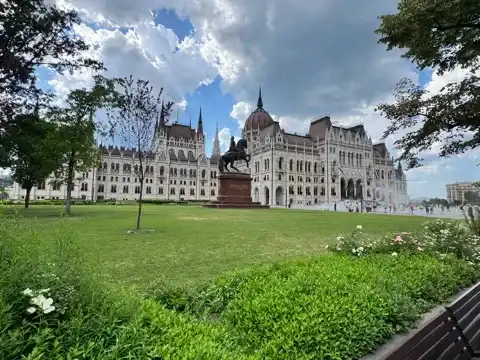
And with that, it was on to the Hungarian Parliament Building. If you read yesterday afternoon’s post, you’ll know I tried to visit it then, but I was thwarted. The ticket seller told me that all of the tickets were sold out for that day and they only sell same-day tickets. I went online right then and there to see if I could buy advance tickets that way. The site showed time slots for future days, but every slot for every day during my time in Budapest said that it was sold out.
This morning at breakfast, I tried again. The website showed that there were tickets available for one, and only one, timeslot today: 4:45. I snapped up a ticket, and there I was.
The exterior of the building is beautiful. I posted a picture of it from on a Danube River cruise yesterday. You can visit that post by clicking here. It’s also attractive from the other side. I posted a picture of that here.
As attractive as the building is from the outside, it’s stunning inside.
The tour was a directed one, not free-flowing, but it used an audioguide, not a live speaker. I think there might be some live guides for some of the time slots because the one I was on said specifically that it was an audioguide tour, as if that’s not standard.
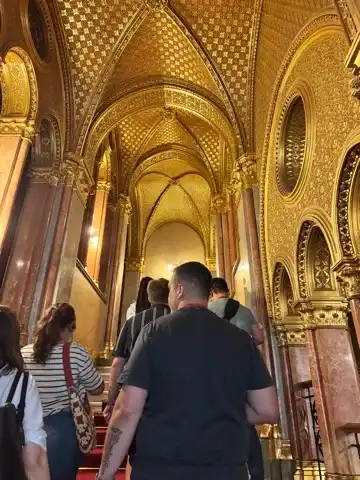
At the start of the tour, everyone tells a staff member what language they speak. The staff member then hands each visitor an audioguide thingamabob preset to that language. There are no buttons to press on the thingamabob. Everyone gets herded around together. When the group enters a room, someone starts up the recorded narrative that plays in everyone’s earpieces simultaneously. I know that it’s simultaneous because at a couple of points, the recording told us to look at such and such, and everyone’s heads swivelled in synch.
The tour starts by going up an ornate staircase with a ceiling richly decorated with gold. Not gold colouring. Gold. The audioguide said how many kilograms of gold there are, but I forgot. The walls up the staircase are made of fake marble, but the columns are real marble.
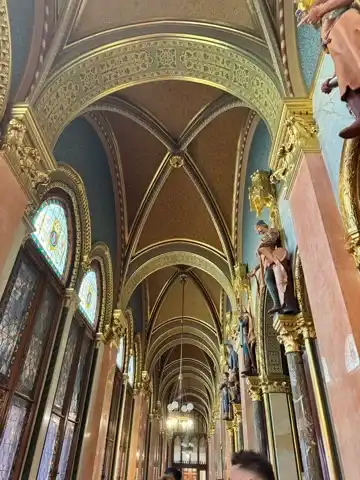
We then walked along some stunningly decorated corridors. They have arched ceilings with gold-coloured (I don’t know if they are real gold) intersecting diagonal ribbing.
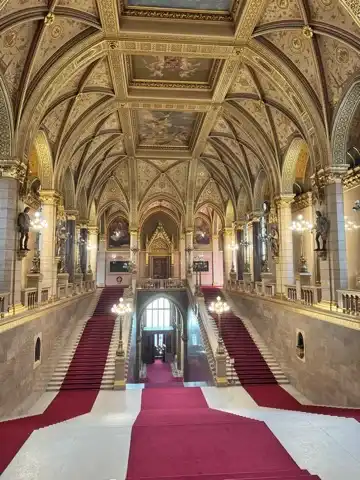
We then reached the top of the grand staircase. Not the beautiful staircase we came up. The grand staircase. It’s an exquisite, red-carpeted, wide staircase. Murals are painted on the ceiling above it, and lots of stunning decorations and chandeliers are around it.
Only the highest levels of officials are allowed to use the grand staircase. Even members of parliament are allowed to use it only at the opening of a new parliament.
I might be getting the order wrong, but I think we next went to the Dome Hall. The reason I might be getting the order wrong is that photography and videos are forbidden in the Dome Hall, so I can’t refer to my photos to check. We had to wait outside the Dome Hall for a bit because we arrived when there was a changing of the guard. Two uniformed, sword-carrying guards are stationed in the hall. They’re replaced with two guards rotated in every hour.
(I think where we waited was in the hall at the top of the grand staircase. If so, I got the order right. But I might be misremembering.)
Then we went inside. The ceiling of the dome hall and the hall itself are also gorgeous. I’d describe them, but because I don’t have any pictures, my memory would probably totally screw up the description. One thing I remember from the audioguide is that the ceiling is a second dome beneath the exterior dome of the parliament building. But it’s not just a little below. There’s a gap of about 30 metres between the two. That’s the equivalent of about a ten-storey building.
In the centre of the Dome Hall sits a heavy glass case on a pedestal. Resting on a grand red pillow, which itself rests atop a sword, sits the Holy Crown. We were told the reason photos and videos aren’t allowed in the Dome Hall is to protect the crown. I understand why they might not want flash photography for that reason, but how much damage can a non-flash photo do to a crown that sits behind what’s likely bulletproof glass?
Also in the case are an orb and a sceptre.
According to the audioguide, no one is sure exactly when the crown was made, but it’s believed to be from the 11th or 12th century.
The crown is made of gold and jewels. There’s a cross at its top, but it doesn’t stand erect. Instead, it’s very noticeably slanted. The audioguide said no one is sure why. It gave a couple of theories about the slant of the cross. Both of them involved damage, not design.
After the Second World War, some Hungarian generals took the crown and shipped it to the United States for storage in Fort Knox. They didn’t want it falling into the hands of the Soviet Union. It stayed there throughout most of the Cold War. I forget when it was returned to Hungary, first to a museum and then, after a formal transfer ceremony, to the parliament building.
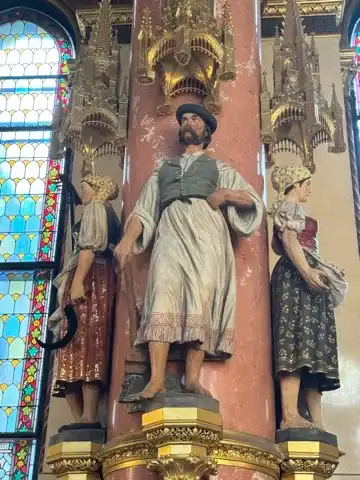
We then (if I have the order right) went on to the lobby outside the upper chamber of the parliament. The lobby is also stunning. Sculptures on its columns represent the various traditional trades, arts, and sciences of Hungary.
It’s called the upper chamber, not because of its elevation relative to the lower chamber. The lower chamber is off in another wing. It’s called the upper chamber because it was the chamber used by the Upper House of Parliament.
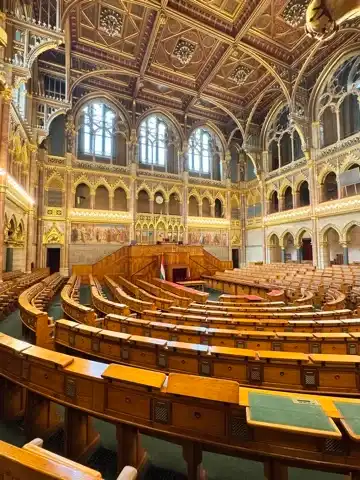
My use of the past tense, “was,” is not a typo. Hungary used to have a bicameral parliament, but it’s now unicameral. The chambers for the former two Houses of Parliament are, according to the audioguide, almost identical in design. They now use the chamber that was for the Lower House as the chamber for the single House of Parliament.
They kept the upper chamber as it was. They use it for special occasions or when the other chamber is undergoing renovations. It’s just as beautiful as the rest of the building. I’d attempt to describe it, but it’s getting really late, and I’m getting really tired. So I’ll leave it at the pictures I’ve posted here.
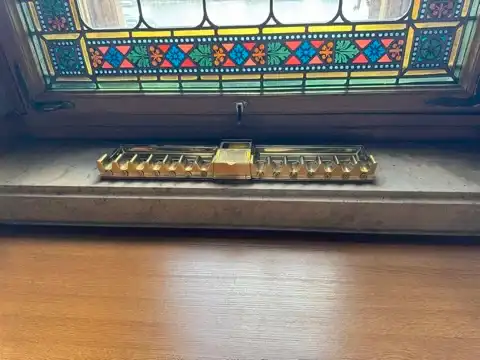
That was almost the end of the tour, but there is one more item worth mentioning. Smoking is not allowed anywhere in the building now, but parliamentarians used to enjoy a good cigar. Cigars burn for a long time, but the members of parliament were not allowed to bring lit cigars into the chamber. On the window sills in the halls just outside the chamber, there are a series of trays with a row of semicylinder slots in them. Below each slot, there’s a number. MPs would leave their cigar in a numbered slot when they went into the chamber. They retrieved it when they came out.
The tour emptied into a room that had displays on the history of parliament in Hungary and the current parliament building. From there, before reaching the exit, visitors had to pass through, you guessed it, the gift shop.
Discover more from Joel's Journeys & Jaunts
Subscribe to get the latest posts sent to your email.


Now that parliament building was nothing short of splendiferous! Hardly seems the kind of thing that usually gets built in a democracy. It may be a parliament house, but it is fit for a king, queen, or emperor for that matter. Certainly a fitting receptacle for the crown, sceptre and orb. Further, an attractive square, and – from what I could see – a very fetching sepulchre in that museum. Good work on the afternoon, Mr. Klebanoff.
Yes, I was pleasantly stunned, in a good way, by the parliament building. Based on the outside, I expected it to be beautiful inside, but not quite that spectacular.