Holocaust Memorial Centre and More
This morning in Budapest, I explored the Holocaust Memorial Centre after taking in Budapest’s central market.
The market was about a half-hour walk from my hotel. The Holocaust Memorial Centre was about a 20-minute walk farther. Today was another scorcher, with the heat already bearing down in the morning. As a result, I neither jogged nor walked briskly between destinations. I very rarely do, particularly in my advancing/advanced age. But at least today I had the heat as an excuse.
Slow mornings seem to be turning into a pattern on this trip. I didn’t wake up as late this morning as I did yesterday, but it was still later than I usually get up. That, combined with my heat- and age-related lethargy, contributed to the reduction in my activities this morning.
When I have a languid morning, I usually take that into account and attempt to make my afternoon equally tranquil. Switching gears too quickly can cause injury. We wouldn’t want that, now would we?
I’m writing these introductory paragraphs over lunch. Thus, I don’t yet know what my pace will be this afternoon. We’ll see, dear.
I probably won’t finish this post until the evening, but I’m much too lazy to come back and update these paragraphs then. So, repeating myself, we’ll see, dear.
Central Market Hall
I enjoy the character and flavour of old markets. So, if a city on my travels has one, I typically visit it. In Budapest, that’s the Central Market Hall, where I started the morning.
Today is Sunday. That’s likely not the best day to visit the market. One of my guidebooks told me it’s open from 10:00 to 4:00 on Sundays. It was, indeed, open when I arrived well past 10:00, but probably more than half the stalls were closed today.
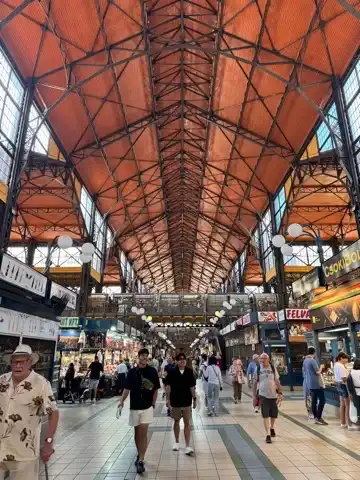
The market is in a building with a soaring, vaulted, light reddish-brown ceiling, with expansive glass on the sides. Sellers are on three floors.
On the ground floor, most of the vendors open today sold foodstuffs. But most vendors of highly perishable goods, such as fresh meat and fish, were shuttered.
Some signage I saw pointed to Hungary-specific goods in the basement. I went down there. It had a lot of small shops. Almost all of them were closed. A couple of small souvenir stalls were open. Plus, there was an open, modern Aldi supermarket.
The third level has a fraction of the floor space of the ground floor and basement. Balconies run along the two long sides of the market. They’re not wide. I’d say they’re about the width of a standard one-lane road. But I’m not a very good judge of such things.
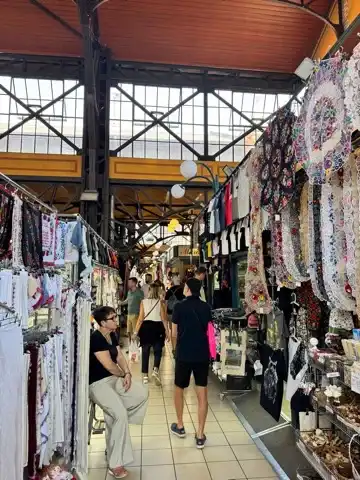
There are also a couple of cross-balconies of roughly equal width that connect the two sides. On one of the side balconies and on the cross balconies, narrow stalls sold mostly clothing and bags.
For about half the length of the other side-balcony, vendors of the characterful, independent food court sort occupy just one side of the balcony. The other half of the length of that side balcony switched to mostly vendors of fabrics and knick-knacks on both edges of the balcony.
On the balcony level at one end of the market, there is a small restaurant that was closed when I was there.
I imagine that Central Market Hall is much more lively and vibrant when all of the stalls are open, but it is an attractive space nonetheless. It’s worth a visit simply for that. And for someone such as me, who hates both crowds and shopping, Sunday might be the better day to visit.
Holocaust Memorial Centre
I have now been to three sites in Budapest that memorialize the Holocaust. First, there were the Holocaust memorials in the Great Synagogue in Budapest’s Jewish District, which I visited the other day. Yesterday, I visited the mournfully moving Shoes on the Danube Bank memorial. Today, it was the Holocaust Memorial Centre.
The Holocaust Memorial Centre is a museum with a permanent exhibition. It also mounts temporary exhibitions.
The permanent exhibition contains some artifacts, but not a lot. Instead, it provides considerable text in Hungarian and English, along with videos. Some of the videos provided only images. The ones with audio had Hungarian narrators with English subtitles. The display space is, appropriately, dark and sombre. As a result of those factors, I didn’t take many pictures in the exhibit space.
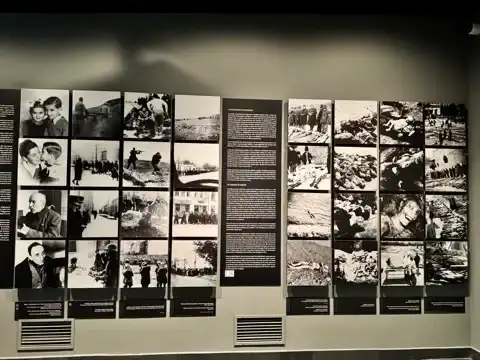
However, the museum includes several photographs, including a couple of large photo montages. I took pictures of them and posted one here. When I upload images to this journal, I first reduce both the size and resolution to save space and speed up page loading. Consequently, I don’t know if the image I posted here retains the detail in the original photo montage. My advice to you is not to try to find out by expanding the image. It’s the Holocaust. There are some gruesome images. How could there not be and still honestly portray the Holocaust?
The primary focus of the Holocaust Memorial Centre is the treatment of the Jews in Hungary before and during the years when the Nazis were in power. But it also puts that into the context of the broader Holocaust. Plus, it’s not solely about the persecution and eventual deportations and executions of Jews in Hungary. It also offers considerable discussion of the Romas, who sometimes suffered roughly parallel fates.
A fifteen-minute video in Hungarian with English subtitles expands that context even further. It presents an obviously very abbreviated history of the rise of antisemitism and its practice in general, not just in Hungary (but with a focus on Hungary).
At the Holocaust Memorial Centre, I learned a lot of specifics that I didn’t know about the treatment of the Jews in Hungary during the Holocaust. But I also learned one fact that is totally inconsequential in the context of the Holocaust, that I probably should have known, nevertheless.
I’d never given much thought to the word “holocaust.” To me, it always almost exclusively referred to the horrific Nazi-perpetrated Holocaust. In fact, I tend to get angry with people who use it as a metaphor for something else. My thinking was, the Holocaust is the Holocaust. Don’t dilute the word.
However, one of the panels near the beginning of the displays said that, “The word ‘holocaust’ originally meant a sacrificial offering to god that is entirely consumed by fire. Since the 1960s, the word has come to mean the extermination of two-thirds of the Jewish population of Europe between 1939 and 1945.”
I’m probably admitting my extraordinary ignorance here, but, for one, I didn’t know the original sacrificial offering definition. But also, I didn’t know that it didn’t start to be used as a label for the massacre of Jews by the Nazis until the 1960s. I’d always assumed that the name had been applied once the outside world learned of the massacre and had been applied since. My ignorance is embarrassing. But I’m learning. Hopefully, I’ll remember, too.
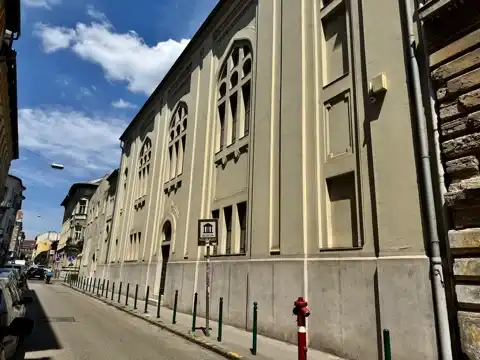
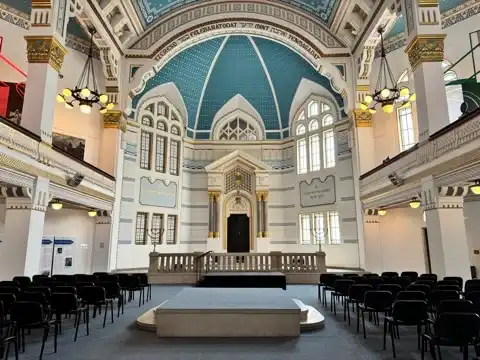
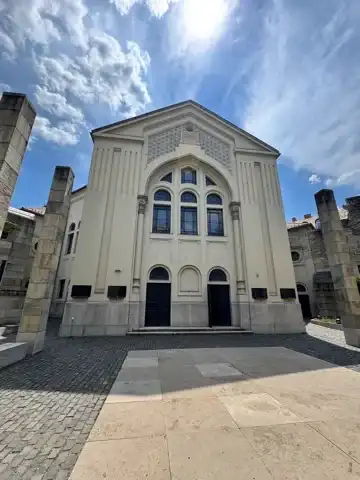
The exit from the main building of the Holocaust Memorial Centre is through a very clean-looking, bright, handsome old synagogue, one of many synagogues in Budapest. I don’t think it’s still active as a synagogue, but I’m not entirely certain.
I’d read that most of the area where the pews would be in the synagogue is normally filled with clear plexiglass chairs to represent the missing victims. I’ve also seen a picture confirming that.
When I was at the Holocaust Memorial Centre today, those plexiglass chairs were pushed off to the side, packed tightly together, and roped off. Temporary padded chairs replaced them. I imagine the space is being or will be used for a program of some sort, and the clear chairs will return to their memorial places when it’s done.
Behind the area where the plexiglass chairs normally are, there are a few rows of permanent dark wood pews.
There is a loft area in the synagogue. That might have been the women’s gallery when it was in use as a synagogue, but I don’t know whether the denomination of Judaism that used the synagogue segregated men and women.
When I was there, the Holocaust Memorial Centre staged one of its temporary exhibits in that loft. This one was specific to the Roma Holocaust.
I’m not going to attach any positive superlatives to the Holocaust Memorial Centre, because no matter how well they present the material, positive superlatives feel too out of place for something that presents information about the horrific Holocaust and memorializes its victims. But if you’re in Budapest, definitely visit it and the Holocaust memorials here. To slip into a cliché, the world must never forget, because if it does, it will inevitably happen again.
Discover more from Joel's Journeys & Jaunts
Subscribe to get the latest posts sent to your email.


Well, not much more to be said. A moment of silence.
As to the market: hard to be lively without crowds. Seems to me that lively usually means lively with people. Sometimes it’s not easy being you. Hope you find the perfect balance this afternoon.
And why can’t it be lively without lively people? I ask you that. It’s never easy being me. Sigh.