Budapest Jewish District
When I left Buda Castle Hill this morning, I crossed back over the Danube to the Pest side of Budapest and visited the Jewish district. Because the primary Jewish district is in the Pest portion of Budapest, I suppose I could have called it the Pest Jewish District in the title above. But that might have been misread, sending a message opposite to what I want to send, thereby insulting my cultural heritage, which I’m very comfortable with. What’s more, it might have attracted, via search engines, a segment of the general population that I’d just as soon not attract to this journal. So, the Budapest Jewish district it is.
Before going there, I stopped at my hotel to “freshen up.” So I didn’t have as much time this afternoon as I otherwise would have. So, this will likely be another shortish post. What’s more, it’s getting late, and I’m going to publish a third post before I go to sleep today, so I need to hustle through this one if I’m going to get any shut-eye at all. Sorry. This deserves much more attention than I’ll probably give it.
I chose the Jewish district for this afternoon for a reason. The activity that will comprise that third post started in the Jewish District. That’s probably more information, particularly the fact that there was another activity today, than regular readers need to guess the nature of that activity accurately. But, never mind that.
The Great Synagogue
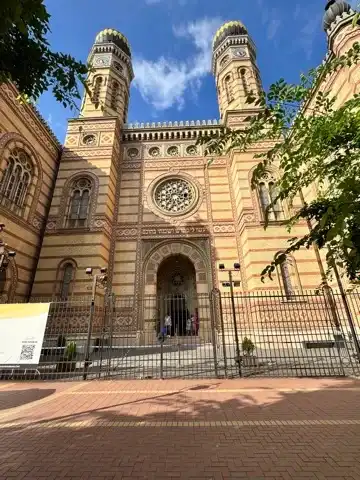
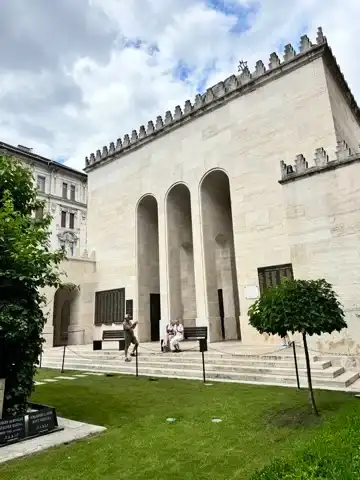
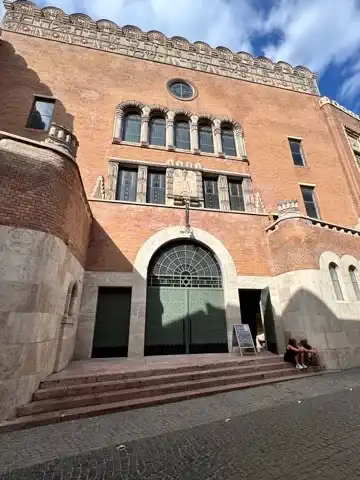
“The Great Synagogue” is what it’s usually called in tourist material, but it’s also known as Dohány Street Synagogue. I’ll leave it up to you to guess what street it’s on. The synagogue is in the heart of what was once Budapest’s large Jewish district. And it is still an active Jewish area, but now it has a much more mixed population, and, although I’m not sure, I think the Jewish community now is a very small minority in the neighbourhood.
There is a fee to enter the synagogue, but it includes more than just the sanctuary.
The fee also covers a free tour, in any of several languages. Most of the language tours run at the same time. When I bought my ticket, the ticket seller told me there was a tour starting then. She said that, for the English tour, go into the synagogue and look for the American flag. I asked her if they had a Canadian flag. She apparently thought I was joking because she laughed when she said, “Sorry. No.”
I found the American flag. The tour guide was already speaking. He gave a brief history of 200 years’ worth of the Jewish community’s time in Budapest. I’m writing most of this from memory, so it’s excessively filtered and possibly unintentionally altered from reality by that horribly faulty faculty. I apologize. I’ll do my best.
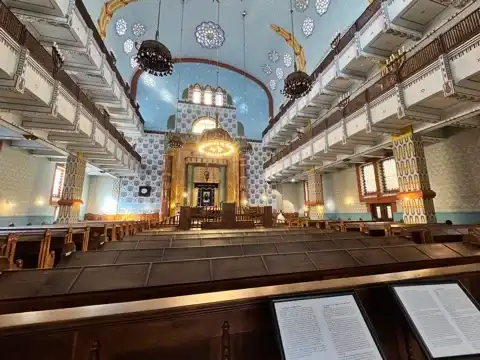
When the Great Synagogue was built in Budapest’s Jewish district in the 1850s, the Jewish community numbered about 3,000 people. The synagogue has seating for 3,000 people. According to the guide, Shabbat services today rarely get a turnout of more than 80 people, but more come for the High Holidays. The Holocaust significantly reduced the Jewish population in Budapest, and more recently, young people have gravitated away from service-going.
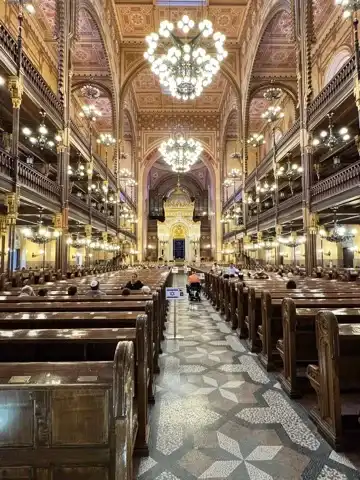
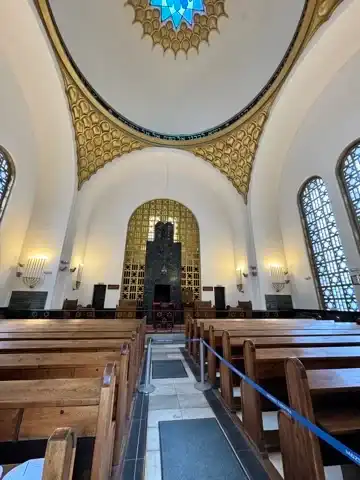
The synagogue’s design looks more like a church than a traditional, almost-orthodox (more on that shortly) synagogue. It’s high-ceilinged and richly decorated. There are several six-sided stars (Mogen Davids) and other Jewish iconography, but there are also a lot of eight-sided stars.
The guide explained that when it was built, the rest of Budapest, beyond the Jewish district, was primarily Catholic. As has been the case throughout history, Jews were discriminated against to one degree or another. The Jewish community wanted to build a synagogue that would impress any Catholics who attended, but also would show them that Jewish people didn’t worship all that much differently than they did. They invited Catholics to visit and observe the services as a means to try to dispel the blood libel myths that existed in the Christian Community.
The synagogue’s architect was not Jewish. He was a Catholic who had designed other synagogues.
With the aim of impressing people, they made it big. The guide said that it’s the largest synagogue in Europe, and the second-largest in the world. However, there’s some dispute about its position in the world rankings.
The guide said that the largest in the world is Temple Emanu-El in New York.
Skipping ahead on the day a bit. The guide for my evening activity mentioned the Great Synagogue and also said it’s the largest in Europe, and the second-largest in the world. She then asked her customers if they knew where the largest was. Having heard the guide in the synagogue, I piped up with “New York.” She replied that’s what she used to think too, but no, she was told that it’s a synagogue in Israel.
When I got back to the hotel, in an attempt to resolve the question, I asked DuckDuckGo what the largest synagogue in the world was. Its AI engine, for what that’s worth, told me that the largest by square footage is Temple Emanu-El in New York. But the largest by capacity is the Great Beth Midrash Gur in Jerusalem. Without being asked, the AI engine also volunteered that the Dohány Street Synagogue in Budapest is the second or third largest synagogue in the world, depending on which measure you use. So, there you have it.
The Great Synagogue practices Neolog Judaism. The guide said it is unique to Hungary and is now mostly restricted to Budapest’s Jewish District. He said it’s close to, but not quite, Orthodox Judaism, and it includes an element of nationalism.
One thing the guide didn’t mention, and I forgot to ask, is whether “close to orthodox” included the separation of men and women. There are balconies on either side of the sanctuary, and I wondered if those were the women’s galleries.
Some time after the tour, I asked that question of another, older man (I don’t think older than I am, but older than the guide) who was manning a position near the entrance of the synagogue and looked very much part of the shul. He said that, yes, men and women are segregated. However, for Shabbat services, when there generally aren’t many attendees, men and women both sit in the pews on the ground level, but on different sides of the aisle. During the High Holidays, when more people attend, the women are relegated to the balconies.
He also said that, in the Great Synagogue, women are not allowed to be rabbis, read Torah portions in services, say Kaddish, or count for a minion.
But, enough of that digression. Back to the tour.
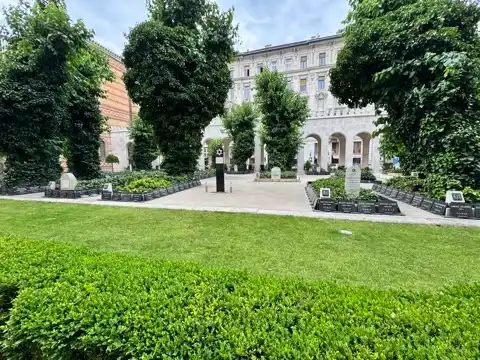
After finishing his spiel in the sanctuary, the guide led us outside to the memorial garden next to it. It consists of a large, rectangular concrete slab with a narrow strip of grass on two sides. On top of the slab, there are several smaller rectangles with open-top boxes containing soil in which large trees and other greenery grow.
Around the edges of each of those boxes are flat, black, rectangular memorial stones with names and, where available, years of birth and death. (The year of death, which sometimes narrowed it down only to a range of two possible years, rather than a specific year, is always there. But the year of birth is not always available.)
Every single one of the years of death is either 1944, 1945, or 1944/1945.
The guide explained that during World War II, Hungary was allied with Germany. However, there were very few deportations or executions of Hungarian Jews in the early part of the Holocaust. Instead, Jews were sent to forced labour and, eventually, walled up in a ghetto.
Again, according to the guide, in 1944, when it became clear that the Axis was losing, Hungary appealed to the West for a peace treaty. The West refused. When the Nazis in Germany heard of this, and when they, too, realized they were losing, they decided it was time to vigorously apply their “Final Solution” in the ghetto in Budapest’s Jewish District.
When the Russian Red Army liberated Budapest and tore down the ghetto walls, they found more than 2,000 bodies there, some of which had been there for a considerable time. The Russians buried many of them in mass graves in a garden immediately beside the Great Synagogue. Many of the bodies in the graves were never identified. The guide explained that in Judaism (I shamefully didn’t know this or forgot it), bodies are considered to be impure and are not supposed to be buried in or immediately beside synagogues.
In other places where this happened, some of the rabbis arranged to have the bodies exhumed and moved elsewhere. But the guide explained that it’s also considered to be a sin in Judaism to exhume a body that’s been buried for more than a day. The rabbi of the Great Synagogue reasoned that, because the first sin had already been committed, it was better not to commit a second sin by exhuming the bodies. So they remain in the memorial garden.
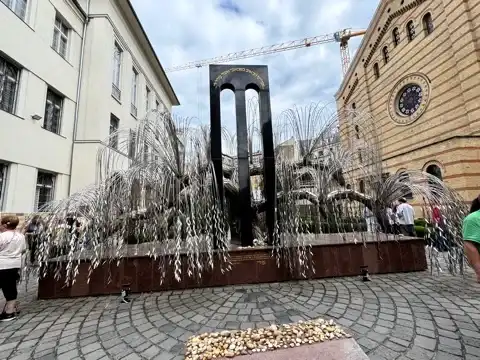
Behind the synagogue is the Raoul Wallenberg Memorial Garden. It has a large sculpture named The Tree of Life. It is a metallic representation of a tree. The branches droop down, making it appear as an upside-down menorah. In front of the tree, two tall polished stone arches represent the tablets of the Ten Commandments, but, because they are arches, the tablets have large holes in the centre. The meaning that is intended to be conveyed is that the Holocaust was the absence of laws.
There is a smaller synagogue, named the Heroes Synagogue, in the complex. It was built after the First World War to commemorate the Jewish Soldiers who fought with the Hungarian Army. It’s a simple but very attractive synagogue. The guide said that, during the winter months, they use it for services rather than the Great Synagogue because it’s easier to heat.
The complex also has a picture gallery of old photographs from the Jewish district, arranged by themes, on panels. There is also a small, separate Hungarian Jewish Museum. I visited both, but I’m way too tired to describe them here, and I still have a lot left to write tonight. Sorry about that.
Other Sights in the Jewish District

Carl Lutz Memorial
The Carl Lutz Memorial in the Jewish District is dedicated to the Swiss Vice-Consul in Budapest from 1942 to the end of World War II. He saved thousands of Jews. He negotiated passes for many Jews to leave and go to Switzerland, where they’d be safe. The passes were each supposed to be for only one person. But he successfully treated them as if they were good for entire families and was able to get out a lot more Jews than he had been permitted to.
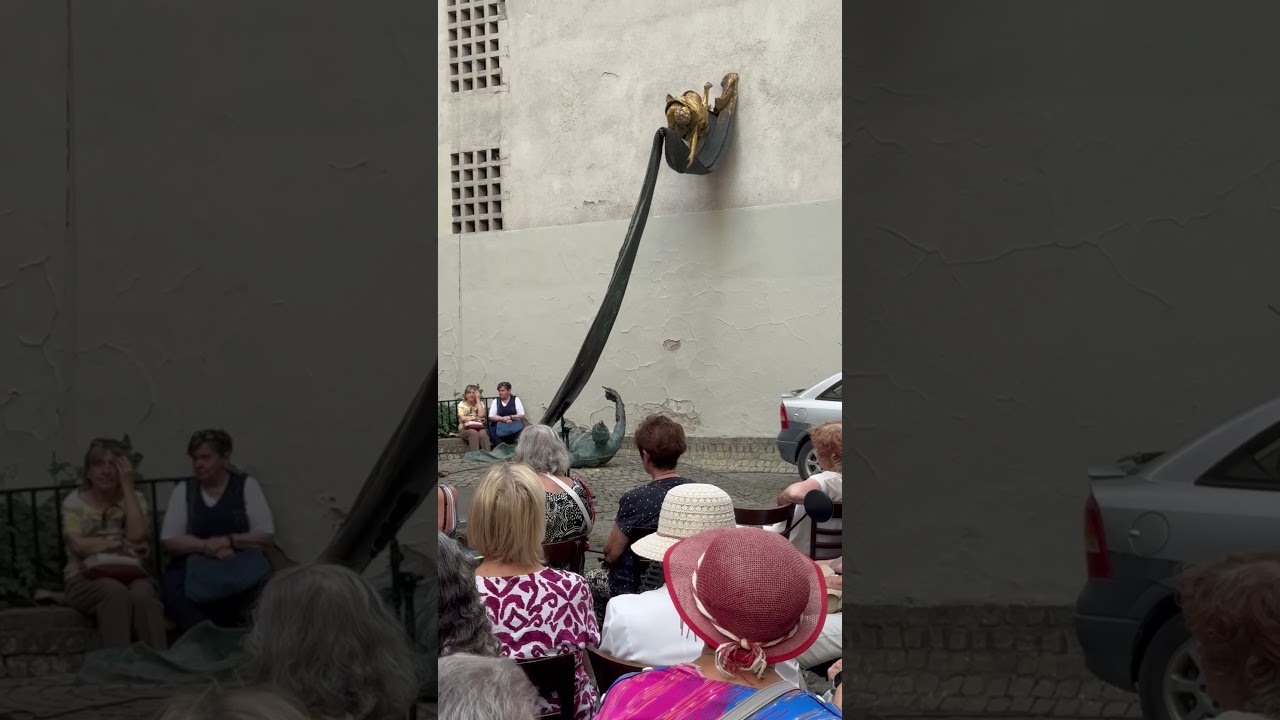
At first, I couldn’t find the monument. It’s at the back of a rectangular public space. When I walked by, they were getting ready for a concert there. The chairs that filled the space behind the small stage were filled with people waiting for the concert. Nevertheless, I should have been able to see at least one component of the monument right away. It’s an angel mounted high up on a wall behind the public square. She is lowering a wide metal ribbon down to a figure sprawled on the ground. Once I spotted the angel, I was able to walk behind the small, low riser of the stage that was, at that point, still unoccupied, and see the whole sculpture.
I later walked back by the square, and the concert was already in progress. I recorded some of it in the video below.
Kazinczy Street
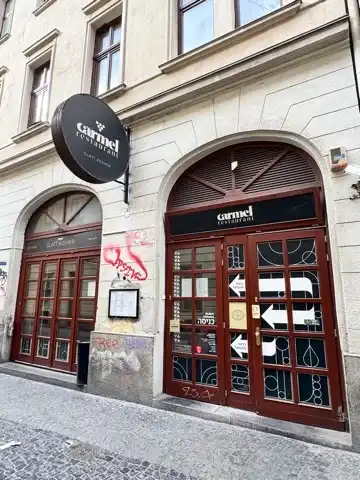
Kazinczy Street is a colourful road in the Jewish district. It contains a few glatt kosher restaurants, along with several non-Jewish restaurants and bars.
The Orthodox Synagogue of Budapest is on Kazinczy Street. It’s much smaller, far less decorated, and much more contemporary-looking than the Great Synagogue. But it’s quite attractive.
There is much more I could say about my afternoon in Budapest’s Jewish District, including more stories about the Great Synagogue, but this is already much longer than I thought it would be, and it’s now far, far later than I thought it would be when I finished this. I have to end it here so I can get on to my final post of the day before I pass out from exhaustion.
Discover more from Joel's Journeys & Jaunts
Subscribe to get the latest posts sent to your email.


I am glad you clarified the terms of the argument about the largest synagogue. The Great Synagogue of Budapest may not be the largest in the world but it is the fancy-shmantziest one I have ever seen. I bet it ranks pretty high on the fancy-shmantzy scale. What an interesting Jewish District, admirably committed to remembering its history. I liked the Carl Lutz Memorial very much. It was a little hard to make out the angel in the photograph, so I am glad you included the video. That way I also got to hear part of a song. I am glad you had such a full day and sorry you had such a full day. I liked hearing and seeing what you had to report about the Jewish District, and would have happily read on. But that is Joel for you – onward, ever onward.
Huh. I didn’t see where the Great Synagogue ranks on the worldwide fancy-shmantzy scale. Then again, I didn’t look. I guess I’ll have to do some more research.
I agree with your comment commending the honouring of history in the Jewish District. Although, in the case of the synagogues (there are more in Budapest), it’s more than just honouring history. They are operating shuls.
One thing I forgot to mention in my narrative is that someone asked the guide in the Great Synagogue how, with diminished membership, they are able to afford to maintain the synagogue. His response was tourism. There are entry fees. Plus, I saw a couple of plexiglass donation boxes. They both had bills from various countries. I didn’t see if there was any Canadian currency in them before, but after I left there was a Canadian $20 in one of the boxes.
Interesting post — well done! Who says your brain punches out at midnight?!
Thanks so much. My brain never punches out it’s totally nonviolent.