Esztergom and the Danube Bend

For today, my last full day in Budapest, I booked a full-day tour to three towns on what’s known as the Danube Bend. In the morning, the tour visited Esztergom and Visegrád. At the Danube Bend, and why it’s called that, the Danube first makes a U-turn and then a 90° turn.
Lunch was included and provided at a restaurant in Visegrád. So this post will end in Visegrád. I’ll post another entry to pick up the action in the afternoon.
To start the tour, I boarded a large bus that was almost full by the time we left.
The guide introduced himself over the bus’s speaker system. I’m going to refer to him as “the guide” in this and the next post. Surprisingly, I remember his name. But he said it, not spelled it. And he didn’t wear a name tag.
I won’t try writing it, other than in this paragraph and the two paragraphs that follow, because I’m sure I’d spell it wrong. It’s not that it was long or difficult for an anglophone to pronounce, but it has an “sh” sound. It sounded like “Borash.”
However, I’ve noted that in Hungarian, “s” is pronounced like “sh.” I don’t know if that’s true in all contexts, but “Budapest” is pronounced as “Budapesht.” And a traditional dish, langos, is pronounced “langosh,” with the “gosh” part pronounced as in, “Gee golly gosh, Daisy May, I sure do think you’re a swell gal.”
Despite knowing this, I still pronounce Budapest as most Anglophones do, namely with an ess-sounding s. However, because I’d never heard of langos before, but I had it on the Budapest Food Tour, where the guide for that tour said it a few times, I now pronounce langos like “langosh.” The point is that what I heard as Borash might be Boras, or possibly something completely different.
Back to today’s tour. The first stop was slightly more than an hour away by bus.
The guide spoke almost nonstop on the way, alternating between two languages, English and Spanish. He provided a wealth of information about the sights we passed in Budapest and beyond.
I, of course, don’t remember much of it, but one thing I do recall is that the three Danube Bend towns we were visiting on the tour had originally been established by the Romans. So, kind of old.
The guide also said that the Romans established fortresses, which spawned towns, every 20 kilometres on their side of the river. (The other side wasn’t part of the Holy Roman Empire, or the unholy Roman Empire either, for that matter.) He said that the frequency was because 20 kilometres was the distance troops could march in a day.
Another thing I remember is that Esztergom was made the first capital of the country when Hungary settled the area. I forgot the dates, but the capital was then moved to Buda. Later, it was moved to different places as a series of empires invaded and took over.
Esztergom, the first town on the tour, is the farthest along the Danube from Budapest of the three we visited on the bend. But the bus did not follow the river to it. Instead, it took a more direct route to Esztergom, so it probably isn’t that much farther than the crow, or other bird or flying machine, flies than the other towns.
View of the Basilica of Esztergom

I know I said that the first town the tour visited was Esztergom. That was not entirely true. At Esztergom, the bus crossed a bridge over the Danube to a town in Slovakia, Štúrovo. We stopped there for about half an hour.
We didn’t stop to see the town of Štúrovo. We stopped close to the river. There is a promenade beside the Danube with an exceptionally picturesque view of the Basilica of Esztergom, across the river and atop a hill.
According to the guide, the Basilica of Esztergom is the largest church in Hungary. It’s gorgeous, especially from that vantage point, but not only from that vantage point.
The peaceful river makes for a glorious foreground, and, at least today, the blue sky provided a heavenly backdrop for the magnificent, large church.
After half an hour of gawking, I got back on the bus, which drove back to the Esztergom side, leaving Štúrovo and Slovakia behind.
(By the way, that was my first time in Slovakia. The closest I’d been before was a few days in next-door Slovenia as an add-on to a trip I took to Croatia. I’m not going to count the 30 minutes I spent in Slovakia as having been in that country. Unless I visit it in the future, because it’s so difficult to visit somewhere in the past; if you ask me if I’ve ever been to Slovakia, I’m going to answer, “No.”)
Basilica of Esztergom
Note: I’ve seen this named as both Esztergom Cathedral and Basilica of Esztergom. If you visit the English language pages of the basilica’s website, the title that the basilica places as the title in your browser tab is “Basilica of Esztergom,” so that’s what I’m going to use. At least, that was the case when I visited. Of course, they can change that at any time on a whim if they like. To confuse things, when I visited the webpage, there was a subtitle in the body of it that said, “Today in the Cathedral,” and another that said, “Visit the Basilica.” So, whatever.

In Esztergom, the bus drove up the hill to the basilica. There were a few more steps (or a small elevator) to get up to the level of the basilica.
Up there, the guide took us not to the entrance of the basilica, but to a spot off to the side and behind the edifice. The reasons for this location were threefold. First, there is a giant, imposing monument there. Second, beyond the monument, there’s a glorious vista. And, third, and possibly the most important on this hot, sunny day, the spot he chose to stop and give his spiel was shaded.
The monument is not old. It was erected in 2000 on the 1,000th anniversary of the coronation of St. Stephen. The statue depicting the coronation is huge and constructed of white stone.
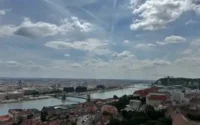
The vista is from a cobblestone platform on the other side of the monument. It takes in the whole panorama of the Danube Bend, including both the U and L shapes that comprise it. It’s breathtaking.
After giving us time to take in the view, the guide took us to another shady spot where he told us about the church, its construction, and the materials used. (He didn’t come into the basilica with us.)

It was consecrated in 1856. Materials inside include both marble and fabricated faux marble. Surprisingly, to me anyway, the faux marble was more expensive than the real stuff because it was a fairly new invention at the time.
The guide also told us about the huge altarpiece in the basilica. This is where things get very dicey.
The guide said that the altarpiece was a copy of a Raffaello (Raphael) altarpiece in a church in Venice, but larger than the original.
Unlike a particular regular reader, whom I’m hoping will help me out here, I know absolutely nothing about these things, so I thought no more of it.
Fortunately, the guide has a bit of an accent, and I didn’t quite make out the name of the Venetian church. I say fortunately because, knowing I’d want to report it here, I searched for it on the internet.
I found a page with information about the Basilica of Esztergom’s altarpiece. It said that, rather than a copy of a Raffaello altarpiece, it was not a copy, but inspired by, not a Raffaello piece, but rather Titian’s “Assumption of the Virgin.”
A further search told me, although I’m certain that particular reader could tell me without looking it up, that the Titian piece is the altarpiece for the high altar of the Basilica di Santa Maria Gloriosa dei Frari.
I then found a Wikipedia page that included a picture of Titian’s piece. Sure enough, the Esztergom altarpiece is definitely derived from it. Some of the figures’ appearances and postures differ somewhat, but the overall composition is very close.

(By the way, I’ve been to the Basilica di Santa Maria Gloriosa dei Frari in Venice, and undoubtedly saw the altarpiece there, but there’s no way I would have recognized it from memory. My last visit there was within the timeframe of this journal. I looked at my journal entry for it. Back then, I was only posting one entry per day, so the description of each sight I saw was abbreviated and with fewer photos. I didn’t post a picture of the altarpiece back then. But I searched in my photos and found one I took on that trip in April 2022.
Unfortunately, I didn’t zoom in on the altarpiece, so you might have to expand it in your browser to get a good look at it. But, for comparison purposes, here is that picture from Basilica di Santa Maria Gloriosa dei Frari in Venice.)

The guide didn’t mention the name of the painter of the local altarpiece. I know I didn’t just forget him telling us because I definitely would have remembered the painter’s first name. But I found it in my internet search. He was an Italian, Michelangelo Grigoletti.
The interior of the church is spectacular, but I did my internet search during the 30 minutes we were given on our own inside. What I found made me wonder about the accuracy of the other things the guide told us.
More pictures from inside Basilica of Esztergom:


The Danube Bend:


After leaving the basilica, the bus travelled on to Visegrád and straight to lunch.
Lunch in Visegrád

As we passed through Visegrád, the guide told us and pointed out the ruins of Visegrád’s two castles, one atop a mountain and one closer to river level. The latter is being restored.
To get to lunch, the bus, with the help of the driver, drove up a twisty road to a restaurant at the top of a mountain. The view from there of the surrounding mountains and the river valley below was spectacular.
The restaurant had some tables on a panoramic patio, but they weren’t in use today. It’s too hot and humid. Instead, we ate in air-conditioned comfort in a room with floor-to-ceiling picture windows to provide us with a beautiful view while we ate.
(The three-course lunch was okay, but nothing special. If you go for just the food, you’ll be disappointed. Although perhaps they just had a problem preparing a set meal for a large group.)
After lunch, we left Visegrád and headed to our next and final stop, but that’s for another post.
Discover more from Joel's Journeys & Jaunts
Subscribe to get the latest posts sent to your email.


That’s the beginning of an exciting day trip. I am a little confused about what Raphael the guide was referring to. I didn’t see a Raphael reproduced on the Wikipedia link you included. Most likely the guide was either temporarily befuddled, or worse, just shoddily informed, because the painting you saw, as you have ascertained (what an art sleuth!) is a rather pedestrian version of Titian’s Assumption in the Frari in Venice. If the Grigoletti painting has any resonance with a Raphael piece, it might be the Transfiguration, a grand piece that has similar grand monumentality and dramatic division into earthly and heavenly, but otherwise none of the specific elements in common with either the Titian or the one you saw today, so not really relevant except in terms of any debt Raphael might have had to Titian, and we don’t want to get pedantic about that. As to the rest of your day: gorgeous views and beautiful sunny skies. Looking forward to seeing the rest of the tour.
No, there was no Raphael that I found, just the Titian. Me saying that I found a Raphael piece was my befuddlement. I meant I found a the Titian. I’m going to correct that typo.
Yeah, I think the guide was confused. He said Raphael (actually, he said Raffaello) a few times, but when I looked online, I found a site that said specifically it was derived from Titian’s “Assumption of the Virgin.” I looked at that online and the overall composition looked the same to me, but there were colour differences and some of the figures had a somewhat different look or slightly different placement. I wonder if the guide was just befuddled that day or if he says the same thing on every tour.
All that notwithstanding, it was a great morning.
Vistas appreciated. And embedded geography lesson — the Danube!
I can’t speak for its full length, but certainly from that vantage point, it’s a beautiful river.