Gamla Uppsala
All three guidebooks I’m using on this trip through Sweden highly recommend Gamla Uppsala. It’s the primary sight they list in Uppsala.
Aside: Yes, I’m using three guidebooks here. I looked at the summaries and previews of a few Sweden guidebooks in an online bookstore. I chose one. When I got the full e-book, I saw that it was weak in some places I’d be visiting. I bought another, which filled in some of the gaps, but the two still didn’t appear adequate. So I bought a third.
I think I now have everything covered, but it’s a pain jumping between the books, and I’m not happy with the way any of them are organized. Suffice it to say that my guidebook experience so far on this trip has been frustrating. It’s only the first full day. Maybe I’ll get used to it. But, at the moment, I don’t think so.
Harrumph. Curmudgeonly aside over.
The first thing to know about Gamla Uppsala is that it’s not in the main part of Uppsala. I’m not even sure if it’s in Uppsala proper. Apple Maps told me it would take almost an hour and a quarter to walk there or fifteen minutes to drive.
The forecast for today said there’s a possibility of some rain, and it’s on the cool side. Looking out my hotel window, I didn’t see any rain, but the sky was foreboding.
I took an Uber. About ten minutes of the drive was on a limited-access road passing by farms.
Another thing to know about Gamla Uppsala is that it’s Old Uppsala. I knew this both from my guidebooks and from the name.
There’s a district in Stockholm called “Gamla Stan.” When I was in Stockholm more than a decade ago now, I loved Gamla Stan. It’s the old section of Stockholm, and a large part of the reason I decided to come to Sweden on this trip. During that first trip, I didn’t think anything of the name. figured it was just a name like any other.
I subsequently* learned that “Gamla Stan” is Swedish for “Old Town.” So “gamla” and “stan” were two Swedish words I already knew before this trip. Other than “hey” (“hi”) and “tack” (“thanks”), they’re pretty much the only Swedish words I knew (IKEA and Saab don’t count), but at least I knew them. However, saying in Swedish, “hi; old town; old town; old town; thanks” doesn’t make for much of a conversation. Fortunately, every local I’ve had to speak to here has been perfectly fluent in English.
(*I don’t remember if phone-based online translators even existed back then, but, if so, they weren’t as prevalent or as good as they are today, so I was much less likely to contemporaneously get translations than I am today.)
But at least I knew that Gamla Uppsala was Old Uppsala.
Gamla Uppsala Kyrka
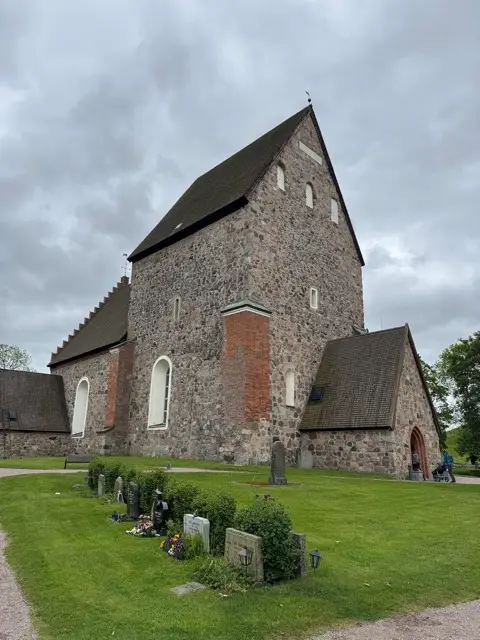
The first sight I came upon after the Uber driver deposited me at the side of the road near Gamla Uppsala was the Gamla Uppsala Kyrka (kyrka = church, another word I know). It’s a handsome 12th-century church. It’s mostly constructed of light grey stone walls and dark gray roofs of I don’t know what material, but there are some red-brick accents on the sides.
A cemetery surrounds the church. Despite it being Gamla Uppsala, which modern Uppsala has mostly left far behind, many of the gravestones were fairly new. Many of the plots had small, simple Zen gardens in front of the gravestones, as in the Uppsala Old Cemetery I saw yesterday morning. (If the cemetery I was in yesterday was the “Uppsala Old Cemetery,” what is this? The “Old Uppsala Cemetery?”)
A couple of the Zen gardens in the plots in the Gamla Uppsala cemetery were quite eroded. But when I was there, someone was freshly raking one of the eroded ones. I don’t know if he was a cemetery employee or a loved one.
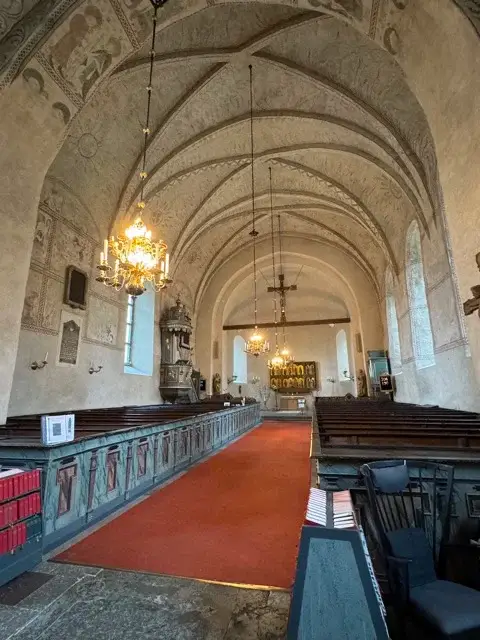
The interior of the church is only moderately adorned, but attractive in a minimalist sort of way.
A sign inside the church told me that the grave of the Celsius family is beneath the carpet running down the aisle of the church. The remains of the astronomer Anders Celsius lie there. I, and a great many other people, use the scale he devised for temperatures. I have some IKEA furniture, I owned a Saab sedan for many years, and I use a scale devised by a Swede. Does that qualify me for Swedish citizenship?
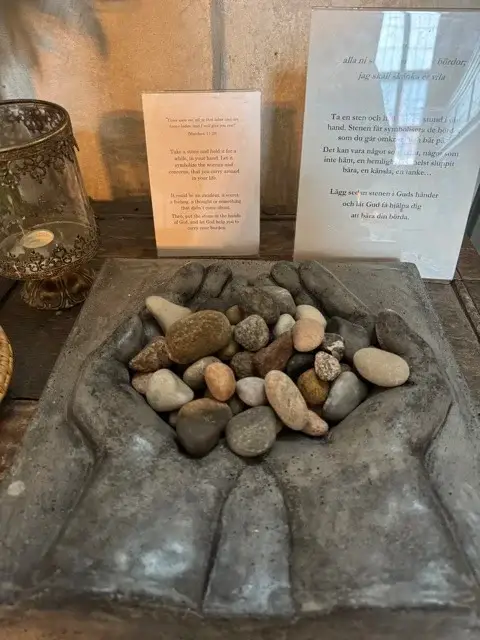
There’s a table off to one side of the church. On top of it, there’s a wicker basket filled with stones. Beside it is a sculpture of two hands flat on the table, with fingers open and palms up. More stones sat in the hands.
Behind these objects were two signs: one in Swedish and one in English. The English sign said, “Take a stone and hold it for a while, in your hand. Let it symbolize the worries and concerns, that you carry around in your life.
“It could be an incident, a secret, a feeling, a thought or something that didn’t come about.
“Then, put the stone in the hands of God, and let God help you to carry your burden.”
I tried it. I’m an atheist. But who knows? Maybe I’m wrong about God not existing. It was worth a try to have him carry my burden. What else has he got to do?
I did feel a smidgen calmer after. Unfortunately, there were only a few dozen stones, and the church closes at 5:00 in the evening. There was no way in the world that would have been sufficient for me to transfer even half of my worries and concerns to the putative God. So, dispirited, I left after just the one.
Gamla Uppsala Burial Mounds
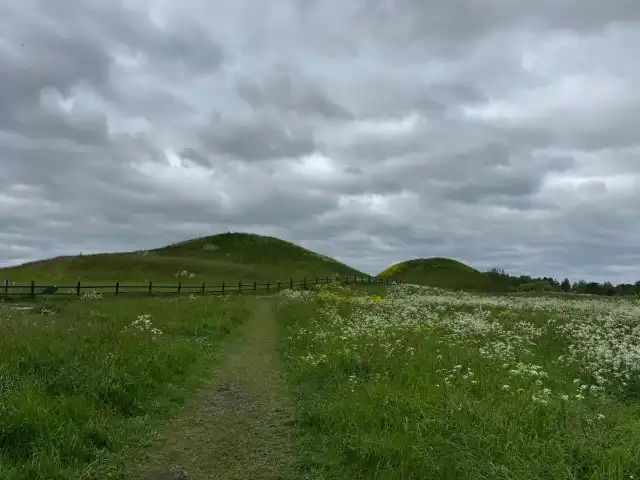
Of the few attractions in Gamla Uppsala, the burial mounds garner the most attention in my guidebooks.
I don’t know about you, but when I hear “burial mounds,” I think of a small bulge of freshly turned earth, slightly larger than a human body, that would cause a detective in a murder mystery to order that it be dug up.
That’s not what these are. They’re small hills. And some of them are not so small.
I read that there are around 300 burial mounds, but from what I saw, only a few of them are of a royal size. Royals were buried in those.
If there are three hundred mounds, I saw only a small fraction of them. I think the non-royal ones are smaller and probably not particularly noticeable. Maybe detectives had them dug up. Probably not.
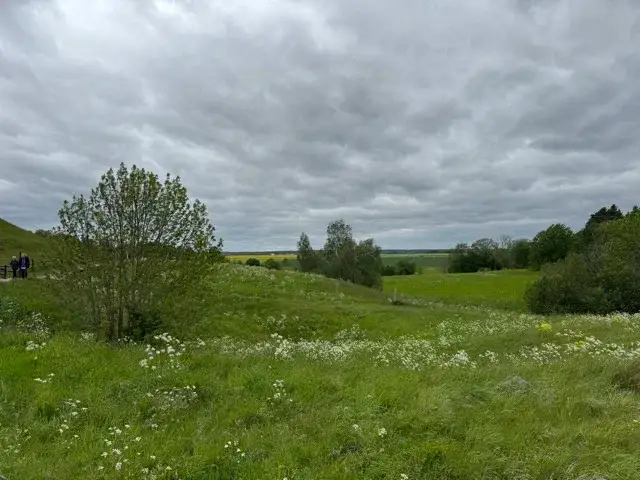
Archaeologists have done some digging in the mounds, but their damage has been repaired and is no longer visible. However, some of the contents of the mounds are now in museums.
You can’t walk on the mounds, but, at one time, people could. I know this because attached to the tasteful, dark-wood-rail fences that surround the base of the mounds, some signs say, in English and I assume that’s what the Swedish says as well, “We appreciate that it is popular to walk on the mounds. Because of this, the topsoil has been worn down.
“Now the mounds need all the help they can get to recover to still be around for future generations.
Please walk next to the paths so that they get a chance to recover.”
The paths allow for nice little hikes around the perimeters of the mounds.
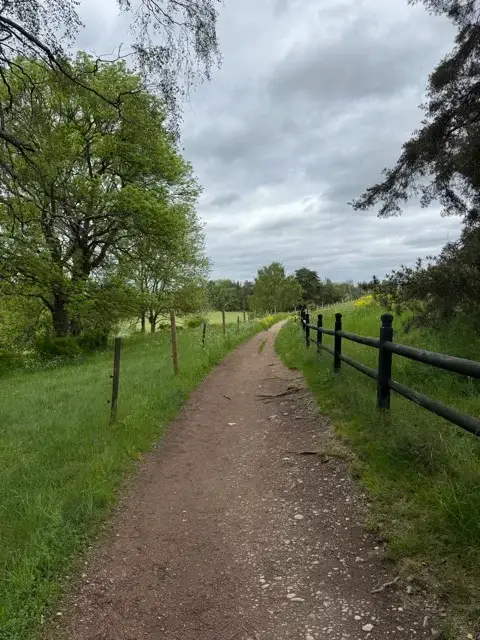
On the far side of the mounds from where the Uber driver let me off and the church, you can see the steeples of the Uppsala Cathedral way off in the distance. As I walked along, I came across a path that veered off in that direction. I pulled out Apple Maps and asked for a walking route back to my hotel. Sure enough, it pointed me along that path.
The path looked like it passed by some scenic fields and through a forested area. I thought it seemed like an enjoyable route. I wasn’t ready to leave Gamla Uppsala yet, but I filed that information away in my head, such as it is, for future reference.
At various points around the mounds, there are interpretive panels with information, in Swedish and English, about the mounds, their history, some of the legends associated with them, and the excavations that discovered some of their contents, including not just bones, but objects that were buried with the deceased.
Gamla Uppsala Museum
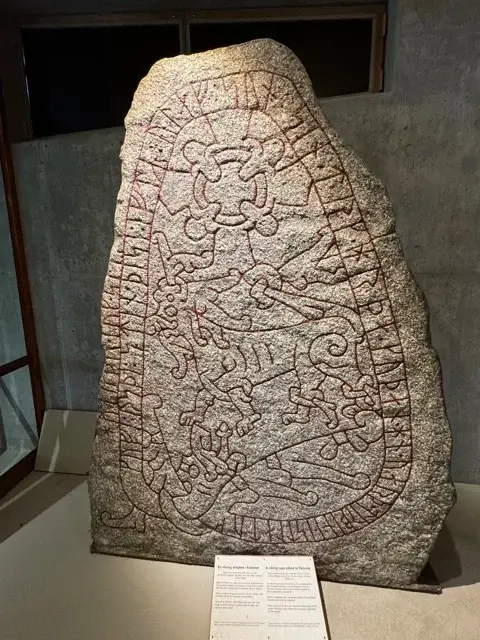
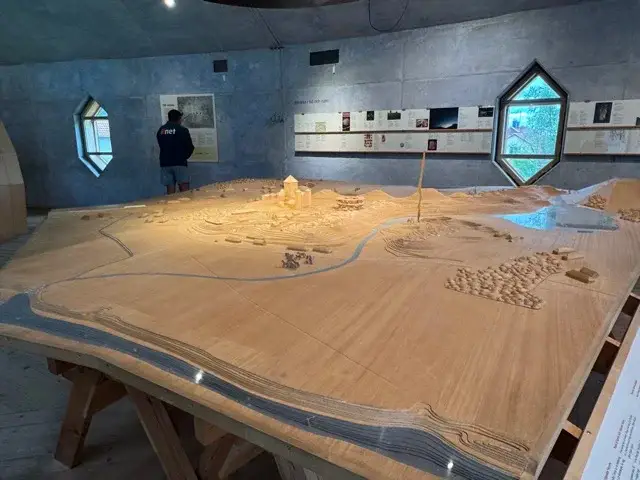
After hiking around the mounds, I went to the small Gamla Uppsala Museum. It has exhibits on two levels that include text in Swedish and English; interactive displays, with options for both languages; replicas of items from the Viking era; a replica rune stone*; some real artifacts, including portions of a real rune stone and excavated objects; and a topographical map of Gamla Uppsala as it was back in its heyday made out of wood.
(*Orthographic note: I spell “rune stone” as two words. That’s the way I’ve seen it spelled elsewhere, including elsewhere on this trip. But the signs in the Gamla Uppsala Museum always spell it as one word, runestone. When I try to type it as one word, spellchecker objects. When I leave it as one word but call for a definition of it, the built-in dictionary doesn’t refuse, but it takes me to a dictionary entry for “rune stone,” two words, without offering an alternate spelling as one word. So, I stuck with two words here.)
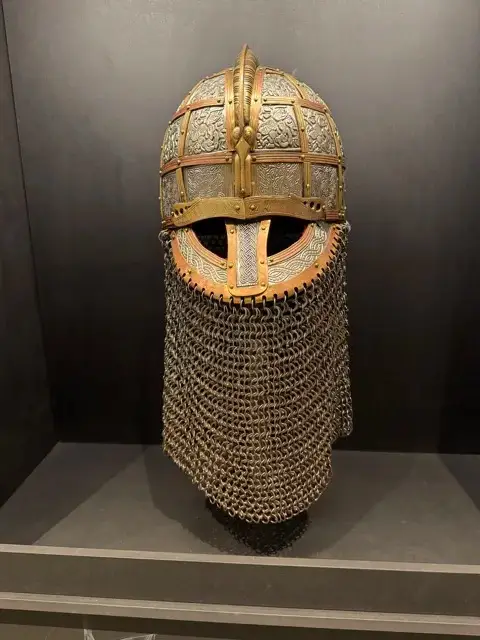
There’s not much to the museum, but it does give a good high-level overview of the history and significance of the mounds, along with the history of Gamla Uppsala, and is worth a visit.
After finishing with wth Gamla Uppsala Museum, it was time for me to decide whether to take that walk back to Uppsala or order an Uber. The sky was still very overcast, and it was a little cool and blustery, but my weather app said there’d be no rain and there’d even be a few sunny periods over the next couple of hours.
However, the time was such that I would need some sustenance before taking the hike, if I chose that option. Fortunately, there’s a cafeteria-style restaurant in an old building of Gamla Uppsala, which offered, among other choices, a nice smorgasbord plate with egg slices, shrimps, lettuce, and I forget what else. I decided to put off the decision as to whether to walk or Uber until after I had some lunch. I always think better after lunch, if it doesn’t put me to sleep.
I’ll pick up after lunch in my next post of the day, anon-ish.
Discover more from Joel's Journeys & Jaunts
Subscribe to get the latest posts sent to your email.

That was an evocative little side trip. I wonder what happened to make the town decide to up and move over to where it is now? I am used to old towns being the nucleus of modern towns. I know there is a story there…Does it have anything to do with the mounds? And I know there is a story coming up. Will Joel walk the path back to civilization or call civilization to come and get him? We’ll see, dear.
I wondered about that too. Gamla Stan in Stockholm, which I’ll visit again later this trip after more than a decade since the only other time I was there, is, as you say very much at the heart of Stockholm. But I don’t know. The burial mounds might very have something to do with it. Their presence doesn’t leave a lot of real estate to build on without bulldozing them. And bulldozing them would have been disrespectful to the dead and to history.
As to whether I walked or Ubered, as you say, we’ll see, dear. I was working on that post when I heard a ping indicating that a new comment had come in. I’ll get back to it now and hopefully publish it soonish.
Burial mounds abound. And rune stones intrigue. Zen gardens at graves. Me like.
It is indeed an intriguing and evocative place.