Uppsala Slott, a Park, and Jona
After checking off Swedish meatballs as one of the must-dos for this trip at lunch today, I headed up to the Uppsala Slott. You might see the word “slott” a few times in my future journal entries for this trip. It’s the Swedish word for castle.
After visiting Uppsala Slott, or what I could visit of it, I strolled and sat in a pleasant park. Before heading back to my hotel, I went to sit with, or more precisely, sit on Jona.
Uppsala Slott

Uppsala Slott was built for King Gustav Vasa in the mid-16th century. It was damaged in a devastating fire in Uppsala in 1702.
After the fire, Uppsala Slott was left to rot for a few decades, but was reconstructed as the large pink castle that can be seen—mostly only from the outside—today.
Uppsala Slott sits on a plateau atop an easily walkable hill. I don’t know if the plateau was mostly naturally occurring or if it was largely the result of the top of the hill being lopped off.
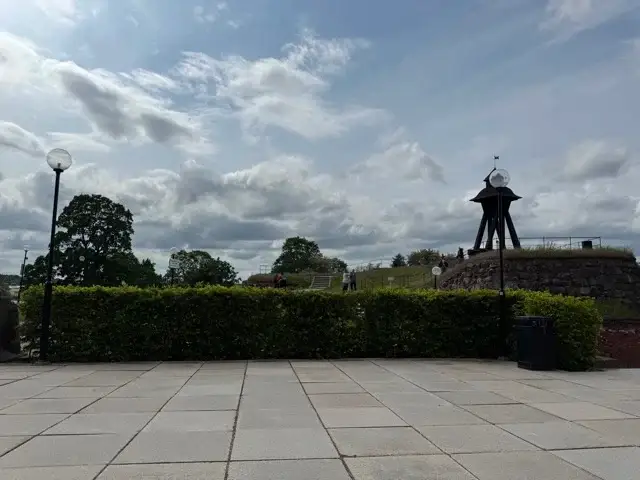
There is a large courtyard on the plateau in front of the castle. A mound rises from off to the side at the front of the courtyard.
On top of the mound, there’s a bell tower or, rather, a bell stand. The small structure containing just the bell perches on about a half-dozen posts sitting at irregular angles. A nearby sign explains that “The bell was cast in 1588 and presented to the castle chapel by Queen Gunilla, wife of King Johan Ill. It hung in the southeast tower until 1702, when much of the castle was destroyed by fire. The tower was completely demolished and after a few years the castle chapel stopped holding services.
“The Gunilla Bell was recast in 1759 and placed on Styrbiskop Bastion in its current bell tower to act as a curfew bell. …
“Today, the Gunilla Bell plays a key role in the students’ spring celebrations for Walpurgis Night.“
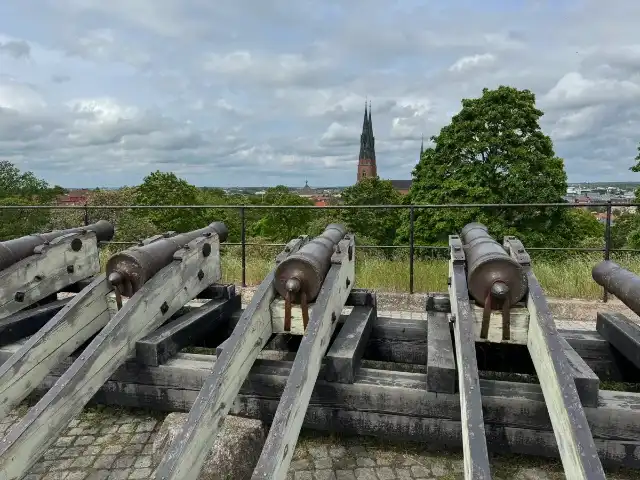
On the mound, there’s an array of six cannons pointed directly at Uppsala’s Cathedral. That led me to wonder if the church and state weren’t just separated, but battling back in the day.
In addition to the cannons on the mound, there are also some other cannons on the plateau pointing in another direction.
I mentioned above that Uppsala Slott can be seen mostly only from the outside. One of my guidebooks told me that most of the interior is open only to tour groups. I didn’t see any signs at the castle indicating otherwise, nor did I see any signs suggesting tour groups could get in.
However, one of my guidebooks mentions one public attraction that carves out a portion of the castle. And it turns out there’s another one too.
Uppsala Slottshistoriska

The attraction in the Uppsala Slott that I didn’t see mentioned in a guidebook, but for which I saw a sign over a door, is the Uppsala Slottshistoriska, which translates into the Uppsala Castle Museum. It’s a very small museum primarily dedicated to the history of Uppsala Slott.
Inside, there’s some text describing that history, along with a small model in glass cases of the castle as it used to be.
In one room, there’s a throne with a canopy over it. It’s not an original historical throne. I know this because the public is invited to sit on it. If you do, a trumpet plays some heralding notes, and a woman’s voice reads an aphorism, first in Swedish, then in English, from a long-former princess or queen. I don’t know how many different aphorisms there are, but it wasn’t the same one all the time. (It’s a specific princess or queen, but I didn’t write it down, and I’ve forgotten her name and position.)
There’s not a lot to it, but its an interesting museum.

Uppsala Art Museum

The attraction inside Uppsala Slott that my guidebook told me about is the Uppsala Art Museum. That’s what my guidebook called it, the Uppsala Art Museum. But the sign on the entrance says its the “Konstmuseum.”
I went inside. The art gallery occupies only a very small footprint inside Uppsala Slott, with exhibits on three floors. It’s all modern art.
The art ranges from abstracted reality to fully abstract. And it runs from reasonably normal, to somewhat weird, to very weird, to what the *&^%@! is that?
After I left, I wasn’t convinced that what I had seen was indeed the promised Uppsala Art Museum. It was kind of small and, while the guidebook did tell me to expect modern art, I wasn’t quite expecting that. (As I complain about its small size I’m, I’m reminded of the joke Woody Allen used in Annie Hall. “Boy, the food at this place is really terrible. … Yeah, I know; and such small portions.”)

I know. Art appreciation is subjective, and some people love that sort of art. I’m not some people.
To check, after I left, I looked at a mapping application. I was indeed standing beside the Uppsala Art Museum. For some reason, I also thought to look at Google Translate. Do you want to guess what the Swedish word “Konstmuseum” translates to in English? I’ll give you a hint. It translates to “Art Museum.” Alright, that wasn’t the most subtle of hints, was it?
So, yes, that was indeed the Uppsala Art Museum

Vasaborgen
As I left Uppsala Stott, I came across another museum immediately beside it, the Vasaborgen museum.
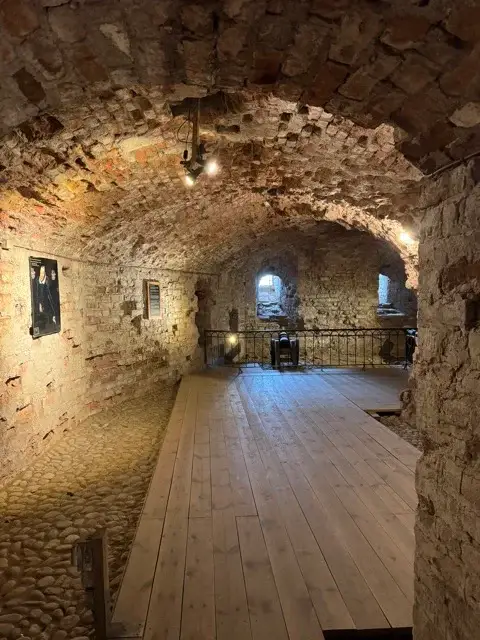
Vasaborgen focuses on the fort that was built on the hill preceding the Castle. Inside, it’s mostly a reconstruction of a portion of the fort, but the dungeons are the original dungeons with the original materials.
The person at the ticket desk was very helpful and took some time to tell me about the fort and the museum. In our discussion, he mentioned some of the cannons. I asked him about the cannons on the mount and mentioned that I noticed that they were pointed directly at the cathedral. I asked if that was significant.
He said that, not only are they pointed at the cathedral, but the archbishop’s house is between the castle hill and the cathedral. Not only could the cannons hit the cathedral, but they could strike the archbishop’s residence too.
The guide said, and I don’t know if he was joking, that this was an implied threat that the king might take action if the archbishop ever thought of communicating with the pope and converting the church back to Catholicism. Like I said, I don’t know if that was a joke or if the ticket guy was serious, but it probably did serve to keep the archbishop and church in line.
Stadsträdgärden

After leaving the Uppsala Slott hill, I took a walk to a nearby park, Stadsträdgärden, which I had seen recommended I forget where.
According to the English summary provided on the sign at the entrance to the park, “In the mid-1800s, many public park projects were initiated in Uppsala. One of them was Stadsträdgarden (the City Garden), created by Uppsala Garden Society 150 years ago. By the end of the 1800s, vegetables, flowers, fruit and berries were grown extensively and sold. It is likely its long period as a market garden that led to the park being known as a City Garden rather than a City Park.”

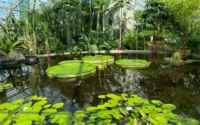
It’s a lovely, fair-sized park right in the heart of Uppsala. There are lots of trees, flowers, benches, a playground, and a lovely little pond with a bridge over it. There’s also an ice cream shop. Say no more. Wink, wink. Nudge, nudge.
Today is Sweden’s National Day, and the park was quite busy. But it is big enough that I could find a few places to sit, stare off into space, and sit and eat some ice cream.

Jona
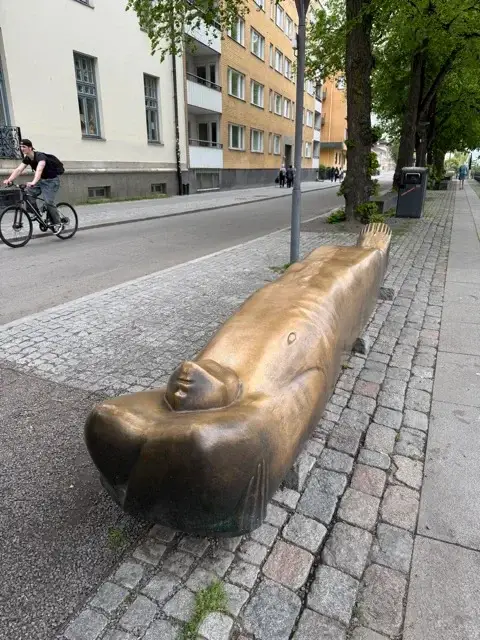
After leaving Stadsträdgärden, I took a walk to visit Jona. Jona is a medal sculpture sitting beside the walk along the river in Uppsala.
Jona has the head of a man, with his arms wrapped around the back of his head. The body of the sculpture is long and transitions into a fish with a tail fin (and no other fins). Jona lies just a little above the ground and parallel to it.
The idea is that people can sit on Jona. But here’s the special part (as if a human/fish sculpture isn’t special): Jona is heated year-round. If you’re ever in Uppsala and want your bum warmed, head over to Jona and have a seat. I did. I sat there for a while. I found it surprisingly pleasing.
Jona was a nice, warm way to end my day.
Discover more from Joel's Journeys & Jaunts
Subscribe to get the latest posts sent to your email.
What a place! A tush-warming man-fish sculpture bench! Now I have definitely warmed up to Uppsala. Another lovely park, an art gallery this reader would have found intriguing, and a castle with cannons aimed at the church canons. What an intriguing place. With ice cream!
Huh. I wouldn’t have thought that was your sort of gallery, but I figured you’d get a kick out of Jona.
Damn! The cannons versus canons pun never occurred to me. And it was right there.