Up in Uppsala
So begins another trip, this one in Sweden. My journey here starts in Uppsala, a smaller city, with a major university, north of Stockholm.
The airport that serves Stockholm, Arlanda Airport, also serves Uppsala and is roughly halfway between the two. Trains run to both cities from a station in the airport, reaching either in less than twenty minutes.
I’ll be doing a counterclockwise circle route around southern Sweden that, as I said, starts in Uppsala. It ends in Stockholm, with about a week in the latter and considerably less time in the other Swedish cities and towns I’ll be visiting.
I’ve been to Stockholm once before. That was in 2014, well before I started this journal. That trip took me to Copenhagen and Stockholm, but I didn’t explore much beyond either city.
I loved Stockholm then and have often told myself that I had to go back one day. That day, or rather days, is coming up at the tail end of this trip. But, after not having done so on that earlier trip, I wanted to explore a little more of Sweden. So, here I am.
(I also liked Copenhagen and didn’t explore much of Denmark beyond that. So much world, so little time and money. We’ll see, dear.)
An unreasonable person might wonder why I chose the title “Up in Uppsala” for this post. A reasonable person would probably think, “Who the heck cares? Just get on with it!”
For the benefit of the unreasonable people, I’ll pause to say that there are more reasons I chose that title than I can count. However, that’s mostly because I’m very tired from the overnight flight I was on to get here. More rested, I could easily count them.
For one, Uppsala is north of Sweden’s principal city, Stockholm, and north of the airport I landed at. The way we normally orient maps, north is up. So, up in Uppsala, I am.
Then there’s the “happy” definition of “up,” as in “I’m having a up day.” (I was going to say, ‘as in “feeling up,”‘ but I didn’t want to go there.) I enjoy travelling. So, I’m usually as happy as a curmudgeon can be at the start of my trips. (As some readers of this journal would be thrilled to tell you, I’ve been a curmudgeon since a very young age. It’s a myth that curmudgeons have to be old. It just so happens that I am now old, but that’s unrelated in my case.)
And then there’s the main reason that I came up with the “Up in Uppsala” title. You can’t spell “Uppsala” without “Up.” So, how could I not go with it?
But never mind that.
I got to my hotel and checked in before 1:30 in the afternoon. That gave me time to see some sights on this lovely afternoon in Uppsala.
Botaniska Trädgården
The Botaniska Trädgården, also known in English as The Linnaean Gardens of Uppsala, is run by the University of Uppsala.
Regular readers know that I like botanical gardens. Uppsala has one that my guidebooks recommend. As I mentioned, today was lovely, but my weather app predicts rain all day tomorrow and some rain the next day. I leave the day after that. So this seemed like the best day to traipse through a botanical garden.
The only complaints I have about Botaniska Trädgården are the umlaut over the first “a” and the circle diacritic over the second “a.” They’re a pain to type for someone like me who doesn’t have them on their keyboard.
Apart from that, The Linnaean Gardens of Uppsala is a lovely botanical garden of middling size. A street divides it into two parts.

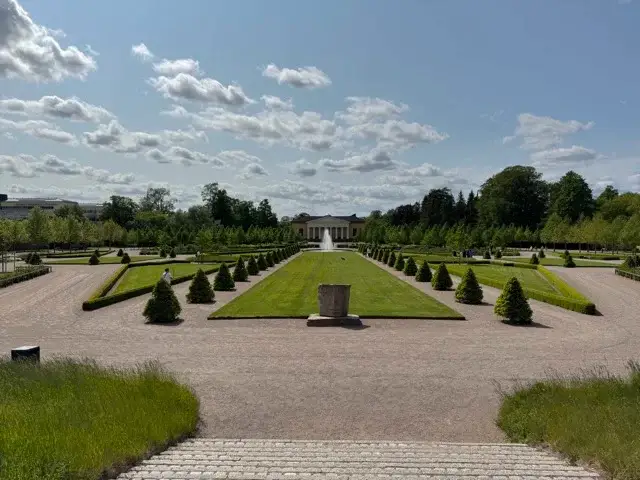
The front of the part I entered first (front based on the entrance I used) is a baroque garden with closely manicured grass, precisely patterned walkways, trees, some other plantings, and a fountain.
Behind that, there’s a building that houses an orangery and a cacti greenhouse. Behind that building, there is a small section with grass and less-precisely planted trees.
On the other side of the road, the botanical garden has a much wider variety of plants and trees, and doesn’t have the dainty touches of the baroque garden. That side also has a tropical greenhouse with a few sections that contain some beautiful, lush plants.

One of those sections has a small pond with, among other species of aquatic plants, some specimens of Victoria water lilies. There are also non-aquatic plants outside of the pond.
I mention the Victoria water lilies because I was in awe when I saw them on an earlier trip that included the Adelaide Botanical Garden in Australia. Not having seen them before that (or if I had, not having recalled seeing them), I marvelled over the Victoria water lily. Their pads appear to form a near-perfect circle, but with a pronounced, upturned brim around the circumference.

The Victoria water lily seems like such an improbable species to me that it almost makes me believe that they could only have been designed by the Flying Spaghetti Monster, but, of course, that’s just silly. The fact that I can’t conceive of how natural selection would have led to a particular species is simply proof of my ignorance, not of the existence of the Flying Spaghetti Monster.
After being awestruck at the Victoria water lilies in Adelaide, I’ve since also seen them in botanical gardens in Oslo, Singapore, and now Uppsala. It’s getting to the point where I’m going to have to stop mentioning them if I come across them again in my travels. “Ho hum. Another Victoria water lily.
Carolinaparken
Carolinaparken (the Carolina park), or the English Park as it is commonly known, is a lovely park in Uppsala. If it hadn’t been smackdab on the route from the botanical garden to the Upsala Cathedral (see below), I probably wouldn’t have visited it today, or possibly at all during this trip, as my guidebooks don’t mention it.

The English Park is nicely forested, with lots of wide paths through it and a playground.
I know the names of the park because a sign with some narrative about the park near the entrance I came in through provided them in the English summary. I know it was just a summary and not a full translation of the Swedish on the sign because there was significantly more Swedish than English. And, if that wasn’t a clue, the fact that the English section was titled “English Summary” gave it away.
According to the English summary, it is one of Sweden’s oldest public parks, with the decision to create it being made in 1805. ‘The area then consisted of fields, tobacco being one of the crops. But the politicians wanted to create a public “place for joy and strolling” to beautify the town and to improve the people of Uppsala’s environment.’
It is a beautiful place and a joy for strolling.
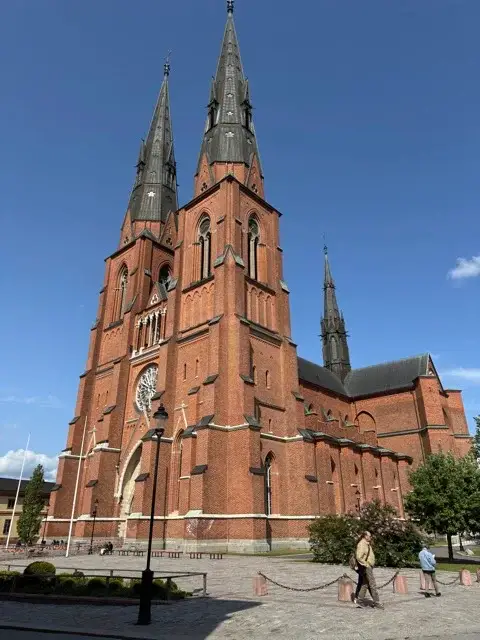
Uppsala Domkyrkan
If you visit Uppsala and you don’t at least notice its Domkyrkan (cathedral), even if you don’t know what it is, you might be advised to speak to an ophthalmologist about your blindness if you aren’t already aware that you are blind.
As far as I could see, the red-brick cathedral’s twin, tall, front spires are the tallest structures in Uppsala. You can’t miss it. There is also a third spire toward the back of the cathedral, but it’s not as tall. The spires are covered with tiles that are metal-grey in colour, but I don’t know if they’re metal.
The interior is underwhelmingly beautiful, as little sense as that makes.

According to a one-page, three-fold leaflet available in a variety of languages, including English, at the entrance to the cathedral, Uppsala has been the seat of the Archbishop of Sweden since 1164. Construction of the Domkyrkan started in 1270, but it wasn’t consecrated until 1435. Hey, Rome wasn’t built in a day either, you know.
A major fire in 1702 damaged the spires, roof and interior. The cathedral that stands today is the result of restoration work undertaken at the end of the 19th century. According to the leaflet, it’s the largest church in the Nordic countries.
There are several attractive chapels along the side and back walls, including one, the one at the back, where King Gustav I (1498-1560) was buried.

Early Impressions of Uppsala

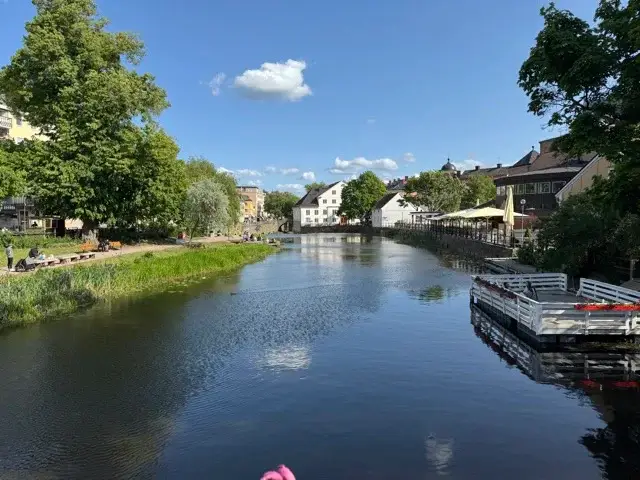
I haven’t yet spent a lot of time in Uppsala, but I’ve formed some early impressions of it. I like Uppsala. I don’t yet love it, but I very much like it. A nice river runs through it. It has some generous sidewalks. There’s a pedestrianized shopping street, along with a couple of shorter pedestrianized cross-streets. Those shopping streets don’t have the charm of some I’ve seen elsewhere in the world, but the absence of cars is always a bonus wherever you find it.
If there’s a high-rise section in Uppsala, I haven’t seen it yet. I didn’t count floors, but I don’t think any of the buildings I’ve seen have more than ten of them unless you count the floor-equivalents of the spires of the Uppsala Domkyrkan. My hotel is seven storeys tall and I think it’s among the tallest in Uppsala, again excepting the spires of the cathedral.
All-in-all, today made for a nice start to this trip.
Aside
The Mysterious 22
As I walked around this afternoon, several open-roofed trucks paraded around the streets of Uppsala. They often honked their horns as they drove. Back in the open part of each truck, several young people stood there, waved a lot, shouted, and sometimes sang. They were dressed in otherwise casual clothes, but the vast majority of them sported identical, jaunty, white sailors’ caps.
All of the trucks bore hand-painted signs that had one element that followed the same format on each truck. They all had signs (often more than one) with a series of five characters (sometimes among actual words), always formatted as “XY22Z.”
The X, Y, and Z above are just placeholders to show the format. There were different letters for each truck. But if there were multiple signs on a truck, they all bore the same version of “XY22Z.” And the number between the two-letter prefix and one-letter suffix was always 22.
In addition to the trucks roaming the streets, a few adults (usually middle-aged or older) walked around carrying signs that also bore the format “XY22Z” (again with other letters substituted for X, Y, and Z, but always the number 22). These signs always displayed a picture of a child.
These adult-borne signs left me distraught. Were they commemorating some sort of disaster in 2022 that made victims of children? Or maybe it was a disaster on the 22nd day of some month? (The latter explanation seemed unlikely because today is the 5th of June, not the 22nd of any month.)
My curiosity got the better of me. I did some web searching to try to find the answer. With the help of the translate function of my browser, I learned that today is (high school) Student Day in Uppsala. It’s celebrated with parades and other formalities and frivolities. I guess the graduates started high school in 2022.
Before successfully finding that out, I stumbled on an unrelated page that informed me that tomorrow is Sweden’s National Day. I don’t know how that’s going to affect the opening hours of sights here. I guess I’ll find out tomorrow.
Discover more from Joel's Journeys & Jaunts
Subscribe to get the latest posts sent to your email.
Up, up, and away! Joel takes flight to Sweden. What a gorgeous-looking day, and big skies in Uppsala. It looks very promising. Doing gardens on the first day in seems like a very gentle way to acclimatize to a new time zone (which is another way to rationalize the choice besides “it’s going to rain tomorrow,” or “I’m getting older, dammit, and this is just my speed” ). Lovely gardens, lovely cathedral. University towns usually have good cafes and bistros, so I hope you get plenty of those too. I am glad to hear that you have landed safely and are savouring your new adventure. You are not nearly as curmudgeonly as you make your legend out to be, but I am happy that your travel is smoothing away whatever edge you have been feeling plagued by lately. Enjoy!
I am a curmudgeon, dammit!
Nevertheless, it was a good start to the trip. Of course, the problem with good starts is, it makes it challenging for the rest to be better, but maybe that’s just the curmudgeon in me speaking.
Aha. I am reaching back from later Malmö posts to find out about your first days in Sweden on this trip. There you are, traveler, up in Uppsala, leaving this reader giddily infected with an ear worm. Will it subside? Up in Uppsala uttered in the sing-song accent of a certain memorable Muppet chef.