Musée Réattu and Museon Arlaten

Jacques Réattu
Paris, 1785
As I related in this morning’s post, it was raining when I ducked into lunch. What I didn’t mention is that it was still raining when I finished lunch, but harder.
I decided this afternoon was a good time to take in some of Arles’s indoor attractions.
I chose one out-of-sight Roman structure, and two museums, one an art gallery, Musée Réattu, and the other an ethnographic museum, Museon Arlaten, but not quite in that order. I also planned to take a look inside an old church, but that didn’t work out.
I know. I know. “But, Joel. You’re not much of a fan of art galleries, and in other posts, you’ve said that ethnographic museums bore the heck out of you. Why the two museums?”
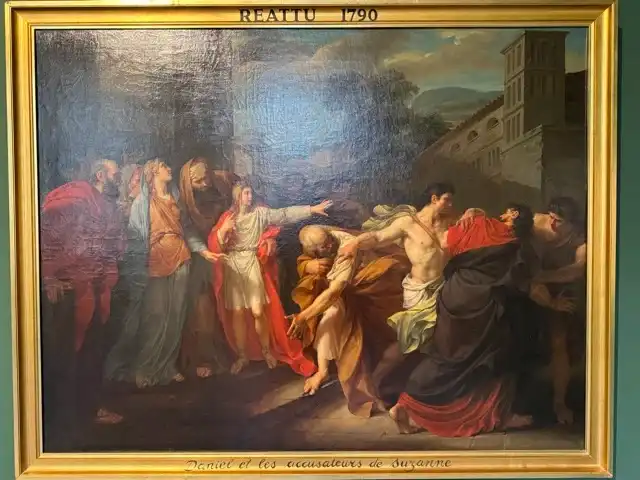
Jacques Réattu
Paris, 1790
That’s a valid point, but did I mention it was raining hard? I didn’t feel like traipsing around. I wanted to stay indoors as much as possible. I don’t think there are many more options.
There is another large museum that comes highly recommended, one that I want to visit. But it’s closed on Mondays and Tuesdays, at least it is at this time of year, but I don’t know about the high season. Today is Tuesday.
So an art gallery and an ethnographic museum, it was. Spoiler: I enjoyed them more than I thought I would, particularly the ethnographic museum. In neither case is liking it more than I expected a high hurdle to leap over, again, particularly the ethnographic museum, but still, I actually enjoyed Museon Arlaten.
Musée Réattu

Musée Reattu is close to the Rhone River. It’s so named because the museum is in the building that had been the Commandery of the Knights of Malta, but was bought in the late 18th century by an Arles-born artist, Jacques Reattu. Reattu then turned a part of the building into his studio and residence.
When Reattu died in 1833, his family held onto the building and Reattu’s large art collection, including many of his own works. It stayed in family hands until the mid-20th century. Then, the City of Arles bought the whole estate, including the art collection, and turned it into the Musée Reattu, which opened in 1965.
All of the signage in the Musée Réattu is exclusively in French. But there’s a QR code that I was able to use to get English-language text. The website the QR code pointed to was very well organized. There are easily accessible, separate pages for each of the more than twenty rooms in the Musée Réattu.
Each page on the website describes the contents of the rooms in general, and specifics about some of the pieces in them. I think there is at least as much information on the website as there is on the text panels in the museum. There’s also an audio guide available on each webpage, but I didn’t have my earbuds with me, so I stuck to the text rather than disturb anyone else there.
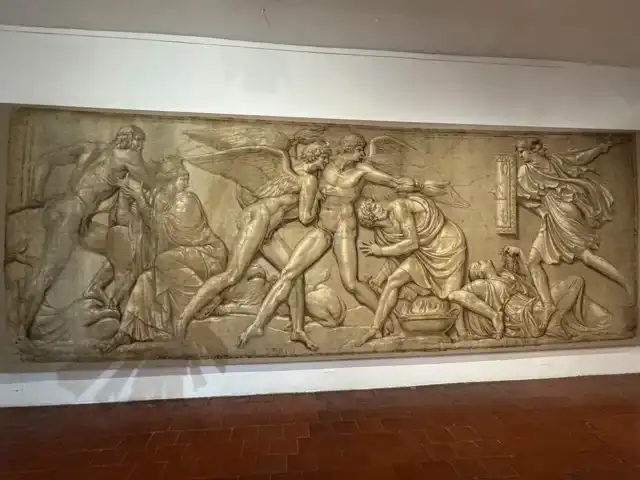
In the first few rooms, the majority of the works were paintings by Jacques Réattu, but progressing through the museum brought me to paintings, sculptures, photographs, and an old tapestry by other artists, a few were from before Reattu’s time, but there were a great many that were more recent as well, including some paintings by Picasso and photographs by Yousuf Karsh.
One of the rooms in the Réattu museum is a chapel. Most of it is quite bare, except for the altar and the beautifully carved, dark wood that fills up the whole wall behind the altar. It was gorgeous. I thought I took a picture of that, but if I did, I don’t know what happened to it because it’s not in my pictures. Sorry about that.
Cryptoportiques
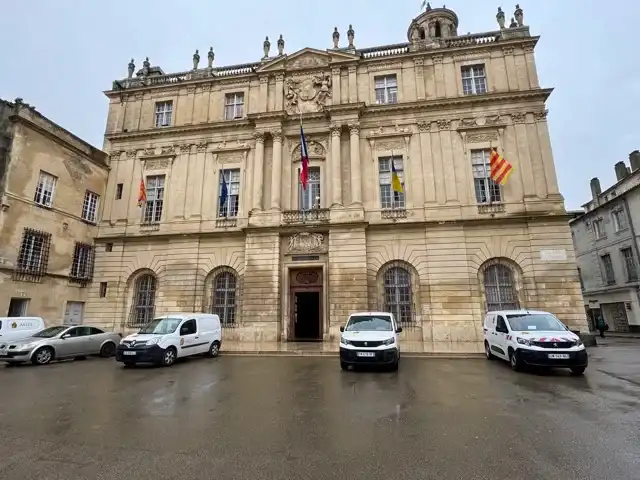
That Roman structure I mentioned in the introduction is the Cryptoportiques. The reason I said it’s out of sight is that you can’t possibly see it when walking around Arles because it’s subterranean.
Before this trip, I wasn’t familiar with the French word cryptoportique or the English equivalent, cryptoporticus, but now I know it’s a Roman covered walkway or arcade. The Arles cryptoporticus is underground.

The Arles cryptoporticus dates back to the first century BCE. It was built to support the Roman Forum and also served administrative and storage purposes. Arles’s Place de la Republique is where the forum used to be.
To get to the cryptoporticus, you have to step inside the Arles Hotel de Ville (City Hall). The City Hall lobby is a very barren, open space. The offices are upstairs.

Off the lobby, there’s an entrance to the cryptoporticus. Past the ticket booth, there’s a set of stairs that go down to its vaulted-ceiling tunnels. The tunnels are raw and dark, but they induce a certain vibe that comes from the knowledge that you’re walking through a well-preserved structure that came into being around the turn of the common era. How often does one get to do that?
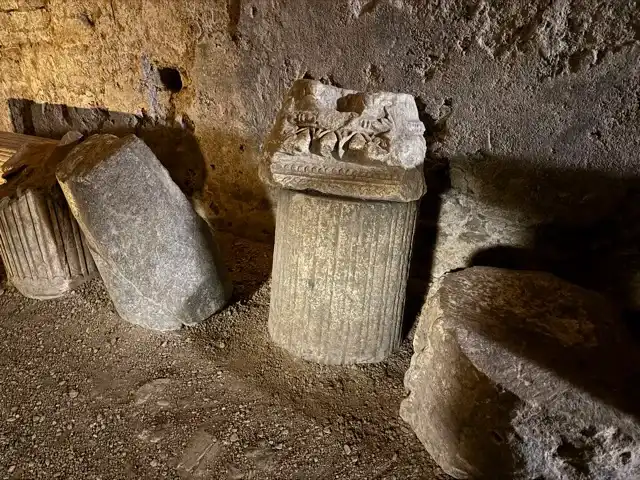
In the cryptoporticus, against one wall, there are some archaeological finds, mostly chunks of Roman columns.
Museon Arlaten
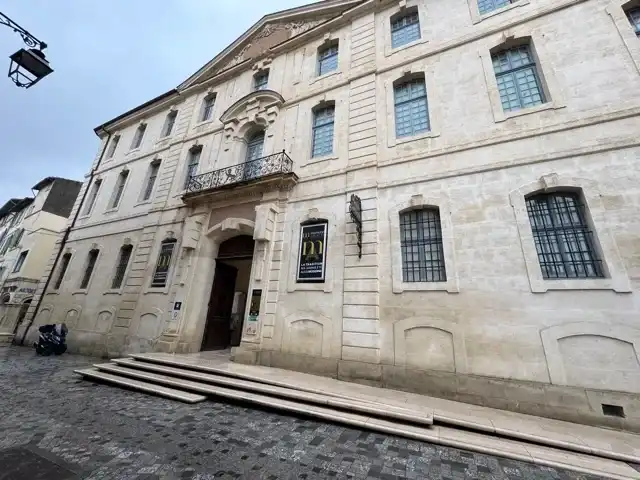
The Museon Arlaten is the one that surprised me the most. And not just because I can’t figure out what the heck is up with “Museon” in its name. The French for “museum” is “musée.” Synonyms happen, but I can’t remember seeing that one. (Admittedly, my not remembering something is not proof, or even decent evidence, that it doesn’t exist. I don’t know a lot of French, so maybe I’ve just never seen that synonym. Or, equally likely, maybe I had seen it, but I forgot it.)
I tried doing some research to see if “museon” is perhaps a specific type of museum. I plugged it into both Google Translate and Apple Translate. Both came back with just “museum” as the English for “museon.” Then I tried going the other way. I plugged “museum” into the English to see if either app would offer up “museon” as a synonym for “musée.” But both returned only “musée” and no French synonyms.
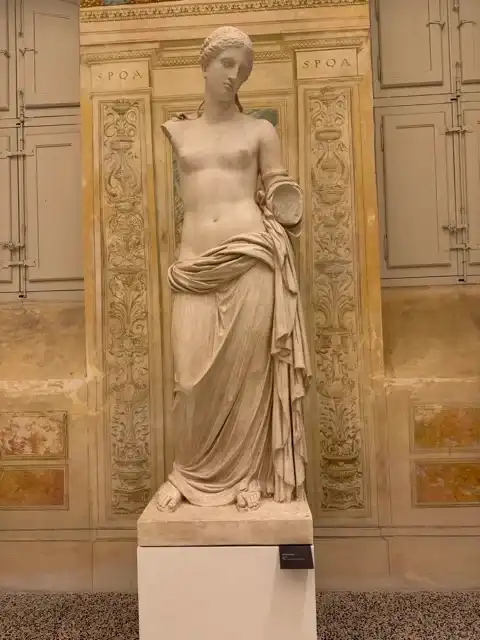
(reproduction)
1900-1925
Then I tried asking a search engine, “What’s the difference between the French words musée and museon?” I came up empty. If anyone knows the difference between museon and musée, please let me know.
But, to make a short story long, the signage at the museum and its website both show the name of the museum as “Museon Arlaten.”
Besides the discovery of “museon” as a French word, what surprised me was that I wasn’t the least bit bored in Museon Arlaten. In other ethnographic museums I’ve been to, they’ve generally been, to my tastes, mind-numbingly tedious collections of traditional regional costumes, furniture and household items. Museon Arlaten has some of those types of artifacts, but they were presented interestingly.
In the first part of the museum, all of the signage was in French. That didn’t matter because in each room there was an interactive video screen, where I could choose from one of three languages: French, English, or Spanish. (No bonus points for guessing which one I chose.) Fortunately, the museum was not the least bit crowded. There’s only one such screen in each room.

Early 20th century
The screen then offered me general information about the subject area of the room, plus it displayed all of the items in the room, in a picture as they were in the room. I could tap on an icon beside any item to get more information about it. Plus, the screens offered up a few “appendices” where I could get more in-depth information about the subject of the room.
Items on display varied from reproductions of ancient sculptures found around Arles to weird curios, and yes, some traditional clothing, furniture, and household items. One display case held some Jewish items, including a couple of ketubahs (Jewish marriage contracts). One room contained what looked like a large, tastefully styled bureau. The front wasn’t opened, and it was tied shut with a ribbon, but the information I got from the accompanying screen said that it “houses a sieve that separates flour from any remaining bran.” There was also a picture of the sieve inside the cabinet available on the screen.
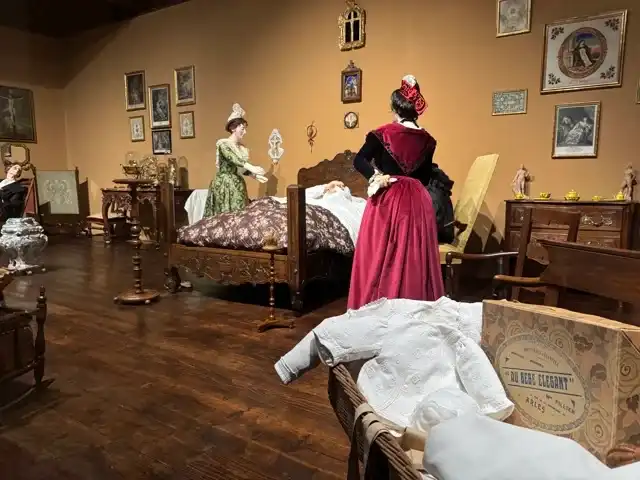
There were also a couple of large dioramas behind glass. One depicted a Christmas dinner scene. Another was titled “Visit to the Woman Lying-In.” It was a scene of people attending to a woman who’d just given birth.
From one of the appendices on the screen associated with this diorama, I learned that, “In the Old Testament, a woman was considered to be impure after giving birth. A new mother had to remain in her room for forty days following the birth of a son and eighty days after the birth of a daughter. At the end of this confinement phase, the mother, accompanied by her friends, came back into society during a ceremony known as the Churching of Women. This tradition of a purifying blessing had been common throughout all of France since the Middle Ages, but began to dwindle in the 1880s. Brittany and the Mediterranean basin, which upheld Churching of Women until the early 1900s, were exceptions. The tradition was particularly strong in Provence where it was a popular custom and men were most often absent. The tradition called for the newborn’s godmother to give a cake decorated with symbolic sweets in the shape of a cradle, a chicken, a turtle dove sitting on its egg, and others. All those present then ate the cake. After the festivities, the godmother gave the traditional gifts – an egg, bread, salt, a match – to her godchild.”

I knew absolutely nothing about the Churching of Women. I have a few questions. First, if it’s in the Old Testament, why is it called “Churching” of Women? For another, really? Women were a) considered impure after giving birth and b) they were impure for 40 days after giving birth to a boy, but 80 days after a girl? What’s up with that? In addition, an egg, bread, salt and a match were given to a newborn? I mean, I’m childless, so what do I know, but I don’t think it’s a great idea for newborns to be eating eggs, bread, and salt. And I particularly don’t think it’s a great idea for them to be playing with matches.
But enough about that. In the latter portion of the museum, there were no interactive display screens. But there, all of the descriptive signage had four languages. I recognized French and English. I think the other two were Spanish and Italian.

The latter part of the museum also had some videos with English subtitles.
Beyond the ethnographic items on display, the Museon Arlaten also had quite a bit of meta information. It spent some of its space and time discussing ethnographic museums—their purpose, their organization, and their evolution. There was also some discussion of the founder of what’s now called the Museon Arlaten, Frédéric Mistral. (The museum was founded in 1899.)
Not Église Notre-Dame-de-la-Major d’Arles
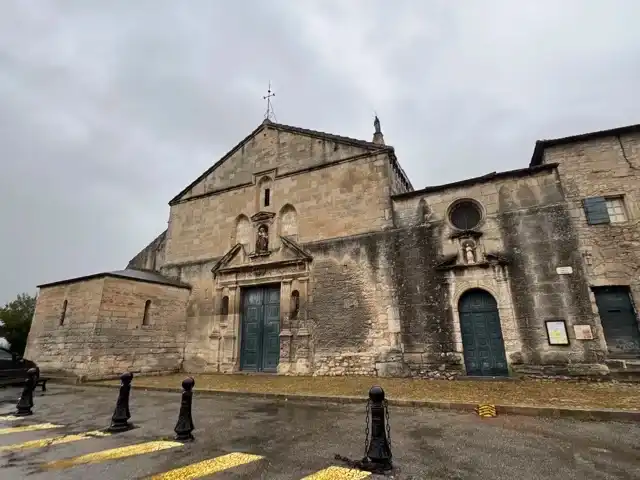
The old church I wanted to visit was the Église Notre-Dame-de-la-Major d’Arles. It was consecrated in 452 on the ruins of a Roman temple, but it was reconstructed in a Romanesque form in 1152. It got Gothic and later additions after that.
My walking tour app advised me to “Step inside, and you’ll discover a richly appointed interior …”
I didn’t have a lot of hope of being able to do that. My walking tour app and guidebooks didn’t provide any opening hours. Neither did Google Maps nor Apple Maps. Nor could I find any opening hours on the web. So, I walked over and took my chances.
There was a sign on the church posted by the diocese, listing, in French, when it was open. It seems to be open only briefly early in the morning and in the evening for services. So I won’t be going inside. But I did get to see its exterior.
And that concluded my rainy afternoon in Arles.
Discover more from Joel's Journeys & Jaunts
Subscribe to get the latest posts sent to your email.



Well, you know how to hedge your bets for a rainy day! Two museums (or a museon and a museum), one Roman archaeological site and a not-church. Not bad work for an afternoon. As to the museon, it seems to me that it refers to the Greek root for Museum, but it’s not a word I see applied a lot. It may be used instead of musée to give the place a little more gravitas, who knows? Liked the hoopoe, poor darling. As to the lying-in thing, I think the women might think of it differently. They were probably pretty happy about the arrangement. I would think it a relief to lock out the men after giving birth for that amount of time, to be allowed to lay low, be exempted from other expectations and need for appearances, and be only in the company by other women who know what the whole thing is about. Yay! Another girl! An extra 40 days! They might well have found it expedient to allow the men to believe the women are locked in because they are impure, while among themselves they can be pretty smug that it is the other way around. Leaving must be hard. A pretty cake to cheer up the mom and celebrate the time they had together and then the stark reminder of what comes next: providing and preparing the necessities of life for the kid and themselves, hence the bread, eggs, salt, and match. No more cake until you have another one. Sigh. As to the churching thing – ya, I hear you.
All-in-all, I had a good afternoon and stayed reasonably dry while doing it.
I like your possible explanation of the museum possibly using Museon to provide the name some more gravitas. There’s no such thing as too much gravitas for a museum.
As to the lying in, now that you mention it, if I somehow make myself impure, can I get in on this deal? And what would I have to do to make myself sufficiently impure?