Arènes d’Arles and More

This morning, I visited the biggest of the remaining Roman structures in Arles, the Arènes d’Arles (Arles Amphitheatre). But I also visited a couple of other sights, the first, a park, serendipitously, and the other, a necropolis, with intent.
By coincidence, all three of the sights were locations where Vincent van Gogh painted some of his paintings. I’ve lost count of how many Van Gogh painting sites I’ve seen on this trip. I didn’t know about the one in the park because, as I said, I visited the park serendipitously. It’s not listed in my guidebooks or walking tour apps.
However, Arles conveniently places concrete easels at spots where Vincent created some of his paintings. Mounted on each easel is a reproduction of one of the paintings he painted there and a brief Vincent van Gogh quote, seulement en français.
There was one of the easels in the park. There were also easels at my other two stops of the morning, but I already knew they were Van Gogh painting locations before I went.
Before getting into that, allow me to briefly joyously pause to give a weather report.
The sun shone all morning gloriously.
And it warmed up a bit. It hasn’t been cold on this trip, but cool enough that I always needed at least a light jacket to be comfortable outside. I usually had to keep the jacket zipped up. And sometimes, I’ve required a layer of a light sweater between my long-sleeve shirt and my light, but zipped-up jacket.
Today I wore a long-sleeve shirt, primarily because I didn’t pack any short-sleeved shirts, and started off wearing my jacket, but I kept it unzipped. By midday, I was able to remove my jacket and still feel comfortable.

When I stopped for lunch at an outdoor table at a restaurant, it was 18°C. It felt much warmer at my sunny table.
For those keeping score back in Canada or in the northern United States, today is February 11th. I could get used to this, but I probably shouldn’t because I’ll be back in Toronto in a couple of weeks.
Jardin d’été
I said I visited the Jardin d’été serendipitously, but in truth, I’d already been in it several times on this trip. It’s almost across the street from my hotel. But my previous times there, I was walking determinedly through it to get to or from somewhere, it was pouring rain, it was at night, or a combination of those factors. I hadn’t stopped to take a look at it before this morning.
Jardin d’été (summer garden) is not terribly large. It’s split in two by a walkway wide enough that it could be a street, except that, at its top end, there are a pair of mirror-image stairs that arc around either side of a gentle fountain filled with plants.

In the park, there are trees, grass, bushes, a few flowers, a few benches, and a playground. There are also some statues, including a Vincent van Gogh monument. The monument sits in a small plot of grass, in a different section of the park than the easel marking the location of a Van Gogh painting. Then again, Vincent painted multiple paintings in Jardin d’été. I don’t know if they were all painted in the same spot.
A small hill sits at the back of the park (hence the above-mentioned stairs). At the top of the hill, immediately behind one section of the park, there’s what looked to me like a surprisingly intact small portion of a Roman wall. This caught me off guard because I hadn’t seen it noted anywhere.
Bars in the arches in the wall kept me from getting through the gap, but I could see through the bars that it was one of the side walls of the Théâtre Antique d’Arles, which I visited on my first day in Arles.
I had no idea that it was that close because the entrance is on the far side of the Théâtre Antique d’Arles. Getting there from my hotel requires navigating some old city streets.
Arènes d’Arles
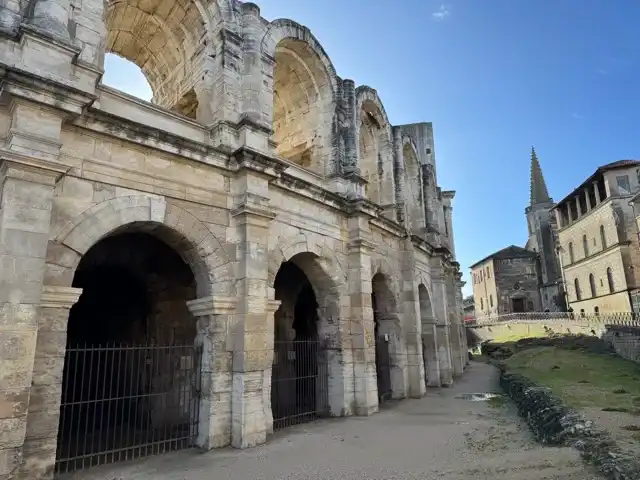
The Arènes d’Arles (Arles Amphitheatre) is the heavy-hitter of the Roman buildings in Arles. It’s very impressive from the outside. As with any ruins, some pieces are missing, but it looks like a reasonably complete, oval-shaped structure. (I learned inside that it’s shorter than it was. I think I may be too.)
The Arènes d’Arles isn’t quite as ancient as the Théâtre Antique d’Arles, but close. The former was constructed in the first century CE, the latter in the first century BCE.

If you want to get a mental image of the Arènes d’Arles, think of a smaller, less grand version of the Colosseum in Rome. Or, if that doesn’t help you to form a mental image, you can look at the picture I provided here.
The interior of Arènes d’Arles is less impressive.
I should pause to qualify “interior.” Arènes d’Arles has no roof. The interior is exterior, except for the corridors under the seating tiers.

A sign with some English in the amphitheatre explains that, “From the end of Antiquity, the building was used as a stone quarry which led to the disappearance of most of the seating and the upper levels of the building. It later became a dwelling place before becoming a refuge for the local population. In the Middle Ages, its defences were reinforced by four towers, three of which remain today, the Southern tower was demolished in the XIX century.”
Arènes d’Arles is still used for major events today. But as a consequence of the recycling of the original stone seating tiers, the seats now consist of wooden benches. Behind and above those, there is a tiered metal scaffolding structure with wood-plank benches. To say the least, it detracts somewhat from the antiquity of the place.
It’s possible to climb up one of the remaining short towers. I did. From there, I got a good view of the city between the Arènes d’Arles and the Rhône River.

Alyscamp

Alyscamp is a necropolis located just outside of the old section of Arles, only a little more than a ten-minute walk from Arènes d’Arles. Its name is derived from a Provençal Occitan word that translates to “Elysian Fields.” Romans generally didn’t allow burials within the walled city, which is why Alyscamp is just outside of the old city. It served as the primary burial ground for Arles for about 1,500 years.
Alyscamp is rather narrow as necropolises go. A, I’ll call it a road, runs down the center of it. Cars are not normally allowed on the road, but I think maintenance vehicles can use it. The road surface is packed earth and stones.

On either side of the road, there are sarcophagi lined up lengthwise. On one side, they are double-parked for some of the way. On the other side of the road, they’re single-parked all the way down. Most of the sarcophagi are missing their lids, but not all. And most of them are moss-covered. All of the open ones, and probably the ones with tops too, were empty.
For a short piece of the road, there’s a narrower path beside it. It too is sarcophagi-lined.
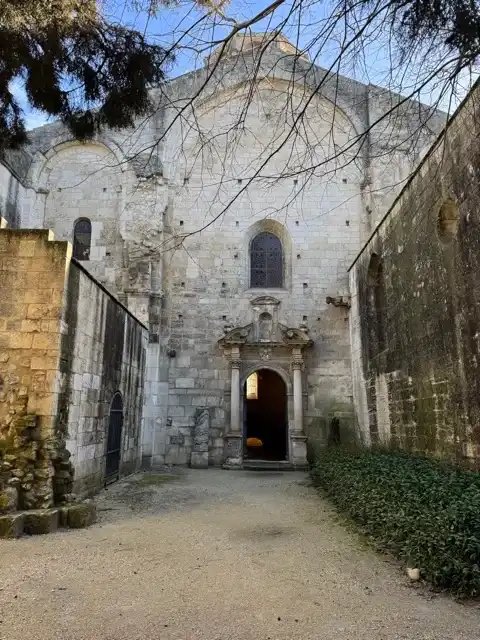
Partway down the road, off to one side, there’s a small, unadorned stone-brick chapel.
At another point on the road, there’s one of the Van Gogh easels I mentioned.
At the end of the road is a small church, Église Saint-Honorat. It too is unadorned and unfurnished, but there’s a dome in the centre and a half-dome on one side, so it’s not unattractive, just barren. There are also some tombs inside the church.
Near the entrance to Alyscamp, there’s a sign with both French and English. It makes it clear that Alyscamp, while it looks much as it did in Vincent’s time, doesn’t look like it did in Roman times. It said,
“From the Middle Ages, the cemetery was sacked, and sarcophagi were carried off to farms to be used as cattle troughs. Les Alyscamps was already half abandoned by the XV century; when it was seriously damaged for the first time in order to allow the construction of the Canal de Craponne in 1584. After 1616, when the religious order of the Minimes took over Saint Honorat, they reorganized the avenues of the necropolis.”

Sarcophagi used as cattle troughs. Some people have no respect. To be honest, though, I don’t know where the missing sarcophagi were unless both sides of the road used to be double-parked with them all the way down.
The sign also said that Alyscamp used to have more chapels, but they were demolished.
After leaving Alyscamp, I walked to where I wanted to start my afternoon, found a restaurant with outdoor tables and a menu that looked nice, and settled in for a lingering lunch under the warm Provençal sun.

Discover more from Joel's Journeys & Jaunts
Subscribe to get the latest posts sent to your email.

I am happy for your pleasant Provençal morning. A fine, sunny, ancient historical type of morning with some van Gogh reminders thrown in. Why not? You’re not in Toronto anymore are you? I hope you enjoyed your lunch.
I did enjoy my lunch. It was a lovely Salade Sud-Ouest, with a variety of kinds of meat, including some foie gras, lettuce, and some other stuff. I also had a glass of wine because, how you linger over ar meal under the Provençal sun without a glass of wine? You’re right. This definitely isn’t Toronto. Particularly not Toronto in February.