Pont Van Gogh and Arles Wandering
After my morning in the Musée départemental Arles antique here in Arles, I walked back into the old part of the city for lunch. After lunch, the sun that had been obscured by unremitting clouds this morning was breaking through, and there was no rain in the forecast. Based on that, I decided to take a more than half-hour walk out to Pont Van Gogh.
Were it not for the nice day, I probably wouldn’t have bothered taking in Pont Van Gogh. I’ll explain why shortly.
After coming back into Arles’ old city, I did some more wandering around.
I leave Arles tomorrow morning, so look for a summary of my time in Arles at the bottom of this post. You probably won’t have to look too hard.
Pont Van Gogh
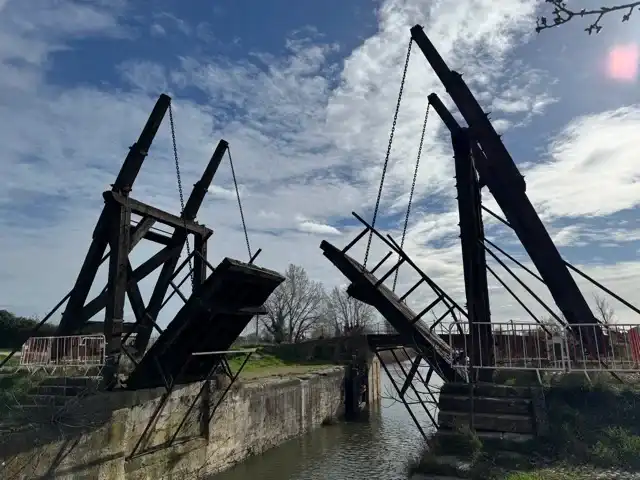
While in Arles, if you want to find Pont Van Gogh on Google Maps, and I assume any mapping app, you can enter any one of four names to do so: “Pont Van Gogh,” its English equivalent, “Van Gogh Bridge,” “Pont de Langlois,” or its English equivalent, “Langois Bridge.”
If, however, you are looking for signs on the streets pointing to the bridge, forget the Langlois name. It’s strictly “Pont Van Gogh,” or if they want to cater to tourists, “Van Gogh Bridge.”
Monsieur Langlois operated the bridge back in the day, hence the Pont de Langlois name. I don’t know when the Pont de Langlois gained the Van Gogh moniker, but I know why. Vincent van Gogh painted some pictures of it, at least one of which is famous.
The reason I wasn’t going to go if the weather didn’t look conducive is, besides the long walk (I like long walks, but not in miserable weather), it’s not the original bridge. The original bridge was replaced in 1930. But that’s not the bridge that’s there today. The 1930 bridge was destroyed in World War II.
The current Pont Van Gogh is allegedly a faithful reproduction of the original bridge. I wasn’t sure I wanted to walk all that way to see a fake bridge if the weather wasn’t nice, but it was. Problem solved.
The route Google Maps gave me to Pont Van Gogh wasn’t the most scenic. Pont Van Gogh is over the Canal d’Arles à Fos. At one point, the canal makes a 90° turn, creating an L-shape. The closest point on the canal to the restaurant I was at for lunch is close to the Rhône River on one of the arms of that “L.” Pont Van Gogh is a piece farther along the other arm of the “L.”
Most of the walk to the canal from the restaurant was through the old city, which was as pretty as ever.
But then Google Maps had me walk along the first arm of the canal for only a short piece. Then, it directed me to take a road that would cut somewhat diagonally to close to where the Pont Van Gogh is on the other arm. The shortest distance between two points is a straight line, after all, not an L-shape.
That road ran through an industrial area and by some residences that were, shall we say, not the most inspiring. Yes, we shall say that. They were not the most inspiring. That was the unscenic part.
Once I got back to the canal, it was again quite pretty. And it wasn’t too far from there to the Pont Van Gogh.
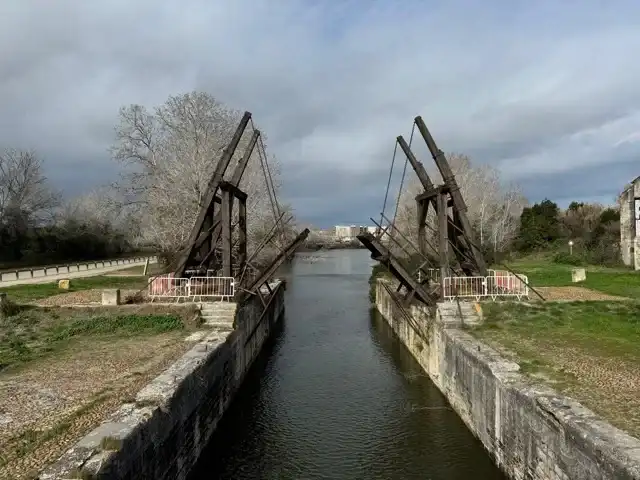
The bridge that’s there today is constructed of what looks like very old, dark wood. I don’t know if they found old wood when they recreated the bridge or if they used new wood and artificially weathered it. But it does look like an old bridge.
Arles placed one of their concrete easels near the bridge with a reproduction of one of Vincent van Gogh’s paintings of it, “Le Pont de Langlois aux Lavandières.” In that painting, there’s a horse-drawn covered wagon crossing the bridge. I know I’ve seen reproductions, and maybe even an original in a museum, of one or more of his paintings of Pont de Langlois.
The Pont Van Gogh is a drawbridge. When I was there, the two sides were raised. I think they’re permanently in that position these days, but I’m not sure. The point is, a wagon couldn’t have crossed it in that state, as one does in the painting.
A short piece along the canal from the Van Gogh Bridge, there’s now a footbridge across the canal. By going over it, you can get a straight-on view (and picture) of the Pont Van Gogh from the footbridge.
Returning from Pont Van Gogh
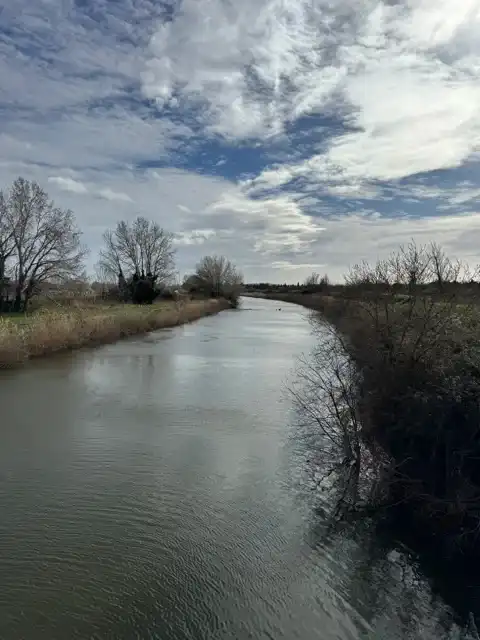
There is a paved trail that runs beside the canal. If I understood the French on the sign by it, it’s part of a long trail that traverses, if memory serves, 700 kilometres, all the way from Geneva to Arles. It was pretty.
My thought was to walk a short distance in the Geneva direction before turning back. I hadn’t taken more than a few steps when dark clouds invaded the sky that had just moments before been only partly cloudy.
It started to drizzle. That was completely uncalled for. When I checked at lunch, the forecast said there’d be no rain this afternoon. I didn’t have my umbrella with me.
I decided to turn back toward the old part of central Arles.
As it turns out, the trail follows the L of the canal back into the city. Despite the drizzle, I decided to take that route rather than the shorter, but dreary way Google Maps sent me along on the way out.
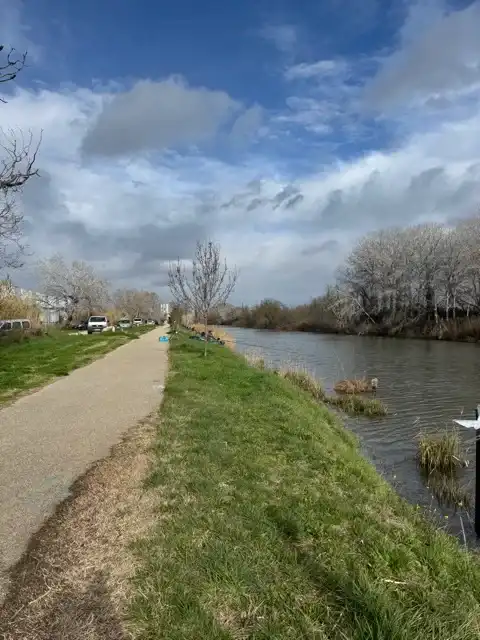
Good choice. The rain never achieved more than a drizzle status, and it didn’t last long. Thankfully, I didn’t melt. It made for a much more pleasing walk.
At one point, there was a long row of fairly evenly spaced fishermen lined up along the bank of the canal. They all sat on perches mounted on one-person platforms, not much wider than required for the seat each fisher sat on. The platforms had adjustable legs so they could adapt to the slope of the bank.
It didn’t look like the platforms were provided by the city. They were all similar, but not identical. Some had attached containers for bait, gear, and any fish caught. Other fishers had independent containers that sat on the grass beside them for those purposes.
All of the fishers had exceptionally long fishing rods to protrude a fair piece out into the canal.
None of the fishers caught any fish while I was there, but it made for a scene that was pretty and interesting enough that Vincent van Gogh might have painted it if he’d been around.
Wandering Around the Old City of Arles Again
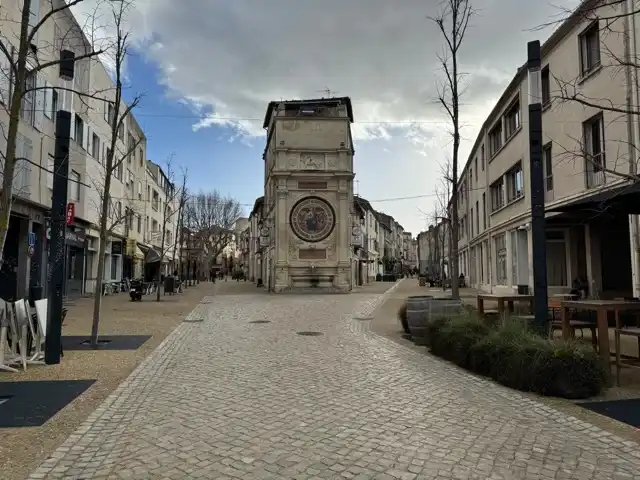
Leaving the canal behind at its closest approach to the old part of Arles, I then wandered largely aimlessly through the old city.
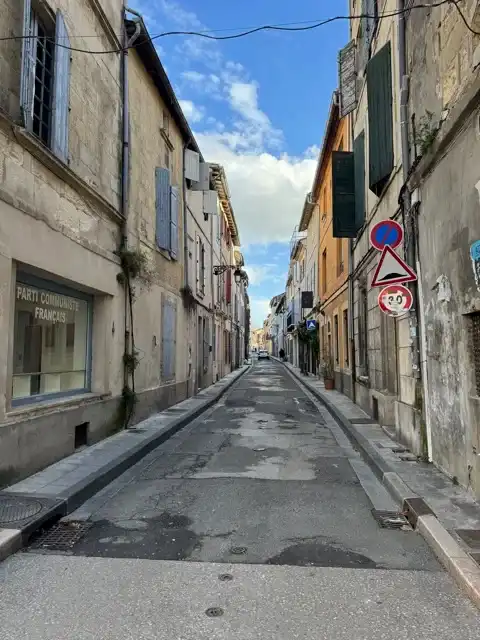
It hasn’t changed much in the last few days, so I won’t repeat what I’ve already said other than to say I loved it.
My stroll took me to one place that I saw before but hadn’t talked about yet, and another beyond it that I hadn’t been to.
Arles used to be a walled city. I walked to the far end of the formerly walled old city from where I entered it and came upon the Porte de la Cavalerie, one of the old portals through the wall.
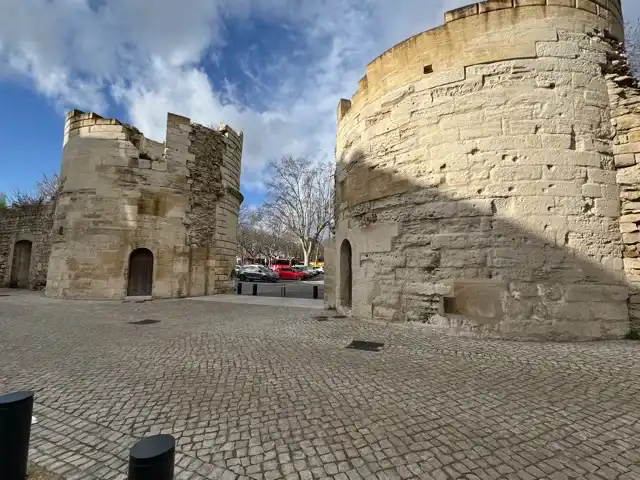
The Porte de la Cavalerie was built in the 13th century, rebuilt in the 16th, and enhanced in the 18th.
There are short but beefy towers on either side of the portal where the gate was. Short runs of stone walls are attached to each tower, but I don’t know if they’re recreations. I read somewhere that the towers survived, but very little of the walls did.
I also read that there is another one of the city’s concrete easels marking a spot where Van Gogh painted a picture, “The Yellow House.”
I wasn’t going to go there because the yellow house isn’t there anymore, and I knew that before going. It was heavily damaged in World War II and later demolished. But my walking tour app said that, despite it no longer being there, you can still readily recognize the scene that surrounded it in Van Gogh’s painting. It was out of the old city, but only a couple of minutes’ walk beyond Porte de la Cavalerie. So, I figured, what the heck?

Comparing the reproduction of Van Gogh’s painting posted on the easel erected by Arles to the current scene, I at first couldn’t see anything in the surroundings that looked anything like what’s in the painting. The building that is where the yellow house was doesn’t look anything like the yellow house did. Nor do the buildings beside it look like the buildings on the side of it in Van Gogh’s painting.
I was about to give up looking for similarities, but then I saw something that’s still there from Van Gogh’s time. The yellow house stood on a corner. In the near distance along the street that runs along its side, there’s a bridge over the street. That bridge is still there. It looks a little farther back in my photo than in Van Gogh’s painting, but it’s the same bridge.
Mission accomplished. And with that, it was time to head back to my hotel and say au revoir to Arles, but not yet to France.
Arles Summary
If you’ve been following along, you know I’m very fond of Arles. Then again, I’m very fond of most old European cities that have kept their old cores largely intact. They tend to be beautiful, quaint, and exceptionally walkable, all qualities I love. Arles is no exception.
There are Roman ruins to see here that, unlike a few ruins in some archaeological sites, still have enough left to be easily recognizable as what they were.
And there are all of the Van Gogh references here. He only spent a couple of years in Arles, leaving not long before he died, but he was prolific while he was here. I didn’t bother counting the number of Van Gogh painting sites I visited, but it was lots.
I think the only way I could have paid more homage to Vincent van Gogh would have been to lop off one of my earlobes while I was here. But the hospital he was treated at is no longer a hospital. So, it wouldn’t have been the same.
As to the amount of time I spent here, I think my four nights/three and a half days were about right for sightseeing.
I saw all of the sights in town recommended by my walking tour app and guidebooks that were open while I was here. There are some recommended sights well out of town, but I think it would have required a car to get to them, which was not something I wanted to do.
That said, another day of strolling the streets and finding cafés to sit, drink coffee, eat food, and sip wine wouldn’t have been unwelcome.
Au revoir, Arles.
Discover more from Joel's Journeys & Jaunts
Subscribe to get the latest posts sent to your email.


That was a lovely stroll and a fine recommendation for Arles. I am thinking it is about time to go back and revisit France. Perhaps one day they will make a Joel Klebanoff trail for those who wish to follow the storied path of your travel blogs. No stone easels to mark the famous sites, perhaps lapidary iPhones?
I like France. At one time, it was probably my most visited country outside of North America. Italy overtook it. And this journal reminded me that I hadn’t been to France in years. This trip is the first appearance that the country made here. I’ve got to do more traveling around France in the coming years.
A Joel Klebanoff trail. Why not?