Musée départemental Arles antique
I’m still in Arles. I spent the bulk of this morning at the Musée départemental Arles antique. It’s amazing how bulky mornings can get sometimes. I hate it when that happens. When it does, you really have no choice but to expend at least some of that bulk.
I didn’t get the earliest of starts this morning because I spent a bit of time trying to solve a problem I had with comments on this blog. However, I didn’t solve it before heading to the Musée départemental Arles antique.
Because that’s the only place I visited this morning, I absolutely, positively promise this will be a short post. Unless it turns into a long one. In that case, I disavow that promise.
I went to the Musée départemental Arles antique for a few reasons. For one, it’s highly recommended by my walking tour app and guidebook.
For another, when I checked into my hotel, another guest of the hotel, who had been near the front desk, felt the need, when she heard me speaking English, and she recognized me as a fellow anglophone tourist, to tell me that I absolutely had to go to the Musée départemental Arles antique. She gushed about it and said she went twice and spent six hours there.
She must have been a scholar or faux scholar of Roman antiquities, the museum’s subject. I spent two hours or so there and felt that was sufficient.
About five minutes of those two or so hours was spent sitting on a bench, resting my feet. Ironically, while sitting among those antiquities, I quickly figured out the problem with comments on my thoroughly modern blog.
Note to commenters: My blog has started to mislabel some comments as spam. Long ago, I adopted a habit of looking at the comment spam folder only infrequently because, until recently, the system had been uncanny in this ability to avoid both false positives and false negatives when filtering comments for spam. I’ll try to remember to check the spam folder more frequently from now on and approve any comments it mislabels as spam. My apologies if you have to wait a while for your comment to appear.
There’s also another tenuously related issue I should mention. You may have problems if you view this journal with Firefox. As best I can tell, it over-aggressively caches web pages. So if a page changes, including, but not exclusively, if you or someone adds a comment, you might not see the change/new comment. That doesn’t seem to be an issue with either Safari or Chrome. I haven’t tried any other browsers.
Technology is fabulous, until it isn’t.
Now, where was I before I went off on that technology tangent? Oh, yeah. Musée départemental Arles antique.
At the Musée départemental Arles antique
Earlier in my time in Arles, I bought a pass that got me into Musée départemental Arles antique, along with many of the other paid attractions I’ve visited here.
When I stopped at the ticket desk to show my pass and pick up my ticket to the museum, the ticket seller asked me if I wanted to rent an audio guide for €2. I said no. I figured I’d make do with the descriptive signage.
I proceeded into the museum, where I saw that all of the signage was exclusively in French. I went back to the ticket desk and rented an audio guide.
I really need to learn French and come back. I’d get so much more out of France if I spoke and read the language. I would like to come back to France at least a few more times in my life. It’s a great country.
I live in Canada, an officially bilingual—French and English—country. But I’ve lived my entire life in Toronto, where the dominant language by far is English. French isn’t even the second-most used language in homes in Toronto.
They made a very weak effort to teach me French in a couple of grades in school. They failed miserably. Back then, I didn’t care. Now, I regret I didn’t learn the language.
Since then, I’ve made sporadic, also weak, attempts to learn it on my own with, first tapes, then CDs, then DVDS, and more recently with apps. But I’ve had only very minimal success. And what very little I have learned is probably, in part, a result of my recent attempts being able to stand on the shoulders of the attempts before them. Je connais quelques mots. C’est tout.
(I’m going to pause to pat myself on the back. I typed those two French sentences on my own. I went to Google Translate only after I finished them to check if I got them right. I did. It means, “I know a few words. That’s all.” Bon travail, Joel. Bon travail.)
The audio guide had commentary for probably less than ten percent of the artifacts at the Musée départemental Arles antique. But all of the objects there had, at a minimum, labels with a title saying what it was, and many had at least some descriptive text. Plus, there were text panels here and there with more general information about each section of the collection.
So, the audio guide was far from a complete substitute for the text. I used the camera function of Google Translate to translate some of the text, but that’s a far too burdensome way to go through a museum. At least, I find it so.
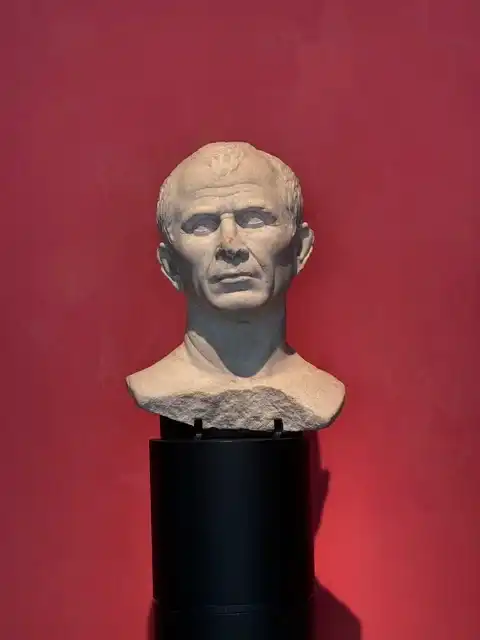
Nevertheless, the audio guide provided me with a wealth of information, most of which I’ve forgotten. Completely. One thing I do remember the gist of is a discussion of a bust. It was found in an underwater archaeological survey, I think in the Rhōne.
The commentary said that it’s believed to be a bust of Julius Caesar because its features resemble those of his visage on coins and on other busts that are known to be of Julius Caesar. And, further supporting that theory, Arles was, after all, a Caesarean colony, or at least sections of it were. (In truth, I think all of it was. But I felt the need to make a Caesarean section pun.)
But there is some controversy over whether the bust was really of Julius Caesar. Some people theorize that it was instead a local dignitary. Because Roman emperors were thought of practically as deities, according to the commentary, sculptors sometimes purloined some of the emperors’ features and subtly morphed them onto the sculptures or busts of other people they were working on.
In the museum, I saw other busts and statues that didn’t have commentaries on the audio guide. The text beside some of them listed who each was a bust or sculpture of, but then there was a question mark beside the name. I imagine that meant that, for them too, there was a question as to whether that really was the subject. Other statues and busts didn’t have question marks beside the name on the accompanying text. So, for those, I assume the museum was (arrogantly?) certain of who the subject was.
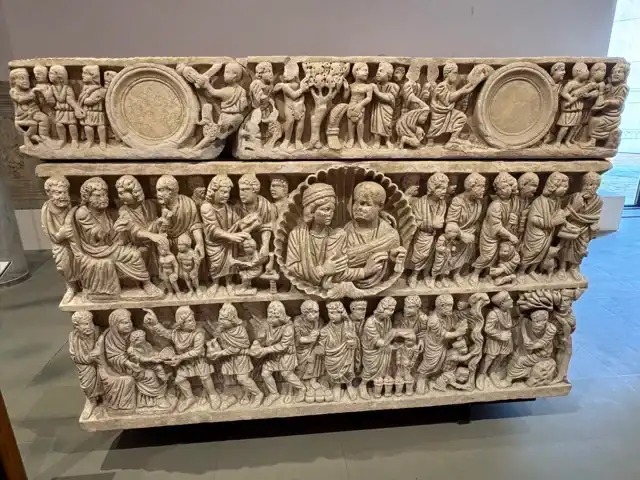
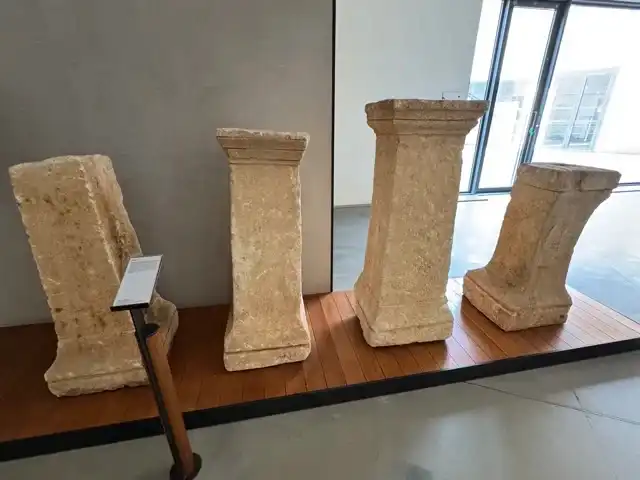
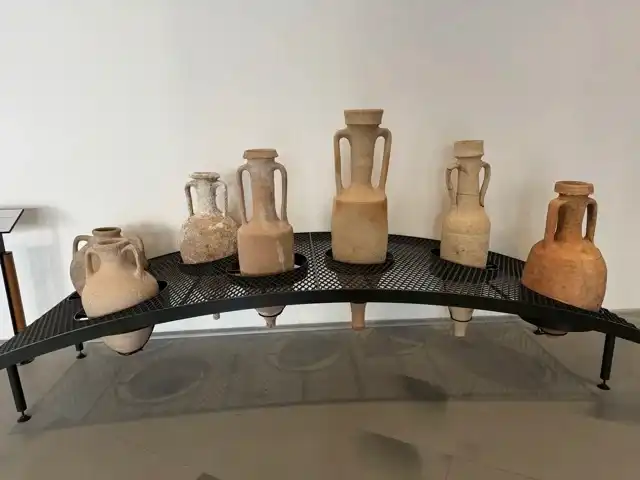
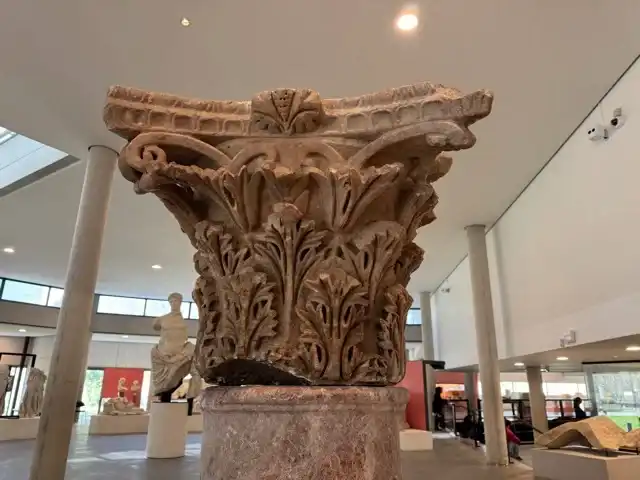
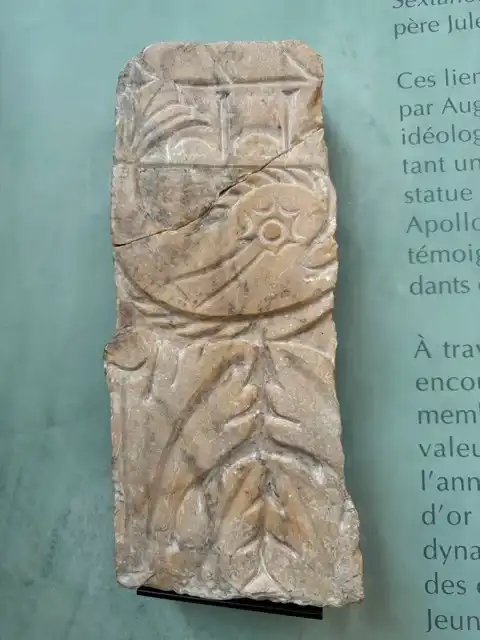
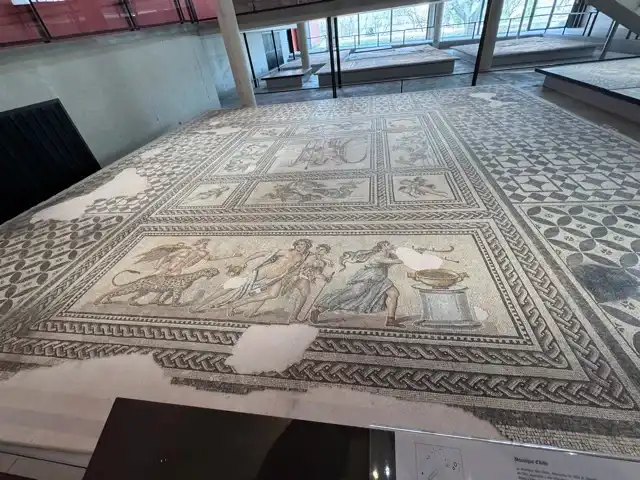
There was more to the Musée départemental Arles antique collection than sculptures and busts. There were, among other objects I’ve forgotten, portions of Roman columns and capitols, other architectural fragments, including one with an engraved dolphin with a comet for an eye, stelae, pottery, jewelry, stone blocks with engraved printing on them, weapons, mosaic tile floors, models of old Roman buildings, and sarcophagi. Lots and lots of sarcophagi. Many of them had elaborate, very three-dimensional carvings on one or more sides. One of them had a couple of holes punched through it, where grave robbers tried to steal the offerings buried with the occupants.
(Note to the executor of my will: You don’t have to bury my remains in anything so fancy. An unadorned cardboard shoebox to contain my ashes would be sufficient. And you don’t have to bury any offerings with my remains. Then again, now that I think about it. I’ve become extremely dependent on my iPhone, particularly when I travel. I’d kind of like to have that with me in the afterlife. So, it might be nice if you included that as a burial offering.)
There. Even with me going off on a tangent, that wasn’t too long, was it? À la prochaine!
Discover more from Joel's Journeys & Jaunts
Subscribe to get the latest posts sent to your email.


That was quite a short entry, but what antiquities! Very high quality, from what you have shown. It took me a while to make out the dolphin with a comet for an eye, but what the heck was that about? Sorry if I had an outsized part in curtailing your morning outing. Or should I say my use of Firefox. Hopefully all is resolved and you will be free to wander freely through history in Arles without more technical problem-solving. And one last thing: I will not be putting your iPhone in the box. Get over it. You cannot take it with you.
Yes, the museum had a lot of pristine antiquities. (Pristine in the sense that they’d obviously worked hard at cleaning and restoring them. They didn’t try to recreate missing pieces, of which there were many.) It is a great archaeological museum, particularly if you can read French. I should say, read and understand French. I can read it. But I can translate little of what I read.
WHAT!!! You want me to go through all of eternity without my iPhone? How cruel!