Van Gogh and the Romans in Arles
The title of this entry notwithstanding, Vincent Van Gogh and the Romans were obviously not in Arles at the same time unless Van Gogh had a time machine or the Romans had one large enough to accommodate more than one Roman person, so the plural, “Romans,” would be accurate.
I don’t have a degree in Roman history or art history, so I might be wrong, but I have never read anything about either the Romans or Vincent Van Gogh having a time machine. I’m sure that would be noted if it were the case. It’s a pity that it’s not.
I titled this post as I did because I started this overcast and later drizzling morning with a Van Gogh theme and ended at a Roman ruin.
Espace Van Gogh
The hospital where Vincent van Gogh recuperated after he sliced off an earlobe and again during a subsequent bout of depression is in the heart of old Arles. The building served as a medical facility from the sixteenth century all the way through to the twentieth century.
Today, the building has a souvenir shop, a café, a library, offices, and some event space.
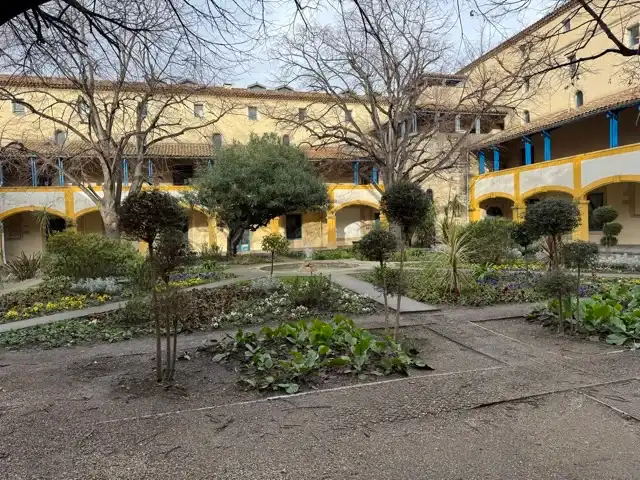
The former hospital wraps around an open, square courtyard that is, well, pretty as a picture. I say pretty as a picture because Vincent van Gogh was inspired to paint a picture of it, “The Courtyard of the Hospital in Arles.” And I took a photo of the courtyard today. I didn’t name my photograph because I’m not as creative as Vincent was. How could I hope to come up with a title as inventive as “The Courtyard in the Hospital in Arles?”
Narrow paths cross the courtyard side-to-side and corner-to-corner. In the center, at the intersection of the paths, there’s a small circular pool with a fountain that jets a short stream of water up from the top of a small mound of stones.
The spaces between the paths are planted with plentiful flowers, many of which are in bloom now, February 10th. I said, in bloom on February 10th!
A large part of why I’m in the south of France now is because it’s possible to coax some blooms outdoors here even in February. (I didn’t look closely. If they were fake, please, nobody tell me. It would spoil everything. But there were enough of them on the ground that I don’t think so.)
Counting yesterday, I’ve now been to the sites of three of the many paintings that Vincent van Gogh created in Arles: “Terasse du café le soir” and “Starry Night Over the Rhone” yesterday, and now “The Courtyard of the Hospital in Arles” today.
Oh, in case you might not have guessed from the title of this section, that courtyard now officially goes by the name of “Espace Van Gogh.” I don’t know when it acquired that moniker.

Vincent van Gogh
Antwerp, December 1885
Fondation Vincent van Gogh
The name of the Fondation Vincent van Gogh is a little misleading.
It doesn’t display a permanent collection. Instead, it rotates shows that take over the entire art centre.

(Commentary on Van Gogh no. 5)”
Isidore Isou
1985
But that’s not the misleading part. This is: It displays very few works by Vincent van Gogh. Instead, it exhibits mostly works by artists who were allegedly influenced by Van Gogh in some way. There were multiple works by each of the artists represented in the show that was on today. There were signs in French and English providing some narrative text about each artist and how they were influenced by van Gogh or the references in their work to van Gogh or his style. Some of the connections seemed extremely tenuous to me.

Martin Boyce
2025
The Fondation Vincent van Gogh always has at least one Van Gogh work in every exhibition, not necessarily ones he painted in Arles. There were two in the show I saw today: Tête de femme, which he painted in Antwerp in December 1885, and “Tournesols fanés (Sunflowers Gone to Seed),” which he painted in Paris in August-September 1887.
I’m not at all discerning in these things, but Tête de femme looked to me like it had the sort of brush strokes that I might recognize as coming from Van Gogh. Tournesols fanés had some similar brush strokes, but a little less bold, to my eye. However, the sunflower looked like a blob to me. Then again, I don’t know exactly what the state of a sunflower gone to seed is, but this one really went to seed in a big, or should I say, blob, way.

(Underwater Vision of Sunflowers)”
Gustave Fayet
undated
Sorry, Vincent, I very much like many of your paintings, but Tournesols fanés, not so much.
As I said, some of the connections of the other artists (both paintings and sculptures) to Van Gogh seemed tenuous to me. But not all of them. One painting by Gustave Fayet (1865-1925) was undated, but it was titled “Vision sous-marine de tournesols (Underwater Vision of Sunflowers).” The painting was as its title succinctly described. I don’t know how the easily recognizable sunflowers ended up underwater, but when I think of paintings of sunflowers, I think of Van Gogh. So I get the connection for that one.
There was a collection of works by Isidore Isuo (1925-2007) in an art form that the text accompanying them said Isuo was a founder and leading figure of: Lettrism. I’d never heard of Lettrism before, which is neither here nor there. The connection to Van Gogh in these works was also clear. Hand-drawn text either overlaid or surrounded a small reproduction of a Van Gogh work.

Louise Sartor
2025
But then there were pieces such as “You Are Here” (2025) by Martin Boyce. It was a three-dimensional piece with a high-design push-button wired phone mounted on some sort of backing in a frame. Um. Okay.
Or there was a set of two paintings by Louise Sartor done in 2025. I didn’t recognize any connection to Van Gogh, and they were painted on pieces of corrugated cardboard. Again, um. Okay.
Despite having a couple of works that I felt the need to mock, I enjoyed Fondation Vincent van Gogh, and not solely because it’s not overly large.

Vincent van Gogh
August-September 1887
Thermes de Constantin

On to the Romans. If you spend enough time wandering around Arles, you’re bound to come across connections to both Van Gogh and to the much more ancient Romans. Yesterday, my Roman content was the Roman amphitheatre. Today, I visited the ruins of Roman baths. (There’s still one larger Roman structure, one you definitely can’t miss if you spend time in Arles, because it’s in the centre of town, and some roads have to curve around it. I’ll probably visit that tomorrow. Stay tuned.)
The Thermes de Constantin (baths of Emperor Constantine) in Arles were built in the 4th century CE. They originally had a surface area of 3,750 square metres, but the ruins that are still around today cover only about 1,100 square metres.
Bathers bathed naked. The baths were for both men and women, but they each had different times when they could use them.
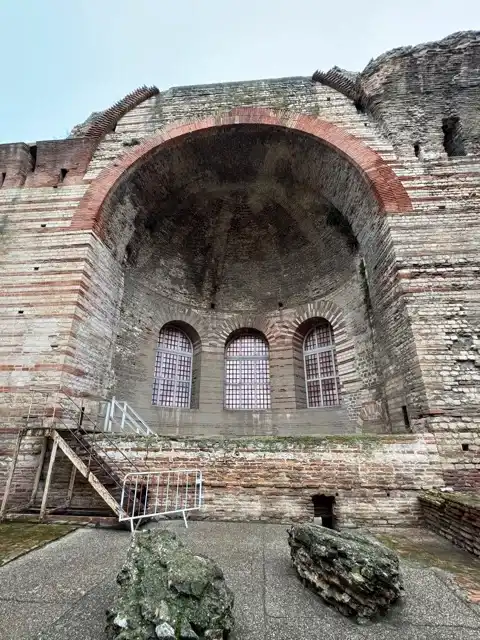
The baths had both hot and cold rooms, with the water in the hot rooms being heated by furnaces. According to a sign at the site, ‘The bather followed a medically established circuit, after he had undressed in the changing rooms, ‘apodyterium.” He could exercise and then go into the outdoor swimming-pool “natatio “and move on to the “tepidarium,” a warm room heated to between 25°C and 30°C.’
Damn! A “medically established circuit.” I’ve never followed that routine. How am I still alive?
Most of the structure, or at least what’s still around in the ruins, was constructed of alternating rows of red- and sand-coloured bricks. Among the ruins, there were walls, arches, and one section with a half-dome ceiling. I always feel in awe when walking around architecture that was constructed more than a millennium and a half ago.

After leaving Thermes de Constantin, I took another walk along the Rhone. As I did, it started to rain. Fortunately, I was expecting the precipitation. Consequently, I had my parapluie. (Unlike me, my parapluie has learned French and refuses to be called an umbrella anymore. I’m hoping it will teach me the language.)
By that point, it was still a little early for lunch in these parts, but not before restaurants had opened and early birds were already eating their midday repast. I decided it would be a good idea to get out of the rain and linger over lunch. I followed through with that decision because once I make a decision, I usually stick to it, particularly if it means I get to eat. So, this is where I’ll end this post. More later.
Discover more from Joel's Journeys & Jaunts
Subscribe to get the latest posts sent to your email.

You really didn’t like that exhausted sunflower did you? Well, it happens to the best of us, and I am feeling like it looks more and more these days. So don’t look at me next time and go ‘feh!’ We all get past our prime. Now the Romans – their stuff has done its share of falling apart over the millennia, but its what makes cool remains like the ones you saw today so heroic. You know what’s under those Roman bricks? Concrete! And to think where that stuff has ended us up. From monumental baths and the Pantheon to urban blight.
I never look at you and go, “feh,” if only because I’ll always be three years older than you are, until I’m not.
Roman concrete, and in general their constructions, amaze me every time I see them. When I was younger, and I don’t mean a child, I mean a young adult, if you asked me, I would have guessed that there couldn’t possibly have been concrete back then. But as I’ve travelled, I’ve seen with my own eyes that, yes, yes indeed, they did. The Pantheon is the one that awes me the most. How incredibly clever they were considering that they had so little of our current engineering and material science. Amazing.